
Introduction
Within the global steel supply chain, steel coils serve as a critical intermediate product. They represent both the production capacity of steel mills and the core raw material for numerous downstream sectors—including construction, shipbuilding, automotive, and home appliances. The efficient and safe handling and storage of steel coils directly impacts corporate and logistics efficiency.
Traditional coil handling relies on forklifts, overhead cranes, and rail-mounted gantry cranes, each with limitations: Forklifts offer flexibility but have limited load capacity and significant shortcomings in high-stacking applications; overhead cranes are fixed installations with poor maneuverability; rail-mounted gantry cranes can handle heavy loads but come with high costs and insufficient flexibility.
Against this backdrop, the rubber-tyred gantry crane (RTG) has emerged as a new solution for coil handling, offering high load capacity, exceptional flexibility, and intelligent capabilities.
What is a Rubber Tyred Gantry Crane?
Definition and Basic Structure
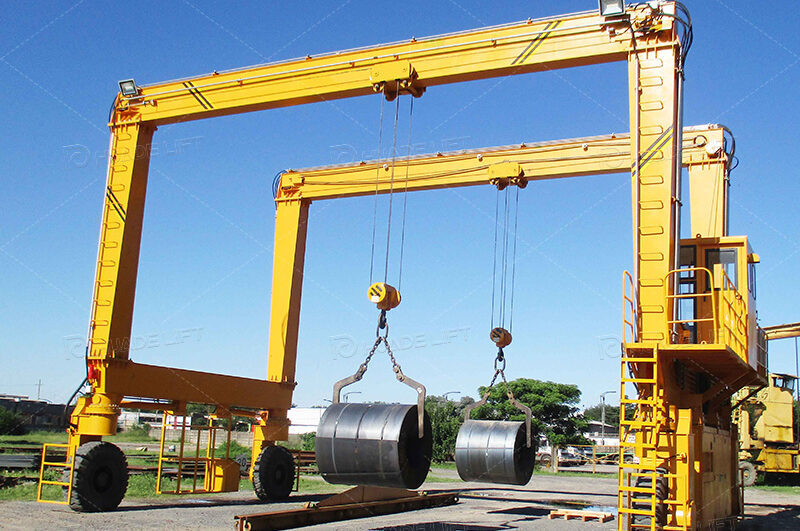
A rubber tyred gantry crane is a lifting device based on a gantry frame structure. Its main frame consists of a robust steel structure equipped with a hoisting mechanism, traveling mechanism, and electrical control system. Unlike traditional rail-mounted equipment, RTGs utilize rubber tires for support, enabling free movement across diverse operational areas.
Originally deployed extensively in container terminals for loading, unloading, and stacking containers, manufacturers have expanded their application to steel coil, plate, and large precast component handling as logistics demands in the steel industry evolve.
Mobility and Flexibility of Rubber Tires
Rubber tires are the defining feature distinguishing RTGs from other gantry cranes. They eliminate reliance on tracks, enabling flexible navigation between different yards and workshops. The tires provide strong shock absorption, ensuring stable operation even on poor ground conditions. This flexibility is particularly crucial for coil handling, as coils often require frequent transfers between factory areas, warehouses, and yards.
Challenges in Coil Handling
Weight and Volume Challenges
Individual steel coils range from tens to hundreds of tons in weight, with substantial diameters and widths. Traditional equipment often experiences overload or instability when handling heavy coils, posing significant safety risks.
Stability and Safety Requirements
Coil surfaces undergo specialized treatments, and any damage to the outer layer directly impacts product quality. Therefore, handling must avoid shaking, impacts, or uneven forces. Stable load control and anti-sway systems are essential.
Efficient Stacking Demands
As steel production increases, warehouses and yards require high-density storage. Precise stacking height and sequence demand exceptional positioning accuracy and operational efficiency from handling equipment.
Advantages of RTG Cranes in Steel Coil Handling
Exceptional Load Capacity and Stability
Adapted for handling oversized, heavy steel coils
Rubber tyred gantry cranes (RTGs) offer rated lifting capacities spanning tens to hundreds of tons, effortlessly handling diverse coil types: For instance, RTGs used in large steel mills for wide plate coil handling feature rated capacities of 80-120 tons, capable of lifting oversized coils exceeding 2 meters in diameter and 1.5 meters in width. Lifting heights adjustable to over ten meters to meet diverse stacking and transfer requirements.
Ensuring Load Balance and Minimizing Coil Damage
Equipped with advanced load balancing systems and precise lifting controls, these cranes monitor real-time stress distribution and weight loadings, automatically adjusting operational parameters to prevent tilting or swaying. Specialized lifting attachments (such as C-type spreaders) conform to coil structures, evenly distributing weight to reduce localized stress concentration. This prevents coil deformation or surface scratches, safeguarding product quality.
Flexible Mobility
Free Movement for Multi-Scene Adaptability
Rubber-tired design enables seamless operation across factory grounds, yards, workshops, and other environments without relying on intermediate equipment. For instance, when transferring steel coils from the steelmaking workshop to the rolling mill, the crane can lift directly from the discharge point and travel along the aisle to the feed point, ensuring efficient, uninterrupted transfer and minimizing transit time.
Track-Free Operation for Enhanced Efficiency
Operates without fixed tracks, allowing flexible positioning based on order and storage changes: For instance, when steel coils in a yard area require urgent retrieval, the RTG can directly travel to the target zone and rapidly load onto transport vehicles. After completing tasks in one area, it can immediately shift to another, minimizing equipment downtime and maximizing utilization.
Efficient Stacking and Retrieval
Precise Positioning for High-Level Stacking
Equipped with high-precision positioning systems like GPS, laser, and infrared, it continuously tracks equipment, lifting attachments, and coil locations. Through electrical control systems, it achieves precise alignment and positioning, enabling 4-6 tier high-level stacking. For instance, in a 10,000-square-meter yard, traditional low-level stacking stores only thousands of tons, while RTG high-level stacking increases capacity to ten thousand tons, significantly boosting space utilization.
Optimized Warehousing, Reduced Land Costs
High-level stacking minimizes land occupation, saving enterprises on land leasing or acquisition costs. This is particularly suitable for steel mills and logistics parks near land-constrained urban areas. Additionally, RTGs can stack coils by specification, material, or order information. Integrated with warehouse management systems, they enable rapid retrieval and access, eliminating the disorganization and inefficiency of traditional warehousing.

Reduced Forklift Dependency
One Crane Replaces Multiple Forklifts
A single RTG crane independently handles tasks requiring multiple forklifts: for instance, moving a 30-ton steel coil traditionally necessitates 2-3 10-15 ton forklifts working together—a complex and high-risk operation. An RTG crane accomplishes this alone, simplifying processes and eliminating coordination errors.
Lower Costs and Risks
Reducing forklift numbers lowers labor costs (each forklift requires one operator, while an RTG crane needs only one person). Additionally, RTG crane operation is less physically demanding, enhancing operator comfort. Simultaneously, the RTG crane’s safety features (overload protection, anti-sway system) and specialized lifting equipment effectively prevent risks like coil slippage and collisions during handling, reducing accident rates and coil damage.
Intelligent and Automated Applications
Automatic Anti-Sway for Enhanced Safety
Equipped with an automatic anti-sway system, sensors monitor coil sway angle and speed, dynamically adjusting hoist and trolley parameters to counteract sway forces. For instance, if a coil sways forward during lifting, the system reduces hoist speed and controls trolley backward movement to stabilize the coil. This minimizes collision and scratching risks while lowering operator skill requirements.
Smart Integration with Dispatch Systems for Enhanced Logistics Efficiency
Integrates with intelligent dispatch systems for automated task management: The system collects production schedules, order requirements, and warehouse status via IoT to generate optimal transport plans, automatically assigning tasks and routing. Upon task completion, the rubber-tyred gantry crane (RTGC) provides real-time progress and equipment status updates, enabling the system to dynamically adjust schedules and eliminate equipment downtime or operational delays. For instance, within steel mills, the system coordinates multiple RTGCs to balance operational loads across zones, ensuring seamless integration between steelmaking, rolling, and warehousing processes.
Optimized Operational Costs
Energy-Efficient Design for Reduced Consumption
Modern rubber tyred gantry cranes incorporate multiple energy-saving technologies: pure electric or hybrid drive systems (pure electric with zero emissions; hybrid utilizing electric power for light loads and fuel-electric coordination for heavy loads); variable frequency drive technology adjusts motor speed based on operational demands, reducing idle energy consumption; energy recovery systems convert potential and kinetic energy from lifting/lowering and braking into electricity, further lowering energy usage.
Low Maintenance, Long Lifespan
Critical components utilize high-strength materials and advanced manufacturing processes for enhanced reliability: Gantry frames undergo fatigue testing to withstand heavy-load deformation; rubber tires, winches, and other parts feature wear and corrosion resistance for extended service life; integrated fault diagnosis systems monitor equipment status in real-time, providing early warnings of potential failures to minimize repair time and costs. Extended equipment lifespan reduces replacement frequency and procurement expenses; low downtime ensures continuous operation, preventing production and logistics delays.
RTG Crane Applications in Coil Handling
Steel Mill Workshop Operations
In steelmaking workshops, RTG cranes lift coils directly from production lines for transfer to temporary storage or rolling mills. Within rolling mills, they transport coils awaiting processing to mill feed points, then move finished coils to cooling zones or storage yards. Their agile maneuverability and precise positioning enable navigation through equipment-dense workshops without collisions, ensuring uninterrupted production flow. Sorting and stacking capabilities optimize workshop space utilization and reduce coil accumulation.
Port and Logistics Yard Loading/Unloading
Ports serve as core nodes for steel coil imports and exports. Rubber-tyred gantry cranes adapt flexibly to vessel berthing positions and yard layout changes, completing “vessel-yard-transport vehicle” loading/unloading operations. For hundred-ton special steel coils, their high load capacity enables independent lifting. Automatic anti-sway and precise positioning systems ensure accurate alignment with cargo holds or vehicle compartments, preventing collisions. In logistics yards, high-level stacking increases storage capacity, while rapid access reduces transport vehicle waiting times, boosting logistics efficiency.
Applications in Large-Scale Warehousing and Processing Centers
Large warehousing centers require long-term storage of substantial coil volumes. RTG cranes enable stacking by specification, material, and customer requirements, integrating with storage systems for organized management. High-level stacking increases storage capacity by 2-3 times within 10-meter-high warehouses. In processing centers (e.g., automotive steel plate processing), rubber tyred gantry cranes transport steel coils to cutting and stamping equipment, then move finished products directly to the finished goods area. This eliminates intermediate transfers, reduces handling time, accommodates dense equipment layouts, and ensures safe production.
RTG Crane vs. Other Material Handling Equipment
RTG Crane vs. Forklift
Forklifts retain advantages for short-distance handling, but prove inefficient and unsafe for handling heavy loads like steel coils. RTG cranes can replace multiple forklifts, reducing labor and equipment costs.
RTG Crane vs. Overhead Crane
Overhead cranes perform well indoors but are restricted by building structures and cannot operate outdoors. Rubber-tyred gantry cranes (RTGs), however, can operate both indoors and freely in outdoor yards, offering broader applicability.
RTG Crane vs. Rail mounted Gantry Crane
Rail-mounted gantry cranes provide high stability but entail costly construction and maintenance. In contrast, RTGs offer flexible installation, lower investment costs, and shorter payback periods, better aligning with corporate economic demands.
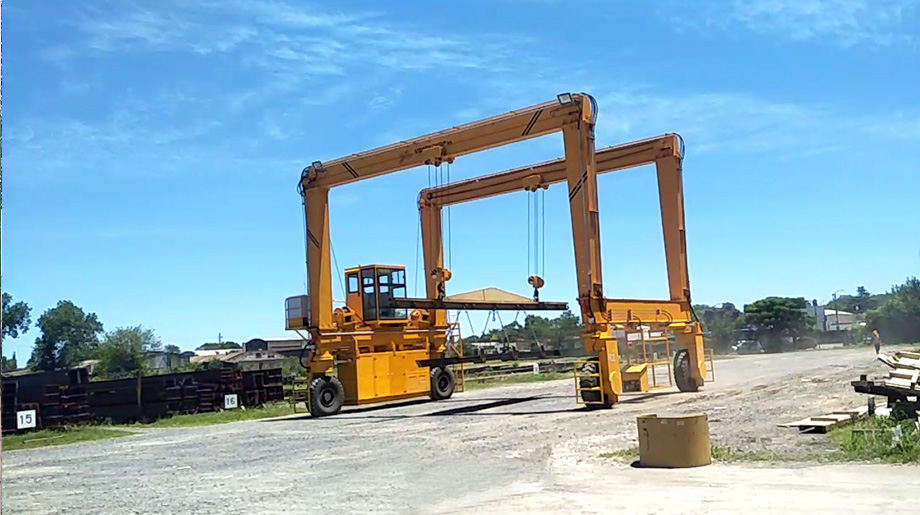
Straddle Carrier
Future Development Trends of RTG Cranes
Green Energy Efficiency and Electrification
With the introduction of the “dual carbon” goals, electrified rubber tire cranes are gradually replacing traditional diesel-powered models. Electric RTGs not only consume less energy but also significantly reduce carbon emissions, aligning with the trend toward green factories.
Intelligent Systems and Remote Control
In the future, RTGs will increasingly adopt autonomous driving and remote control technologies to reduce manual operation, enhance safety, and improve efficiency. Some ports and steel enterprises have already begun testing unmanned RTG systems.
Integration with Smart Factories
Under the Industrial 4.0 framework, RTG cranes will deeply integrate with intelligent warehousing, MES systems, and ERP systems, becoming a vital component of smart factories. They will evolve beyond mere handling tools to serve as critical nodes within the entire intelligent logistics chain.
Conclusion
The above analysis demonstrates that rubber-tyred gantry cranes offer multifaceted advantages in coil handling: they possess robust load-bearing capacity and stability, capable of handling oversized steel coils; they feature flexible maneuverability, adapting to diverse factory and yard environments; they incorporate efficient stacking and intelligent functions, enhancing warehouse utilization and overall operational efficiency. It also helps enterprises reduce reliance on forklifts, lowering labor and equipment costs. Furthermore, it excels in optimizing operational costs and promoting green energy efficiency.
Amid the future trend of logistics upgrades in the steel industry, RTG cranes will inevitably become the core equipment for coil handling. They are not only a vital pillar of modern steel logistics but also an indispensable component of smart factories and intelligent logistics systems.
