
Introduction
In recent years, with the rapid advancement of global infrastructure development, bridge engineering has become a vital component of transportation network upgrades. Whether for expressways, urban elevated bridges, high-speed railways, or conventional rail bridges, the installation and transportation of prefabricated concrete beams demand significant effort. Bridge beams are typically characterized by their substantial weight, large dimensions, and complex transportation and installation requirements, placing extremely high demands on construction equipment.
Among various lifting solutions, the Rubber Tyred Gantry Crane (RTG) has emerged as an indispensable key piece of equipment in bridge construction due to its formidable load-bearing capacity, flexible mobility, and precise operational capabilities. This paper will explore in depth how the RTG leverages its advantages in lifting and moving bridge beams from multiple perspectives, analyzing its differences from other lifting methods and future development trends.
What is a Rubber Tyred Gantry Crane?
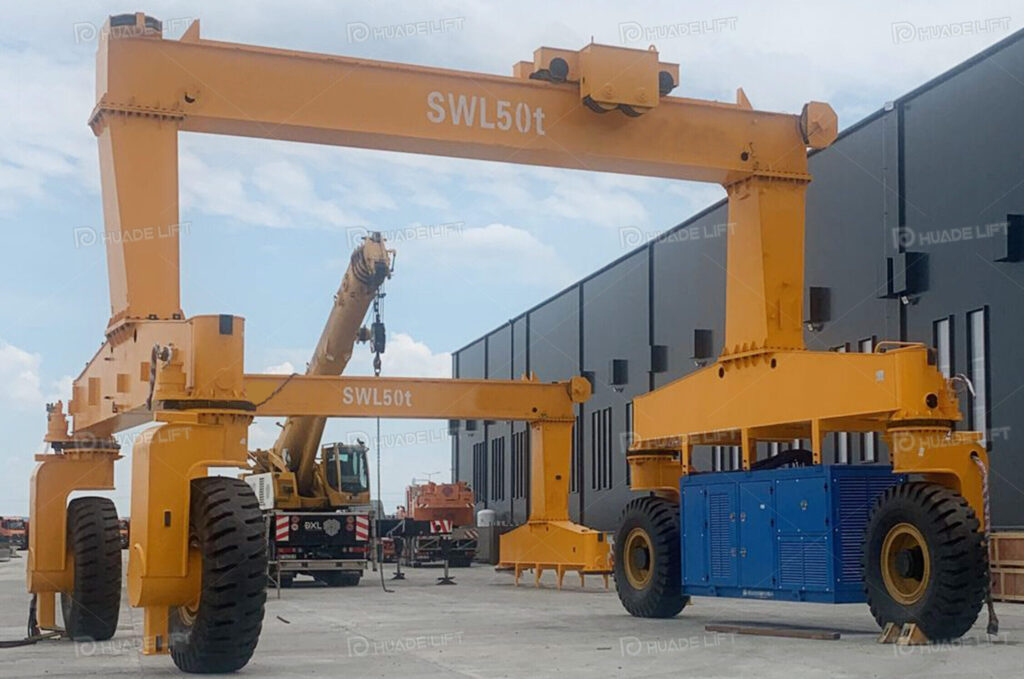
A rubber-tyred gantry crane is a mobile gantry crane system utilizing rubber tires for both support and mobility. Unlike rail-mounted gantry cranes, it operates without fixed tracks, enabling unrestricted movement within construction sites. This characteristic facilitates its widespread application in bridge construction, modular building, port logistics, and other sectors.
In bridge engineering, rubber-tyred gantry cranes primarily handle the lifting and installation of precast beams. Their substantial lifting capacity, often reaching hundreds of tons, effortlessly handles the heavy beams required for long-span bridges.
Technical Features
High-Capacity Load Handling: Supports lifting hundreds of tons of precast beams.
Flexible Mobility: Rubber-tired travel eliminates track dependency.
Precision Positioning: Equipped with automated control systems for millimeter-level accurate lifting.
Dual-Crane Coordination: Capable of collaborative operation with two or more units for transporting extra-long girders.
These characteristics confer unique advantages to rubber-tyred gantry cranes in bridge girder construction.
Bridge Engineering Requirements for Lifting Equipment
Weight and Dimensions of Bridge Girders
Bridge girders are typically prefabricated concrete structures weighing tens to hundreds of tons. Single-span beams for major expressway and high-speed rail bridges can exceed 800 tons. Such immense weights render traditional lifting methods inadequate.
Complex Construction Sites
Bridge projects are often located along major thoroughfares, waterways, or urban centers, where workspaces are confined and heavily restricted. Urban elevated bridge construction particularly lacks sufficient space for large crawler cranes or rail-mounted equipment. This is where the mobility advantages of rubber-tyred gantry cranes (RTGs) become paramount.
Limitations of Traditional Lifting Methods
While crawler cranes offer high lifting capacity, they are inconvenient to relocate and costly to operate. Bridge erectors require complex installation and dismantling procedures, limiting their applicability. RTGs, however, meet weight requirements while rapidly adapting to complex construction environments, making them a more cost-effective solution.
Advantages of Rubber Tyred Gantry Cranes in Bridge Girder Lifting
High Load Capacity
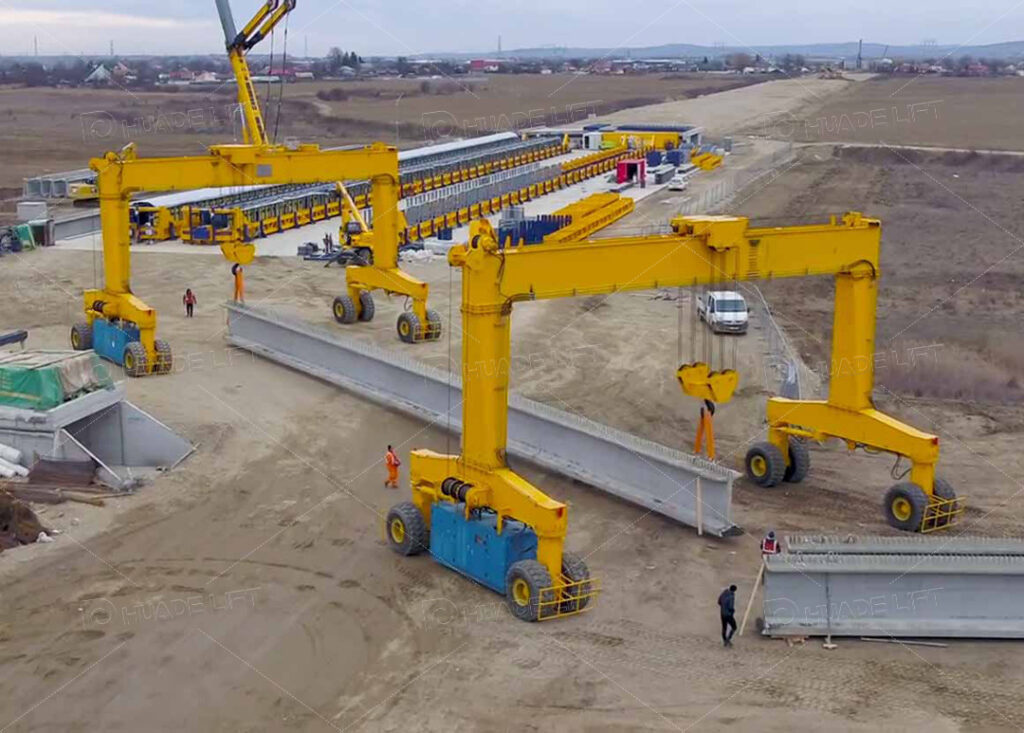
Rubber Tyred Gantry Cranes (RTGs) deliver reliable high load capacity, handling large precast girders common in bridge construction with ease. In most standard bridge scenarios, a single RTG independently performs core girder lifting tasks without additional equipment. When encountering exceptionally long or wide beams, two RTGs can operate in precise synchronized coordination—maintaining consistent movements throughout the entire process from lifting and hoisting to relocation. This effectively prevents beam displacement or damage caused by uneven stress distribution, maximizing stability and safety during transportation.
Flexible Mobility
Compared to traditional gantry cranes reliant on fixed tracks, the rubber-tired gantry crane’s wheeled system delivers exceptional flexibility. Bridge construction sites often feature complex ground conditions—temporary material piles, uneven terrain, or irregular work zones—yet the RTG effortlessly adapts to these challenges, freely adjusting its path without track constraints. This advantage is particularly evident in short-distance intra-site beam transfers: RTGs can perform direct “point-to-point” transport from precast beam production areas to bridge erection sites without requiring additional transport vehicles like trailers, significantly streamlining the transfer process.
Efficient Positioning and Precise Lifting
Modern rubber-tyred gantry cranes are equipped with advanced intelligent control systems. Combined with sensors and positioning technology, they enable efficient beam positioning and precise lifting. Bridge construction demands extremely high installation accuracy for beams, requiring placement deviations to be strictly controlled within millimeter tolerances. This directly impacts the overall structural stability and service life of the bridge. With its precise operational capabilities, the RTG rapidly adjusts beams to preset installation positions and ensures smooth placement. This not only significantly reduces manual alignment difficulties but also eliminates time losses from repeated adjustments, effectively enhancing construction efficiency and installation quality.
Reduced Construction Costs
Employing Rubber Tyred Gantry Cranes in bridge beam lifting operations effectively reduces reliance on specialized equipment like crawler cranes and bridge erectors. These specialized machines not only carry high rental or purchase costs but also require additional investment for transportation and on-site commissioning. Furthermore, since RTGs do not require fixed tracks, they eliminate the material, labor, and site leveling costs associated with track construction, making site preparation simpler and faster. Considering multiple aspects—from equipment investment and transportation coordination to site preparation—RTGs undoubtedly offer a more cost-effective solution for bridge construction.
Rubber Tyred Gantry Crane Typical Application Scenarios
Highway Bridge Construction
In highway and urban expressway bridge projects, the rubber tyred gantry crane (RTG) serves as the core equipment for girder transportation and hoisting operations. Highway bridge construction often faces compact site constraints, particularly in urban core areas where construction zones are frequently surrounded by existing buildings, roads, or utility infrastructure, leaving limited working space. Leveraging the flexible steering and precise maneuverability of rubber tires, RTGs eliminate the need for large-scale site leveling or track laying. They can lift, rotate, and position beams within confined spaces, perfectly meeting the “small footprint, high efficiency” demands of urban core construction while minimizing disruption to surrounding traffic and residents.
Urban Elevated Bridge Construction
Urban elevated bridges typically employ off-site prefabrication for beams, which are transported to the construction site for centralized installation. Since these structures often follow existing roadways, work zones are adjacent to heavily trafficked thoroughfares. Large cranes occupying lanes for extended periods not only cause prolonged lane closures but also trigger traffic congestion. RTGs, however, can operate directly on elevated construction platforms or temporary roadside work zones. Their compact design and agile travel systems enable rapid lifting and precise positioning of beams from transport vehicles to installation points—all without occupying main lanes, significantly minimizing urban traffic disruption.
High-Speed Rail and Railway Bridge Construction
High-speed rail and railway bridges demand far higher engineering quality than conventional bridges. Not only are the girders heavier, but installation precision—including planar positioning and elevation tolerances—is extremely stringent, directly impacting track laying quality and train operational safety. The RTG’s high load capacity effortlessly handles the lifting demands of heavy railway girders. Combined with its intelligent positioning system, it controls installation deviations to the millimeter level, precisely meeting railway bridge construction standards. Additionally, during multi-span continuous construction of railway bridges, the RTG can flexibly move between piers and abutments for operations, eliminating the need for frequent equipment relocation and providing stable assurance for construction progress.
Beam Handling at Precast Yard
Within the precast yard, the rubber-tyred gantry crane plays a pivotal role in beam storage and logistics. Precast beams are first stored in designated areas for curing. After curing, they are transported to loading vehicles or directly delivered to the construction site. The RTG can freely adjust its travel routes according to the precast yard layout, efficiently completing both short-distance transfers from production platforms to storage areas and loading operations from storage areas onto transport vehicles. Its smooth lifting actions prevent beam damage from collisions or vibrations during transfer. Additionally, by eliminating reliance on auxiliary transport equipment, it significantly shortens beam turnaround cycles and enhances overall precast yard productivity.
Comparison of Rubber Tyred Gantry Crane with Other Lifting Methods
Compared to Crawler Cranes
Crawler cranes are commonly used for heavy lifting due to their powerful lifting capacity, but they demand extremely high operational space requirements—not only necessitating open areas for support platform construction, but also requiring significant time for site leveling and reinforcement before operation. More critically, relocating a crawler crane requires disassembling it into multiple components transported by heavy-duty trailers. Upon arrival at the new site, a specialized team must reassemble and calibrate the crane, often taking several days and severely impacting construction schedules. In contrast, RTGs utilize a rubber-tired travel system, eliminating the need for complex site preparation. They can navigate tight spaces like urban cores or between bridge piers with agile steering and precise movement. Relocation is achieved simply by driving to the new site, making them highly adaptable for efficient construction in confined areas.
Comparison with Gantry Cranes
Gantry cranes are specialized equipment designed for bridge girder installation, demonstrating unique advantages in erecting large-span girders on tall piers. However, their limitations are equally pronounced: not only are procurement or rental costs prohibitively high, but installation and dismantling require additional auxiliary equipment, and the commissioning process is complex. More critically, gantry cranes are highly specialized, capable only of aerial beam installation. They cannot perform tasks like beam storage in precast yards or short-distance beam transportation, limiting their application strictly to bridge erection sites. In contrast, RTGs offer exceptional multi-scenario adaptability. They can precisely lift beams at construction sites, transport beams from production platforms to storage areas within precast yards, and directly transfer beams from storage to transport vehicles. This integrated “lifting-transportation” capability significantly enhances overall equipment utilization.
Comparison with Rail-mounted Gantry Cranes
Rail-mounted gantry cranes offer superior operational stability, but track installation remains an unavoidable limitation: it requires advance planning of track routes, procurement of rails and sleepers, and precise track leveling and securing—resulting in lengthy site preparation cycles and high costs. Once tracks are laid, the operational area becomes rigidly fixed. If construction requirements change, relocating tracks necessitates dismantling and reinstalling them, consuming substantial labor and resources. RTGs, however, are entirely free from track constraints. Leveraging the mobility advantages of rubber tires, they can relocate operations at any time based on construction schedules—whether on hardened surfaces at precast yards or temporary work zones at construction sites. Even when cross-area operations are required, movement only necessitates simple verification of ground load-bearing capacity, offering a qualitative leap in flexibility compared to rail-mounted gantry cranes.
Future Development Trends and Technological Innovations
Automation and Intelligence
Future rubber-tyred gantry cranes will incorporate enhanced automation features such as autonomous path planning, remote monitoring, and driverless operation to boost efficiency and safety.
Digital Integration with BIM Technology
As BIM technology becomes mainstream in bridge construction, RTGs will interface with digital models to enable visualized and intelligent management of lifting operations.
Green and Energy-Efficient Development
To meet sustainable development requirements, future RTGs will adopt electric or hybrid drive systems, reducing carbon emissions and promoting green construction practices.
Conclusion
In summary, rubber-tyred gantry cranes play an irreplaceable role in bridge girder lifting and transportation. They not only meet the high load-bearing demands of bridge engineering but also adapt to complex and dynamic construction environments through their mobility and precision operation. Simultaneously, RTGs effectively reduce construction costs and enhance project efficiency.
With continuous technological advancements, the application of rubber-tyred gantry cranes in bridge construction will expand further. They represent not only critical equipment for current bridge projects but also a vital foundation for future infrastructure development.
