
What is a Rubber Tyred Gantry Crane (RTG Crane)?
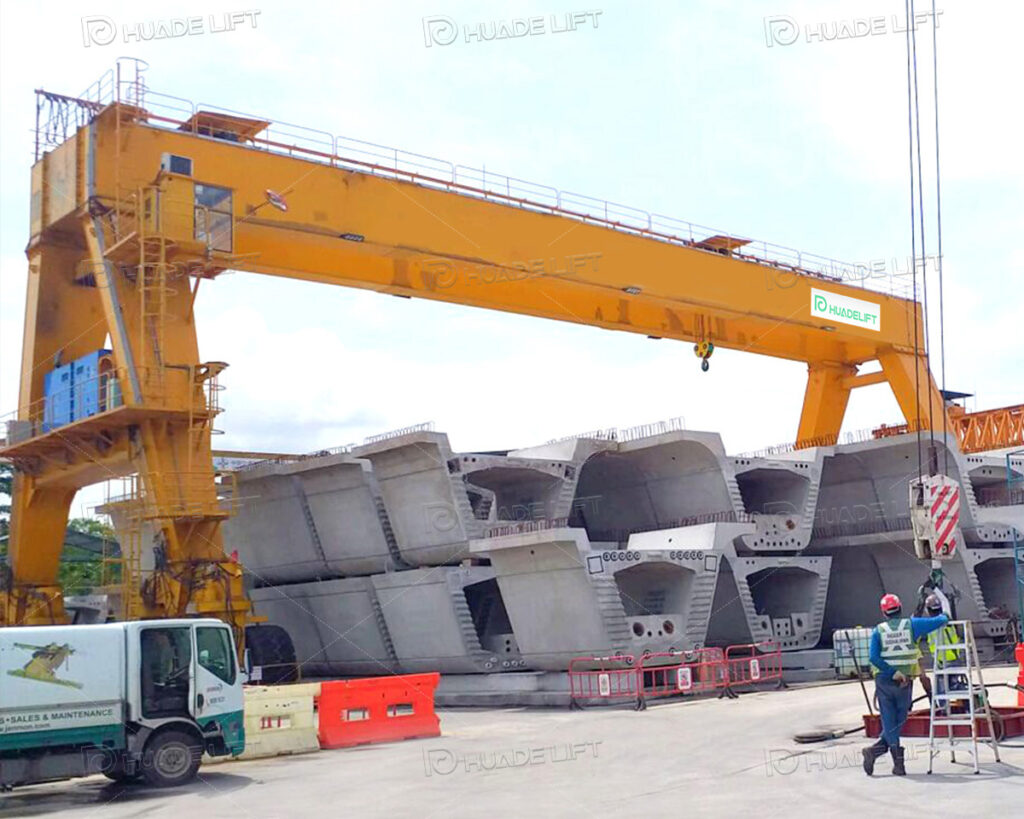
A rubber tyred gantry crane is a mobile gantry crane equipped with rubber tires as its travel mechanism. Unlike traditional rail-based models, its primary advantage lies in eliminating track constraints, enabling free movement within the operational area. The core function of this crane is to span multiple rows of containers, trucks, or cargo platforms, enabling vertical lifting and horizontal transportation of heavy loads. It is particularly suitable for scenarios requiring frequent layout adjustments and high flexibility.
Structural Components:
Supporting and Mobile Section
Two main support legs equipped with rubber tires at the base provide stable support and the foundation for the crane’s mobility.
Load-bearing Structure
A horizontal main beam connecting the two support legs, serving as the crane’s core load-bearing framework.
Hoisting Mechanism
A hoist or trolley traveling along the main beam, responsible for driving the hook or lifting device to perform lifting actions.
Gripping Components
Lifting devices or hooks used to grasp cargo, adaptable to different cargo types. Examples include specialized container spreaders for containers and hooks for bulk cargo.
Key Features and Specifications
Mobility and Flexibility
The mobility and flexibility of rubber tyred gantry cranes primarily rely on rubber tires and convenient relocation designs, which are key characteristics distinguishing them from other gantry cranes.
Advantages of Rubber Tires
Agile Maneuverability: Trackless operation enables multidirectional movement, adapting to narrow passages and complex layouts while overcoming linear movement limitations.
Wide Surface Compatibility: Operates on concrete, asphalt, and other surfaces without special preparation, suitable for ports, construction sites, and similar environments.
Superior Shock Absorption: Resilient rubber tires absorb ground impacts, reducing equipment wear and ensuring stable handling operations.
Cost-Effective: Eliminates track installation and maintenance, lowering initial investment and ongoing repair costs.
Manifestations of Easy Relocation
Efficient Deployment: Simple installation and rapid positioning, ideal for emergency and temporary operations.
Flexible Scheduling: Adjusts operational positions as needed, optimizing space utilization in logistics parks and similar areas.
Low Cost: Relocation requires no disassembly or modification, minimizes downtime, and significantly reduces expenses.
Easy Expansion: New equipment integrates seamlessly into existing systems, adapting to business growth.
Environmentally Friendly: Minimizes ground construction, reducing impact on surrounding ecosystems.
Load Capacity and Lifting Height
The load capacity and lifting height of rubber tyred gantry cranes can be flexibly designed to meet operational requirements, covering diverse heavy-load handling scenarios.
Flexible Load Capacity Adaptation
Load capacity is customizable to handle everything from light goods to heavy industrial materials.
Significant load capacity variations exist across different models. Users can select the appropriate model based on the maximum weight of actual workloads to ensure operational safety and efficiency.
Diverse Lifting Height Options
Standard models provide lifting heights sufficient for routine stacking operations.
Customized models achieve greater stacking heights, maximizing vertical space utilization for scenarios like low-level warehouse stacking and high-rise container handling in ports.
Customizable Span and Width
Standard spans suit conventional work areas.
Wider span models span multiple rows of containers or trucks, expanding single-operation coverage and boosting overall efficiency.
Detailes on 5 Types of Rubber Tyred Gantry Crane – Designs and Uses
Single-Girder Rubber Tyred Gantry Crane
Structural Features
The single-girder rubber tyred gantry crane employs a single-girder core load-bearing structure supported at both ends by two support legs. The base of these legs is equipped with multiple sets of rubber tires, ensuring stable mobility for the entire machine. Compared to double-girder models, its frame is more lightweight, effectively reducing overall weight and lowering power requirements for operation, enabling low-energy consumption.

Single-Girder Rubber Tyred Gantry Crane
Core Component Configuration
Hoisting Mechanism: Typically equipped with an electric wire rope hoist or chain hoist for vertical lifting of loads.
Travel Mechanism: Features a compact trolley that traverses the main girder horizontally, enabling precise hook positioning for accurate load alignment.
Technical Advantages: The streamlined structural design delivers multiple benefits, including reduced manufacturing and maintenance costs, shorter maintenance times, and minimized production disruptions due to equipment downtime.
Load Capacity and Span
Single-girder rubber tyred gantry cranes offer moderate load capacity, adjustable to meet operational requirements, handling most medium-sized heavy loads. Its span design primarily targets medium-sized spans while offering customization options: For compact work areas requiring higher stacking heights, narrow-span models with high lifting heights can be selected. For handling long-dimension materials, wide-span models with medium lifting heights are available, adapting to the spatial and material characteristics of different operational scenarios.
Application Scenarios
Outdoor steel fabrication yards: Handles post-fabrication component transport between processing zones.
Power plant maintenance: Lifts machinery components for equipment inspection or replacement.
Small container warehouses & logistics hubs: Performs container stacking and loading/unloading tasks.
Construction & manufacturing: Transports various long-length materials for production and construction needs.
Double Girder A-Frame Rubber Tyred Gantry Crane
Structural Features
Structural Features: The double girder A-frame rubber tyred gantry crane utilizes two parallel main girders for load-bearing, supported below by A-frame legs. This design evenly distributes the load weight to the rubber tires, enhancing overall balance and mobility stability.
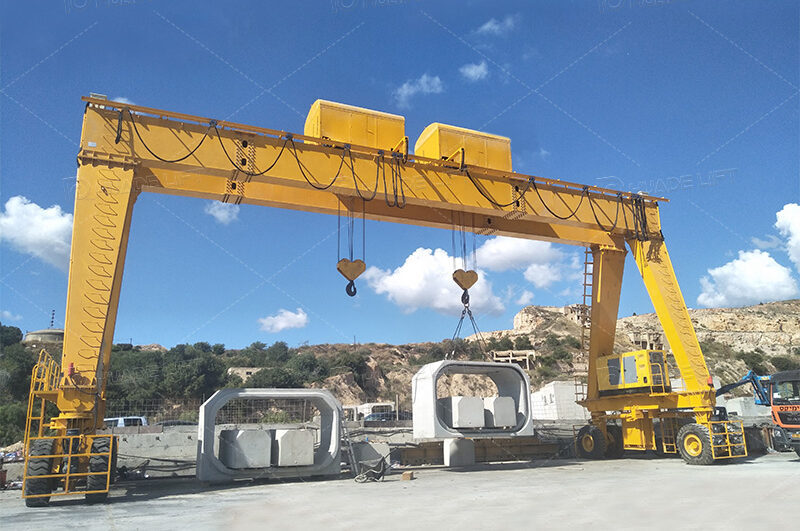
Double Girder A-Frame Rubber Tyred Gantry Crane
Performance Advantages:
High structural rigidity; the dual-girder design significantly increases load capacity, making it suitable for heavy-duty handling;
A-frame supports reduce girder deformation under load, ensuring operational safety.
Hoisting Mechanism: Typically equipped with heavy-duty wire rope hoists or specialized trolleys mounted between the dual girders, enabling stable lifting and precise positioning of heavy loads.
Design Focus: Prioritizes structural strength and stability over maximizing clearance height beneath the main beams compared to other models.
Load Capacity and Span
Load Capacity: Dual-girder A-frame rubber tyred gantry cranes deliver robust load-bearing capabilities to meet heavy-duty requirements. Custom configurations accommodate specialized heavy material handling.
Span Design: Wide span range allows large-span models to cover multiple work zones, enabling simultaneous handling of multiple heavy loads.
Application Scenarios
Medium-capacity and span models suit factory workshops and small work areas;
High-capacity and wide-span models cater to heavy industrial sites and large outdoor warehouses, meeting large-scale heavy material handling needs.
Steel Industry: Used in steel mills and distribution yards to transport heavy steel materials, ensuring efficient transfer during production and storage.
Construction Engineering: Suitable for large construction sites to lift heavy construction materials like prefabricated components and main beams, facilitating on-site installation.
Logistics Transportation: In small ports and multimodal logistics parks, capable of handling medium-scale container loading/unloading and stacking, reducing reliance on large port-specific equipment and lowering operational costs.
Double Girder U-Frame Rubber Tyred Gantry Crane
Structural Features
Structural Design: Utilizes U-shaped support legs, with two parallel main girders supported by the U-legs to form an open bottom space. This design provides ample clearance beneath the main girders and eliminates obstructions between the support legs, allowing tall or wide-body cargo to pass directly underneath the crane without requiring adjustments to cargo placement or crane operation routes.
Component Configuration: The hoisting mechanism offers high adaptability, enabling flexible selection based on cargo type. For instance, specialized lifting attachments can be fitted for containers, while custom hoisting devices can be designed for large equipment.
Performance Advantages: The overall structure combines strength with flexibility, meeting heavy-load carrying requirements while significantly enhancing operational convenience through the U-frame design. It is particularly suited for handling cargo with unusual dimensions.
Load Capacity and Span
Heavy-Duty Performance: As a heavy-duty model, the double-girder U-frame tire-mounted gantry crane delivers outstanding load capacity. Custom configurations accommodate ultra-heavy cargo like large industrial equipment.
Span Customization: Flexibly tailored spans match cargo dimensions and site layouts. Wide-span models optimize multi-row container stacking zones for efficient throughput.
Lifting Height Adaptation: Supports customized lifting heights for high-level stacking requirements. Flexible span and clearance height adjustments ensure smooth handling of oversized cargo.
Application Scenarios
Port Loading/Unloading: Ideal for container stacking zones, enabling direct grabbing/placement across multiple rows without displacing surrounding cargo.
Rail Transfer: Facilitates container transfer between railcars and trucks. U-shaped frame allows vehicles to pass underneath, boosting efficiency.
Logistics Storage: Optimizes container storage layout by maximizing space utilization through high-level stacking.
Special Cargo Handling: Serves heavy industrial and energy projects, capable of moving large equipment, long steel structures, and other specialized cargo.
Tire-Mounted Straddle Carrier
Structural Features
Structure and Mobility: Featuring an integrated frame structure, the wheeled straddle carrier enables “straddle operation” by directly spanning cargo. Equipped with rubber tires, it functions as a self-propelled crane for flexible movement.
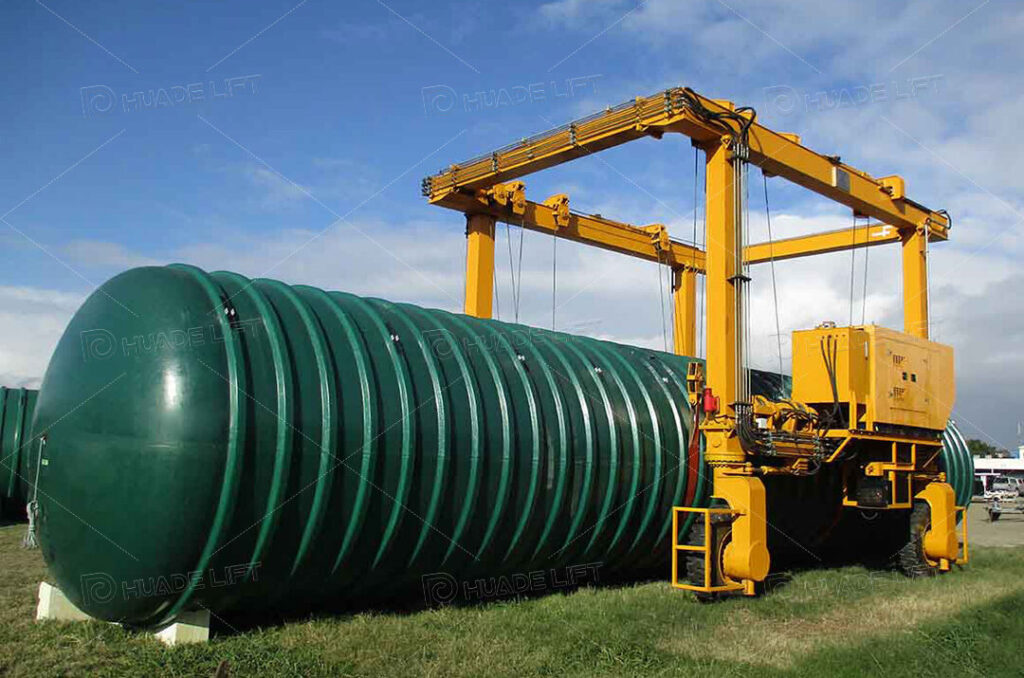
Tire-Mounted Straddle Carrier
Operational Flow: The top lifting mechanism grips cargo, executing integrated “grip-move-place” operations without bypassing cargo for high efficiency.
Key Component Design
Lifting Mechanism: Equipped with adjustable lifting attachments compatible with standard containers of varying dimensions, enhancing equipment versatility.
Operator Cab: Elevated design provides operators with an unobstructed view, facilitating precise monitoring of cargo positioning and surrounding conditions to ensure operational safety and accuracy.
Operational Advantages: Operates independently without forklifts or trailers, handling cargo transport and stacking tasks autonomously. This reduces equipment investment and operational steps, significantly boosting overall efficiency.
Load Capacity and Span
Load Capacity Matching: The tire-mounted straddle carrier is engineered specifically for container handling, with load capacity precisely matched to standard container weights. It fully meets the transport needs of all common container types.
Scientific Span Design:
Dimension Coverage: Span dimensions are based on standard container sizes, ensuring stable operation when crossing containers.
Stability Considerations: While ensuring operational functionality, stability during movement is prioritized to effectively mitigate risks of imbalance caused by excessive span.
Application Scenarios
Port Applications: Enables rapid transfer from berth to stacking areas and stacking area organization at container terminals, enhancing loading/unloading efficiency.
Multimodal Transport: Facilitates seamless container transfers between trucks, trains, and stacking zones within freight yards, reducing transit times.
Logistics Parks: Optimizes storage layouts in large logistics parks by enabling rapid stacking and relocation, improving warehouse space utilization. Ideal for high-frequency turnover and high-speed requirement scenarios.
Tire-Mounted Ship Hoisting Crane (Mobile Ship Crane)
Structural Features
Design: U-shaped frame spans the hull, with multiple sets of rubber tires at the base of the support legs ensuring flexible and stable movement across docks and shipyards.
Core Functionality: The adjustable sling system adapts to vessel contours, ensuring even load distribution during lifting to prevent hull damage.
Performance Advantages
Flexibility: Freely traverses between docks and shipyards, eliminating fixed equipment constraints to meet ship maintenance and transfer needs.
Safety: Specifically engineered for marine operations, featuring high-protection components suited for humid and highly corrosive environments.
Load Capacity and Span
Load Capacity: Wide coverage range with customizable models based on vessel weight, accommodating small yachts to large ships.
Span Design: Based on vessel width, adjusts support leg spacing to fit different hull widths, ensuring stability during traversal.
Lifting Height: Customizable to meet diverse needs, such as lifting vessels from water to docks or transferring from docks to storage racks.
Applications Scenarios
Marina Operations: Facilitates launching and retrieving small yachts at marina docks for owner maintenance.
Shipyard Applications: Lifts vessels from water onto repair platforms for hull inspections, painting, and component replacements.
Yacht Storage Facilities: Enables vessel transfers between storage racks and transport trailers, optimizing space utilization and minimizing ground footprint.
Comparison with Other Types of Gantry Cranes
Rubber Tyred Gantry Crane (RTG)
Highly mobile with rubber tires enabling trackless movement and flexible positioning; suitable for dynamic operational scenarios; low infrastructure costs requiring no tracks or fixed support structures, resulting in reduced initial investment and maintenance expenses.
Rail-mounted gantry crane (RMG)
Limited mobility, restricted to movement along predetermined rails with constrained operational range adjustments; suitable for fixed operational layouts and long-term unchanging routes; infrastructure requires dedicated rail installation and power supply systems, with higher rail maintenance costs.
Overhead crane
Low mobility, fixed to overhead tracks in factory buildings with restricted operational range; suitable for enclosed spaces like factories and warehouses (e.g., material handling on workshop production lines); Requires overhead track installation, high infrastructure costs, and complex installation/maintenance.
Gantry Crane
Poor mobility, typically fixed installations or short-distance rail operation with limited adjustments; Suitable for heavy-duty applications in ports, shipyards, etc., handling vessel loading/unloading and large component lifting; High infrastructure costs, requires fixed foundations, complex structure, and significant investment.
Mobile Crane
Highly mobile, adaptable to diverse terrains including roads and off-road environments, facilitating long-distance relocation; suitable for temporary operations, emergency rescue, and construction sites requiring frequent relocation; however, limited load capacity makes it more appropriate for light-duty, temporary lifting tasks, struggling to meet heavy-duty, long-term operational demands.
In summary, rubber tyred gantry cranes combine high load capacity with exceptional mobility: capable of heavy-duty operations while flexibly adapting to diverse working conditions, making them the preferred equipment across multiple industries.
Maintenance Requirements
Daily Maintenance Tasks
Daily maintenance forms the foundation for ensuring stable operation of rubber tyred gantry cranes, primarily encompassing three categories of tasks: inspection, lubrication, and tire maintenance.
Inspection Maintenance
Regularly inspect structural components such as the main beam and support legs for deformation or cracks; examine wire ropes and hoists in the lifting mechanism for wear or looseness; and monitor the operational status of the electrical system to identify potential faults.
Lubrication Maintenance
Periodically apply lubricants to moving and rotating joints including tire bearings, trolley tracks, and lifting mechanism gears to reduce friction and wear, thereby extending component lifespan.
Tire Maintenance
Regularly inspect tire pressure, tread wear, and damage; check the tightness of tire-to-outrigger connections. As the core components for crane mobility, the condition of rubber tires directly impacts maneuverability and stability. Any abnormalities must be promptly repaired or replaced.
The Importance of Preventive Maintenance
Preventive maintenance offers multiple advantages by establishing scheduled maintenance plans to proactively identify equipment hazards and avoid sudden failures:
Extended Equipment Lifespan
Regular maintenance reduces component wear, prevents cascading damage, and ensures long-term stable operation.
Reduced Downtime Risk
Scheduling maintenance during non-operational periods avoids unexpected failures that interrupt operations, safeguarding production continuity.
Controlled Repair Costs
Addressing minor issues early prevents component failure, significantly lowering repair expenses.
Practical Recommendations for Buyers
Selecting Models Based on Operational Requirements
Define Operational Requirements Clearly
Begin by identifying your daily operational needs. Determine the maximum load weight and required stacking height to ensure the selected crane’s lifting capacity and height can fully meet your workload demands.
Evaluate Worksite Conditions
Analyze your site layout, including aisle width, turning radius, and ground conditions. These factors will help determine the most suitable crane span, tire configuration, and maneuverability requirements.
Assess Operating Frequency and Intensity
For continuous or heavy-duty operations, choose cranes with reinforced structures, enhanced durability, and reliable performance to ensure long-term efficiency and reduced downtime.
Identify the Need for Specialized Models
Container handling requires cranes equipped with container spreaders.
Ship handling calls for ship-lifting or marine-specific cranes.
Avoid using general-purpose models when specialized applications are needed, as they may not deliver optimal safety or efficiency.
Balancing Initial Investment and Long-Term Returns
When purchasing, weigh initial costs against long-term benefits by evaluating three key dimensions:
Energy Efficiency
Prioritize energy-efficient models. Their higher upfront cost can be quickly offset by significantly reduced energy consumption during high-frequency operations.
Maintenance Ease
Opt for models with mature designs and widely available spare parts to mitigate risks of component shortages and high maintenance costs associated with specialized configurations.
Scalability
Based on operational plans, select modular designs or equipment with upgrade potential. Flexibly expanding parameters like lifting height and span extends service life and enhances investment value.
Partnering with Professional Manufacturers
Collaborating with experienced manufacturers is crucial when selecting rubber tyred gantry cranes. Consider three key aspects:
Customized Solutions
Provide manufacturers with parameters like load weight, site dimensions, and ground load capacity to obtain tailored solutions and quotes, avoiding efficiency losses and safety risks associated with generic models.
Evaluate Technical Support
Verify the manufacturer’s ability to provide standardized installation guidance and maintenance training. This improves installation quality, equips operators with basic maintenance skills, and reduces operational costs.
Review Credentials and Reputation
Prioritize brands with certifications like the Crane Manufacturing License and proven experience. Validate product quality and after-sales service through customer case studies and user reviews to ensure equipment reliability and robust post-purchase support.
Conclusion
Rubber tyred gantry cranes dominate heavy-load handling due to their mobility, flexibility, and adjustable load capacity. Single-girder models offer lightweight efficiency; double-girder A-frames deliver robust high-load stability; U-frames accommodate special dimensions; straddle carriers specialize in container handling; and ship-mounted cranes service marine equipment—five precise solutions for diverse needs.
Enterprises should select models by comprehensively evaluating operational scenarios, costs, and planning. Compare model characteristics, assess cost-effectiveness, and collaborate with professional manufacturers. Simultaneously, prioritize maintenance and upkeep to ensure stable equipment operation, achieving efficiency gains and cost reductions.
