
What is a Rubber Tyred Gantry Crane?
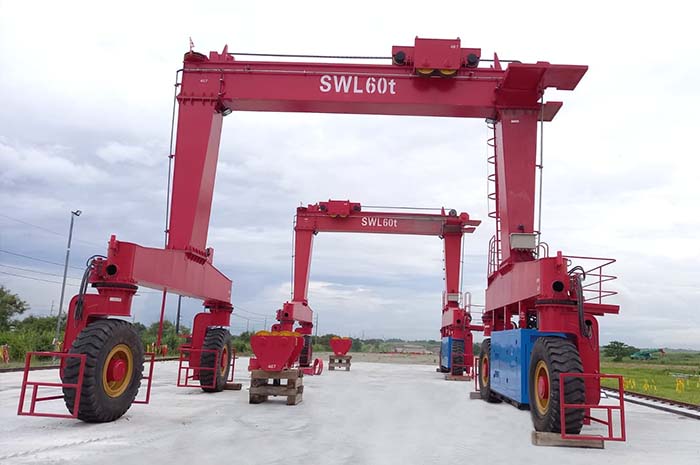
A rubber-tyred gantry crane (RTG) is a type of mobile crane specifically engineered for lifting and transporting heavy cargo, commonly utilized in outdoor or semi-outdoor operational environments. Unlike traditional rail-mounted gantry cranes, RTGs are equipped with rubber tires, granting them exceptional mobility and flexibility. This feature enables them to navigate large warehouse spaces with ease and handle various loads effortlessly.
Their design typically includes an elevated gantry frame to support the crane’s lifting mechanism and a set of wheels that enable horizontal movement across warehouse floors. While RTGs are commonly found in container yards and ports, they also play a crucial role in warehouses handling large or heavy materials, automotive components, and various industrial products. Their ability to move, lift, and transport goods across vast areas makes them indispensable in specific warehouse environments.
Advantages of Rubber Tyred Gantry Crane
Mobility and Flexibility
Free Movement:
RTGs can move freely on the ground without tracks, offering exceptional adaptability. They can quickly adjust their position within the yard as needed, covering a larger working area. This feature allows RTGs to respond swiftly in scenarios where cargo stacking locations frequently change, avoiding the operational limitations caused by track restrictions and significantly improving site utilization.
Multi-Directional Movement:
Rubber tires enable RTGs to move in multiple directions, allowing them to operate effortlessly in narrow yards and adapt to various complex terrains and layouts. Whether making right-angle turns or diagonal movements, RTGs can respond flexibly, which is a significant advantage for sites with limited space and irregularly arranged cargo.
Energy Conservation and Environmental Protection
Electric Drive:
Modern RTGs typically use electric drive systems, reducing reliance on diesel engines and thereby lowering carbon emissions and noise levels, meeting environmental protection requirements. In today’s focus on green development, this environmentally friendly feature makes RTGs more competitive in various settings with high environmental quality standards, while also helping to establish a positive corporate image.
High Energy Efficiency:
RTG cranes are more cost-effective for long-term operations because of their low energy consumption, which lowers operating expenses. Lower energy consumption not only means direct cost savings but also reduces the environmental impact associated with energy acquisition and consumption, achieving a win-win situation for both economic and environmental benefits.
Efficient Operation
Quick Positioning:
RTGs can quickly position themselves at designated locations, reducing loading and unloading time and improving work efficiency. In ports, warehouses, and other locations requiring rapid cargo turnover, time is money. The quick positioning capability of RTGs can significantly shorten cargo handling cycles and enhance overall operational speed.
Precise Control:
Equipped with advanced electrical control systems and sensors, RTGs can perform precise lifting, moving, and placing operations, reducing the likelihood of cargo damage. For fragile or valuable cargo, precise control is critical, as it minimizes losses caused by improper operation and ensures the integrity of the cargo.
High Safety
Windproof Design:
During the design process, RTGs were fully engineered to withstand windy conditions, ensuring stable operation in ports and other windy environments while maintaining operational safety. Ports and other outdoor locations frequently experience strong winds, and the wind-resistant design allows RTGs to operate reliably in such conditions, preventing equipment failures or safety incidents caused by excessive wind force.
Complete Safety Devices:
The RTG is equipped with various safety devices, such as collision prevention systems, emergency braking systems, and load monitoring systems, to comprehensively ensure operational safety. The collision prevention system prevents collisions between cranes and between cranes and other equipment or cargo; the emergency braking system can quickly stop the equipment in case of emergencies; and the load monitoring system can monitor the lifting load in real time to prevent safety issues caused by overloading.
Good Economic Benefits
Low Initial Investment:
Compared to rail-mounted cranes, RTGs do not require the construction of rail foundations, resulting in lower initial investment costs. The construction of rail foundations not only requires significant financial investment but also consumes a substantial amount of time and manpower, whereas RTGs eliminate these costs and time, enabling businesses to commence operations and generate revenue more quickly.
Low Operating Costs:
The use of an electric drive system helps reduce fuel and maintenance costs, making long-term operations more economical. Compared to diesel-driven systems, electric drives have lower fuel costs, longer maintenance intervals, and lower maintenance expenses, resulting in significant cost savings for businesses over the long term.
Convenient Maintenance
Simple Structure:
Compared to fixed-track cranes, RTGs have a simpler structure, making maintenance and repairs more convenient. A simple structure means fewer components and fewer potential points of failure, thereby reducing maintenance complexity and workload.
Easy to Maintain:
The design of the rubber tires and electrical system makes daily maintenance and upkeep of RTGs more straightforward, reducing downtime and maintenance costs. Rubber tires are relatively easy to maintain and replace; the modular design of the electrical system facilitates inspection and repair, enabling quick troubleshooting to ensure the equipment operates normally.
Strong Adaptability
Multi-Purpose:
RTGs can be utilized for a variety of tasks, including handling containers and transporting large materials like steel and equipment. This multi-purpose functionality enables RTGs to perform effectively in various operational scenarios, enhancing equipment utilization and reducing equipment procurement costs for businesses.
Suitable for Multiple Environments:
The absence of tracks makes RTGs suitable for various ground conditions, including uneven or unpaved surfaces, offering exceptional flexibility. Whether on muddy construction sites, rugged mines, or ordinary warehouse floors, RTGs can operate normally without being overly restricted by ground conditions.
Remote Control Capability
Many modern tire-mounted gantry cranes are equipped with remote operation functionality, allowing operators to control the crane from a safe distance. Remote operation technology enables operators to monitor crane operations and make adjustments without physically being inside the operator’s cabin, reducing manual intervention while further improving efficiency. This feature is particularly beneficial in hazardous or restricted areas where direct operator access could pose significant risks, ensuring operational safety through remote control.
Improved Operator Comfort and Safety
Electric tire-mounted gantry cranes provide notable enhancements in terms of operator comfort and safety when compared to their diesel-powered models. They are equipped with ergonomically designed cabins featuring better visibility, climate control, adjustable seats, and intuitive control interfaces. These designs take into account the operator’s working environment and needs, reducing fatigue and enhancing operational accuracy and safety.
Applications of Rubber Tyred Gantry Crane
Port and Container Terminals
The primary application area for rubber-tyred gantry cranes is ports and container terminals. Here, they are utilized for stacking and relocating containers. The RTG’s capacity to span multiple container rows allows for the efficient optimization of storage space. Its mobility allows it to quickly and precisely reposition containers, facilitating smooth and continuous port operations. Additionally, RTGs can be used for loading and unloading containers from trucks and trains, enhancing multimodal transportation capabilities.
Manufacturing and Warehousing
In manufacturing and warehousing industries, RTGs play a critical role in material handling. They are used to transport heavy machinery, raw materials, and finished products within large facilities. The flexibility of RTGs to move freely across various areas within factories or warehouses makes them an ideal solution for improving workflow efficiency and reducing manual labor. Industries such as automotive manufacturing, aerospace, and heavy machinery manufacturing have significantly improved production efficiency through the application of RTGs.
Precast Concrete Yards
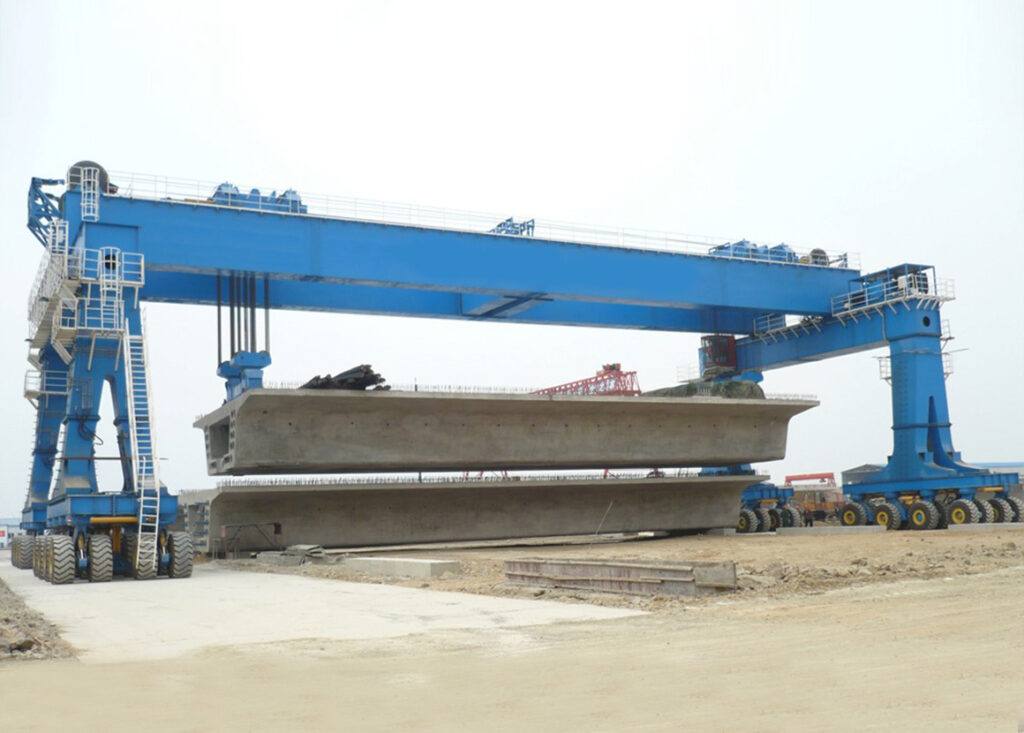
RTGs are widely used in precast concrete yards for handling large concrete components. These components typically weigh several tons and require precise movement and positioning. RTGs provide the necessary lifting capacity and maneuverability to efficiently complete these tasks. They operate on rubber tires, minimizing damage to concrete surfaces, making them suitable for this delicate environment.
Power Plants and and Utility Installations
In power plants and utilities, RTGs are used for the maintenance and installation of heavy equipment. These cranes can transport turbines, transformers, and other large components in confined spaces. The ability to move these devices without permanent track infrastructure makes RTGs a cost-effective solution for these industries.
Mining and Material Handling
In the mining industry, RTGs are used for handling bulk materials such as ore and coal, as well as transporting mining equipment. Their robust design enables them to operate in harsh environments, providing reliability and efficiency in material handling tasks.
Road and Bridge Construction
In road and bridge construction, RTGs are used for various tasks, including lifting and placing precast concrete components, moving steel beams, and assembling large components critical to bridge and interchange construction. Their mobility allows them to move easily between different areas of a construction site, making them highly efficient for large-scale projects.
RMG vs. RTG Cranes
Rail-Mounted Gantry Crane (RMG)
RMG cranes operate on fixed rails. This design offers a more stable lifting platform, which allows RMG cranes to handle heavier loads compared to RTG cranes. Their steel wheels reduce friction and have higher load-bearing capacity, making them an ideal choice for large container yards with high-capacity container handling requirements. The main limitation of RMG cranes is their lack of mobility. Unlike RTG cranes, they cannot move freely within the yard but are restricted to the track system. This means that yard layout must be carefully planned to accommodate the fixed movement paths of RMG cranes.
Rubber-Tired Gantry Cranes (RTG)
RTG cranes are equipped with rubber tires, enabling them to move freely within container yards. This mobility provides greater operational flexibility, making RTGs ideal for yards with dynamic layouts and diverse container placement requirements. RTG cranes can be positioned at different locations within the yard to optimize container handling efficiency. However, rubber tires also have some limitations. Compared to rail-mounted cranes, RTGs have limited lifting capacity, as the weight they can carry is constrained by tire strength and the need to maintain balance during movement.
The Significance of Rubber Tyred Gantry Crane
In today’s fast-paced logistics, industrial, and port environments, efficiency and flexibility are of the utmost importance. Rubber-tyred gantry cranes stand out for their ability to move freely across different areas without being restricted by tracks or fixed positions. In port operations, layout and storage requirements can change rapidly, making this mobility crucial. RTGs simplify container handling, facilitating faster loading and unloading processes, thereby reducing vessel turnaround times and enhancing overall port productivity.
In industrial settings, these cranes are used to move large and heavy materials across vast areas, offering a versatile solution capable of adapting to various tasks and operational changes. Their ability to handle substantial loads in complex environments makes them a valuable asset across numerous industries, from manufacturing to logistics.
