
Introduction
In recent years, global infrastructure development has accelerated continuously, with port logistics throughput rising year after year. Modular construction and the new energy industry have experienced explosive growth. In these sectors, lifting and transport equipment serves as core production tools, where their performance and adaptability directly impact project efficiency and cost control.
As industry specialization deepens, operational demands across diverse scenarios exhibit increasingly pronounced diversification and customization. Traditional standardized lifting equipment struggles to meet complex working conditions, while the customizable options offered by rubber-tyred gantry cranes (RTGCs) emerge as the key solution—delivering precisely tailored lifting capabilities across industries.
What is a Rubber Tyred Gantry Crane?
Definition and Working Principle
A Rubber Tyred Gantry Crane is a gantry crane equipped with tire-based travel mechanisms. It primarily consists of a metal structure, hoisting mechanism, travel mechanism, luffing mechanism, and control system. Its operating principle involves using the hoisting mechanism to drive the hook or specialized lifting attachments for lifting and lowering loads. The tire-based travel system of the traveling mechanism enables the equipment to move within the work area, while the luffing mechanism adjusts the horizontal position of the lifting attachments. This allows for operations such as cargo lifting, transportation, and stacking.
This equipment eliminates the need for fixed tracks, offering flexible mobility within the worksite through its rubber-tired design. It is particularly suited for scenarios requiring frequent repositioning. Currently, rubber-tyred gantry cranes are widely deployed across ports, logistics yards, construction sites, new energy projects, and other sectors.
The Necessity of Customizable Design
Customizing rubber-tyred gantry cranes enables precise alignment with site conditions, materials, and operational workflows. This avoids waste and inefficiency caused by over- or under-performance, facilitates seamless integration into existing production systems, reduces adaptation costs, and maximizes corporate benefits.
Varied Operational Requirements Across Industries
The operational characteristics of each industry dictate fundamentally different requirements for rubber-tyred gantry cranes. In ports, the core task is rapid container loading/unloading and stacking, demanding high lifting speeds and precise positioning capabilities. In photovoltaic and new energy projects, equipment must operate in complex outdoor terrain, requiring exceptional ground adaptability and maneuverability. In the power industry, lifting operations often involve high-voltage equipment, necessitating stringent standards for stability and safety. At modular construction sites, equipment must frequently transport large-volume modules, challenging load-bearing capacity and operational flexibility. In mining scenarios, equipment must withstand harsh environments like dust and heavy loads, making durability and wear resistance critical metrics.
Diverse Material Handling Requirements
The weight, dimensions, shape, and physical properties of lifted materials vary significantly across industries, directly dictating the customization direction for rubber-tyred gantry cranes. When lifting extra-long steel structures, extended booms and specialized securing devices must be customized to prevent material deformation or slippage. For handling precast concrete components, equipment requires stable lifting performance and shock absorption mechanisms to avoid vibration damage. Port container handling necessitates quick-change container spreaders to enhance loading/unloading efficiency. Wind turbine blades, as large fragile components, impose special demands on lifting smoothness and sway prevention, necessitating custom lifting attachments and intelligent control systems.
Site Condition Adaptability Requirements
Variations in worksite conditions represent a core challenge rubber-tyred gantry cranes must address. Within confined construction sites, equipment requires compact dimensions and agile maneuverability to adapt to limited operational space. Off-road scenarios on unpaved terrain demand equipment fitted with high-traction tires and reinforced suspension systems; while large-span work zones like bridge construction sites require custom extended-span main beam structures that maintain overall stability. Failure to adapt to site conditions not only reduces operational efficiency but may also lead to equipment damage and safety incidents.
Primary Customization Options
Structural and Dimensional Customization
Structure and dimensions form the foundation of RTG customization, directly determining operational reach and load capacity. Core customization dimensions include:
Lifting Height: Adjustable from approximately 10 meters to over 30 meters to accommodate diverse stacking or elevated tasks. Ports often customize cranes exceeding 20 meters to enhance storage density.
Span and Wheelbase: Spans can be designed from 15 meters to over 50 meters. Long-span equipment reduces movement frequency and enhances efficiency, suitable for scenarios like bridge construction. Wheelbase is adjusted based on site road conditions and material dimensions to ensure operational stability.
Load Capacity: Ranges from 20 tons to over 100 tons. Heavy-duty scenarios achieve high-tonnage customization through high-strength steel and reinforced main beams.
Modular Structure: The mainstream approach, where key components like main beams and outriggers can be disassembled and reassembled. This facilitates transportation, setup/teardown, and relocation, making it ideal for companies operating across multiple projects.
Power System Options
Customized power systems directly impact the operational efficiency, running costs, and environmental performance of rubber-tyred gantry cranes. Three primary types exist:
Diesel Drive: The traditional form offers strong power, long endurance, and resilience in harsh environments, suitable for remote locations without power or high-intensity operations. However, it features high fuel consumption, significant pollution, and faces increasing restrictions due to environmental policies.
Electric Drive: Includes mains power and battery drive. It boasts low energy consumption, minimal noise, and zero emissions, making it the preferred choice for environmentally sensitive scenarios. Mains power suits fixed sites with electrical access; battery power eliminates cable constraints for greater flexibility, aligning with urban and renewable energy projects demanding high environmental standards.
Hybrid systems: Combining the advantages of both, these automatically switch power modes based on operating conditions, balancing efficiency with energy conservation and environmental protection. Additionally, energy-saving and eco-friendly configurations—such as energy recovery systems and high-efficiency filters—have become popular customization options.
Control and Operation Modes
Customized control and operation modes are key to enhancing the efficiency and safety of rubber-tyred gantry cranes (RTGCs), primarily categorized into three types:
Cabin Operation: The traditional method where the operator controls the equipment via joysticks and instrument panels, suitable for high-precision and complex working conditions. Cabins can be customized with air conditioning, shock-absorbing seats, wide-angle windows, and other features to improve operator comfort.
Remote Control Mode: Utilizes interference-resistant, responsive wireless controllers for long-distance operation, mitigating risks in hazardous zones and adapting to harsh or confined environments like high temperatures and dusty conditions. Premium controllers feature displays showing real-time equipment parameters.
Automated Control: A cutting-edge technology integrating laser navigation, visual recognition, and algorithms to achieve autonomous lifting, travel, and stacking without human intervention. Ideal for standardized environments like ports. For instance, certain port equipment receives IoT-based commands for automated operations, boosting efficiency by over 30% compared to manual labor.
Tires and Travel System
Customization of tires and travel systems directly determines the rubber-tyred gantry crane‘s adaptability and maneuverability. Different tire types can be tailored for varying ground conditions. On hardened surfaces like port yards and factory premises, wear-resistant solid tires or pneumatic tires can be selected to reduce tire wear rates. For unpaved surfaces like outdoor construction sites, off-road tires with deep tread patterns are required to enhance traction and passability. On soft surfaces such as gravel yards, customized wide tires or crawler tracks increase the contact area between the equipment and the ground, reducing ground pressure and preventing sinking.
Anti-slip and anti-sinking designs are safety assurances for customized tire and travel systems. Anti-slip design enhances traction on wet or muddy surfaces through specialized tread patterns or anti-slip materials. Anti-sinking features include adjustable outrigger height and ground support pads. When operating on soft ground, deploying outriggers or laying pads further distributes the equipment’s weight, preventing tip-over accidents caused by ground collapse.
Safety and Intelligent Features
Safety is paramount in tire-mounted gantry crane operations, making customized safety and intelligent features indispensable. These primarily encompass three critical systems:
Overload Protection System: Utilizes load cells to detect load weight. Upon exceeding rated capacity, it automatically cuts power to the hoisting mechanism and triggers an alarm, preventing equipment damage or load drop accidents.
Wind and Anti-Overturn System: Essential for outdoor operations, incorporating wind speed sensors and rail clamps. When wind speeds exceed thresholds, it automatically triggers alarms and locks the travel mechanism. Operators can secure the equipment using rail clamps and wind braces, ensuring safety in windy areas like coastal ports.
Intelligent Monitoring and Maintenance Alert System: Integrates operational data for full lifecycle management. Continuously monitors engine RPM, oil temperature, and other parameters while issuing early warnings for anomalies. Automatically generates maintenance reminders based on operating hours, reducing failure rates and extending equipment lifespan.
Customized Industry Applications
Ports and Container Yards
As a primary application scenario for rubber-tyred gantry cranes, ports demand exceptional loading/unloading efficiency and compatibility. To boost container throughput, a coastal container port customized a fleet of specialized rubber-tyred gantry cranes. Addressing the need to handle both 20-foot and 40-foot containers simultaneously, the equipment features quick-change telescopic container spreaders. These spreaders adapt to different container sizes within 30 seconds, significantly reducing changeover time.
Additionally, to accommodate the port’s large-span stacking requirements, the equipment features a customized 35-meter span and a lifting height of 22 meters, enabling seven-tier container stacking operations. Furthermore, the equipment incorporates a diesel-electric hybrid power system and intelligent anti-sway technology. This ensures operational efficiency while reducing fuel consumption and emissions. Compared to traditional equipment, operational efficiency has increased by 25%, saving nearly 100,000 yuan in annual fuel costs.
Photovoltaic and New Energy Projects
Photovoltaic power stations are often constructed in open wilderness areas with complex terrain and predominantly unpaved surfaces, demanding rigorous ground adaptability and lifting precision from rubber-tyred gantry cranes. A photovoltaic new energy enterprise customized a fleet of off-road rubber-tyred gantry cranes for a desert project in Northwest China. To tackle soft desert ground and sandstorm conditions, the equipment features 1.2-meter diameter off-road tires with deep tread patterns and dust-proof sealing systems. Tire ground pressure is reduced below 0.15MPa, ensuring smooth desert mobility and minimal sand ingress.
To handle the installation of 12-meter-long photovoltaic panels, the equipment features extended booms and specialized vacuum suction cup lifting attachments. These attachments secure panels via vacuum adhesion, preventing physical damage to the components. An integrated precision positioning system enables millimeter-level accuracy in panel installation. Additionally, the equipment operates in battery-powered mode, delivering zero emissions and low noise levels to meet desert environmental requirements. A single unit can complete the installation of 80 photovoltaic panels daily, achieving a 40% efficiency increase over traditional equipment.
Bridge and Infrastructure Engineering
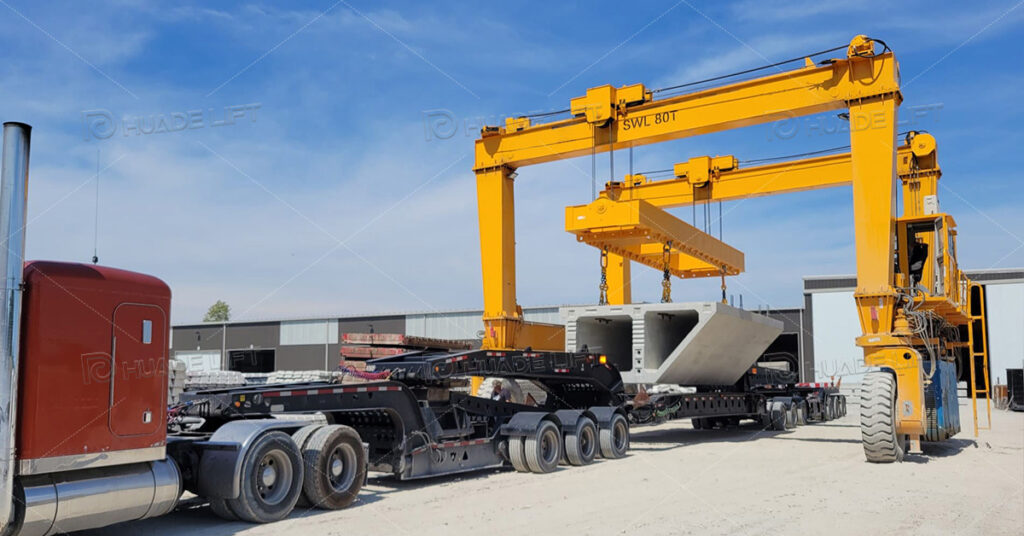
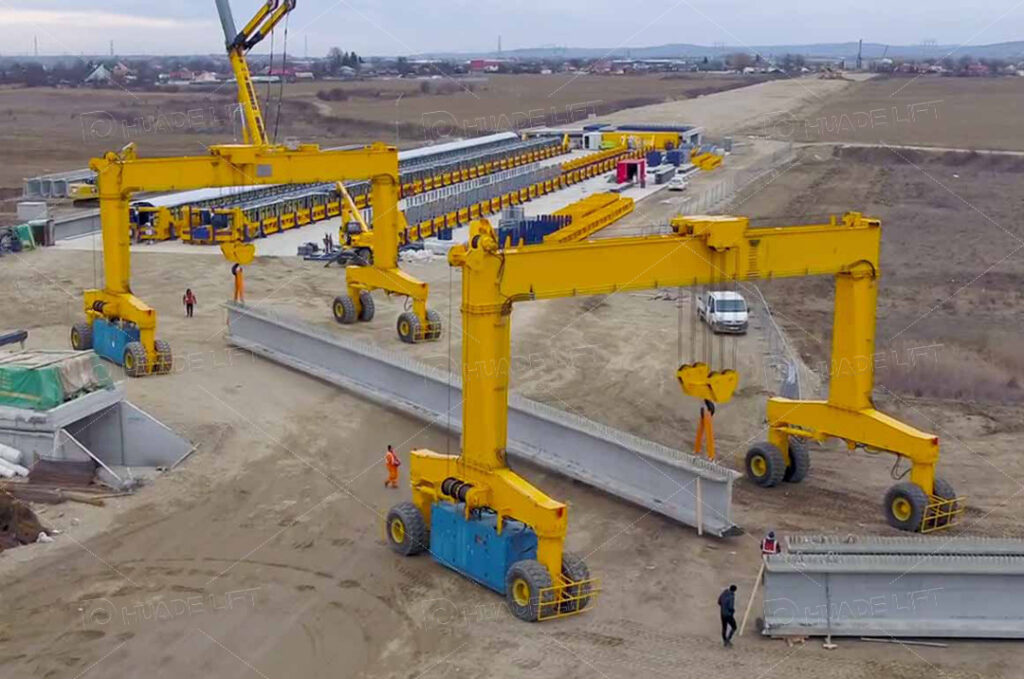
In bridge construction, the hoisting of precast beams is a core process. These beams are typically heavy and long-span, imposing special demands on the load capacity and span of rubber-tyred gantry cranes. For a river-crossing bridge project, a bridge engineering company customized two heavy-duty rubber-tyred gantry cranes. To meet the lifting requirements for 80-ton, 30-meter-long precast box girders, the equipment was engineered with a 100-ton load capacity and a 40-meter span. The main girder is constructed from high-strength Q690 steel, ensuring structural stability during lifting operations.
To accommodate the confined space of the bridge construction site, the equipment features a modular design. The main girder can be disassembled for transportation, reducing on-site assembly time to under 3 days. Additionally, a 360° steering system enables the equipment to maneuver flexibly on construction access roads as narrow as 5 meters. Furthermore, the equipment integrates intelligent weighing and anti-tipping systems that monitor lifting weight and tilt angle in real time, ensuring safe and stable precast beam hoisting. A single unit can lift three precast box girders daily, laying the foundation for project completion ahead of schedule.
Modular Construction
In modular construction, large-volume modules with uneven weights are often installed in urban centers, demanding exceptional flexibility and safety from rubber-tyred gantry cranes. A modular construction firm customized a fleet of compact rubber-tyred gantry cranes with a span of 18 meters, a lifting height of 15 meters, and a total weight under 30 tons—ideal for confined urban worksites.
To accommodate the diverse dimensions of modular units, the equipment features an adjustable frame-type lifting device. Its width and length can be flexibly adjusted according to module sizes. Multiple buffer devices are installed on the lifting device to prevent collision damage between the modular units and the lifting device during hoisting. Furthermore, the equipment utilizes a remote control operation mode. Operators can clearly observe the lifting process from the ground, working in conjunction with a precise positioning system to achieve accurate module unit alignment and installation. Lifting errors are controlled within 5 millimeters, improving operational efficiency by 30% compared to traditional cranes.
Mining and Heavy Industry
In mining and heavy industry settings, equipment must withstand harsh operating conditions such as heavy loads, dust, and vibration, imposing stringent demands on the durability and load-bearing capacity of rubber-tyred gantry cranes. To enhance ore handling efficiency, a major mining enterprise customized a fleet of heavy-duty rubber-tyred gantry cranes. Customized with a 120-ton load capacity, these cranes feature a multi-wheel travel system equipped with 16 load-bearing tires. This design distributes the weight of the equipment and cargo, enabling operation on unpaved mining terrain.
To enhance durability, the metal structure surfaces are coated with wear-resistant treatments. The hydraulic system incorporates high-precision filters, while the engine and electrical systems employ dustproof and waterproof sealing designs to effectively resist mining dust and rain erosion. Additionally, the equipment incorporates overload protection, collision avoidance systems, and intelligent monitoring devices that track operational status in real time and provide early warnings of potential failures. Field testing confirms a continuous operation failure rate below 2% in harsh mining conditions, achieving five times the durability of standard equipment and extending the service life of a single unit to over 15 years.
Advantages of Choosing a Customized Rubber Tyred Gantry Crane
Significantly Enhanced Operational Efficiency
Customized rubber-tyred gantry cranes precisely match operational workflows, eliminating efficiency losses from mismatched equipment and conditions. For instance, port-specific rapid-change attachments and anti-sway systems directly reduce lifting tool changeovers and hoisting adjustments. Precision positioning systems for new energy projects drastically lower rework costs from component installation errors, boosting efficiency at the process root.
Reduced Operational and Maintenance Costs
Adaptive design eliminates energy consumption from redundant performance. Hybrid or electric drive customization options lower fuel and electricity expenses. Modular structures and intelligent maintenance systems minimize disassembly and repair time, while wear-resistant and dustproof custom features reduce replacement frequency of vulnerable parts. These enhancements yield over 30% savings in long-term maintenance costs.
Extend Equipment Lifespan
Customized protection for harsh environments (e.g., dust-proof seals for mining, anti-corrosion treatment for coastal areas) minimizes environmental erosion of core components. Load-matched designs prevent prolonged overload operation. These tailored features extend equipment lifespan by 2-3 years compared to standard models, boosting return on investment.
Meeting Sustainability and Environmental Requirements
Custom options like electric drive and hybrid power directly reduce carbon emissions and noise pollution, aligning with global environmental policies. Some equipment can be customized with energy recovery systems that convert potential energy during lowering operations into stored electricity, further improving energy efficiency and supporting green operational goals.
How to Select Appropriate Customization Options
Assess Work Environment and Requirements
Prioritize analyzing site conditions such as ground hardness, spatial constraints, and climate factors. For example, soft ground may require wider tires or extended outriggers. Identify material characteristics including weight, dimensions, and fragility to determine load capacity and lifting gear type. Evaluate operational frequency to assess power system endurance needs—high-frequency operations may benefit from hybrid or fast-charging battery solutions.
Consider Future Scalability
Reserve lifting interface adaptability for diverse materials, such as switching between container and steel structure handling. Select control systems supporting software upgrades to accommodate future automation retrofits. Modular structural design ensures cross-project deployment, preventing equipment idleness due to operational shifts.
Consult Experts and Suppliers
Select manufacturers with cross-industry experience who can provide proven solutions tailored to actual operating conditions. Request performance data and user feedback from similar projects to validate custom solutions. Compare technical service capabilities across manufacturers to ensure reliable equipment upgrades and maintenance.
Conclusion
As industry demands become increasingly specialized, the customizable options of rubber-tyred gantry cranes (RTGs) have become a core consideration in equipment selection. From structural dimensions to power systems, and from control modes to safety features, customized designs liberate equipment from standardization constraints, precisely matching diverse requirements across ports, new energy, construction, and other scenarios.
Customized RTG cranes not only enhance operational efficiency and reduce costs but also strengthen enterprises’ competitiveness in green operations and flexible production. Companies must base their decisions on current working conditions while considering future development. Through scientific evaluation and professional consultation, they should select suitable solutions, enabling equipment to truly become the core driver of efficient business growth.
