
A Comprehensive Guide for Buyers and Users
In today’s industrial landscape, efficient and flexible material handling equipment is key to boosting production efficiency. Rubber-tired gantry cranes (RTGCs), with their unique advantages, have become the preferred choice across numerous industries. Whether in ports and terminals, logistics parks, construction sites, or factory workshops, rubber tyre gantry cranes play an irreplaceable role. For buyers and users, gaining in-depth knowledge about rubber tyre gantry crane, mastering selection techniques and maintenance methods, and familiarizing themselves with leading manufacturers and suppliers in the market are essential to ensuring efficient equipment operation and maximizing investment value.
What is a Rubber Tyre Gantry Crane
The rubber tyre gantry crane is a highly efficient and flexible material handling device that plays a pivotal role in various infrastructure projects and industrial production. Visually, it primarily consists of front and rear portal frames and a bottom beam. The entire structure rests stably on rubber pneumatic tires mounted beneath the bottom beam. Its main girders, legs, and crossbeams typically feature robust box type construction, endowing the crane with exceptional load-bearing capacity.
Configuration Types and Technical Specifications
Differences Between Single and Double Girder Gantry Cranes
Single-girder and double-girder rubber tyre gantry cranes exhibit distinct application scenarios. Single-girder cranes feature a single main girder, offering simplified structure, lighter weight, lower manufacturing costs, and easier maintenance. With smaller lifting capacities and spans, they suit light-load applications such as component handling in small factories and light cargo loading/unloading in warehouses. Double-girder cranes utilize a dual-girder box-type structure, offering superior load-bearing capacity and stability. Their advantages in lifting capacity and span make them ideal for heavy-duty operations like port container handling and heavy equipment manufacturing.
Characteristics of Rubber Tyre Gantry Cranes
The core advantage of rubber tyre gantry cranes lies in their rubber-tire travel system, enabling free movement across yards, docks, and other sites without fixed tracks. Supporting both right-angle and fixed-axis turning, they navigate confined spaces with agility, significantly enhancing site utilization. In container yards, they swiftly reposition for loading, unloading, and stacking operations. The elasticity of tires accommodates minor ground irregularities, ensuring stable operation while performing logistics tasks independently or in coordination.
Rail Free Flexibility of Mobile Gantry Systems
Mobile gantry systems leverage high-performance tires for rail-free mobility, demonstrating distinct advantages in complex environments. On construction sites, they swiftly transport building materials across variable terrain. In logistics warehouses, they dynamically adjust positions to optimize space utilization based on cargo flow demands. For temporary operations or emergency scenarios, they enable rapid deployment for material handling while maintaining a compact footprint that minimizes space consumption.
Hybrid Electric-Diesel Power Configuration
Power options are selected based on requirements: Electric models offer zero emissions and low energy consumption, ideal for environmentally sensitive areas like city centers and indoor spaces, though range depends on charging availability. Diesel models deliver strong power and convenient refueling, suitable for remote locations or extended continuous operation, but come with higher emissions and maintenance costs. Hybrid models combine both advantages, using electric mode for daily energy efficiency and switching to diesel mode for special scenarios to ensure uninterrupted operation.
Custom Solutions for Specialized Applications
Tailored rubber tyre gantry cranes precisely match unique requirements, adjusting core parameters like lifting height and load capacity as needed. For corrosive or high-temperature environments, specialized materials and protective systems are available. High-precision positioning and control systems enable micro-movement control in demanding scenarios. Customizable aesthetics and operating interfaces further enhance efficiency and reduce costs for enterprises.
Key Features and Advantages
Characteristics
Mobility and Flexibility
The most prominent feature of rubber tyre gantry cranes is their high mobility and flexibility. The rubber tire design frees them from track constraints, enabling smooth operation on concrete surfaces and slightly uneven terrain while allowing rapid switching between work areas. The tires support both right-angle and fixed-axis steering, allowing flexible navigation in densely packed cargo areas with narrow aisles. This enables precise stacking and unloading operations, adapting to diverse operational requirements.
Rapid Deployment Capability
Compared to rail-mounted cranes, rubber tyre gantry cranes offer significantly more efficient deployment. Traditional rail cranes require extensive pre-installation of tracks, consuming substantial labor and time. In contrast, rubber tyre gantry cranes can be operational after a simple on-site inspection and preparation. During emergencies, they can rapidly augment material handling capacity, minimizing the time gap between equipment arrival and operational readiness, making them an ideal solution for addressing urgent needs.
Load Adaptability
Truck cranes offer exceptional load adaptability. Their hoisting mechanisms feature speed control devices and weighing systems, enabling flexible adjustment of lifting parameters based on cargo weight to ensure stable handling. By swapping different lifting attachments, they accommodate cargo of various shapes and sizes. Their broad load capacity range meets the handling needs of diverse industries and scales, streamlining processes and reducing equipment procurement costs.
Advantages
Operability and Load Capacity
Their compact body and agile steering system enable rubber tyre gantry cranes to excel in confined spaces. Advanced control systems support precise maneuvering, enabling fine movements of lifting attachments. Their robust structure and high-performance hoisting system deliver formidable load capacity, meeting most industrial heavy duty requirements. They serve as core equipment for port container handling and lifting heavy engineering components.
Ground Friendliness and Safety
Rubber tires provide soft, elastic cushioning that distributes the machine’s weight, reducing ground pressure and preventing surface damage. Their excellent shock absorption minimizes operational vibration and noise. The truck crane incorporates multiple safety features: load limiters and height limiters prevent overloading and collisions, while obstacle detection and wind speed sensors provide real-time environmental monitoring, forming a comprehensive safety defense.
Efficiency and Cost Effectiveness
Manual mode supports precision operations, while automated mode leverages sensors and AI technology for automatic cargo lifting and stacking, enhancing efficiency and accuracy. From a cost perspective, rubber tyre gantry cranes feature low procurement and installation costs. Electric or hybrid models offer low energy consumption and simplified maintenance. Over the long term, their high efficiency operations accelerate cargo turnover, significantly reducing costs for enterprises.
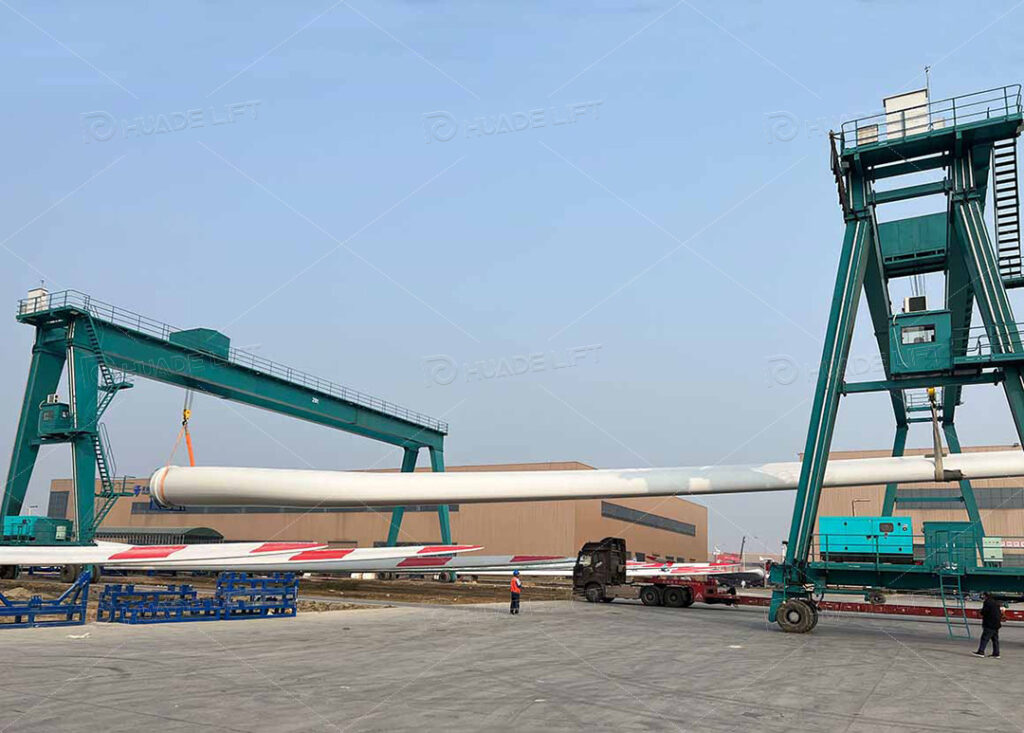
Straddle Carrier used in wind power
Application Scenarios
Transportation and Logistics Industry
In transportation and logistics, rubber tyre gantry cranes serve as core equipment at hub operations. At ports and terminals, their high load capacity and mobility enable container loading, unloading, and stacking tasks, precisely handling goods for orderly storage while collaborating with other equipment to build efficient logistics chains. Within logistics parks, they navigate diverse cargo types and complex demands, freely shuttling to complete goods intake and outbound operations, accelerating turnover and reducing operational costs.
Bridge Construction Sector
In bridge construction, rubber tyre gantry cranes play a pivotal role. During the preliminary phase, they transport large quantities of building materials from storage yards to construction sites, ensuring a steady supply of resources. During the main construction phase, leveraging their advantages in large spans and lifting heights, they precisely hoist and install large bridge components. Their rubber tire design enables stable operation on complex terrain, allowing flexible adjustment of working positions and overcoming the site limitations of traditional cranes.
Steel Manufacturing and Processing
Rubber tyre gantry cranes underpin the entire steel production process. They handle heavy duty material handling throughout operations—from loading/unloading and storage in raw material warehouses, to supplying materials in steel making shops, and transporting steel products in rolling mills. By switching specialized lifting attachments, they safely handle diverse heavy steel products. Their rapid movement within workshops minimizes material waiting times, while their design adapts to harsh environments involving high temperatures and heavy loads.
Container Handling
In container handling, rubber tyre gantry cranes reign supreme. Within container yards, they operate efficiently in confined spaces, maximizing yard utilization through high stacking capabilities. They rapidly complete container loading, unloading, and stacking, significantly boosting cargo throughput. At inland freight terminals, they enable swift container transshipment. Today, electric and hybrid models further meet green logistics demands.
Modular and Prefabricated Construction
The rise of modular construction has driven widespread adoption of rubber tyre gantry cranes. In manufacturing plants, they lift prefabricated modules from production lines to storage areas for organized storage, utilizing their powerful lifting capacity to handle large, heavy components. On construction sites, they hoist modules from transport vehicles to installation points for assembly. Their high maneuverability allows adaptation to changing site layouts, and coordinated operation with tower cranes and other equipment shortens project timelines.
Precast Concrete Sites and Wind Power Equipment
At precast concrete yards, rubber tyre gantry cranes handle the placement of large concrete components, lifting precast beams, slabs, and other elements from production lines to storage areas or transport vehicles. Their rubber tires protect yard surfaces, while shock-absorbing properties prevent component damage. In wind power applications, they lift wind turbine components onto transport vehicles at manufacturing plants and perform precise loading/unloading and assembly of towers, blades, and other parts at construction sites, supporting the wind energy industry.
Maintenance and Safety Tips
Maintenance Essentials
Regular inspections form the core of rubber tyre gantry crane maintenance. Weekly routine checks and monthly comprehensive inspections are recommended, focusing on metal structures, mechanical components, and electrical systems. For metal structures, pay special attention to load-bearing elements like main beams and outriggers, particularly stress-concentration points such as boom hinge joints. Promptly address issues like cracks or weld separation.
Mechanical component inspections require detailed scrutiny: Replace wire ropes when wire breaks exceed 10% or brake pads wear beyond one-third of their original dimensions. Verify smooth rotation of drums and pulleys, listen for abnormal noises in slewing and travel mechanisms, ensure proper reducer oil levels, and confirm wheels maintain stable contact with the ground without drifting. Electrical systems must be inspected for cable aging/damage and loose terminals. Clean oxidized contacts inside distribution boxes and ensure indicator lights and alarm devices function properly.
Regularly clean critical equipment components to prevent dust and oil residue from affecting operation and to facilitate surface defect detection. Lubrication is key to extending service life. Apply appropriate lubricants to all lubrication points according to specifications: gear oil for gear drives, grease for bearings. Avoid mixing different grades of grease. Maintain material cleanliness during refilling or oil changes. Inspect lubrication system seals to prevent leaks.
Safety Precautions
Operators must undergo professional training and hold valid certifications, demonstrating familiarity with equipment performance, operating procedures, and safety protocols. Training must cover both theory and practical application, with periodic refresher courses to reinforce safety awareness and emergency response capabilities. Safety devices serve as critical safeguards; regularly inspect the effectiveness of load limiters, height limiters, etc., to ensure power disconnection during overload conditions and lifting cessation when hooks reach extreme positions. Unauthorized modification of safety devices is strictly prohibited.
Strictly adhere to procedures during operation: Conduct a comprehensive pre-operation inspection of all equipment components, verify proper tire pressure, clear the work area, and set up warning signs. Before starting, place the control lever in neutral. Only commence operations after hydraulic pressure and temperature meet specifications. Select appropriate lifting gear and methods for hoisting. Extend outriggers to stabilize the machine. Lift steadily only after confirming secure lifting points. Overloading is strictly prohibited.
Operators must maintain focus and immediately stop the machine and report any abnormal noises, oil leaks, or other irregularities. Cease operations during inclement weather, move the equipment to a safe location, and secure it. Coordinate efficiently with signalers during operations, follow signal instructions, and wear protective gear such as hard hats and slip-resistant shoes to ensure comprehensive safety for personnel and equipment.

How to Select the Right Rubber Tyre Gantry Crane
Anchor Core Operational Requirements
Defining requirements is the foundation of selection. Accurately assess the weight range of goods, which is key to determining lifting capacity—e.g., port container handling requires load capacities from several tons to tens of tons. Consider cargo dimensions to match crane lifting height, span, and lifting gear. For high frequency operations, prioritize models with high stability to minimize downtime losses.
Matching Model Characteristics to Scenarios
Single-girder cranes feature simplified structures and lower costs, but offer limited lifting capacity and span. They suit small factories for component handling and light-load warehouse operations. Double girder cranes employ box-type structures with superior load bearing capacity and stability, excelling in heavy-load scenarios like port container handling and heavy equipment manufacturing. Avoid over-speccing or under-performance by selecting the appropriate model.
Optimal Power Source Selection
Power sources directly impact cost and environmental impact. Electric models offer zero emissions and low energy consumption, suitable for urban warehouses with convenient power access but dependent on grid supply. Diesel models deliver strong power and easy refueling, ideal for remote sites, yet feature high emissions and maintenance costs. Hybrid models provide flexible mode switching, balancing energy efficiency with operational continuity for diverse scenarios.
Evaluate Brand Reputation and Total Cost of Ownership
Prioritize reputable brands for enhanced reliability and comprehensive installation/maintenance support from suppliers. Assess credentials and market reputation. Budgets must cover procurement, operational, and maintenance costs. Select cost effective equipment—avoid inferior products to save upfront, as they may cause long-term issues.
Leading Manufacturers and Suppliers
Key Market Players
The global rubber tyre gantry crane market features numerous prominent enterprises. Konecranes, an industry leader, equips its products with advanced automated control systems supporting remote operation and intelligent monitoring, widely used in ports, logistics, and other sectors. Germany’s Liebherr Group is renowned for its precision engineering, featuring advanced hydraulic systems and power technologies. Its equipment offers strong lifting capacity and high stability, capable of withstanding harsh operating environments.
Terex Corporation (USA) offers a diverse product line featuring flexible, multi-functional rubber tyre gantry cranes. Through technological upgrades, they enhance operational convenience and precision, serving construction and logistics industries. China’s Sany Group leverages robust R&D capabilities to deliver products combining high performance, reliability, and cost-effectiveness. Their independently developed intelligent control systems enable automated operations, widely adopted in domestic ports and logistics parks. Kalmar, a Konecranes subsidiary, specializes in container handling. Its rubber tyre gantry cranes are energy-efficient, environmentally friendly, and highly productive, holding significant market share in major global ports.
Technological Advancements and Innovation
Technological innovation drives rubber tyre gantry cranes toward high end development. Automation is a core focus: laser scanning and image recognition enable automatic cargo identification, lifting, and stacking, reducing human error and fatigue. Digital technology enables remote monitoring and control. Leveraging IoT, real time equipment parameters are tracked, while big data and AI algorithms predict failures, allowing proactive maintenance to minimize downtime.
In energy innovation, electric models deliver zero emissions and low noise, paired with high efficiency batteries and fast charging technology to meet demanding operations. Hybrid models flexibly switch power modes, balancing performance and environmental requirements.
Regional Market Insights
Asia-Pacific: Rubber tyre gantry crane demand continues to grow driven by economic development and infrastructure expansion. Port upgrades in China fuel significant demand, while India and Southeast Asia show gradual increases.
Europe: Strong environmental awareness prioritizes electric or hybrid models. High demand exists for automated and intelligent equipment, with emphasis on product quality and stability.
North America: Advanced port logistics focus customer attention on equipment safety, comfort, and intelligence levels. Efficient models are preferred to reduce labor costs.
North America’s advanced port logistics concentrate demand around major hubs, where customers prioritize equipment safety, comfort, and intelligent capabilities, favoring high-efficiency models to reduce labor costs. Understanding regional characteristics enables enterprises to strategically position their offerings.
Conclusion
Rubber-tired gantry cranes are indispensable across logistics, construction, steel, and other industries due to their exceptional maneuverability, robust load capacity, outstanding safety, and efficient performance. From container handling to wind turbine assembly, they play a pivotal role in supporting high efficiency operations across sectors.
Moving forward, rubber tyre gantry cranes will continue evolving toward automation, intelligence, and sustainability to further enhance efficiency and reduce costs. Industry practitioners must scientifically select models based on operational requirements while prioritizing equipment maintenance.
