
As the “heavy-duty movers” of the industrial sector, gantry cranes have become indispensable core equipment in industries such as shipping, construction, manufacturing, and warehousing, thanks to their unique structural design and powerful functionality.
This article will start with a basic definition, break down the core components, operating mechanisms, and operational processes of gantry cranes, and then explore the characteristics and applications of different types, providing you with a comprehensive understanding of “how gantry cranes work.”
What Is a Gantry Crane?
In simple terms, a gantry crane is a heavy-duty device consisting of a horizontal beam (main beam) connecting two vertical support legs, equipped with lifting mechanisms (hoists and trolleys). Its core design philosophy is “ground-independent support + mobile operation”—it does not rely on factory buildings or other structures, but stands stably on its own support legs while using wheels or tracks to achieve large-scale mobility.
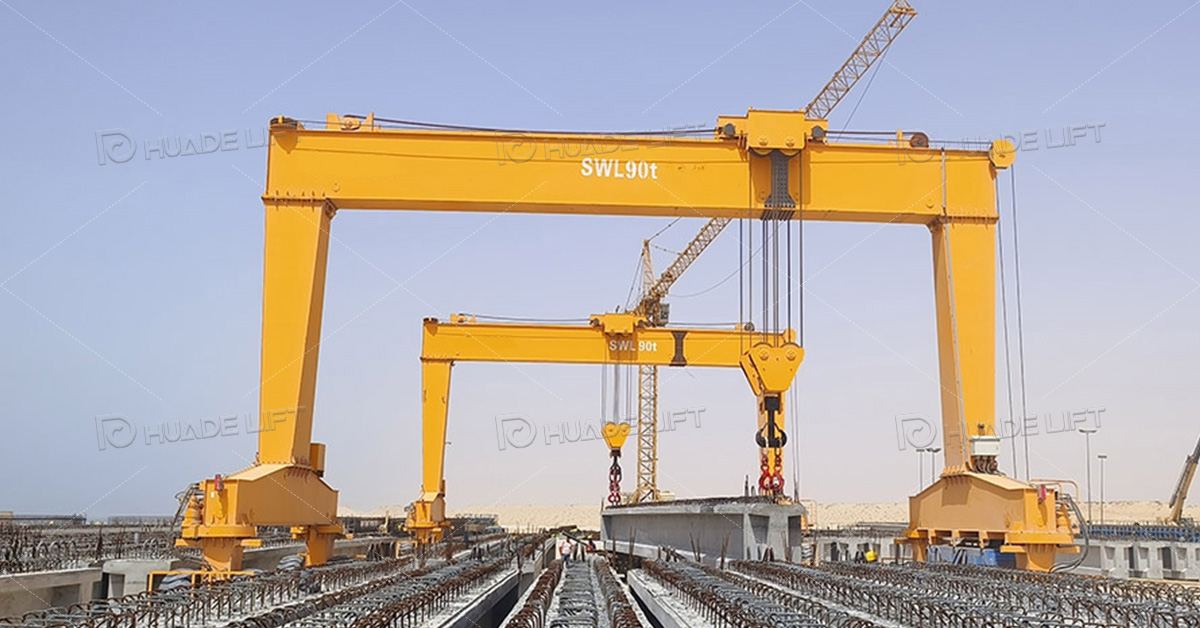
Gantry Cranes for Construction
Core Components of a Gantry Crane
To understand the working principle of a gantry crane, one must first familiarize oneself with its “body components.” These components work together seamlessly, like precision-engineered building blocks, to support the entire process of “lifting – moving – placing.”
Gantry (Main Beam)
The gantry serves as the “spine” of the gantry crane, horizontally connecting the two vertical support legs. It is the core structural component that supports the trolley, hoist, and heavy loads. It is typically made of high-strength steel and is categorized into single-beam and double-beam types based on load requirements:
Single beam: Compact structure, lightweight, suitable for medium to small tonnage (1-50 tons) operations, commonly used in workshops and warehouses;
Double beam: Composed of two parallel beams, offering greater rigidity and load-bearing capacity up to hundreds of tons, primarily used in heavy-duty applications such as ports and shipyards.
The surface of the beams is equipped with tracks for the trolley to move along its length, and undergoes anti-corrosion and wear-resistant treatment to withstand outdoor humid or dusty environments.
Hoist
The hoist serves as the “power source” of the gantry crane, responsible for vertical lifting and lowering operations, and is considered the “heart” component. It primarily consists of a motor, drum, steel wire rope (or chain), and hook:
Motor: Provides power, reduces speed and increases torque through a reducer to ensure smooth lifting;
Drum: A cylindrical component that winds the steel wire rope; the motor drives the drum to rotate, enabling the winding and unwinding of the steel wire rope;
Wire rope/chain: Connects the drum and hook, transmitting pulling force, and must have high strength (e.g., 6×37 type wire rope with a breaking load of hundreds of kilonewtons);
Hook: The component directly connected to the load, equipped with safety latches to prevent detachment, with a load-bearing capacity matched to the hoist.
Some high-end winches are also equipped with an “anti-swing device”—which uses sensors to detect load swaying and automatically adjusts motor speed to reduce swaying during lifting operations, particularly suitable for precision tasks (such as installing large equipment).
Trolley
The trolley is a “mobile platform” mounted on the crossbeam, with the winch fixed to the trolley. Its function is to move the load horizontally along the crossbeam, achieving precise horizontal positioning.
The trolley’s structure includes a chassis, wheels, a drive motor, and a reducer:
The wheels are mounted on the beam’s track and driven by the motor via the reducer, enabling forward/reverse control of movement direction;
Speed is typically adjustable (0.5–5 m/s), allowing for high-speed movement under light loads to improve efficiency and low-speed operation under heavy loads or for precise positioning;
Some trolleys are also equipped with “limit switches” that automatically slow down or stop when approaching the ends of the beam to prevent collisions.
For example, at a container terminal, the trolley must quickly move along the beam with the lifting device to transfer containers from directly below the crane to trucks or stacking positions, with errors controlled to the centimeter level.
Support Legs
Support legs are the “lower limbs” of gantry cranes, extending vertically from both ends of the crossbeam to the ground to support the entire equipment’s weight (including self-weight and lifted loads). Their design directly affects the crane’s stability, typically featuring two structures:
Gantry-type support legs: Both sides form a “door” shape with a wide bottom spacing, suitable for lifting extra-long or extra-wide cargo (such as steel or precast components);
Truss-type support legs: These use a triangular truss structure, which is lightweight and high-strength, and are commonly used in large-span applications (such as cranes with spans exceeding 30 meters).
The bottom of the support legs is equipped with a “traveling mechanism” (wheels or track components), which is the key to the gantry crane’s ability to move freely.
Wheels/Rails
The “mobility” of gantry cranes relies entirely on the wheels or rail assemblies at the bottom. Depending on the operational scenario, they are primarily divided into two categories:
Tire type: Rubber tires (such as solid tires or pneumatic tires) are installed at the bottom of the support legs, allowing free movement on flat surfaces without the need for pre-set tracks. Advantages include high flexibility, making them suitable for scenarios requiring frequent relocation, such as cargo yards or construction sites; The disadvantage is limited load capacity (typically ≤50 tons) and high requirements for ground flatness.
Rail-mounted: Steel wheels are installed at the bottom of the support legs, moving along pre-set steel tracks on the ground. The advantage is high load capacity (up to hundreds of tons) and smooth operation, suitable for fixed operational areas such as ports and railway yards; the disadvantage is high track installation costs and restricted mobility due to track limitations.
Some track-mounted cranes also install “buffers” (such as springs or hydraulic buffers) at both ends of the tracks to prevent the crane from colliding with the track ends in case of loss of control.
Electric Motors
All movements of the gantry crane (lifting, horizontal movement of the trolley, and longitudinal movement of the support legs) rely on electric motors for power. Depending on the application, different types of motors are used:
Lifting motor: Requires high torque and low speed, typically using wound-rotor asynchronous motors, which can be speed-regulated via a variable frequency drive to achieve “soft start” (preventing sudden starts from impacting the structure);
Travel motor (trolley and support legs): Requires continuous and stable operation, typically using squirrel-cage asynchronous motors, combined with a reducer to adjust speed.
Control System
The control system is the “brain” of the gantry crane, responsible for receiving operator commands and coordinating the collaborative operation of all components. Modern gantry cranes primarily employ three types of control systems:
Manual control: Operators directly control the start/stop and speed of motors via handheld button boxes or control levers in the cab, suitable for simple operations;
Remote control: Operators use wireless remote controllers (with an effective range of 50–100 meters) to operate the crane, enabling them to monitor the load’s status from the ground and enhance safety;
Automatic control: Equipped with a PLC (programmable logic controller) and sensors, the system can automatically perform lifting, moving, and placing operations after pre-programming, such as in automated container terminals at ports, where cranes can operate unmanned.
The control system also integrates a “safety protection module” that continuously monitors parameters such as voltage, current, and load weight. In case of abnormalities (e.g., overload or motor overheating), it automatically shuts down and triggers an alarm.
Core Working Mechanism – Working Principle
Lifting Mechanism
Lifting is the core function of a gantry crane, performed by a hoist, with the following specific process:
Preparation Stage: The operator controls the trolley and support legs to move the hook directly above the heavy object, ensuring the hook aligns with the object’s center of gravity;
Securing the Load: Use lifting equipment (such as steel wire ropes or slings) to connect the load to the hook, and verify that the connection is secure (e.g., that the latches are locked);
Lifting Initiation: The operator starts the lifting motor, which drives the drum to rotate via a reducer, winding the steel wire rope, and lifting the load vertically;
Process control: The motor speed is adjustable (via a variable frequency drive). When the load is off the ground, it operates at low speed (to avoid sudden forces), and can accelerate as needed during the lifting process;
Stop and hover: Upon reaching the target height, the motor stops, and the brake (such as an electromagnetic brake) immediately locks the drum to prevent the load from slipping;
Lowering Process: The motor is reversed to release the steel wire rope from the drum, allowing the load to descend slowly. As it approaches the target position, the speed is reduced to ensure smooth placement.
Trolley Operation Mechanism
After the load is lifted, the trolley must move horizontally along the beam to transport it to the target location (e.g., from above a truck to inside a warehouse). The trolley operation mechanism is as follows:
Startup preparation: Confirm that the load is off the ground (to avoid friction with the ground) and has sufficient clearance from surrounding obstacles;
Direction selection: The operator selects the trolley’s movement direction (left or right) via control buttons;
Drive operation: The motor drives the trolley wheels to roll along the beam track, with speed adjustable as needed (e.g., fast movement when unloaded, slow speed when loaded);
Positioning and stopping: When approaching the target position, the operator slows down or stops the trolley. If equipped with a “position sensor” (such as a laser rangefinder), automatic precise positioning can be achieved (error ≤ 5 cm).
Large Crane Operation Mechanism
If the target position is outside the trolley’s movement range (e.g., from work area A to work area B), the “large crane operation mechanism” using support legs is used to move the entire crane longitudinally.
The process for large crane operation is similar to that of the small crane, but with a larger travel range (up to hundreds of meters):
Path Inspection: The operator confirms that there are no obstacles (such as rocks or personnel) on the track or ground ahead. For rail-mounted cranes, the tracks must be checked for flatness;
Drive Activation: The operator selects the direction of travel, and the motors on the support legs drive the wheels (or steel wheels) to rotate, moving the entire crane;
Speed control: Adjust the speed based on distance (e.g., high speed for long-distance movement and low speed when approaching the target). The speed of track-mounted cranes typically ranges from 10 to 30 meters per minute, while tire-mounted cranes can reach up to 50 meters per minute;
Coordinated operation: If the crane has a large span (e.g., 30 meters), the motors on both sides of the support legs must operate synchronously (regulated by the control system) to prevent “drift” (the difference in movement distance between both sides must be ≤5 centimeters);
Stop Positioning: Upon reaching the target position, the motor stops, and the wheel brakes (e.g., wheel-end brakes) lock to prevent the crane from slipping (especially for track-mounted cranes, to prevent slipping due to slopes).
How to Operate a Gantry Crane?
Taking a rail mounted gantry crane (RMG) at a port container terminal as an example, let’s look at its typical workflow:
Pre-Operation Preparation
The operator arrives at the site and inspects the crane’s condition: appearance (e.g., whether the beam or support legs are deformed), critical components (e.g., whether the steel wire rope has broken strands or the brakes are responsive), and the control system (e.g., whether the buttons and display screen are functioning normally);
Power on and conduct an empty load test: perform each operation (hoisting, trolley movement, and gantry movement) once to confirm no abnormalities;
Receive the work task: e.g., “Transfer the 20 containers unloaded from the cargo ship to stacking area A.”
Step 1: Position the Crane
The operator uses the gantry movement mechanism to move the crane to the berth where the cargo ship is docked, aligning it with the position of the containers to be unloaded;
Adjust the support leg positions to ensure the crossbeam is parallel to the container arrangement direction, and the trolley movement range covers all containers to be unloaded.
Step 2: Lift the Container
The operator controls the trolley to move above the first container, lower the lifting device (specialized container lifting device that automatically aligns with the lock holes on the container top);
Lower the lifting device to the top of the container, activate the “twist lock” (the locking pin on the lifting device) to insert it into the container’s lock holes and secure it;
Activate the hoisting motor, and the lifting device slowly raises the container (pause when it is 30 centimeters off the ground to check for levelness), then continue raising it to a height of 2 meters (above surrounding obstacles).
Step 3: Transfer to the Stacking Area
Control the trolley to move along the crossbeam, transferring the container from above the cargo ship to the inner side of the crane;
Activate the main crane’s travel mechanism, moving the crane along the track to stacking area A;
Use the trolley again to position the container at the stacking location (e.g., row 3, layer 2).
Step 4: Place the Container
Start the hoisting motor in reverse, slowly lowering the container; reduce speed when approaching the lower-level container;
When the bottom of the container aligns with the lower-level container, stop lowering, release the lifting device’s twist lock, and separate it from the container;
Raise the lifting device to a safe height (1.5 meters) to prepare for the next container’s lifting operation.
Post-Operation Inspection
After completing all tasks, park the crane at the designated location and retract the lifting device below the crossbeam;
Turn off the power, inspect all components for wear (e.g., steel wires, wheels), and clear debris from the tracks;
Complete the operation record, noting any abnormalities (e.g., unusual noise from a motor during operation).
Types of Gantry Cranes
Based on structure and application, gantry cranes can be classified into various types, each with distinct operational characteristics:
Single Girder vs. Double Girder Gantry Cranes
Single girder gantry crane:
Structure: The beam consists of a single I beam or box-type beam, with the trolley running along the lower flange of the beam;
Operational characteristics: Lightweight, low cost, suitable for medium and small tonnages (1-50 tons) and spans ≤20 meters (e.g., workshops, warehouses);
Limitations: Weak torsional resistance of the beam, unsuitable for lifting eccentric loads (e.g., long steel bars).
Double girder gantry crane:
Structure: The crossbeam consists of two parallel box beams, with the trolley running between the two beams;
Operational characteristics: Strong torsional resistance, high load capacity (50-500 tons), large span (20-50 meters), suitable for heavy duty operations (e.g., shipyard lifting of ship sections);
Advantages: Can be equipped with additional auxiliary devices (such as side-shifting attachments), offering greater operational flexibility.
Rubber Tyred vs. Rail Mounted Gantry Cranes
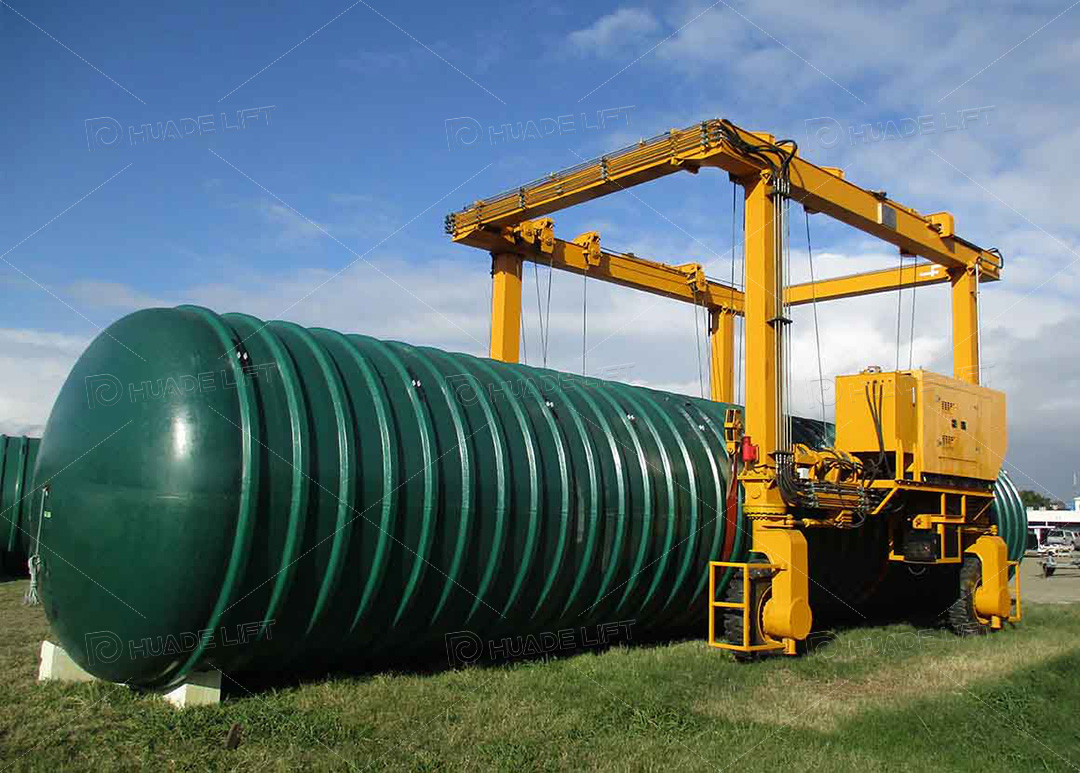
Rubber tyred gantry crane (RTG):
Mobility: Support legs are fitted with rubber tires at the bottom, powered by a diesel generator;
Operational characteristics: No tracks required, can move freely within the yard, with flexible turning capabilities (minimum turning radius approximately 5 meters);
Application scenarios: Suitable for medium to small-sized ports and container yards (under 50 tons), especially for temporary operations requiring frequent relocation.
Rail mounted gantry crane (RMG):
Mobility: Support legs run along steel tracks, powered by an overhead power grid;
Operational features: Smooth operation, high load capacity (up to hundreds of tons), suitable for fixed areas (e.g., large ports, railway yards);
Advantages: Can be operated unmanned via an automated system (e.g., remote control or pre-set paths).
Portable Gantry Crane
Structure: Compact design, with beams and support legs often removable (e.g., aluminum alloy material), lightweight (≤500 kg);
Operational characteristics: Manually or electrically driven, with a small lifting capacity (0.5–5 tons), foldable for transportation, suitable for workshops, repair stations, and similar scenarios;
Operation method: Manual joystick or small motor control, slow lifting and movement speed (≤0.5 meters/second), prioritizing portability over efficiency.
For example, a portable gantry crane used in an automotive repair workshop can easily lift an engine (2-3 tons) and move it above the repair bench without relying on large equipment.
Applications of Gantry Cranes
The flexibility and load-bearing capacity of gantry cranes make them essential equipment in multiple industries:
Construction Industry
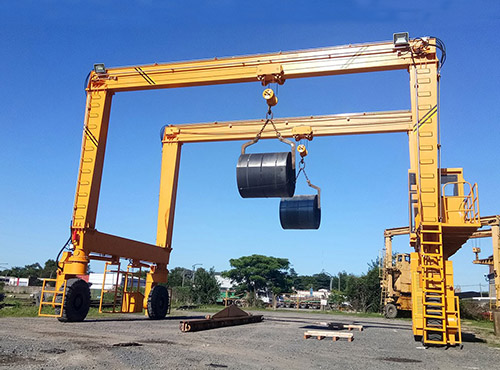
Common tire mounted or portable gantry cranes on construction sites:
Lifting objects: Steel components (such as steel beams, steel columns), precast concrete slabs, large equipment (such as tower crane sections);
Work characteristics: Can be moved with the progress of the construction site, suitable for muddy terrain (tire mounted models use off-road tires);
Case study: At a bridge construction site, a 50ton gantry crane was used to lift a 30-meter-long precast beam. By coordinating the trolley and support legs, the beam was precisely placed on the bridge pier.
Ports and Shipping
At container terminals, rail mounted gantry cranes (RMG) and rubber tyred gantry cranes (RTG) are core equipment:
Work scenario: Lifting containers from cargo ships onto trucks, or organizing containers in stacking areas.
Advantages: High efficiency (30-40 containers can be loaded/unloaded per hour), precise positioning (error ≤ 10 cm);
Special design: Equipped with a “container-specific lifting device” that can connect/disconnect from containers in 30 seconds.
Manufacturing Industry
In heavy machinery factories (such as machine tool factories and shipyards), double-girder gantry cranes are essential equipment:
Work scenarios: Moving large machine tool components (e.g., lathe beds weighing 50 tons) and lifting ship sections (weighing hundreds of tons);
Advantages: Can be integrated with workshop tracks to achieve seamless transportation from the machining area to the assembly area;
Special requirements: Some are equipped with “electromagnetic clamps” that can directly attach to steel plates (without lifting equipment), improving efficiency.
Warehousing and Logistics
In large warehouses and logistics centers, medium and small gantry cranes are used for stacking goods:
Work Scenarios: Stacking palletized goods (such as steel and chemical raw materials) to heights of 5–6 meters to save warehouse space;
Advantages: Higher load capacity than forklifts (forklifts typically ≤5 tons, while gantry cranes can reach 20 tons or more) and ability to cover larger areas;
Automation trend: Some warehouses adopt “unmanned gantry cranes,” which automatically receive tasks through the WMS system (warehouse management system) to achieve 24-hour operation.
Modern Innovations in Gantry Cranes
With the development of industrial automation, gantry cranes are upgrading from “manual operation” to “intelligent unmanned” systems:
Automated Control Systems
By pre-setting operational workflows via PLC (Programmable Logic Controller), cranes can automatically complete the entire process of “lifting – moving – placing”:
In automated terminals at ports, gantry cranes use lidar and cameras to identify container locations without human intervention;
In manufacturing workshops, gantry cranes integrate with MES systems (Manufacturing Execution Systems) to automatically transport materials according to production schedules.
Remote Monitoring and Maintenance
IoT (Internet of Things) Technology: Sensors are installed on critical components such as motors and bearings to collect real-time data on temperature, vibration, etc., and monitor equipment status via a cloud platform;
Predictive Maintenance: The system analyzes data trends to provide early warnings of potential failures (e.g., motor bearing wear), preventing unexpected downtime;
Remote Diagnosis: Manufacturer engineers can access the crane control system via the network to troubleshoot issues, reducing on-site maintenance time.
Conclusion
Understanding the working principles and mechanisms of gantry cranes not only helps us select and use equipment more effectively but also provides insight into the technological logic behind “heavy-duty material handling” in modern industry.
If you need to select a gantry crane for a specific application, it is recommended to consider factors such as load weight, operational range, and ground conditions, and consult professional manufacturers (such as those offering customized designs) to obtain the most suitable solution. Feel free to contact Huadelift at any time!
