
In core industrial settings such as road and bridge construction sites, precast component factories, and heavy machinery plants, the rubber tyred gantry crane has become indispensable heavy equipment due to its flexible mobility and efficient loading/unloading capabilities. Drawing on industry practical experience, this article comprehensively analyzes the full rubber tyred gantry crane installation cycle and optimization strategies across dimensions such as equipment types, core installation elements, and influencing factors.
Type and Design of the Rubber Tyred Gantry Crane
Installation efficiency is directly tied to the equipment type and structural design. Significant variations exist across models in component disassembly, weight distribution, and assembly complexity, all impacting labor hours. Currently, mainstream rubber tyred gantry cranes fall into five primary categories, each with distinct structural and installation characteristics:
- Single girder Rubber tyred Gantry Crane: Features a single main girder as the core load-bearing structure with rubber tires at the base of the outriggers. Compared to double girder models, it is more compact, requiring lower weight and power, making it a “lightweight” solution. Its core components are smaller and lighter, simplifying on-site lifting and assembly. Foundation preparation is straightforward, making it one of the fastest to install.
- Double girder A-frame tyred gantry crane: Two parallel main girders bear the load, supported by A-frame legs. This design ensures even load distribution, superior balance, and stability, with lifting capacities reaching 50-65 tons. However, the main girder components are heavy and bulky, requiring large-tonnage auxiliary cranes for handling. Additionally, the connection between the main girders and A-frame demands high precision, resulting in longer assembly times.
- Double girder U-frame tyred gantry crane: The U-shaped legs create an open space beneath, providing ample clearance under the main girders to accommodate tall components like precast box girders. Widely used in road/bridge construction sites and precast plants. However, the U-legs involve intricate disassembly, requiring multiple steps for on-site assembly, positioning, and calibration, demanding high technical proficiency from the installation team.
- Tyre mounted transport vehicle:Its integrated frame enables cross-transport of cargo, while rubber tires provide high maneuverability. With high integration and extensive factory pre-assembly, on-site installation primarily involves hydraulic system debugging and travel mechanism calibration, resulting in short cycles. Suitable for short-distance transfers within precast plants. Due to bearing heavy precast components, strict load testing is required post-installation.
- Boat Lift:The U-shaped frame spans large components, while tires ensure stable and flexible movement across complex site terrains. Installation typically occurs in challenging outdoor environments requiring temporary work platforms. Foundation reinforcement and positioning are time-consuming, with additional considerations for rain and dust protection.
Understanding Rubber Tyred Gantry Crane Installation
As practitioners deeply rooted in the rubber tyred gantry crane field, we frequently clarify a common misconception for clients: rubber tyred gantry crane installation is not merely assembling components,but a systematic engineering process encompassing foundation preparation, structural assembly, system commissioning, and safety acceptance. Before understanding installation timelines, it is essential to grasp the core logic of rubber tyred gantry crane installation.
Rubber tyred gantry cranes are rubber tired gantry cranes primarily used for stacking, loading/unloading, and short-distance transport of precast components. Installation quality directly determines operational safety and work efficiency. Unlike rail mounted gantry cranes, rubber tyred gantry cranes do not require fixed tracks. However, this does not imply lower installation thresholds—quite the contrary. Their mobile nature imposes stricter demands on site ground bearing capacity and travel mechanism calibration.
The fundamental answer regarding installation duration is: For standard-configuration rubber tyred gantry cranes under typical site conditions, the complete installation cycle typically spans several weeks. This period encompasses the entire process from site surveys and foundation construction to final acceptance and handover. However, customized equipment, complex site environments, or projects requiring cross-departmental coordination can significantly extend this timeline. Next, we will break down the key variables influencing this cycle in detail.
Key Factors Influencing Installation Time
The installation timeline for rubber tyred gantry crane operates like a domino effect—any variable in one stage can trigger fluctuations throughout the entire process. Drawing from extensive project data, we have identified key influencing factors that procurement teams should prioritize during project planning:
Crane Specifications and Load Capacity
Rubber tyred gantry crane cranes exhibit significant specification variations, with broad ranges in load capacity and span. Certain customized units feature particularly large dimensions. Larger cranes feature heavier and bulkier core components (e.g., main girders, outriggers, hoisting mechanisms). For instance, the main girder of a heavy-duty double-girder rubber tyred gantry crane weighs significantly more than that of a light-duty single-girder model. Transporting these heavy components requires higher tonnage auxiliary lifting equipment, along with stricter balance control and positioning accuracy during hoisting. The time difference for lifting the main girder alone can be substantial. Simultaneously, large-span equipment demands stringent structural alignment precision, with deviations constrained within minimal tolerances, consequently increasing calibration time.
Component Delivery and Pre-assembly Level
Rubber tyred gantry cranes are typically transported as disassembled components, with core parts including the main girder, trolley, hoisting mechanism, lifting gear, tire sets, and electrical systems. The degree of pre-assembly is a critical variable affecting the on-site installation timeline: if the manufacturer completes girder welding, electrical pre-wiring, and hoisting mechanism debugging at the factory, the site only requires component hoisting, connection, and final calibration, significantly shortening the cycle. Conversely, if components are delivered as loose parts, the site must perform foundational tasks like girder welding and electrical wiring, substantially increasing the time required. Furthermore, timely component delivery is critical—delays in core components directly cause on-site “work stoppages awaiting materials,” a primary cause of project schedule delays.
Site Conditions and Accessibility
The installation site serves as the rubber tyred gantry crane’s final habitat, where conditions directly dictate construction efficiency. First, ground conditions: If road and bridge construction sites or precast plants feature muddy, pitted surfaces or insufficient bearing capacity, ground leveling, compaction, or pouring temporary concrete pads becomes necessary—a process consuming considerable time. Second, infrastructure: Does the site provide adequate hoisting clearance, temporary power connections, and transport routes? Narrow passages or obstructions like piled construction materials will slow down the transportation and hoisting of large components, potentially requiring obstacle removal and adding extra labor hours. Finally, environmental constraints: Some sites near residential areas enforce nighttime construction bans or noise control requirements, reducing effective working hours and indirectly extending the project timeline.
Foundation and Power Supply
Although rubber tyred gantry cranes do not require tracks, they still necessitate specific foundation support. Reinforced concrete foundation pads must be poured in the operational area to bear the concentrated pressure when the crane is fully loaded, preventing settlement or tilting during equipment operation. The time required for foundation engineering primarily depends on the concrete curing cycle. Standard concrete pads require a certain period to achieve design strength. Using early strength concrete can shorten the curing time, but the cost will increase accordingly. Additionally, power supply system deployment is critical: rubber tyred gantry crane motors and control systems require stable electricity. This necessitates laying dedicated cable trenches, installing distribution boxes, and grounding systems on-site—a process that also demands construction time. Complex electrical integration further extends this phase.
Team Experience and Technical Capability
People are the core factor determining installation efficiency. A professional team led by factory-trained engineers, familiar with the assembly logic of different rubber tyred gantry crane types, can swiftly resolve common issues like hoisting positioning deviations and electrical wiring faults. Their installation efficiency under identical conditions far exceeds that of ordinary teams. Conversely, inexperienced teams may encounter “incorrect assembly requiring disassembly and modification” due to unfamiliarity with assembly sequences, with a single mistake potentially causing significant delays. Additionally, team composition is critical, a complete rubber tyred gantry crane installation crew requires multiple trades including riggers, fitters, electricians, and welders. Incomplete staffing disrupts workflow transitions and impacts overall progress.

rubber gantry cranes operate in tandem to hoist a long precast bridge beam at the beam yard.
Step-by-Step Installation Process
Rubber tyred gantry crane installation is an interlocking systematic process with specific technical requirements at each stage. Below is a detailed breakdown based on industry standard procedures to help you precisely manage project timelines:
Site Survey and Preparation
This foundational phase before installation requires significant time. Core tasks include: ① Surveying terrain, ground bearing capacity, and spatial dimensions to confirm crane placement and travel routes; ② Clearing obstacles, leveling ground, and planning component storage areas and lifting radii; ③ Confirming foundation construction standards and power supply interface locations with contractors or manufacturers. Oversights here may necessitate rework later, demanding meticulous attention.
Foundation and Surface Construction
Concrete foundation pads and reinforced work surfaces are poured based on survey results, requiring a specific curing period. During construction, strictly control foundation flatness and load-bearing capacity while reserving cable trenches and drainage channels to prevent rainwater immersion affecting construction. For sites with poor ground conditions, lay a gravel base layer before pouring concrete, which will add extra time.
Transportation and Logistics
Core components are transported to the site via heavy-duty trucks, with transit time depending on distance and road conditions. Prior coordination with local traffic authorities is required to obtain oversize transport permits. Upon arrival, components must be stacked in assembly sequence to minimize rehandling—large elements like main beams and legs should be placed directly within the crane’s lifting radius to reduce hoisting distances. For imported equipment, customs clearance time must be factored in, potentially adding extra duration.
Main Structure Assembly
This constitutes the installation’s core phase and requires significant time. The process involves: ① Using auxiliary cranes to lift and secure the outriggers onto foundation pads; ② Hoisting the main beams, precisely aligning them with the outriggers and tightening connecting bolts; ③ Installing the travel carriages and tire assemblies, adjusting the parallelism of the travel mechanisms; ④ Hoisting the hoisting mechanism and lifting gear to complete the main structure assembly. For standard rubber tyred gantry cranes, thorough pre-assembly of components and an experienced team can shorten assembly time; however, significantly more time is required for large-tonnage custom models.
Mechanical and Electrical Installation
Following completion of the main structure, installation and commissioning of mechanical and electrical systems proceed, requiring considerable time. Mechanical aspects: Install hoist motors, brakes, trolley drive systems, and hydraulic components; commission operational flexibility of all mechanisms. Electrical Aspects: Connect main cables, install control systems (typically PLC-based intelligent controls), deploy lighting and safety devices (e.g., limit switches, emergency stop buttons), and perform electrical circuit continuity testing. Additional time is required if the equipment incorporates automation features (e.g., automatic positioning, anti-sway systems).
Calibration and Load Testing
This constitutes the “critical acceptance phase” ensuring safe equipment operation and requires considerable time. Core tasks include: ① Calibrating the parallelism and span of the travel wheels to ensure smooth movement; ② Conducting no-load tests to verify the operating speed and braking performance of each mechanism; ③ Performing full-load tests using standard weights (or equivalent heavy prefabricated components) to validate the lifting mechanism’s load-bearing capacity and test the reliability of limit switches and safety interlocks. Certain items require third-party inspection agency participation in acceptance, necessitating advance scheduling.
Training and Handover
Following installation, specialized training is provided to operators covering equipment operation procedures, emergency fault handling, and key maintenance points. Upon completion, both parties sign acceptance documents to finalize equipment handover. Though brief, this phase directly impacts subsequent operational efficiency at the precast plant or construction site, requiring operators to master core skills.
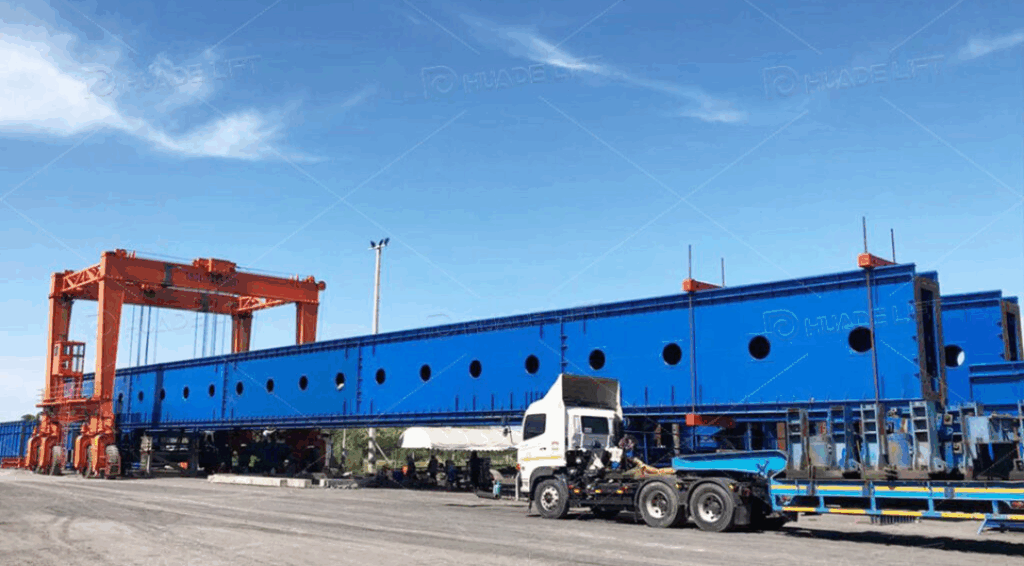
A double girder rubber tyred gantry crane lifts a long steel structure at the fabrication yard.
Typical Installation Timeline
Considering the aforementioned factors and steps, we have compiled reference installation cycles for rubber tyred gantry cranes in various scenarios. Purchasers may select the applicable timeline based on their specific circumstances.
The actual installation time can vary significantly depending on the crane’s capacity, span, lifting height, structural configuration, and power system.
For example:
-
Small-capacity, full-electric RTG cranes
Typically require around 20 days for complete installation, thanks to simpler power integration and a more compact structure. -
Large-capacity units—especially those with wide spans, high lifting heights, or complex steel structures—
Often need 30–45 days, as the structural assembly, alignment, electrical integration, and safety testing involve more intensive work.
Additional time may be needed if the project involves special foundation preparation, on-site modifications, or customized control system commissioning.
Tips to Shorten Installation Time
For purchasers prioritizing rapid project commissioning, multiple techniques can optimize the installation process to reduce cycle times while maintaining quality:
Advance Planning and Concurrent Foundation Work
After signing the crane procurement contract, immediately initiate site surveys and foundation construction at the worksite or factory premises—no need to wait for equipment delivery. Foundation work can proceed concurrently with equipment manufacturing and transportation, significantly saving time. For customized equipment, confirm specific foundation parameters (e.g., foundation pad dimensions, bolt hole locations) with the manufacturer to ensure precise alignment between the foundation and equipment, preventing delays in subsequent precast component hoisting operations.
Require Manufacturers to Increase Pre-assembly Levels
- Standard Scenario: For standard rubber tyred gantry cranes commonly used in precast component handling, high factory pre-assembly rates, leveled site/factory ground with adequate bearing capacity, and professional construction teams result in shorter cycles.
Specify in the procurement contract that the manufacturer completes main girder assembly, electrical system pre-wiring, and hoisting mechanism debugging at the factory, shipping only major subassemblies like “main girder-outriggers-carriage” in disassembled form. This approach significantly reduces on-site assembly time while mitigating quality risks associated with field welding and wiring.
- Complex Scenario: Custom rubber tyred gantry cranes for heavy steel component lifting, delivered as loose parts. Site requires foundation reinforcement and material clearance, with construction constrained by environmental factors (e.g., nighttime work restrictions)—longer cycle;
Select Experienced Construction Teams and Clearly Define Responsibilities.
- Urgent Scenarios: Lightweight rubber tyred gantry cranes for small prefabricated component transfers, utilizing early-strength concrete foundations, continuous construction, and on-site manufacturer technical support—significantly compresses the timeline (subject to additional rush fees).
Prioritize teams with extensive rubber tyred gantry crane installation experience and proven track records on similar equipment. Ideally, require teams to include manufacturer-certified engineers. Simultaneously, clearly define milestones and delay liabilities in the construction contract to incentivize teams to enhance construction efficiency.
Optimize On-site Logistics and Component Storage
Pre-plan component transportation routes and arrival schedules to avoid peak construction periods, ensuring components are “installed as soon as they arrive.” Upon arrival, stack components according to the “lifting sequence.” Place large components like main beams and outriggers directly within the crane’s lifting radius. Store small accessories centrally in nearby temporary warehouses to avoid time-consuming secondary handling. Pay particular attention to coordination with other construction activities on-site.
Adopt Modular Power Supply and Foundation Solutions
Replace on-site concrete pouring with “precast concrete modules” for foundation work, requiring only on-site assembly and fixation. This significantly reduces curing time, making it ideal for time-sensitive road and bridge projects. For power systems, utilize “prefabricated cable boxes” that connect directly to the main power source on-site. This minimizes cable trench excavation and wiring time while reducing disruption to ongoing construction activities.
Coordinate Third-Party Inspections and Training in Advance
Schedule third-party inspection agencies well before installation completion to avoid delays post-installation. Simultaneously, organize on-site or factory personnel to participate in manufacturer-led online training to familiarize them with basic equipment operation. This enables hands-on training immediately after on-site installation, shortening the delivery cycle and accelerating the equipment’s deployment for precast component lifting operations.
Conclusion
The installation timeline for rubber tyred gantry cranes is not fixed. Variations ranging from weeks to months fundamentally reflect the interplay of equipment characteristics, site/facility conditions, and construction management.
Shortening the installation cycle must be achieved while ensuring quality. Never compromise on critical steps such as foundational calibration and load testing in pursuit of speed. After all, as industrial heavy equipment, the operational safety of RTG cranes directly impacts the security of site personnel and precast components. Only by balancing efficiency with safety can a project truly maximize its value. For customized installation plans tailored to specific equipment models and site/facility conditions, consult our industry-leading professionals anytime to receive precise cycle assessments and technical support.
