
In the field of infrastructure construction, bridge engineering has always been renowned for its high technical complexity and demanding construction conditions. From river and ocean-spanning bridges to urban elevated hubs, the core challenges faced by engineering teams share significant commonalities: First, the trend toward heavier prefabricated components is pronounced. Whether it’s large-span concrete box girders or steel main trusses, individual weights frequently exceed heavy-duty levels, making traditional lifting equipment inefficient for handling such loads. Second, construction sites are subject to significant constraints. Bridge projects often involve water bodies, existing transportation arteries, or densely populated urban areas, frequently encountering fragmented workspaces and uneven ground bearing capacities. Third, project timelines face intensifying pressure. Against the backdrop of accelerated “new infrastructure” development, owners’ demands for shorter construction periods are continuously tightening, exposing the inefficiency of traditional construction workflows.
Functional Expansion in Modern Construction
In contemporary construction scenarios, mobile cranes deliver core value by overcoming the site constraints of fixed lifting equipment. Traditional gantry cranes rely on rail tracks or concrete foundations for operation, severely limiting their working range. Their high upfront infrastructure costs and lengthy construction cycles make them ill-suited for bridge projects requiring “multi-point operations and dynamic relocation.” In contrast, rubber tyred gantry cranes combine rubber tires with hydraulic suspension systems, enabling them to traverse unprepared surfaces. They maintain stable operation even on undulating terrain with moderate slopes or temporarily compacted gravel surfaces. Furthermore, modern rubber tyred gantry cranes are commonly equipped with “four-wheel steering” and “crab mode,” enabling complex maneuvers like lateral movement and on-the-spot rotation. This allows precise positioning adjustments within the confined spaces of bridge construction sites, significantly enhancing operational flexibility.
Core Advantages of RTG Cranes in Bridge Construction
Site Adaptability and Operational Flexibility
The complexity of bridge construction sites is a key factor limiting hoisting efficiency. Whether at riverside work zones for cross-river bridges or alongside existing roads for urban overpasses, sites often present challenges of “limited space, complex terrain, and numerous obstacles.” The rubber tyred gantry crane’s advantage in such scenarios lies primarily in its low site dependency—requiring no rail laying or concrete foundations. Simple site leveling and compaction suffice for immediate deployment, drastically reducing preliminary preparation time.
Moreover, their adaptability to challenging terrains is unmatched. During mountainous bridge construction, some work zones feature slopes or irregular undulations. While traditional crawler cranes can traverse complex terrain, they suffer from large turning radii and cause severe ground compaction damage. Truck cranes, however, utilize hydraulic suspension systems to dynamically adjust ground pressure per tire. This capability maintains chassis leveling even on inclined slopes, preventing component tilting during lifting operations. Furthermore, their rubber tires exert significantly lower ground pressure than tracked equipment, effectively preserving temporary construction roads and vegetation while minimizing environmental impact—aligning with modern green construction principles.
Enhanced Heavy-Load Capability
Lifting bridge components demands not only sufficient load-bearing capacity but also millimeter-level positioning accuracy. The alignment error of steel box girders must be strictly controlled to prevent compromising the bridge’s overall structural integrity. Similarly, installing bearings for precast concrete beams requires precise alignment between the beam centerline and pier axis to avoid stress concentration issues later.
In terms of load capacity, modern large-scale rubber tyred gantry cranes can meet the heavy-load demands of bridge construction. Commonly used in bridge projects, these cranes feature box-section gantry structures with main truss materials made of high-strength steel, minimizing structural deformation under heavy loads. Additionally, their dual-trolley design enables “two-point lifting,” preventing bending deformation in long components caused by single-point loading during hoisting. For offshore bridge projects involving large steel box girders, multiple rubber tyred gantry cranes can perform “lifting and carrying” operations. Synchronized control systems ensure even load distribution, maintaining structural stability during hoisting and enabling precise placement on designated bearings—preventing structural deformation or positional deviation throughout the process.
Schedule Assurance
The time pressure in bridge construction projects impacts not only engineering costs but also social factors like traffic diversion and public welfare needs. The role of rubber tyred gantry cranes in shortening project schedules manifests primarily in two dimensions: “enhanced operational efficiency” and “reduced downtime.”
Regarding operational efficiency, the rubber tyred gantry crane’s “multi-task parallel processing” capability is particularly crucial. Traditional lifting equipment typically requires coordination with auxiliary machinery—transporting precast beams necessitates trailers, while adjusting lifting positions demands loaders. In contrast, rubber tyred gantry cranes leverage their mobility to directly lift components from storage areas and autonomously travel to installation points without requiring intermediate equipment transfers.
Simultaneously, the high reliability of tire-mounted cranes significantly reduces downtime. Bridge construction often involves outdoor operations heavily influenced by weather and equipment failures. Traditional cranes feature complex mechanical structures, with their travel systems prone to malfunction in muddy or damp conditions, requiring lengthy maintenance cycles. In contrast, tire-mounted cranes employ sealed hydraulic drive systems for their travel mechanisms, offering strong environmental adaptability. They maintain stable operation even in rainy conditions or dusty sites.
Optimized Control of Full Lifecycle Costs
Cost control in bridge construction must encompass not only equipment purchase or rental expenses but also the full lifecycle costs, including preliminary infrastructure development, mid-term operation and maintenance, and post-project equipment relocation. The cost-efficiency advantages of tire-mounted cranes manifest through synergistic optimization across multiple stages.
Significantly reduced upfront investment costs. Traditional gantry cranes require rail laying and concrete foundations, where infrastructure costs constitute a high proportion. Moreover, these foundations are difficult to reuse after project completion, leading to resource wastage. In contrast, rubber tyred gantry cranes require no special foundations, incurring only the equipment’s rental or purchase costs, substantially lowering initial investment expenses. In an industrial park overpass project, the high foundation costs of traditional gantry cranes were replaced by rubber tyred gantry cranes, which required only minimal site preparation expenses, directly saving substantial upfront costs.
Equipment versatility reduces mid-term operational costs. Bridge construction involves diverse lifting requirements. Using specialized equipment necessitates renting multiple crane types, incurring high rental fees and requiring separate operation and maintenance teams. In contrast, rubber tyred gantry cranes can handle the lifting of diverse components—such as precast beams, steel structures, and cap beams—by adjusting span, counterweights, and lifting attachments, achieving “one machine for the entire process.” For large-scale bridge projects, deploying rubber tyred gantry cranes substantially reduces the variety of equipment required, significantly lowers the number of operators and maintenance expenses, and effectively controls mid-term operational costs.
Upgrade of Safety Protection Systems
The high-risk nature of bridge hoisting operations demands utmost priority in project management. During large-component lifting, equipment instability, load drops, or component collisions can not only damage machinery but also cause personnel injuries and project delays. Mobile cranes significantly enhance operational safety through multi-layered protective designs.
Load monitoring systems enable “real-time alerts.” Modern rubber tyred gantry cranes equip their main hoisting mechanisms with tension sensors that continuously monitor current lifting loads and compare them against the equipment’s rated capacity. When loads approach the upper limit of the rated capacity, the system triggers audible and visual warnings. Should loads exceed the rated capacity, the hoisting action is automatically cut off to prevent structural damage caused by overloading. Additionally, some high-end models incorporate “load imbalance monitoring,” continuously detecting load distribution across both ends of the lifting device. When significant load discrepancies occur, the system automatically adjusts hoisting speed to prevent device tilting or component slippage due to imbalance. During steel box girder lifting projects, if load abnormalities arise from component center-of-gravity shifts, the system immediately triggers protective mechanisms to halt hoisting operations, averting accidents.
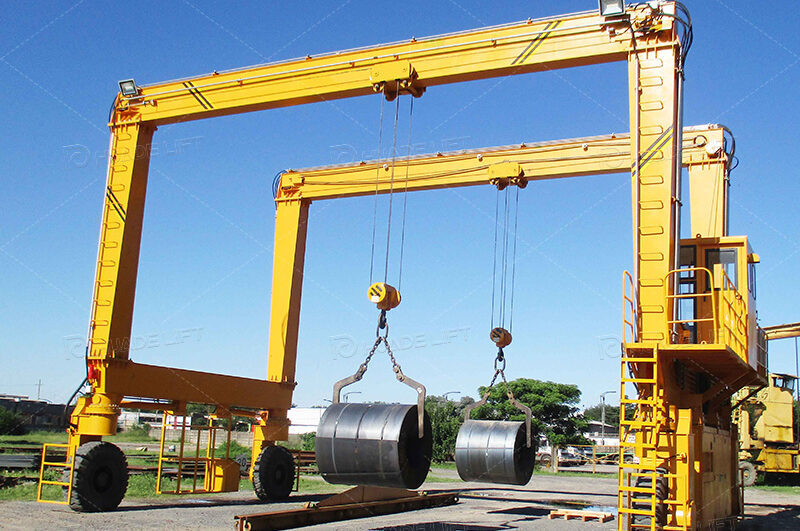
Application in Bridge Construction
Precast Components
Precast construction represents the mainstream trend in modern bridge engineering, centered on reducing on-site labor and enhancing quality through factory-prefabricated components assembled at the construction site. The application of tire-mounted cranes in precast component lifting has completely resolved the challenges of “heavy precast components, high assembly precision requirements, and dispersed work points.”
The advantages of tire-mounted cranes are particularly evident in lifting precast concrete beams. In highway bridge projects, traditional construction methods rely on coordinating truck cranes with gantry cranes, requiring temporary lifting points beside each pier and multiple machines to coordinate each beam lift—a cumbersome process. With the introduction of rubber tyred gantry cranes, a “flow operation” model is adopted: one rubber tyred gantry crane retrieves beams from the precast beam storage area and transports them autonomously to the lifting point; while another rubber tyred gantry crane precisely positions the beam onto the bearing at the installation point. After completion, it immediately moves to the next pier. This process requires no additional equipment, ensuring high operational continuity. It significantly reduces single-beam installation time while controlling both axial deviation and elevation deviation within specification limits, markedly improving project quality.
Large Steel Structures
Large steel structures in bridge construction (e.g., steel box girders, steel truss girders) feature substantial weight, large dimensions, and stringent docking precision requirements, making traditional lifting equipment inadequate. Rubber-tired cranes, with their heavy-load capacity and precise control, emerge as the ideal choice for lifting such structures.
In steel box girder lifting operations, the crane’s “lifting and carrying” mode plays a crucial role. Steel box girders for cross-sea bridges or large-span urban bridges are typically massive and heavy, making single-unit lifting impractical. In such cases, multiple rubber tyred gantry cranes can perform “lifting in tandem,” using synchronized control systems to coordinate movements. This ensures the steel box girder remains level during lifting, preventing structural deformation caused by uneven forces. In a cross-sea bridge project, two rubber tyred gantry cranes were employed for the “lifting and carrying” of a large steel box girder. Real-time load monitoring and synchronized control ensured the girder remained stable throughout the lift, achieving precise alignment at the designated position with minimal positioning error. This met the structural load requirements of the bridge.
Cross-Industry Expansion
While tire-mounted cranes primarily serve bridge construction, their dual characteristics of “heavy-load capacity + flexibility” have extended their application to new energy sectors like wind power, establishing them as cross-industry “multi-functional lifting equipment.” Components like wind turbine towers and blades in wind power projects share characteristics with bridge construction requirements: heavy weight, high installation heights, and remote work sites.
In tower hoisting, tire-mounted cranes excel in site adaptability. Wind farms are often located in mountainous regions, grasslands, or coastal areas, where work sites are typically temporary, leveled ground with limited bearing capacity. While traditional crawler cranes can handle complex terrain, they exert high ground pressure and are prone to sinking in soft ground. In contrast, rubber tyred gantry cranes adjust ground pressure through hydraulic suspension systems, enabling stable operation on soft surfaces while preventing ground subsidence. At a grassland wind farm project, rubber tyred gantry cranes were used to hoist wind turbine towers without requiring special ground reinforcement. Simple site leveling sufficed for immediate operation, significantly reducing preliminary site preparation costs.
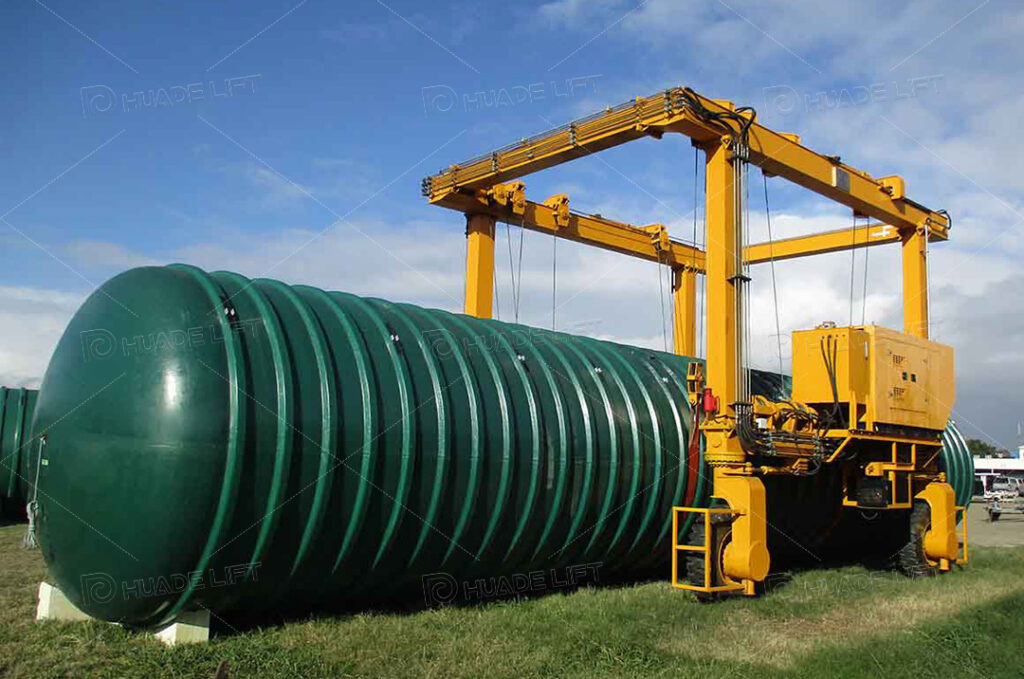
Comparative Analysis
Rubber Tyred Gantry Cranes vs. Container Straddle Carriers
Container straddle carriers are designed for “efficient transport” rather than “precise lifting.” Their hoisting mechanisms only perform basic lifting actions, lacking anti-sway and precise positioning capabilities. This makes them unsuitable for meeting the millimeter-level installation accuracy required for bridge components. In contrast, rubber tyred gantry cranes utilize specialized lifting systems and precision control systems to achieve stable lifting and accurate alignment of heavy components, fully meeting the technical demands of bridge construction.
In short, container straddle carriers are “specialized container handling tools,” while rubber tyred gantry cranes are “multi-functional heavy-duty lifting equipment.” The latter’s professionalism and adaptability in bridge construction cannot be replaced by the former.
Mobile Crane vs. Traditional Gantry Crane
Traditional gantry cranes require rail tracks and concrete foundations for operation. Their preliminary infrastructure demands high costs, lengthy construction cycles, and permanently occupies site resources.
Cost-wise, foundation construction for traditional gantry cranes accounts for a significant portion of total investment, and the foundations cannot be reused after project completion, resulting in resource wastage. In contrast, rubber tyred gantry cranes require no foundation investment, facilitate easy relocation, and offer high equipment reuse rates, leading to significantly lower lifecycle costs than traditional gantry cranes. Consequently, rubber tyred gantry cranes have progressively replaced traditional gantry cranes as the mainstream lifting equipment in modern bridge construction.
Conclusion
The development trends in bridge construction indicate that prefabrication, large-scale components, and green practices have become industry standards. Prefabricated components will increase in weight and size, demanding greater precision in lifting operations.
For bridge construction enterprises, selecting tire-mounted cranes represents not only an optimization of equipment selection but also an upgrade in construction philosophy. This choice translates to shorter project timelines, lower costs, enhanced safety, and superior environmental performance, empowering companies to gain a competitive edge in the market.
Against the backdrop of accelerated infrastructure development, tire-mounted cranes are poised to play a pivotal role in more major bridge projects, emerging as indispensable “transformative equipment” in the field of bridge construction.
