
Rubber tyre gantry crane (rubber tyre gantry cranes) serve as core equipment in steel, wind power, and concrete product industries. Through their gantry structure and agile mobility, they enable efficient lifting, transfer, and stacking of containers, with their operational efficiency directly determining the throughput capacity of logistics hubs. Behind each precise and stable heavy-load lift lies not merely power output, but the systematic integration of multidisciplinary engineering principles—structural mechanics, hydraulic technology, and electrical control systems. It is precisely these meticulous designs and technological innovations that form the foundation of the rubber tyre gantry crane’s exceptional performance.
Core Design Philosophy of Rubber Tyre Gantry Cranes
Mobility
Compared to the fixed operational paths of rail-mounted cranes, the use of rubber tires completely eliminates site restrictions. Equipped with high-strength engineered rubber tire assemblies, rubber tyre gantry cranes achieve flexible movement across entire yard areas without requiring dedicated tracks. They adapt stably to both leveled concrete surfaces and temporarily prepared gravel sites. This capability not only reduces site infrastructure costs but also enables rapid relocation based on operational needs, supporting multi-area rotation workflows and significantly enhancing yard space utilization.
Modular Steel Frame Design
The entire machine adopts a modular steel frame structure, where core components like the mast, main beam, and outriggers are produced as standardized units. This design allows for disassembly during transportation, solving the challenge of moving large structural parts. On-site assembly requires only precise alignment of bolt holes for connection, shortening the installation cycle. More importantly, the modular structure employs stress-distribution design to evenly transfer localized forces across the entire frame. Combined with high-strength alloy steel materials, this enhances structural strength compared to traditional monolithic frames while facilitating maintenance and replacement of individual components, thereby reducing operational costs.
Power System
The selection of the power system directly determines the equipment’s environmental performance and adaptability. The fully electric-powered rubber tyre gantry crane relies on grid power supply, achieving zero tailpipe emissions during operation with low noise levels. Its energy consumption cost per standard container is only a fraction of traditional equipment, making it particularly suitable for inland yards and ports near urban areas with stringent environmental requirements. Diesel-electric hybrid drive combines diesel generators with energy storage units, eliminating dependence on fixed power grids and enabling stable operation in temporary work sites. Its generators automatically adjust output power based on load, avoiding idle power consumption. Compared to pure diesel drive, it achieves greater energy efficiency, balancing environmental performance with mobility.
Structural Engineering
Structural design forms the fundamental guarantee for the rubber tyre gantry crane’s load-bearing capacity and operational safety. Every design detail targets countering complex stresses while minimizing deformation and vibration.
Robust Mast Frame Design
The mast employs a “double-leg + main beam” rigid frame structure. The legs utilize box-section steel, with the base connected to the tire assembly via a widened load-bearing beam, forming a stable load-supporting system. When lifting heavy loads like standard containers, the mast frame evenly distributes vertical loads to the ground while resisting lateral forces from horizontal wind loads and off-center loads through its triangular stabilizing structure. Test data confirms that high-quality rubber tyre gantry crane masts maintain minimal lateral displacement under rated loads, ensuring no swaying or tipping risks during lifting operations—the core structural safeguard for heavy-duty tasks.
Optimized Design of Crossbeams and Longitudinal Beams
As critical force-transfer hubs, crossbeams and longitudinal beams employ a composite “H-beam + stiffener” structure. Crossbeams are arranged transversely along the main beams, with thickened flange plates enhancing bending resistance. Longitudinal beams feature variable cross-sections, increasing dimensions at stress-concentrated ends. Combined with staggered stiffeners, this design effectively disperses torsional loads from suspended loads. This optimization minimizes structural vibration during operation, reducing component wear caused by vibration while preventing hook misalignment and improving lifting precision.
Application of Finite Element Analysis (FEA)
During the design phase, the in-depth application of Finite Element Analysis (FEA) technology became pivotal for structural optimization. Engineers established three-dimensional mechanical models to simulate stress states under various operating conditions—including rated load lifting, off-center load operations, and operation in high-wind environments—accurately identifying stress concentration zones. Taking the main beam design of a specific rubber tyre gantry crane model as an example, FEA analysis revealed excessive stress in the central section of the original design. After optimization by adding an arc-shaped transition structure, peak stress levels decreased while reducing steel consumption. This approach ensured safety, achieved lightweight design, and extended equipment service life.

Mobility and Maneuverability
Rubber tires not only provide mobility but also, through coordinated supporting technologies, deliver a “flexible and precise” operational experience.
Engineering Principles of Rubber Tires
Rubber tyre gantry crane tires employ a “ply carcass + steel belt plies” structure. The ply carcass consists of multiple layers of fabric plies, providing strong load-bearing capacity. The steel belt plies enhance tread rigidity and reduce rolling resistance. Tire pressure adjusts to ground conditions: standard pressure ensures efficient travel on hard surfaces, while reduced pressure on soft terrain increases contact area to lower ground pressure and prevent sinking. This adaptive capability enables stable operation on sloped terrain without additional anti-slip mats.
Steering System and Suspension Technology
The steering system employs a multi-wheel steering design, with a PLC controller enabling intelligent switching between multiple modes: In straight-line mode, tires rotate synchronously in the same direction for efficient long-distance travel; in diagonal mode, tires precisely deflect at specific angles to achieve lateral movement, enabling rapid alignment with container positions; in spot-turning mode, tires rotate in opposite directions, allowing the equipment to maneuver flexibly in confined spaces. Integrated with a hydraulic balance suspension system, each tire group features independent hydraulic shock absorbers that automatically adjust height in real-time based on ground undulations. This minimizes body leveling errors, ensuring stable, sway-free operation of the lifting device during travel. Simultaneously, the suspension system cushions impacts from ground vibrations on the equipment structure, reducing component wear. It also automatically adjusts support force during load changes, further enhancing operational stability and safety.
Impact of Maneuverability on Operational Efficiency
Agile handling directly translates to enhanced operational efficiency across multiple industries. Within steel mills, heavy-duty wheel loaders swiftly respond to blast furnace cycles, transitioning between raw material stockpiles and steelmaking workshops to minimize idle waiting time. At wind farms, all-terrain cranes adapt to complex terrain, rapidly adjusting positions to shorten relocation times; in precast concrete plants, wheeled mobile formwork platforms circulate between reinforcement and pouring zones, flexibly accommodating order adjustments. Data shows that equipment equipped with advanced systems achieves significant improvements in daily raw material handling capacity per unit, monthly wind turbine installation volume, and daily component output, enhancing dynamic scheduling and emergency response capabilities across industries.
The hoisting system serves as the “execution core” of rubber tyre gantry cranes, with its design centered on three objectives: “precise gripping, stable lifting, and safety protection.” Every component selection and control logic undergoes rigorous calculation.
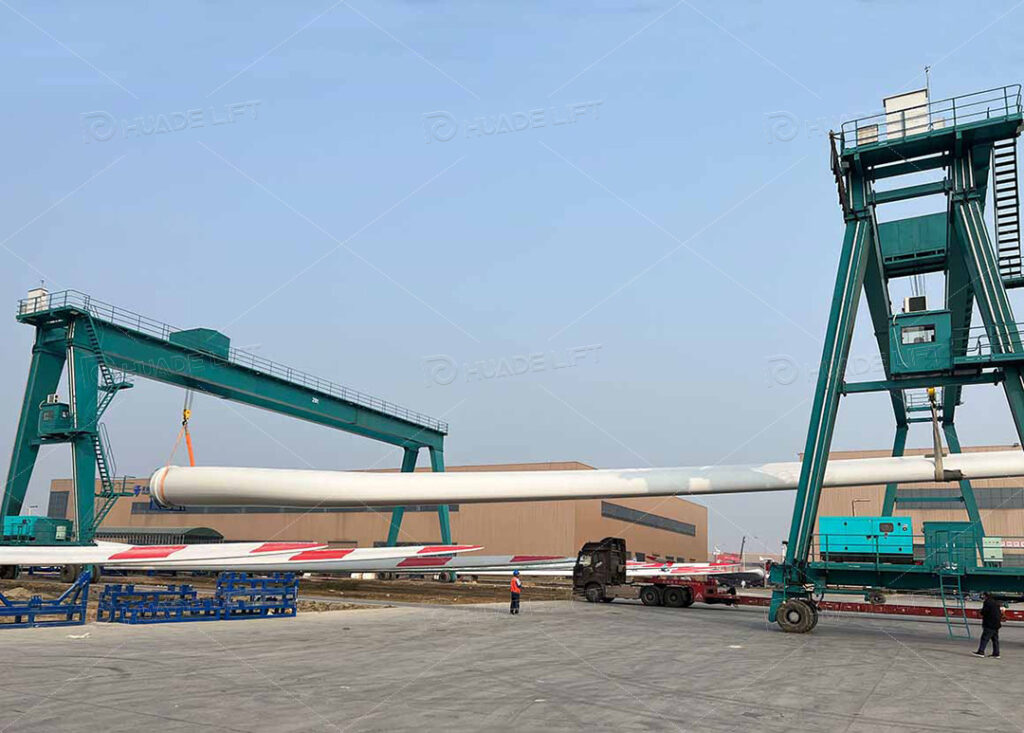
Straddle Carrier used in wind power
Hoisting Mechanism and Lifting System Design
Key Hoisting Components
The spreader, as the component directly contacting containers, employs a fully automatic twist-lock mechanism. Hydraulic power drives the twist-lock rotation to engage with container corner fittings, ensuring rapid locking response. The unlocking process simultaneously triggers position detection sensors to guarantee operational safety. Lifting power is provided by the coordinated operation of wire rope drums, winches, and pulley blocks: – Drums are constructed from high-strength alloy steel with surface hardening for enhanced wear resistance, each capable of winding a specified length of wire rope; The pulley system employs a combination of movable and fixed pulleys. Multiple pulley sets amplify the winch’s pulling force, enabling effortless heavy-load lifting while reducing stress on individual wire rope strands and extending service life. Additionally, the lifting device incorporates anti-sway damping mechanisms to minimize container sway during lifting and movement, preventing collision risks. The winch features a built-in overload protection system that automatically cuts power when loads exceed rated capacity, safeguarding against component damage. Sealed bearings at all connection points reduce dust ingress and lower routine maintenance frequency, ensuring continuous and stable equipment operation.
Key Engineering Features
Load balancing control forms the technical core of the lifting system. Weight sensors continuously monitor container weight distribution. If the weight difference between sides exceeds preset limits, the system automatically adjusts the retraction/extension speed of both wire ropes to maintain horizontal alignment, preventing structural damage from uneven loading. For safety, a dual redundant braking system is employed: primary hydraulic disc brakes instantly lock the drum upon power loss, while mechanical clutches automatically engage as a backup when primary brakes fail. An overload protection device immediately cuts lifting power and triggers alarms when loads exceed rated capacity, fundamentally eliminating overloading risks. Furthermore, the system incorporates dynamic precision compensation. During lifting acceleration or deceleration phases, it automatically corrects wire rope tension deviations to ensure smooth load movement. For adverse weather conditions, wind and slip prevention devices are installed. These either clamp the tracks or increase friction to prevent equipment displacement in high winds, comprehensively safeguarding operational safety and precision.
Advanced Electric Hoist Drive Technology
The new generation of rubber tyre gantry cranes widely adopts variable frequency electric hoist drive systems, replacing traditional DC drives. This technology employs vector control algorithms to achieve stepless adjustment of lifting speed, enabling precise control from fine adjustments to high-speed lifting. Combined with real-time feedback from position encoders, it ensures high positioning accuracy of lifting attachments. More importantly, the electric hoist drive system offers high energy efficiency, reducing energy consumption compared to traditional systems. It also minimizes mechanical wear components, extending maintenance intervals and perfectly aligning with modern logistics demands for high efficiency and low consumption.
Drive and Power Systems
Innovations in power and drive technology are propelling rubber tyre gantry cranes from “high-efficiency operation” to “green efficiency,” achieving dual breakthroughs in performance and environmental protection.
Diesel-Electric vs. Fully Electric Rubber Tyre Gantry Cranes
The two power modes offer distinct complementary applications: Diesel-electric hybrid rubber tyre gantry cranes equipped with high-power diesel generators enable continuous operation in areas without grid coverage. However, they consume diesel during idle periods, emit pollutants like nitrogen oxides during operation, and produce higher noise levels. Fully electric rubber tyre gantry cranes rely on municipal power or energy storage batteries, eliminating exhaust emissions entirely, reducing noise levels, and further lowering energy consumption through regenerative braking technology. However, they require supporting infrastructure like charging stations or energy storage facilities, entailing higher initial investment. Currently, mainstream domestic operating scenarios have adopted a hybrid configuration model: “fully electric in core areas, diesel-electric in peripheral areas.”
Diesel-electric hybrid rubber tyre gantry cranes utilize diesel generators as their primary power source, supplemented by energy storage units. This setup eliminates dependence on fixed power grids, offering superior adaptability in remote areas or temporary yards without grid access while meeting continuous operation demands. However, these units emit pollutants like nitrogen oxides and particulate matter during operation. Idling still consumes diesel fuel, resulting in relatively significant energy waste. Additionally, their high operational noise levels pose challenges for controlling acoustic pollution in work environments.
Fully electric rubber tyre gantry cranes rely on municipal power or energy storage batteries for operation, achieving zero tailpipe emissions during work. This fully complies with the stringent environmental requirements of inland yards, ports near urban areas, and similar scenarios. Their operational noise is significantly lower than diesel-electric models, effectively improving workplace comfort. Simultaneously, they offer higher energy efficiency by reducing fuel consumption through electric drive, resulting in lower long-term energy costs. However, fully electric rubber tyre gantry cranes require supporting infrastructure like charging stations or energy storage facilities, entailing higher initial investment costs. In areas without grid coverage or with unstable power supply, operational flexibility is limited, necessitating advance planning for energy replenishment solutions. Each type has distinct advantages, and selection should be based on a comprehensive assessment of environmental requirements, energy supply conditions, and cost budgets specific to the actual operational scenario.
Performance Enhancements
Technology integration delivers three major performance leaps:
– Environmental: Fully electric rubber tyre gantry cranes achieve “zero emissions.” Diesel-electric hybrid models reduce pollutant emissions through exhaust aftertreatment systems and idle-saving technologies.
– Efficiency: Variable frequency control accelerates operational response, while energy recovery systems minimize waste. Qingdao Port case studies demonstrate annual electricity savings per unit. Reliability: The electric drive system reduces mechanical components compared to traditional hydraulic systems, lowering failure rates and significantly improving equipment uptime.
Conclusion
The design essence of rubber tyre gantry cranes lies in engineering’s precise response to operational demands: modular structures solve transportation and maintenance challenges for large equipment; rubber tires and steering technology enable full-scenario adaptability; finite element-optimized frame structures ensure heavy-load safety; while innovations in power and control systems achieve a balance between efficiency and environmental sustainability. The integration of these technical principles not only elevates the rubber tyre gantry crane’s performance to “lift heavier loads, move more nimbly, and operate with greater precision,” but also propels the industry’s transformation from “extensive operations” to “green and intelligent” practices.
