
What is a Rubber Tyred Gantry Crane (RTG)?
A rubber tyred gantry crane (RTG) is a mobile crane used for lifting and transporting heavy loads, typically suited for outdoor or semi-outdoor environments. Its core design feature lies in the use of rubber tires as the mobile component, rather than the tracks relied upon by traditional gantry cranes. RTGs feature a high-rise gantry frame structure that supports the crane’s lifting mechanism, while the tire assemblies at the bottom enable flexible movement on the ground.
Although RTG cranes are commonly found in container yards and ports, they are also widely used in warehouses for handling large or heavy materials, automotive parts, and various industrial products. Their ability to move, lift, and transport goods over vast areas makes them indispensable in certain warehouse environments.
Performance Comparison: RTG vs. RMG
Mobility
Rubber-tyred gantry cranes (RTGs) have a clear advantage in terms of mobility. Their rubber-tired configuration allows them to operate on concrete, asphalt, and even some unpaved surfaces, enabling them to move between different yards or work areas within a facility without the need for complex rerouting or additional infrastructure. This high mobility enables them to quickly respond to changing operational demands, such as when container arrivals suddenly increase in a specific area of a port, allowing RTGs to be easily deployed to that area to handle the load.
In contrast, rail-mounted gantry cranes (RMG) are restricted by their tracks and can only move along the linear paths defined by the tracks. While they offer high precision when moving along tracks, they lack the flexibility to deviate from the path, which becomes a significant disadvantage when operational positions need to change rapidly, such as when container yard storage patterns suddenly change.
Economic Performance
The purchase cost of RTGs is typically lower than that of RMGs, as they do not require complex and expensive track infrastructure, thereby reducing initial investment. Additionally, their mobility enhances equipment utilization, as they can be used in multiple areas within the facility, reducing the likelihood of idleness. However, it should be noted that due to wear and tear from continuous movement across various surfaces, the maintenance costs for RTG tires and overall mechanical components may be slightly higher in the long term.
RMG requires significant upfront investment for track installation, but once installed, it offers higher efficiency and stability during operations. In some cases, its energy consumption is more predictable and may be lower, as it can be powered by a fixed power supply system. For high-capacity, fixed-location operations, RMG is more cost-effective in the long term.
Application Scenario
RTGs are suitable for scenarios requiring flexible operations across different locations. In ports, they are ideal for handling containers in mixed storage areas with frequently changing layouts and are also suitable for small or temporary facilities where installing a track system is impractical. In industrial sites, they are particularly suitable for moving heavy loads between different production areas in factories with diverse products and production processes.
RMG is more suitable for high-intensity, high-efficiency operations in fixed work areas. In large port terminals and railway yards with high container throughput and relatively stable layouts, RMG can operate continuously along tracks to maximize throughput. Its precision and stability make it the preferred choice for operations requiring continuous, accurate movement of heavy loads.
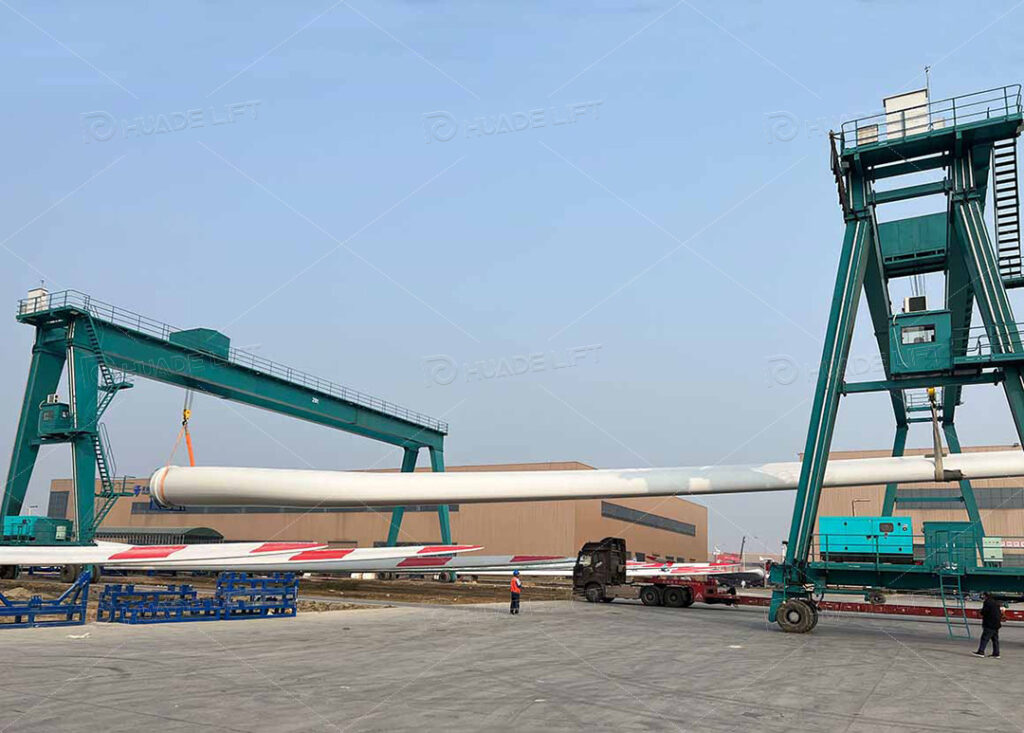
Design Features That Enable RTG Crane Flexibility
Rubber Tyre without Rails
RTGs are equipped with specially designed rubber tires that offer excellent wear resistance, load-bearing capacity, and shock absorption performance. These tires do not rely on fixed tracks and can operate smoothly on various surfaces such as concrete, asphalt, and gravel. Whether on flat port yards or slightly uneven industrial sites, rubber tires ensure stable movement of the crane, significantly expanding the operational range of RTGs.
360° Maneuverability
The RTG is equipped with an advanced steering system, enabling 360° maneuverability. A smaller turning radius allows it to maneuver flexibly in narrow spaces and easily avoid obstacles. Meanwhile, precise steering control and positioning systems ensure the RTG can accurately reach designated work positions, enhancing lifting operation precision and efficiency, particularly in scenarios with high positioning requirements such as container stacking.
Adjustable Span and Height
The span and lifting height of the RTG can be adjusted according to actual requirements. Different types of cargo, such as containers of varying sizes or heavy machinery, have different requirements for the crane’s span and height. By adjusting the span, the RTG can cover a wider operational area; adjusting the lifting height can meet the needs of different stacking heights or loading/unloading heights, enabling it to adapt to diverse cargo types and operational environments.
Diverse Power Options
RTGs offer multiple power options, including diesel, electric, and hybrid. Diesel-powered RTGs have strong endurance and are suitable for outdoor operations without relying on external power sources. Electric-powered RTGs are more environmentally friendly, have lower operating costs, and are suitable for sites with stable power supply. Hybrid-powered RTGs combine the advantages of diesel and electric power, automatically switching between power modes based on operational conditions to improve fuel efficiency while reducing emissions, adapting to different environmental requirements and operational conditions.
The Role of Technology in Enhancing Flexibility
GPS and Fleet Management Systems
GPS technology enables real-time tracking of the crane’s location within the site, with this information utilized by fleet management systems to optimize RTG movement. For example, when a bottleneck occurs in container handling in a specific area of the port, the fleet management system can swiftly dispatch available RTGs to that area based on their real-time locations.
Additionally, GPS-enabled RTGs can be programmed to follow specific routes within the site, helping to reduce collision risks and ensure smooth traffic flow. Data collected by the GPS system can also be used for performance analysis, allowing operators to review the crane’s movement patterns and identify areas for improvement, such as reducing unnecessary travel distances or optimizing time at each loading/unloading point.
Anti-Sway and Auto-Steering Systems
Anti-sway systems are critical for ensuring the safe and efficient operation of RTGs, especially during movement. When the crane moves with a load, the load may sway due to the crane’s acceleration, deceleration, or turning. The anti-sway system uses sensors to detect the load’s movement and then applies counterforce to minimize swaying. This not only enhances operational safety but also allows the crane to move faster, as operators can operate with greater confidence without worrying about the load swaying out of control.
Automatic steering systems represent another technological advancement enhancing RTG maneuverability. These systems combine sensors, cameras, and control algorithms to automatically maneuver the crane, enabling it to follow pre-programmed paths, avoid obstacles, or maintain safe distances from other equipment. This reduces the operator’s workload and allows the crane to move more precisely and efficiently in complex or crowded environments.
Remote Monitoring
Remote monitoring technology enables operators to monitor the performance and operation of RTGs from a central location. Sensors installed on the crane collect data on various parameters, such as the crane’s position, speed, load weight, and mechanical health, which is transmitted in real-time to the monitoring station for analysis by the operator.
Based on the received data, operators can make informed decisions regarding the RTG’s route and operation. For example, if a crane experiences mechanical issues, operators can quickly transfer the workload to another crane and schedule maintenance for the affected crane. Remote monitoring also supports predictive maintenance, allowing operators to detect early signs of component failure and take preventive measures before a failure occurs, further reducing downtime and enhancing the overall mobility of the crane fleet.
Operational Advantages of Enhanced Flexibility
Increased Mobility for Faster Operations
Rubber-tired gantry cranes (RTGs) can move freely without being constrained by fixed track systems, offering significant advantages in terms of speed and efficiency. Traditional gantry cranes are typically restricted by tracks, limiting their mobility range and thereby reducing overall operation speeds. In contrast, RTG mobile gantry cranes can move within the yard, quickly adjust their position, and perform lifting and stacking operations without wasting time on repositioning. This enhanced mobility accelerates container handling speeds, increases throughput, and is critical in environments such as container ports where rapid turnaround times are essential.
Adaptability to Changing Layouts
Many ports and industrial facilities face layout changes due to expansions, shifting demand, or changes in cargo types. RTGs are an ideal solution for such environments, as they can easily adapt to these changes without requiring major structural adjustments. Whether expanding yards to accommodate more containers or reconfiguring layouts to optimize traffic flow, RTGs can be moved to new areas and redeployed without the need for costly upgrades or new infrastructure.
Efficient Use of Space
In busy container yards, space is often at a premium. Rubber-tyred gantry cranes (RTGs) allow operators to handle containers from multiple angles and stack them higher, thereby improving space utilization and maximizing storage capacity. RTGs can stack containers closely together and easily adjust their positions to clear pathways, thereby achieving optimal yard utilization. This is particularly beneficial in crowded areas where traditional fixed-track cranes struggle to achieve similar efficiency.

Operational Flexibility in Diverse Environments
RTGs are not limited to container yards but can also be used in other environments such as shipyards, railway yards, construction sites, and warehouses. Their versatility allows them to handle various loads, including bulk materials, machinery, and construction equipment, making them an indispensable part of multi-functional facilities. The ability to switch between different types of work environments without requiring specialized equipment makes RTGs an ideal choice for businesses with diverse operational needs.
Reduced Need for Additional Equipment
Integrating lifting, moving, and stacking functions into a single machine reduces the need for additional equipment such as forklifts or tow trucks. This functional integration lowers operational costs, streamlines workflows, and enhances overall efficiency. Businesses can reduce the number of machines required to perform the same tasks, thereby lowering maintenance costs and minimizing downtime caused by repairs or maintenance.
Improved Safety and Operational Control
Modern tire-mounted gantry cranes (RTGs) are equipped with advanced safety features that further enhance operational flexibility. Features such as collision avoidance systems, load sway control, and automatic monitoring systems help ensure smooth and safe operations. Operators can better control the crane’s movement and lifting operations, minimizing the risk of accidents and improving overall productivity. Improved safety also enables companies to operate RTGs in more challenging environments or adverse weather conditions, further enhancing operational flexibility.
RTG Flexibility Application Cases
Port Container Yard: Handling Containers in Mixed Storage Areas
A large port’s container yard employs multiple RTGs for operations. The yard includes both standard container storage areas and special container storage areas, with a complex cargo storage layout. RTGs, with their flexible mobility, can freely navigate between different storage areas, quickly reach the target container location according to operational instructions, and efficiently complete container loading, unloading, and transfer operations, ensuring rapid cargo turnover at the port.
Industrial Site: Moving Oversized Loads Between Different Production Areas
Within the production site of a heavy machinery factory, large machine tool components need to be transported between different production workshops. These components are large in size and heavy in weight, making transportation challenging. The RTG leverages its powerful lifting capacity and flexible mobility to easily move oversized load components from one production area to another without relying on other complex transportation equipment, simplifying the production process and improving production efficiency.
Construction Project: On-Site Lifting without Permanent Infrastructure
At a large construction site, traditional cranes were unable to operate due to the absence of permanent lifting infrastructure in the construction area. The RTG, which does not rely on fixed tracks or infrastructure, can move directly on the construction site and perform various lifting operations according to construction requirements, such as lifting reinforcing bars, precast concrete components, and other construction materials, providing strong support for the smooth progress of construction.
Conclusion
In summary, the rubber-tired gantry crane demonstrates exceptional performance in enhancing mobile lifting flexibility through its unique design and technological advantages. Its distinctive design features lay the foundation for flexible operations in complex environments. The integration of advanced technology further optimizes the RTG’s mobility and operational efficiency. It can be said that RTGs provide efficient, flexible, and reliable solutions for modern heavy-duty mobile operations, playing an irreplaceable role in adapting to dynamic demands across industries.
