
Introduction
In recent years, the global energy structure has been rapidly transforming, and the new energy industry has experienced rapid development in areas such as wind power, photovoltaics, energy storage, and hydrogen energy. The International Energy Agency (IEA) predicts that by 2030, global renewable energy installed capacity will account for a majority of the power system. As the scale of new energy construction continues to expand, the demand for the lifting, transportation, and high-precision installation of large equipment has also increased significantly.
Against this backdrop, rubber-tyred gantry cranes, as highly maneuverable and adaptable lifting equipment, have gradually become a vital component of new energy project construction. Compared to rail-mounted gantry cranes or tower cranes, they do not require fixed rails and can be flexibly moved, making them particularly well-suited to the complex and changing working conditions of new energy projects. This article will systematically explore how rubber-tyred gantry cranes support new energy projects and analyze their application value, development trends, and future potential.
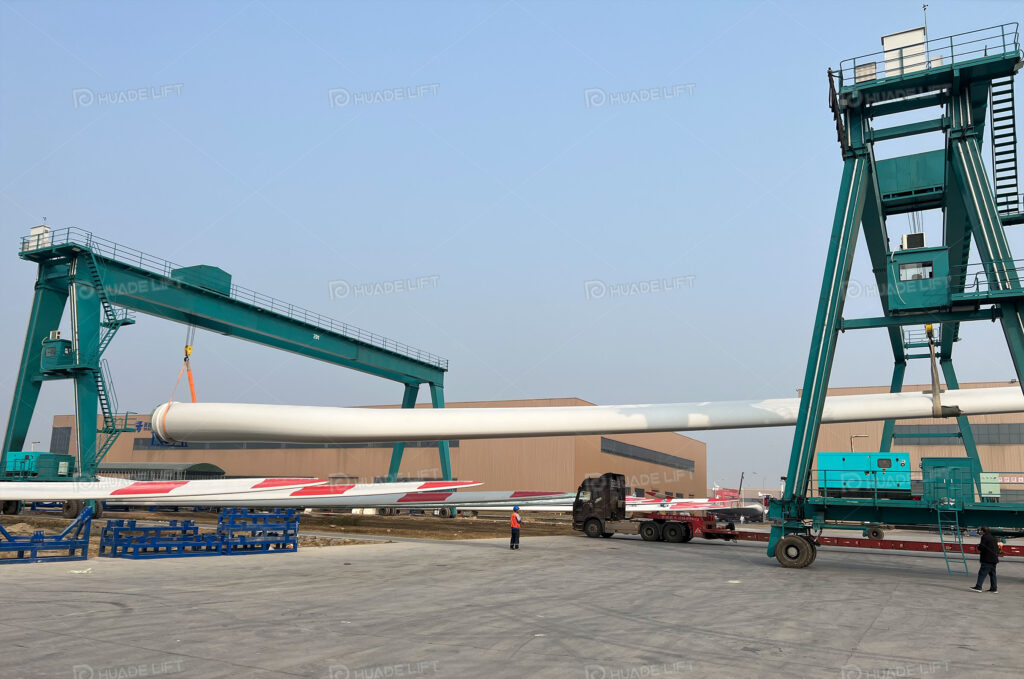
What Is a Rubber Tyred Gantry Crane?
A rubber-tyred gantry crane is a gantry crane system using rubber tires as a traveling support. It features a large span, high lifting capacity, and excellent flexibility. Unlike traditional rail-mounted gantry cranes, RTGs (Remote Guided Trolleys) do not rely on fixed rails, but instead travel on rubber tires, allowing for free movement over a wide range.
This type of equipment was originally used for loading, unloading, and stacking containers in container yards. However, with the rise of the new energy industry, more and more project owners are adopting RTGs to meet the lifting needs of wind power, photovoltaic, and energy storage applications.
Operating Principle and Core Features
The RTG relies on a diesel engine, electric motor, or hybrid drive system, providing powerful power to handle complex environments. It performs lifting operations using wire ropes or telescopic spreaders, and is equipped with automatic deviation correction and precise positioning systems, meeting the high-precision requirements of new energy equipment installation.
Core Features include:
High Maneuverability: No rails are required, allowing for rapid movement to different work areas.
Large Span and High Lift Capacity: Suitable for lifting extra-long and heavy wind turbine blades or photovoltaic structures.
Adaptable to Complex Sites: Suitable for use in mountainous, desert, and coastal locations.
Customizable: Designs with varying spans, lifting capacities, and power modes can be tailored to the needs of new energy projects.
Analysis of Lifting and Transportation Demands for New Energy Projects
Demands for Wind Farm Construction
Wind power projects place extremely high demands on lifting equipment. Wind turbine blades can reach lengths exceeding 100 meters and weigh tens of tons, and individual tower sections are equally heavy. Traditional lifting methods often rely on large crawler cranes or tower cranes, but transportation and assembly are difficult and costly in complex terrain, such as mountainous or coastal areas.
Rubber-tyred gantry cranes offer significant advantages in wind power projects: they can flexibly transport blades and towers within the site and precisely position them, significantly improving construction efficiency.
Demands for Photovoltaic Power Stations
The construction of photovoltaic power stations involves the transportation and installation of large numbers of photovoltaic modules and mounting brackets. These modules are large but moderately heavy, resulting in large quantities and a tight construction schedule. Traditional forklifts have limited handling efficiency, while RTG cranes can lift photovoltaic panels or steel structures in batches and quickly dispatch them within the site, reducing labor and time costs.
Demands for Energy Storage and Hydrogen Projects
As energy storage systems gain increasing importance in new energy power grids, large battery pods and containerized energy storage equipment need to be efficiently deployed within the plant or power station. This type of equipment often weighs tens of tons and is large in size, requiring extremely high lifting precision. RTG cranes enable smooth lifting and millimeter-level positioning, ensuring safe and reliable equipment installation.
Site Challenges at New Energy Bases
New energy projects are often located in remote areas with complex site conditions, such as Gobi, desert, and mountainous terrain. Fixed-track cranes struggle to adapt, while the maneuverability and adaptability of rubber-tyred gantry cranes make them an ideal choice.
The Value of Rubber-Tyred Gantry Cranes in New Energy Projects
With the rapid advancement of new energy projects, rubber-tyred gantry cranes, with their unique advantages, have become key equipment for improving construction efficiency and ensuring smooth project progress. Their application value is evident in multiple stages.
High Maneuverability
One of the most significant features of rubber-tyred gantry cranes is their exceptional maneuverability, thanks to their specialized rubber tires. Unlike traditional cranes that rely on fixed tracks or complex foundations, they are not restricted to specific routes and can operate freely even on unpaved roads, easily navigating the complex terrain common in new energy projects. Wind power projects are often located in mountainous and grassland areas, while photovoltaic projects are often located in open but rugged deserts or wastelands. These areas often lack smooth, hardened roads, making them difficult to access with conventional lifting equipment. However, the RTG, with its adaptable rubber tires, can navigate uneven terrain with stability and reach equipment installation sites smoothly. This provides a crucial guarantee for new energy project construction in remote and complex terrain, avoiding delays caused by equipment inaccessibility.
Precision Lifting
The installation of new energy equipment requires extremely high lifting precision; even the slightest deviation can impact the subsequent operation of the equipment. For example, wind turbine blades must be precisely installed in specific positions on the hub. Any deviation during installation not only increases wear and tear during operation but can also directly affect power generation efficiency and, in severe cases, pose a safety hazard. The RTG’s design takes this requirement into account, featuring advanced positioning systems and anti-sway technology. The positioning system accurately captures the equipment’s position in real time, ensuring it remains on the pre-set lifting path during lifting. Anti-sway technology effectively reduces the sway of loads during lifting, preventing positional deviations caused by such movement. The synergy of these two technologies ensures stable and reliable lifting operations, minimizes errors, and meets the high-precision installation requirements of new energy equipment.
Flexible Scheduling
At new energy project construction sites, multiple workstations often require simultaneous operations. The efficiency of equipment scheduling directly impacts the overall construction progress. The Rubber Tyred Gantry Crane offers the advantage of flexible scheduling. It doesn’t rely on fixed infrastructure and can be quickly moved between different construction sites. Once a workstation completes its current lifting task, the RTG can quickly adjust its position and move to the next workstation, enabling multi-station collaborative operations. This flexible scheduling method effectively avoids the waiting time caused by equipment being fixed to a single workstation, significantly improving construction efficiency. Furthermore, when faced with unexpected construction needs, the RTG can quickly respond and be deployed to the required area, providing strong support for the smooth progress of project construction.
Reducing Transportation Costs
For new energy projects, initial infrastructure investment and equipment costs are a significant component of the total project cost. The Rubber Tyred Gantry Crane plays a crucial role in reducing these costs. First, compared to traditional lifting equipment that requires laying fixed tracks or constructing large foundations, the RTG eliminates these preparatory steps, directly reducing initial infrastructure investment and shortening the project preparation period. Second, on the construction site, the RTG offers comprehensive functionality and can replace some forklifts and large crawler cranes. Forklifts have limited capacity when handling heavy equipment, while large crawler cranes are not only expensive to purchase but also require high maintenance. By replacing these two types of equipment, the RTG reduces the need for additional equipment and lowers maintenance costs, ultimately saving money for new energy projects.
Real Case Studies and Application Scenarios Supporting New Energy Projects
The practical value of the Rubber Tyred Gantry Crane has been fully demonstrated in various new energy project scenarios worldwide. Its flexible and efficient features adapt to the construction needs of projects in diverse regions and environments, making it a key driver of the global new energy industry.
Wind Power Project Case Study
A large onshore wind farm in northern Germany, Europe, was constructed in wetlands and gently sloping terrain along the Elbe River. The soil on the site was high in moisture and the ground was weak in bearing capacity. Traditional crawler cranes were prone to sinking into the muddy ground during movement, and relocation required the coordinated use of multiple heavy-duty trailers, which was not only time-consuming but also potentially damaging to the wetland ecosystem. The RTGs selected for this project addressed this challenge. The RTGs feature a wide span design and low ground contact pressure tires, allowing them to span directly over the dedicated blade stacking area. Workers simply stacked the wind turbine blades neatly on the raised, moisture-proof stacking area. The RTGs, with their anti-slip and low-rolling properties, navigated the wetlands and gently sloping terrain with stability, accurately lifting the blades to the tower installation point. Furthermore, the RTGs can adjust the angle of the hoist to smoothly transport heavy tower sections to the assembly station. Throughout the entire process, RTGs significantly reduced the frequency of large crawler crane use, avoiding the time lost from frequent crawler crane relocations and minimizing the equipment’s impact on wetland ecosystems. This significantly increased the wind farm’s blade and tower installation efficiency by nearly 30%, effectively shortening the project construction period.
Photovoltaic Project Application
At a desert photovoltaic base in Morocco, Africa, the core challenges faced were the vast site, significant day-night temperature swings, and numerous shifting sand dunes. The photovoltaic panels and steel supports needed to be dispersed across an area of dozens of square kilometers. Traditional small forklifts were not only unable to meet the long-distance, high-volume transport requirements but were also prone to mechanical failure due to the high temperatures. RTGs demonstrated their adaptability in this scenario: they relied on no hardened roads and could maneuver flexibly between dunes. Equipped with a high-temperature heat dissipation system, the equipment was adaptable to the extreme desert climate. Its adjustable lifting device also allowed it to simultaneously grasp multiple photovoltaic panels or sets of steel supports, preventing damage to the panels during transport due to collisions. During construction, RTGs departed from the base’s material collection point and, following the route outlined in the construction drawings, lifted the photovoltaic panels and supports to each installation location. Because RTGs are unrestricted by sand dune terrain and high temperatures, and their single-transfer capacity far exceeds that of forklifts, they effectively avoid construction delays caused by insufficient equipment capacity or malfunctions. This ensures that the desert photovoltaic base can complete module installation on schedule, safeguarding subsequent grid-connected power generation and providing a stable source of clean energy for the local area.
Energy Storage Project Application
In the construction of a large-scale energy storage power station on the coast of Japan, containerized battery pods are used as core energy storage equipment. These individual pods are heavy, and the power station site is restricted by the coastal terrain, requiring centralized stacking and orderly arrangement within a limited space while also addressing moisture and wind protection requirements. The RTGs’ high stacking capacity and precise lifting capabilities play a key role in this scenario. Construction workers first build a moisture-proof foundation in a designated area of the power station and plan the battery pod stacking area. Using a high-precision positioning system, the RTGs accurately locate the stacking location, steadily lift the battery pods onto the foundation, and stack them in multiple layers according to the designed height, up to three layers, significantly improving site utilization. When battery pods need to be individually arranged into energy storage cabinets, the RTG can flexibly adjust the height and angle of the hoist to avoid gusty winds in coastal areas, precisely placing the pods in their pre-set locations and avoiding positioning errors caused by manual handling or lifting with small equipment. Throughout this process, the RTG not only solves the space and protection issues associated with bulk battery pod stacking, but also ensures installation accuracy, laying the foundation for the rapid commissioning of energy storage power stations and helping Japan meet energy storage needs in coastal areas.
Cross-Industry Applications
In addition to new energy power generation and energy storage projects, RTGs are also widely used in supporting scenarios such as new energy ports and logistics parks around the world. For example, a new energy vehicle port in California, USA, primarily handles the transshipment of new energy vehicles and their components, such as batteries and motors. Due to the scattered operating areas within the port, traditional cranes must be stationed at specific locations on the quayside, lacking flexibility and unable to meet the demands of simultaneous multi-berth operations. RTGs can move freely between port yards and multiple berths. They can not only transfer new energy vehicle parts unloaded from ships from berths to the yard for storage, but also quickly lift parts from the yard to vehicles based on the dispatch needs of logistics vehicles, achieving seamless “ship-yard-vehicle” connectivity and significantly improving the efficiency of multi-berth collaborative operations. At a new energy logistics park in Australia, Oceania, RTGs are used for the transfer of wind turbine equipment parts. After receiving wind turbine gearboxes, generators, and other components from Southeast Asia, the park classifies and transfers these components to different storage areas based on the needs of local Australian wind farms, or directly lifts them onto transport vehicles, ensuring timely delivery of parts to remote inland wind farm construction sites. The application of RTGs has significantly improved the transfer efficiency of new energy ports and logistics parks around the world, strongly supporting the efficient global operation of the new energy industry chain.

Rubber Tyred Gantry Cranes Align with Green and Low-Carbon Development
The core goal of the new energy industry is to reduce carbon emissions and achieve sustainable development. RTG cranes themselves are also transitioning towards green development. Electrification and Hybrid Development
Traditional RTGs are mostly diesel-powered, but modern models are gradually transitioning to electric or hybrid systems. This not only reduces fuel consumption but also reduces on-site emissions, aligning with the environmental protection principles of new energy projects.
Reducing Carbon Emissions
According to industry data, electric RTGs can reduce carbon emissions by over 50% compared to diesel RTGs. Furthermore, they reduce operating noise, improving the construction environment.
Conforming to Global Green Strategies
Driven by the “Dual Carbon Goals” and global green energy strategies, the electrification of rubber tire gantry cranes will become an inevitable trend. They are not only a construction tool for new energy projects, but also a vital component of the green industrial chain.
Choosing a Rubber-Tyred Gantry Crane for New Energy Projects
Selection Considerations
Lifting Capacity: Select an appropriate tonnage based on the weight of equipment such as wind turbine blades and energy storage battery compartments.
Span: Wind power and photovoltaic projects often require large spans for lifting, so the design should be appropriately tailored to the site width.
Powertrain: The choice between electric, diesel, or hybrid should be based on the project’s environmental requirements and power supply conditions. Terrain Conditions: Complex terrain requires an RTG with strong off-road capabilities.
Customized Solutions
Some manufacturers offer customized RTG solutions for new energy projects, including ultra-long span designs, wind and dust-proof structures, and intelligent dispatching systems to improve construction efficiency and safety.
Intelligent and Automated Trends
In the future, RTG cranes will increasingly incorporate intelligent control, remote monitoring, and automated dispatching to achieve unmanned operation. This will not only improve efficiency but also reduce the risks associated with manual operation.
Conclusion
Rubber-tyred gantry cranes, with their high maneuverability, precise lifting capabilities, and adaptability to complex working conditions, are becoming key equipment in new energy project construction. From hoisting wind turbine blades to installing photovoltaic panels to stacking energy storage battery pods, RTG cranes cover virtually the entire lifting process of new energy projects.
More importantly, with the advancement of electrification and intelligent technology, rubber-tyred gantry cranes are also contributing to the realization of green energy goals, becoming a vital force in promoting the sustainable development of the new energy industry.
In future new energy construction, rubber-tyred gantry cranes will not only be a lifting device but also a vital support for green engineering and smart construction.
