
Tire-mounted gantry cranes (tire cranes) play a central role in ports, container yards, and industrial projects. With their flexible mobility and powerful lifting capabilities, they are essential equipment for cargo loading, unloading, and handling, efficiently driving the operation of logistics and industrial work.
Ground conditions have a fundamental impact on the deployment of tire cranes. Suitable ground provides stable support and ensures smooth operations; however, neglecting proper ground preparation can lead to a series of risks. In terms of safety, it may cause the tire crane to tilt, slip, or even overturn, resulting in severe accidents. In terms of maintenance, it accelerates component wear, increases repair frequency, and raises costs. In terms of efficiency, frequent failures and adjustments disrupt operational rhythms and cause delays.
Why are Ground Conditions Critical for RTG Cranes
Load-bearing and Distribution Mechanisms
During operation, the combined weight of the crane and the load it is lifting generates significant loads that must be transmitted through the tires to the ground. Due to the limited contact area between the tires and the ground, the ground must have sufficient load-bearing capacity to effectively distribute concentrated loads into the underlying soil. If the ground lacks sufficient load-bearing capacity, prolonged stress can cause settlement. Minor settlement affects lifting accuracy, while severe settlement can distort the equipment structure, leading to damage or even imbalance.
Core Connection between Stability and Safety
Stability is a prerequisite for safe tire crane operations, and ground conditions are a key factor influencing stability. Uneven ground causes uneven support point heights for the tire crane, leading to shifts in the center of gravity, which can result in tilting during lifting or movement. Soft or sunken areas in the ground may cause tires to become stuck, leading to slippage and loss of control. Additionally, insufficient shear strength in the ground can cause the tire crane to slide during turns or braking due to horizontal forces, which may result in equipment damage and personnel injuries.
Hidden Long-term Cost Impact
From a long-term operational perspective, ground conditions have a profound and often overlooked impact on costs. Operating on poor ground conditions increases the impact and friction forces on tires, accelerating wear and tear and increasing replacement frequency, directly raising consumable costs. Additionally, uneven ground and uneven load distribution subject structural components such as the chassis, boom, and reducer to extra stress and vibration, accelerating fatigue aging, shortening service life, and reducing major maintenance intervals, leading to soaring repair costs. More seriously, ground-related downtime disrupts production processes, leading to schedule delays and order delivery delays, with indirect economic losses often far exceeding direct repair costs.
Key Ground Conditions for Rubber Tire Gantry Cranes
Load-bearing Capacity
Ground load-bearing capacity is the primary safeguard for the safe operation of tire cranes. Different models of tire cranes have varying load-bearing requirements due to differences in their own weight and lifting capacity.
Soil type is a fundamental factor influencing bearing capacity. Sandy soil has good permeability and drainage but naturally low bearing capacity, requiring treatment to meet requirements; clay soil has naturally high bearing capacity but poor drainage, becoming muddy and losing bearing capacity when moisture content is high; rock-based foundations have extremely high bearing capacity, making them an ideal foundation, but such sites are rare in actual operational environments.
The degree of soil compaction significantly affects bearing capacity. Uncompacted soil has many pores, is prone to settlement under load, and has low bearing capacity. Using specialized equipment such as vibrating rollers or plate compactors to fully compact the soil reduces pores, increases particle density and friction, and significantly enhances ground bearing capacity.
Reinforcement measures can effectively enhance ground bearing capacity. For example, laying reinforcing mesh can enhance overall integrity and crack resistance while distributing localized loads; lime-soil compression piles form pile bodies by injecting lime-soil, working with surrounding soil to enhance foundation bearing capacity; grouting reinforcement involves injecting grout into soil pores, which solidifies to bind particles, enhancing strength and stability.
Ground Flatness and Levelness
Ground flatness and levelness are critical for the stable operation of tire cranes. Uneven ground causes uneven force distribution at the crane’s support points, generating additional torque that is transmitted to components such as the boom and chassis, subjecting them to extra stress. Over time, this can lead to fatigue, deformation, or even fracture. Additionally, uneven ground affects driving stability. Vibrations during movement accelerate tire and mechanical component wear and tear, and may cause suspended cargo to sway and fall, leading to safety incidents.
In rubber tyred gantry crane operation standards, there are explicit acceptable tolerance ranges for ground flatness. During construction, high-precision measurement instruments must be used for real-time monitoring and adjustment to ensure compliance with standards.
Surface Material Selection
When selecting surface materials, factors such as site usage requirements, load conditions, and budget costs must be comprehensively considered.
Asphalt surfaces are easy to construct, have moderate costs, and offer some flexibility to cushion equipment vibrations. However, they have weak high-temperature resistance and load-bearing capacity, tend to soften and deform at high temperatures, and may develop ruts or cracks under prolonged heavy loads. They are suitable for sites with light loads and low operational frequencies.
Reinforced concrete surfaces are strong, durable, capable of withstanding heavy loads and prolonged pressure have high structural integrity, are resistant to localized damage, and have long maintenance intervals and extended service life. However, they have high construction costs, lengthy construction periods, and are difficult and expensive to repair once damaged. They are suitable for ports, large container yards, and other areas with heavy loads and frequent operations.
Compacted gravel pavement is low-cost, easy to construct, and has good drainage performance, preventing water accumulation. However, it has low load-bearing capacity, is prone to settlement and loosening under heavy loads, and struggles to maintain long-term flatness, requiring regular maintenance and replenishment. It is suitable for temporary work sites or light-load industrial zones.
Drainage and Waterproofing Performance
Water can severely damage the ground, and water penetration into the soil reduces its load-bearing capacity. Moisture reduces the cohesion and internal friction of soil particles. Sandy soil particles become mobile, while clay soil expands and softens. Therefore, good drainage and waterproofing performance are crucial for ground stability.
Proper slope design aids drainage. Work site surfaces should be designed with a certain slope to allow rainwater to flow quickly into the drainage system and prevent water accumulation. Additionally, a comprehensive drainage system, including drainage ditches, collection wells, and drainage pipes, should be constructed to ensure smooth drainage.
For waterproofing, waterproof membranes can be laid or waterproof coatings applied to the ground base layer to prevent groundwater or surface water penetration from affecting bearing capacity. In special areas, waterproof curtains can be installed to enhance waterproofing effectiveness.
Durability against Repeated Vehicle Traffic
Rubber tyred gantry cranes frequently move within the site, and repeated tire rolls on the ground can cause fatigue damage. As the number of passes increases, the ground may develop issues such as cracking, settlement, and potholes, which can affect driving stability and safety, shorten the service life, and increase maintenance costs.
To enhance the ground’s durability against repeated vehicle traffic, reinforcement measures should be implemented. Laying steel plates, high-performance composite material plates, or other reinforcement plates can distribute loads and reduce stress concentration. Steel plates offer high strength and stiffness, while high-performance composite material plates are lightweight, corrosion-resistant, and wear-resistant. Reinforcement plates can be laid according to the driving path and work area to form temporary or permanent reinforcement layers.
Optimizing ground structure design can also enhance durability, such as adding reinforcing mesh or glass fiber grids to the base layer to improve overall strength and crack resistance; using high-strength concrete with a reasonably designed mix ratio to increase compressive strength and wear resistance; and applying wear-resistant coatings to the surface to reduce tire wear.
Common Ground Preparation Practices
Soil Testing and Geotechnical Engineering Surveys
Soil testing and geotechnical engineering surveys are essential before installing tire cranes. Soil testing assesses soil physical and mechanical properties, such as density, moisture content, porosity, liquid limit, plastic limit, compression coefficient, and shear strength, to evaluate natural bearing capacity and compressibility, providing foundational data for ground treatment plans.
Geotechnical investigations comprehensively assess the geological conditions of the site, including stratigraphic distribution, rock outcrops, groundwater levels, and water quality. Data is obtained through drilling, sampling, and in-situ testing to evaluate the stability of geological structures and the impact of adverse geological phenomena on ground stability.
These results provide scientific basis for designing ground treatment solutions, ensuring that measures meet the requirements for tire crane use and avoiding ground issues caused by insufficient understanding of geological conditions.
Ground Compaction and Stabilization Techniques
Ground compaction is a fundamental method for enhancing soil bearing capacity. Commonly used equipment includes vibrating rollers, tire rollers, and plate compactors. Vibrating rollers displace soil particles through vibration to achieve compaction; tire rollers are suitable for compacting clayey soils; and plate compactors are suitable for small-area sites. During compaction, equipment and parameters must be selected appropriately based on soil type and requirements to ensure the specified compaction degree is achieved.
Ground stabilization techniques improve soil properties through physical, chemical, or biological methods. Physical methods include soil replacement and gravel bedding; chemical methods involve adding materials like cement or lime to soil to bind particles through chemical reactions; biological methods utilize microbial metabolic processes to improve soil, offering environmental benefits and low costs but are less commonly applied.
Adding Reinforced Concrete Slabs or Load Distribution Pads
For sites with high load-bearing requirements, adding reinforced concrete slabs is an effective reinforcement measure. Their thickness and reinforcement are designed based on load requirements, enabling concentrated loads to be uniformly distributed to the subgrade, enhancing load-bearing capacity and structural integrity, and resisting uneven settlement and deformation.
Load distribution pads are suitable for temporary or low-impact scenarios, made from materials such as wood, rubber, or plastic, and can be customized in shape and size. Placing them under tires increases the contact area, reduces ground pressure, minimizes settlement and damage, and offers easy installation, removal, and reusability, making them widely used on construction sites.

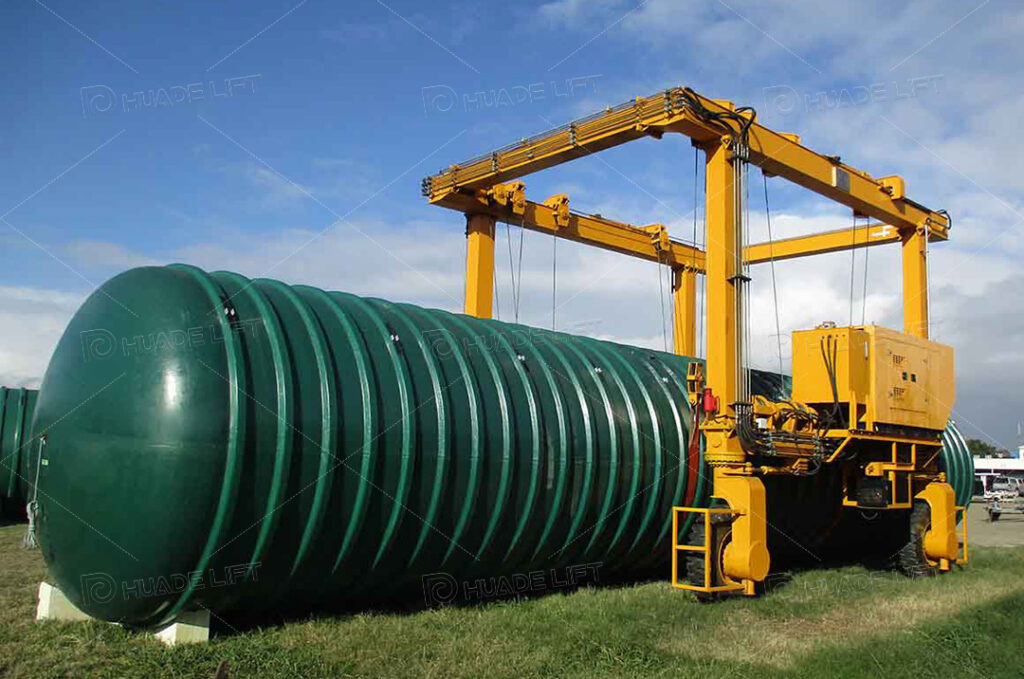
Straddle Carrier for Precast Concrete Production-Huadelift
Ground Requirements in Different Application Scenarios
Ports & Container Yards
Ports and container yards are primary application sites for tire cranes, where cranes handle numerous containers with heavy loads and frequent operations, imposing extremely high demands on the ground.
In terms of ground strength, heavy-duty structures are required, typically reinforced concrete surfaces capable of withstanding immense weight. High flatness is essential to ensure stability during high-speed crane movement and precise positioning.
Drainage is a top design priority. Given the large site area and exposure to rainwater and seawater, an efficient drainage system is necessary, with closely spaced drainage channels and appropriate slopes to ensure rapid water runoff and prevent pooling. Additionally, the ground must undergo corrosion-resistant treatment to withstand port salt corrosion, which can be achieved using corrosion-resistant concrete or applying a corrosion-resistant coating.
Industrial Zones & Factories
In industrial zones and factories, crane operations have lower load capacities and frequencies compared to ports and container yards. Ground requirements must balance cost and durability to accommodate the diverse operational needs within the facility.
When selecting ground materials, precise planning is required based on the load conditions of different areas. For areas with lighter loads, such as light-duty parts assembly zones or small material storage areas, asphalt pavement is a suitable choice. During asphalt pavement construction, the base soil is first thoroughly compacted, followed by the laying of asphalt mixture. After rolling and forming, it creates a pavement structure with a certain strength. It not only has a short construction period and can be put into use quickly but also allows for convenient repairs and lower costs when local damage occurs. Compacted gravel pavement is suitable for temporary pathways and auxiliary work areas within the factory premises. Its construction process is relatively simple: well-graded gravel is spread out and compacted using a vibrating roller, enabling cost control while meeting basic traffic and light-duty operational requirements. For high-load areas such as heavy equipment production zones, large raw material storage areas, and finished goods loading/unloading zones, reinforced concrete pavement is the inevitable choice. During construction, a crushed stone base layer is first laid, followed by reinforcing steel mesh, then concrete is poured, and after curing, a hard pavement is formed. This pavement can withstand the long-term heavy loads from tire cranes, effectively reducing ground deformation and damage.
In terms of load-bearing capacity, precise design must be based on the maximum operational load of tubber tyred gantry cranes within the factory premises. For light-duty areas, the ground bearing capacity must meet the operational requirements of small tire cranes, ensuring that the ground does not settle during the lifting of light-duty cargo or during movement. For heavy-duty areas, the ground bearing capacity must be significantly increased to withstand the combined pressure of the tire crane’s self-weight and the load it is lifting. This is typically achieved through soil reinforcement or increasing the thickness of the concrete.
Construction Sites
Construction site environments are complex and ever-changing, with RTG crane operating positions and ranges frequently shifting as construction progresses. Ground requirements prioritize temporary reinforcement and mobility to adapt to dynamic construction conditions.
Construction site grounds are often untreated natural soil or temporarily cleared areas, characterized by loose soil structure and low load-bearing capacity, unable to directly meet tire crane operational requirements. Therefore, temporary reinforcement measures are critical. Laying steel plates is one of the common reinforcement methods. The selected steel plates must have sufficient thickness and strength, typically made of Q235 or Q345 grade steel plates, with thickness determined based on the tire crane’s load capacity. During installation, the ground is first roughly leveled, removing large stones and debris, then the steel plates are laid flat. The plates are connected via welding or bolts to ensure secure fixation, preventing displacement during tire crane movement. Road base boxes are also ideal temporary reinforcement materials. They are made of welded steel plates, have a large area and load-bearing capacity, and can effectively distribute the load of the tire crane. Road base boxes can be laid individually or connected in multiples to accommodate different work area requirements, and they are relatively lightweight, making them easy to hoist and move.
Drainage is equally critical for construction sites. If water accumulates on the site, it not only affects tire crane operations but may also cause muddy ground conditions, exacerbating ground settlement. Temporary drainage ditches should be designed based on local conditions, dug along the edges of the work area or both sides of roads, with ditch width and depth determined according to anticipated drainage volume. Drainage ditches can be lined with gravel or equipped with drainage pipes to improve drainage efficiency. Sump pits should be installed in low-lying corners to collect water from the drainage ditches, which can then be pumped out to the drainage system outside the construction site using a pump. During rainy weather, silt and debris in the drainage ditches and sump pits should be promptly cleared to ensure smooth drainage.
Conclusion
Ground preparation, as an “hidden cost” in rubber tire gantry crane investments, significantly impacts equipment safety, operational lifespan, and operational costs. Adequate and compliant ground preparation provides reliable support for tire cranes, reduces safety incidents, minimizes equipment wear and failures, extends operational lifespan, lowers maintenance and downtime losses, and enables efficient operations.
Therefore, rubber tyred gantry crane buyers must recognize the importance of ground preparation and incorporate it into their investment planning. It is recommended to consult suppliers to understand the specific ground requirements for the equipment, combine this with the actual site conditions, hire professional personnel for site surveys and design, develop a scientific ground preparation plan, strictly enforce construction and acceptance standards, and ensure the ground meets usage requirements.
Only by properly preparing the ground can rubber tyred gantry cranes operate at maximum efficiency in a safe and stable environment, creating more value for businesses and achieving long-term efficient operations.
