
Introduction to Rubber Tyred Gantry Cranes
Rubber-tired gantry cranes (RTGs) serve as the core mobile heavy-duty container handling equipment in multimodal transport yards and logistics hubs. Their primary advantage lies in their freedom from fixed rail constraints, enabling flexible deployment to efficiently meet container turnover demands within yards. They are essential equipment for enhancing cargo transfer efficiency within modern logistics supply chains.
Essential Parts of Rubber Tyred Gantry Cranes
Gantry Frame
The gantry frame structure provides rigid support for the trolley and hoisting mechanism. It must bear the full span load and resist bending under dynamic operating conditions, forming the foundation for stable equipment operation.
Material Standards: High-strength steel is prioritized for its superior fatigue resistance and load-bearing capacity. Welding quality is ensured through non-destructive testing to prevent latent defects like weld cracks.
Protective Treatments: Corrosion prevention methods are selected based on operational environments, with each process suited to specific conditions. Full surface coverage is mandatory to prevent steel rusting.
Safety Matching: The frame’s rated load capacity must exceed the maximum container weight lifted to ensure structural integrity under extreme conditions, preventing deformation or fracture due to overload.
Trolley and Hoisting Mechanism
The trolley and hoisting mechanism are the core components enabling the tire crane’s container “lateral movement” and “vertical lifting,” directly impacting operational precision and efficiency.
Trolley System
The trolley runs smoothly along the main girder, with its technical core being reliable drive motors and fully lubricated wheels. Drive motors provide stable power to ensure uniform movement under load; fully lubricated wheels reduce friction resistance, prevent stalling, and enable precise positioning.
Hoisting Mechanism
Lifting Principle: Utilizes wire ropes or chains to drive the lifting device for vertical movement. The transmission process must ensure even force distribution on the ropes to avoid localized overloading.
Braking Assurance: Utilizes specialized brakes with “forward load-holding” capability. These automatically engage and lock during power failure or malfunction, preventing hoist and container drop—offering superior safety over conventional electromagnetic brakes.
Performance Matching: Hoisting speed selection balances efficiency and energy consumption based on operational cycles, accommodating diverse throughput requirements.
Safety Protection: Built-in overload sensors trigger shutdown protection when the load exceeds a specified percentage of the rated capacity, accompanied by audible and visual alarms to prevent mechanical damage.
Lifting Device
The lifting device serves as the direct connection between the tire crane and the container, fulfilling three key requirements: secure attachment, rapid switching, and universal adaptability.
Connection Principle: Locking is achieved via container corner fittings. The twist lock on the lifting device inserts into the corner fitting hole and rotates to secure it, ensuring no loosening during handling.
Type Comparison: Based on operational frequency and automation requirements, spreaders are categorized as semi-automatic or fully automatic. These types differ in manual intervention levels and operational cycles, making them suitable for varying throughput scenarios.
Standard Compliance: The twist-lock mechanism must comply with international standards to ensure compatibility with global container dimensions and prevent compatibility issues.
Adjustability: Features lateral/longitudinal sliding adjustment to flexibly modify spreader spacing according to container dimensions, accommodating various cargo specifications.
Lifting Beams and Ropes
Lifting beams and ropes uniformly distribute load from the spreader to the hoisting mechanism, serving as the “force transmission hub.” Critical control focuses on load balance and safety redundancy.
Lifting Beam Function: Its core value lies in “force balancing,” dispersing single-point loads from lifting devices into multi-point distribution to the hoisting hook, preventing localized stress concentration. It must also meet deflection control standards to avoid structural fatigue caused by excessive beam bending.
Rope Selection: Ropes must possess sufficient safety factors with built-in redundancy to withstand impact loads. Rope/chain grades must align with the hoisting mechanism’s capacity to prevent load mismatch issues.
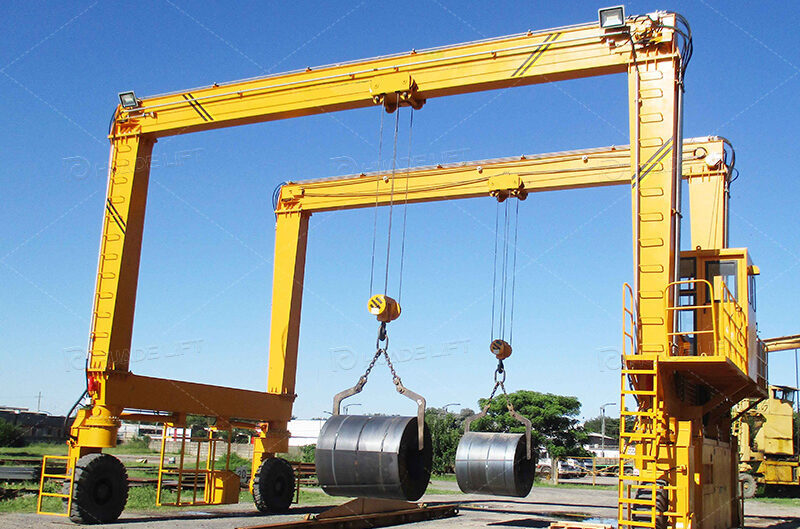
Undercarriage and Tires
The undercarriage and tires determine the equipment’s site adaptability and maneuverability.
Chassis Advantages: Rubber-tired chassis require no fixed tracks, enabling movement across any yard area. Dynamic leveling adjusts chassis height via hydraulic outriggers to adapt to uneven surfaces.
Tire Selection: Choose tires of varying hardness based on ground conditions to meet requirements for traction, oil resistance, etc. Steering systems come in different types with distinct steering capabilities, adapting to various site layouts and reducing tire wear.
Performance Testing: Pre-delivery testing must verify steering accuracy under load, ensuring steering deviation remains within acceptable limits at full capacity to prevent collision risks in congested scenarios.
Power and Drive System
The power and drive system supplies energy to tire cranes, balancing three key objectives: “sufficient power, optimized energy consumption, and environmental compliance.”
Power Types: Primarily categorized into diesel-electric generators and pure electric systems, each suited for different grid coverage and environmental requirements. Key considerations include fuel consumption, emission standards, and voltage compatibility.
Drive Technology: Utilizes variable frequency drive technology, offering advantages such as smooth acceleration/deceleration, reduced peak current, and long-term energy savings, making it particularly suitable for continuous operation scenarios.
Energy Optimization: Automatically adjusts output power based on load, enabling “on-demand power supply,” which reduces energy costs during long-term operation.
Operator Cab and Electronic Equipment
The operator cab serves as the operator’s workspace, while electronic equipment functions as the “brain” of the tire crane, requiring a balance between ‘comfort’ and “operational convenience.”
Operator Cab Design
Ergonomics: The control console features an ergonomic layout adapted to the operator’s seated posture. Equipped with climate control and a shock-absorbing seat to reduce fatigue during extended operations. The cab incorporates soundproofing to control noise levels.
Visibility Assurance: Tempered safety glass provides unobstructed views of lifting gear, containers, and surrounding areas, ensuring precise observation during container placement and preventing collisions caused by blind spots.
Electronic Control System
Core Components: Utilizes programmable logic controllers (PLCs) or microcontrollers to execute “lift-move-place” motion sequences, featuring safety interlocks to prevent misoperation.
Diagnostic Accessibility: Features a user-friendly touchscreen for fault code reading and parameter adjustment, enabling basic troubleshooting without specialized personnel and lowering technical barriers.
Safety and Monitoring System
The safety and monitoring system employs multi-level protection to safeguard personnel, equipment, and cargo.
Limit Switch Protection: Installs limit switches on three axes—gantry travel, trolley travel, and lifting height—providing dual safeguards against overtravel and mechanical overload.
Load Monitoring: Displays real-time load weight. Issues warnings or automatically locks lifting functions when approaching or exceeding a specified percentage of rated capacity, preventing overload risks.
Anti-Collision Technology: Radar or laser sensors detect surrounding obstacles in real time. When proximity reaches a specific threshold, the system automatically decelerates or stops to prevent collisions.
System Coordination: All safety components operate in tandem to ensure the equipment is in a completely safe state when safety protections are triggered, achieving triple protection for personnel, equipment, and cargo.
Wiring and Power Supply System
The wiring and power supply system must guarantee “stable power supply, interference-free signals, and easy maintenance” to prevent operational interruptions caused by power outages or signal disruptions.
Power supply methods primarily include drag chain cable systems, busbars, and spring reels. Each method differs in cable wear resistance, replacement ease, maintenance requirements, and applicable travel distance, necessitating selection based on actual scenarios.
Lighting and Auxiliary Equipment
Though not core components, lighting and auxiliary equipment directly impact operational precision during nighttime or complex conditions.
LED Work Lights: High-brightness LEDs mounted beneath the lifting device precisely illuminate container corner fittings, resolving nighttime alignment visibility issues. Their low power consumption and long lifespan reduce replacement frequency.
Visual Assistance: Integrates high-definition cameras or 3D sensors to transmit real-time alignment views between the spreader and container to the operator’s cabin screen. Supports zoom and close-up functions to enhance alignment precision in challenging environments.
System Compatibility: Auxiliary equipment must seamlessly interface with the PLC control system to prevent signal conflicts or delays, ensuring synchronized operations.
Features of Rubber Tyred Gantry Cranes
Maneuverability and Flexibility
Rail-free design enables movement across any yard area; multi-directional steering adapts to confined spaces; dynamic leveling accommodates uneven surfaces without requiring pre-grading.
Efficiency Enhancements
Intelligent anti-sway system reduces container sway, shortens positioning time, and boosts operational efficiency; Fully automated lifting gear eliminates manual operations, shortening per-container cycle times; Supports 24/7 continuous operation with pre-scheduled tasks via yard management systems, minimizing equipment downtime and idle runs.
Intelligent Control Features
PLC-based precision control with intuitive interfaces reduces operator training complexity; Premium models support remote operation and integration with yard management systems for “unmanned operations,” lowering labor costs.
Safety Protection Features
Multi-level safety interlocks prevent misoperation, prohibiting unauthorized personnel from starting equipment and automatically locking critical actions during malfunctions. Comprehensive monitoring eliminates safety blind spots. An emergency backup system enables manual lowering of the lifting device during sudden power outages.
Environmental Protection & Energy Efficiency Features
Diverse power options meet varying environmental requirements, adapting to regions with stringent environmental policies. Noise-reduction design controls operational noise levels. Eco-friendly materials minimize environmental pollution.
Durability and Reliability Features
Corrosion-resistant design withstands harsh environments, extending equipment lifespan; reinforced materials for wear parts enhance durability; simplified maintenance with fault warning capabilities minimizes unplanned downtime.
Multi-Function Adaptability Features
Lifting gear accommodates multiple container sizes, with select models compatible with specialized containers to meet diverse cargo needs; supports expandable auxiliary functions for enhanced operational convenience and multi-scenario reuse.
Operation of Rubber-Tyred Gantry Cranes
The pre-operation inspection must cover both “visual inspection” and “functional testing” to ensure the equipment is free of potential faults.
Visual Inspection: Check the condition of components such as the mast, tires, cables, and lifting device twist locks, while also verifying that no obstacles exist in the surrounding area.
Functional Testing: Verify the operational status of the control system, brakes, emergency stop button, lights/alarms, and communication systems.
Operation Planning
Operation planning must integrate “load characteristics” and “site conditions” to prevent reckless operation.
Load Assessment: Confirm the weight, dimensions, and center of gravity of the container to ensure it does not exceed the crane’s rated capacity and to control the off-center load within acceptable limits.
Route Planning: Avoid yard obstacles, reserve sufficient operating space; consider ground levelness, bypass unfavorable areas to prevent chassis tilt.
Full Load Handling Process
Positioning
Move chassis over the container. Adjust position via tire steering to align the lifting mechanism with the container’s center. Utilize cab visibility or camera assistance to ensure precise alignment between the lifting device’s twist locks and the container’s corner fitting holes.
Connection
Engage the lifting device’s twist lock, confirming full insertion into the corner fitting hole and rotation to lock. Double-check connection reliability, such as observing for container looseness after a slight lift.
Lifting
Raise the lifting device smoothly, controlling the lifting speed from slow to fast. The intelligent anti-sway system automatically activates to reduce container sway. Control the lifting height to avoid uneven cable tension.
Transportation
Activate the chassis drive, controlling travel speed; maintain low container height to prevent sway caused by bumps; monitor surroundings in real-time during travel, stopping promptly upon encountering obstacles.
Lowering
Upon reaching the target position, slowly lower the lifting device to place the container steadily; after confirming stable placement, activate the twist lock to unlock; slowly raise the lifting device to complete the operation.
Applications of Rubber Tyred Gantry Cranes
Precast Concrete
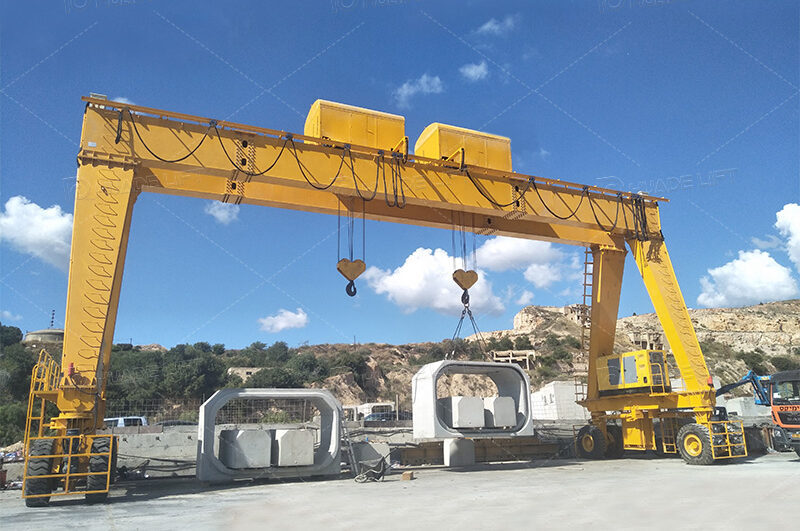
Core applications include precast component production, prefabricated building construction, and municipal engineering projects. At production facilities, straddle carriers safely transport precast elements like wall panels, beams, and columns, preventing cracking caused by uneven stress distribution. On construction sites, they precisely lift components from transport vehicles to installation points, suitable for high-rise residential buildings and large-scale venues. In municipal engineering, they handle precast utility tunnels and road covers, reducing on-site pouring and accelerating construction schedules.
Steel Mills
Primarily serving the entire steel production process, covering steelmaking, rolling, and finished product storage. In steelmaking shops, they transport ladles and ingots, requiring high-temperature resistance, impact resilience, and precise braking. During rolling, adjustable lifting tool spacing facilitates transport of various steel specifications. In finished product warehouses, it enables multi-tier stacking storage and rapid loading. Its wear-resistant and dust-proof design suits high-dust, high-abrasion environments, significantly boosting material handling efficiency.
Wind Power Equipment
Focuses on manufacturing and construction scenarios across the wind power industry chain. For manufacturing, it handles ultra-long (tens of meters) and ultra-heavy (hundreds of tons) components like blades and nacelles, requiring large-span gantries and heavy-duty equipment. For construction, it navigates complex terrains like mountains and grasslands with rubber-tired chassis, enabling flexible movement without tracks. Equipment can be transferred from transport vehicles to installation sites, coordinating with hoisting equipment to complete turbine assembly and significantly improving transportation efficiency at wind farms.
Modular Construction
Primarily used in the production and construction of modular buildings. In factories, it safely transports modular units integrated with utilities and finishes, ensuring structural integrity and facility completeness. On construction sites, it precisely lifts modules from transport vehicles to designated locations, meeting “whole-unit lifting” requirements without scaffolding. Suitable for standardized projects like hotels and dormitories, it shortens construction timelines and reduces labor costs.
Choosing the Right Rubber Tyred Gantry Crane
Component Performance
Span and Height: Determine mast span based on yard layout; determine stacking height based on storage requirements.
Power Source Selection: Choose the power type based on grid coverage, environmental requirements, and mobility needs.
Automation Level: Select models with varying automation levels according to workload, frequency, and unmanned operation requirements.
Operating Conditions and Cost
Ground Conditions: Choose tire and chassis types based on ground material and levelness.
Maintenance Capability: Select models with low spare part acquisition difficulty and convenient diagnostics based on company scale and geographic location.
Budget Balancing: Holistically evaluate initial procurement costs, long-term energy consumption, and maintenance expenses to avoid single-cost-item focus.
Compliance and Manufacturer Selection
Compliance Requirements: Must meet local safety and environmental standards, ensuring complete safety components and compliance with emissions and noise regulations.
Manufacturer Qualifications: Prioritize manufacturers with relevant application case studies; verify provision of training and after-sales support to ensure sustainable operations.
Maintenance of Rubber Tyred Gantry Crane Parts
Structural Components
Regular Inspection: Conduct routine visual inspections and non-destructive testing to identify structural defects and ensure structural integrity.
Protective Maintenance: Perform periodic anti-corrosion maintenance. Reapply protective coatings or perform cleaning maintenance as needed based on protective procedures and environmental conditions.
Wear-Prone Components
Tires
Regularly inspect tire wear and pressure; replace or inflate promptly. Avoid overloading to prevent tire damage. Rotate tires periodically for even wear; remove debris from tires after operation.
Ropes / Chains
Regularly inspect rope condition and replace any with potential hazards; lubricate periodically to reduce friction; conduct load tests regularly to ensure load-bearing capacity.
Twist Locks
Clean and inspect twist locks regularly; replace worn or deformed components promptly; test lock flexibility and lubricate any jammed parts after disassembly; calibrate locking precision periodically.
Electronics and Power Components
Electronic Systems
Regularly inspect cable connections and equipment cleanliness to prevent short circuits; promptly update software to address vulnerabilities; calibrate sensors periodically to ensure detection accuracy.
Power Systems
Diesel Models: Replace engine oil and filters regularly based on operating hours; clean components and inspect engine condition.
Electric Models: Regularly check battery voltage and charging interfaces; inspect motor insulation to prevent leakage.
Variable Frequency Drives: Regularly clean heat dissipation components and inspect output current to prevent overload burnout.
Safety Systems (Monitoring, Anti-Collision)
Regularly test limit switches and emergency stop functions to ensure proper equipment shutdown; regularly calibrate anti-collision sensors to maintain detection range and response mechanisms; regularly inspect load monitoring system accuracy to ensure precise warning and shutdown thresholds.
Summary
As “critical equipment” in the logistics supply chain, the quality of a tire crane’s core components directly determines operational efficiency and competitiveness. Whether in selection, operation, or maintenance, adopting a “systemic approach” to ensure component synergy is essential to maximize the tire crane’s value and support the logistics industry’s high-quality development.
