
What is Modular Design in Rubber Tyred Gantry Cranes
Simply put, the modular design of rubber tire gantry cranes is to disassemble the crane as a whole into a number of pre-designed independent components, each with a unified interface and specifications, can be quickly assembled into a complete device, but also according to the needs of individual disassembly, replacement or upgrading.
The core of this design idea is standardized components and flexible combination. Unlike traditional integrated cranes, which are manufactured from start to finish, the modular design first splits the crane into multiple functional modules, each of which is individually produced and debugged in the factory, and then transported to the site for assembly, which not only ensures the quality of the components, but also improves operational efficiency.
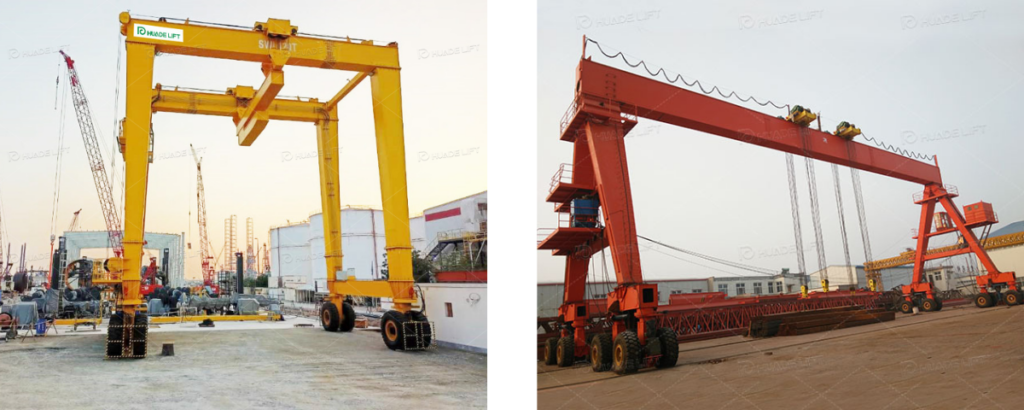
Core Components of Modular Design
The modular components of the tire gantry crane are divided according to its functional partition, with each module assuming a specific role and seamlessly connecting with each other. These modules cover all aspects of the crane’s structure, mechanical, electrical, control and so on.
Structural Module
The structural module is the skeleton of the crane, which mainly includes the main girder module, outrigger and frame module, cantilever module and boom structure module. The main girder module, as the core load-bearing component, adopts standardized design and can be flexibly combined according to different span requirements; the outrigger and frame module determines the overall height and stability of the crane, and the specifications can be adjusted according to the spatial limitations of the operating site.
Mechanical Module
The mechanical module is responsible for the power transmission and operation execution of the crane, the key includes the trolley and hoist module, steering and driving wheel components. The trolley and hoisting module is the core of container lifting and horizontal movement, and its modular design allows it to replace different specification parts according to the lifting weight demand; the steering and driving wheel assembly determines the crane’s flexibility of movement, and the steering mode can be adjusted according to the layout of the site.
Power Modules
Power modules provide the crane with the energy required for operation, including diesel genset modules, hybrid modules, pure electric system modules, and auxiliary power components such as battery packs, cable reel systems, etc. These modules can be customized according to the energy requirements of the job site. These modules can be selected flexibly according to the energy conditions of the operation site, for example, when there is a stable grid supply in the harbor, the pure electric module can be used, and the remote site can be used for diesel generator module.
Electrical and Control Module
The electrical and control module is responsible for crane operation control and signal transmission, including the electrical room module, PLC/VFD/HMI control cabinet module and automation control system module. These modules are pre-completed with wiring and debugging, and only need simple docking after on-site assembly to realize normal operation and intelligent control of the crane.
Core Features of Modular Design
The most prominent feature of the modular rubber tire gantry crane is the seamless compatibility between components. All modules are designed according to a unified standard with consistent interface specifications, so that both modules produced in different batches and modules with different functions can be flexibly combined without additional modifications.
This compatibility allows the crane to quickly adjust the configuration according to the actual operational requirements. For example, if a port needs to raise the height of container stacking, it only needs to replace the longer outrigger module and the main girder extension module without redesigning and manufacturing the whole crane; if the power condition of the operation site changes, the power module can be directly replaced to realize the switch of energy type.
The Engineering Logic Behind Modularity
Modular design can become the development trend of rubber tire gantry cranes, the core is to fit the engineering manufacturing efficiency and logistics and transportation scenarios, to solve the traditional pain points and reduce the cost of the whole process, the logic is mainly reflected in the engineering efficiency and logistics convenience.
Design Logic at the Level of Engineering Efficiency
The core of modular design is to improve production accuracy, optimize structural performance and facilitate late upgrade and maintenance. Traditional integrated cranes require single production line sequential processing and assembly, vulnerable to a single link; modular parallel production, synchronous manufacturing of modules, can shorten the cycle, and the factory controlled environment can strictly control the accuracy and quality, but also individually optimize the module force and structure, the later upgrade only need to replace the corresponding module, no need to change the whole.
Logic of Design at the Level of Logistics Convenience
Traditional one-piece rubber tire gantry cranes are bulky, and transport requires special equipment, complicated approvals, high cost and difficult to control the cycle; modular design through standardized modules adapted to conventional means of transport, significantly reducing the difficulty of transport, and its component size is small, which can simplify the customs clearance and on-site handling process, saving costs and time, laying the foundation for rubber tire gantry cost control.
Advantages of Modular Structural Design
Modular design of rubber tire gantry crane cost impact throughout the entire life cycle, compared with the traditional design can only be a single ring cost savings, it can achieve multi-link cost optimization, bringing significant overall cost savings, which is also its core competitiveness.
Shorten the Manufacturing Cycle and Reduce Manufacturing Costs
Traditional one-piece rubber tire gantry cranes are assembled sequentially and have a long manufacturing cycle; modularization adopts parallel production, which can significantly shorten the cycle, reduce manpower and machine costs and speed up delivery. Modular to achieve standardized mass production of components, can reduce costs and waste, to solve the traditional customized production of high manufacturing costs, quality instability.
Simplify the Transportation Process, Save Logistics Costs
Transportation costs are an important part of the overall cost of rubber tire gantry cranes, the traditional one-piece cranes oversized parts of the high cost of transportation, difficult, modular components adapted to the conventional transport equipment, can eliminate the need for special vehicle leasing and complex approvals to reduce losses, improve transport accessibility, and significantly save logistics costs.
Enhance Installation Efficiency and Reduce Installation Costs
Traditional one-piece rubber tire gantry crane installation is complex, time-consuming, high cost, large equipment and a lot of labor; modular crane components are lightweight, can be used with conventional temporary crane lifting, module pre-commissioning interface to reduce the amount of on-site work and error, but also support the installation in phases to reduce the initial investment and operational losses, significantly improve efficiency and reduce costs.
Enhance Flexibility and Avoid Repeated Investment
Traditional integrated crane design is fixed, changes in operational requirements need to be re-procured resulting in repeated investment, modular cranes can be flexibly combined, replacement modules to adapt to new scenarios without the need to change the whole equipment, and the module can be reused; components are damaged, the modularity can be disassembled and replaced individually to shorten the maintenance cycle and reduce operational losses.
Simplify the Maintenance Process, Extend the Life of the Equipment
Rubber tired gantry cranes crane later maintenance costs are high, the traditional integrated crane components are highly correlated, maintenance is difficult and costly; modular design can effectively solve the problem, the module can be disassembled and overhauled individually, the spare module can reduce the loss of downtime, standardized parts to facilitate bulk purchasing to reduce the cost, but also through the replacement of the module refurbishment and upgrading, saving the cost of updating and extending equipment Life span of the equipment can be extended.
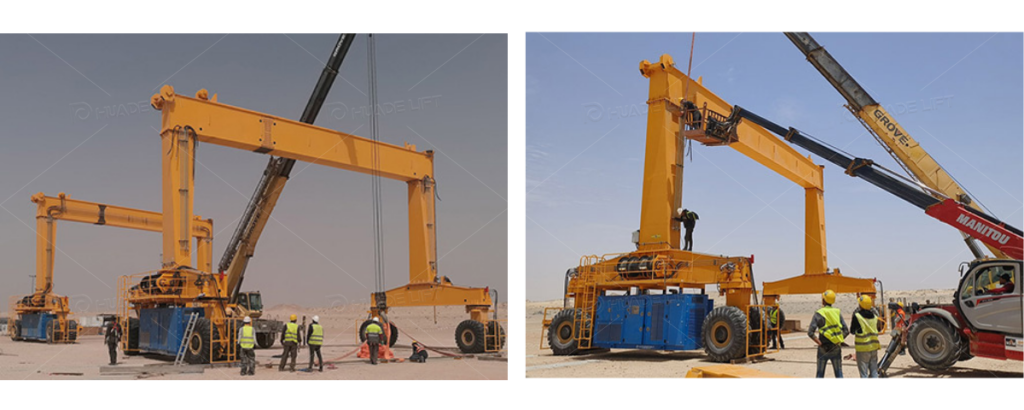
Modular Realization of Each System of Rubber Tyred Gantry Crane
Modular design in rubber tired gantry cranes crane is not the simple design of a single module, but covers various systems such as mechanical, electrical, control, etc., and the modularity of each system has its own specific design ideas and realization, which together constitute the modular system of rubber tired gantry cranes crane.
Modularization in Mechanical Systems
Mechanical system is the core execution part of rubber tired gantry cranes crane, which undertakes the lifting and moving of containers and other operations, and its modularization design mainly focuses on two aspects of the structural components and driving wheel system, with the core objective of improving the stability of the structure and flexibility of operation.
Modularization of Structural Components
Rubber tired gantry cranes crane structural components are the basis of equipment stability and load-bearing, and its modularization adopts standardized prefabricated components, replacing traditional welding with bolting to enhance the flexibility of disassembly and assembly.
Core components such as gantry frames are processed and anticorrosive treated in the factory, and can be stabilized on-site through high-strength bolt connections, which makes assembly faster and without on-site welding hazards, and facilitates disassembly, maintenance and reconfiguration in the later stage.
Structural components can be adjusted according to the needs, replacing different specifications of the cantilever, wheel modules can be adapted to the needs, without redesigning the overall framework.
Modularization of Drive and Wheel System
Rubber tired gantry cranes need to move flexibly, and the modularization of drive and wheel system adopts pre-fabricated integrated components, which can be quickly replaced and upgraded. Wheel set module is the core, the motor, transmission, braking system pre-integrated, factory commissioning is completed, the site fixed wiring can be used.
The wheel set module can be disassembled and replaced as a whole when it fails, without the need to disassemble the components, shortening the maintenance cycle, and it can also be replaced with different torque motor modules according to the operational requirements, improving the load carrying and mobility performance. The steering module can adopt plug-and-play design with 90 degree and 360 degree steering options, which can flexibly adjust the steering mode to fit the narrow space and different mobility requirements without complicated reconfiguration.
Modular Electrical and Control Systems
Electrical and control system is the “brain” of rubber tired gantry crane, responsible for the power supply and operation control of the equipment, and its modular design mainly focuses on the power supply module and control automation module, and the core objective is to improve the energy adaptability and ease of operation.
Modularization of Power Supply Module
Environmental protection requirements to promote the development of rubber tyred gantry cranes to hybrid and pure electric power, power supply module modularization can be flexibly adapted to different energy types, but also to facilitate the later upgrading. It mainly includes diesel generator sets, battery packs, cable reels, conductive rails and other independent modules, which can be flexibly selected and combined according to the energy conditions of the operating site.
Remote sites without a stable power grid can choose diesel generator sets, a stable power grid or need to take into account the environmental protection and flexibility of the site, respectively, can choose pure electric, hybrid modules to adapt to the needs. Cranes with diesel generator sets in the early stage can be upgraded by adding battery packs and cable reel modules directly in the later stage without modifying other systems, which significantly reduces the upgrade cost.
Modularization of Control and Automation Module
Rubber tyred gantry crane operation tends to be automated, control and automation module modularization can be flexibly adapted to different levels of automation, easy to upgrade and expand later. The control module adopts pre-wired PLC, VFD, HMI control cabinets, replacing the traditional hard-wired system, completing the wiring and debugging in the factory, and controlling the crane on site by wiring, reducing the workload and potential faults on site, and improving stability.
The automation module includes anti-shaking control, automatic steering, positioning system, etc., which can be independently designed and combined according to the need to adapt to different operational precision and labor requirements. Customers can combine their own needs and budgets to gradually improve the automation level, from manual transition to semi-automation, full automation, to avoid one-time high investment.
Impact on Lifecycle Cost and Sustainability Rubber Tire Gantry Cranes
Evaluation of the cost-effectiveness of rubber tyred gantry cranes can not only look at the upfront procurement costs, but also consider the full life cycle cost covering the whole chain of procurement, manufacturing, maintenance, etc. Although the modular design of the upfront inputs are slightly higher, but the later stage of the cost can be sustained to save costs, and ultimately reduce the full life cycle cost.
Optimization of the Whole Life Cycle Cost
Modular rubber tyred gantry pre-investment is concentrated in the module standardization design and mold development, although higher than the traditional model, but can be gradually recovered through the later mass production, logistics and maintenance savings; installation and commissioning costs are lower than the traditional model of more than 20%, the maintenance cost can be saved by 30%, the service life is extended by 5-10 years, which reduces the investment in the renewal of the equipment, and the overall total life cycle cost can be reduced by 15%-25%, and the long-term life cycle cost can be reduced by 15%-25%, and the long-term life cycle cost can be reduced by 15%-25%. The overall life cycle cost can be reduced by 15%-25%, and the long-term cost advantage is significant.
Sustainability Enhancement
Under the tightening of environmental protection policies, green operation has become a trend in logistics parks and other trends, modular design can both reduce costs and enhance the sustainability of rubber tyred gantry cranes. It moves welding, anti-corrosion and other processes to the factory, reducing on-site pollution; easy to adapt to hybrid, pure electric and other environmentally friendly power to achieve zero-emission upgrades; modules can be reused, standardized production of components can reduce resource waste and consumption, helping to achieve a win-win situation in terms of economic and environmental benefits.
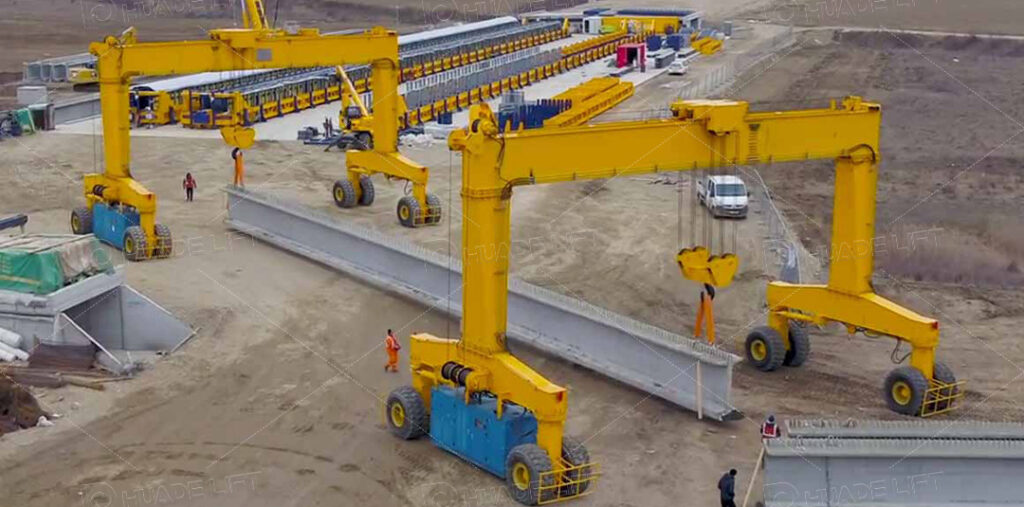
Modular Design vs Customized Rubber Tyred Gantry Crane Solutions
When to Choose Modular Rubber Tyred Gantry Cranes
Modular rubber wheeled gantry crane with standardization, high efficiency, low-cost advantage, the regular scene of outstanding cost performance, suitable for: fixed parameters of large sites, short delivery cycle projects, variable demand scenarios and focus on long-term operation and maintenance of the buyer, respectively, can achieve the cost of customization to save, improve the efficiency of the payback, reduce the duplication of inputs, reduce the loss of operation and maintenance of the effect.
When Full Customization is Required
Customized gantry crane because there is no standard module reuse, need to be individually designed and processed, high cost, long cycle time, the core value is to adapt to the modular can not cover the special scenarios, specifically for: extreme environments/irregular sites, oversized and overweight and other special operational needs, the need to adapt to the non-modernization of the old facilities, as well as special industry specifications or personalized needs of the scene.
Cost, Lead Time, and Maintenance Comparison
Modular and customized gantry cranes in the cost, delivery cycle, maintenance of the significant differences, directly affecting the return on investment and operational efficiency: cost, modular mass production cost control, accessories cost-effective, customized inputs and accessories cost is high; delivery cycle, modular 2-4 months, customized 6-12 months (affected by the complexity of the design); maintenance, modular On maintenance, modularization is simple, low cost, and short downtime, while customization is difficult, and the procurement of accessories is long and has a big impact.
How Buyers Balance Standardization and Customization
Balance standardization and customization, the core is to “grasp the core, abandon redundancy”, control costs and improve efficiency to adapt to the key needs: clear core and non-core needs, the core of the standard module, non-core local customization; choose to provide standard + local customization of the manufacturer; combined with the long-term planning of the space reserved for the adaptation; Analyze the whole life cycle cost, compare the selection to avoid blind decision-making.
Key Considerations for Modular Design of Rubber Tire Gantry Cranes
Although modular design has many advantages, in the actual design process, it is necessary to consider a number of factors to ensure the compatibility of the modules, the stability of the structure and the safety of the operation, and to avoid the increase in costs or safety hazards caused by improper design.
Reasonableness of the Connection Method
The stability of modular cranes depends on the connection method between modules, and the connection parts need to withstand various types of loads, dynamic stresses, and adapt to temperature changes, corrosion and other environmental impacts. Between the modules mainly use bolts, high-strength welding, hybrid three types of connections, bolt connection is easy to disassemble but need to ensure the strength of the preload, high-strength welding is stable but inconvenient to disassemble, hybrid connection to take into account the advantages of both. When designing, we need to combine the module function, force and environmental factors, choose the appropriate connection method and pay attention to anti-corrosion to ensure the stability of the structure.
Alignment Accuracy and Tolerance Control
Modular crane modules need to be accurately docked on site to ensure normal operation, alignment accuracy and tolerance control is critical, excessive dimensional tolerances will lead to docking deviations, poor connection, abnormal operation, and even affect the operating accuracy and structural safety. Module design and production need to use precision equipment, strict control of dimensional and shape tolerance, set up positioning devices at the interface parts to assist accurate docking, and at the same time, reserve a temperature compensation gap to avoid temperature changes leading to deformation of the module affecting docking accuracy.
Rationality of Load Distribution
Rubber tyred gantry cranes will be subject to a variety of weight and wind when working, the modular design should ensure that these forces are evenly distributed on each module to prevent individual modules from being damaged due to excessive force.
When designing, it is necessary to analyze the force of the crane as a whole and each module through relevant technology, simulate different working scenarios, optimize the module structure, such as optimizing the structure of the main beam and outriggers, to ensure that the force is uniformly transmitted to avoid deformation and damage.
Consideration of Environmental Adaptability
Rubber tyred gantry cranes are mostly used in outdoor places and often face harsh environments such as salt spray, high temperature, low temperature, and strong winds, etc. The modular design needs to take these factors into account to ensure the stable operation of the equipment. In the salt spray environment, the module structural components need to use corrosion-resistant steel and surface anticorrosion treatment; high-temperature environment needs to optimize the heat dissipation of the electrical module; low-temperature environment using low-temperature-resistant steel and electrical components; strong wind environment to optimize the overall streamlined structure to reduce wind resistance and enhance stability.
Safety and Compliance Requirements
Rubber tyred gantry cranes, as heavy lifting equipment, are designed and manufactured in accordance with national and international standards to ensure safety and compliance. In the modular design, each module needs to comply with the standards, key modules need to be set up redundant design to avoid equipment loss of control, the connection parts need to be equipped with failure protection mechanism to prevent accidents, the module also needs to be rigorously tested to ensure that the performance meets the standards before being put into production and use.
Conclusion
Modular design provides rubber tyred gantry cranes with a new solution for cost control and performance enhancement, optimizing the whole life cycle cost through standardized modules, enhancing the flexibility and stability of the equipment, which has significant advantages over the traditional one-piece cranes. Need to pay attention to the connection, precision and other key factors, it is the future development trend of both efficiency and environmental protection, selection can be configured in accordance with their own needs.
