
As a core sector of industrial production, the steel industry operates in environments characterized by extreme conditions and demanding requirements. Production processes involve persistent high temperatures, heavy materials, and significant dust levels within workshops and plant areas. Certain zones also contain corrosive substances, collectively posing severe challenges to production equipment.
Challenges Presented by Steel Mill Environments
Impact of High-Temperature Environments
Processes like smelting and rolling generate substantial heat, creating persistently high temperatures around furnaces and hot-rolled steel storage areas, accompanied by intense radiant heat. This not only affects the mechanical properties of equipment’s metal structures but can also cause insulation degradation in electrical components and viscosity reduction in hydraulic fluids. Such conditions may trigger electrical short circuits, hydraulic system leaks, and other failures, shortening equipment lifespan.
Handling Pressures from Heavy Materials
Steel mills routinely handle materials like steel coils, billets, and plates, which are typically characterized by concentrated weight, regular shapes, and high inertia. This places extremely high demands on the strength, rigidity, and stability of lifting systems within equipment. Traditional handling equipment often experiences lifting vibrations and operational deviations when handling such materials, disrupting production rhythms and potentially creating safety hazards due to material imbalance.
Erosion from Dust and Debris
Raw material processing and steel cutting generate substantial metal dust and debris. Fine dust particles readily infiltrate equipment gaps, entering electrical control cabinets, transmission gearboxes, and bearing housings. Long-term dust accumulation degrades electrical component contact conductivity, increases friction resistance in gear meshing clearances, accelerates bearing raceway wear, and leads to increased operational noise, slower response times, and even sudden failures.
Damage from Corrosive Environments
Certain areas require production processes that introduce humidity, acidic vapors from smelting, and corrosive substances like scale particles into the air. These substances cause electrochemical corrosion on equipment metal structures, leading to surface coating peeling and substrate rusting. They can also infiltrate hydraulic systems, degrading hydraulic oil and compromising the sealing performance of components like cylinders and valves, thereby undermining overall equipment operational stability.
Primary Applications of Rubber Tyre Gantry Cranes in Steel Mills
Coil Handling and Stacking
As critical finished and semi-finished products in steel mills, coils feature surface coatings susceptible to scratching and edges prone to deformation. Handling requires strict control of clamping force and smooth operation. Rubber tyre gantry cranes can be fitted with specialized coil clamps. The clamp arms feature an arc-shaped design that perfectly conforms to the coil’s outer circumference. The gripping surfaces are covered with wear-resistant rubber pads, preventing scratches from direct metal contact while allowing precise hydraulic adjustment of clamping force to avoid coil deformation. During stacking operations, the equipment utilizes a laser positioning system to precisely determine storage locations, controlling lifting height and lateral displacement to achieve multi-layer, orderly stacking of steel coils, thereby enhancing space utilization in storage areas.
Transport of Steel Ingots and Steel Plates
Steel ingots must be transported from the continuous casting shop to the reheating furnace, then from the reheating furnace to the rolling mill; while steel plates must be transported from the rolling mill to straightening and cutting processes, ultimately reaching finished product storage areas or loading docks for shipment. Wheel-mounted gantry cranes can be equipped with appropriate lifting attachments based on billet and plate dimensions: For long, slender billets, flat-bar lifting attachments are used, distributing weight evenly across multiple hooks to prevent bending; For large-sized steel plates, electromagnetic suction pad attachments are employed. The suction pad surface utilizes high-permeability silicon steel sheets, generating a strong magnetic field via electromagnetic coils to achieve point-free adhesion of steel plates. The adhesion area can be adjusted according to plate dimensions to ensure even force distribution. During transportation, the equipment’s travel mechanism utilizes variable frequency speed control technology, enabling smooth speed transitions during both start-up and stop phases to prevent material sway caused by inertia.
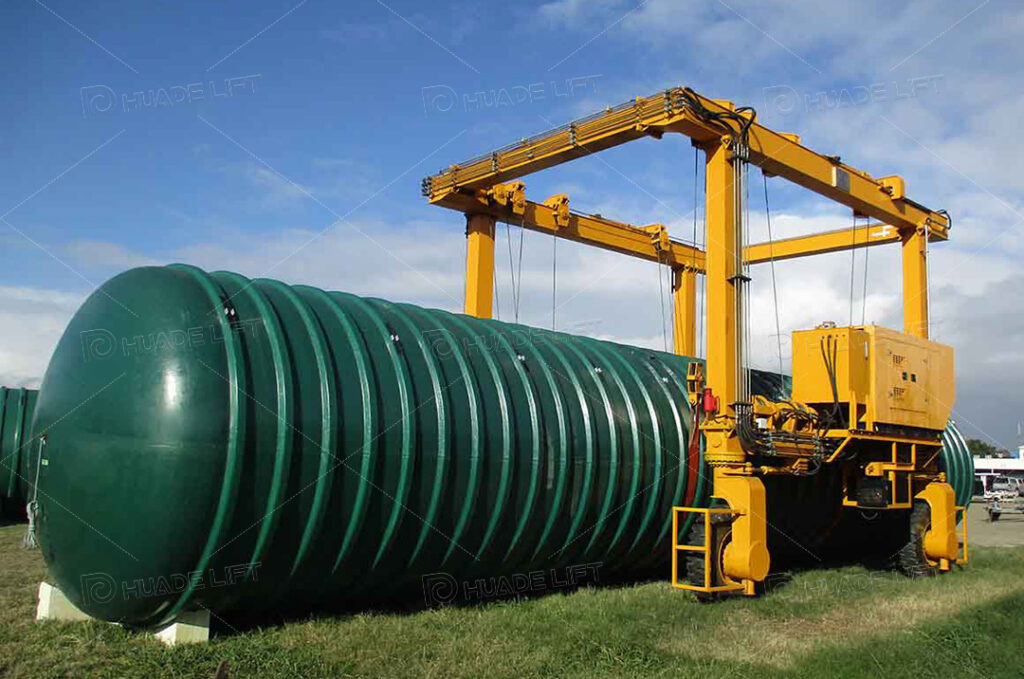
Why Choose a Rubber Tyre Gantry Crane for Steel Mills
Meeting Heavy-Duty Material Handling Demands
Core design focuses on “stable load-bearing + precise control,” tailored for heavy materials like steel coils and billets:
- Structural Strength Assurance: The main body features a box-type main girder structure made of high-strength low-alloy structural steel. After CNC cutting, automated welding is performed by robotic welders. Post-welding, the entire structure undergoes stress-relief aging treatment to completely eliminate internal welding stresses. This ensures no permanent deformation occurs during long-term heavy-load handling, preventing structural cracking risks.
- Stable Hoisting System: Dual synchronous winch drives feature forged steel drums with high-temperature quenching for enhanced wear resistance, preventing deformation from prolonged wire rope entanglement. Multi-layer orderly rope winding with automatic rope guides eliminates jamming and tangling, ensuring smooth material lifting. Equipped with a torque limiter that continuously monitors lifting torque. When torque approaches the equipment’s rated capacity, it automatically reduces lifting speed to prevent overload damage.
- Multi-Mechanism Coordination: Both the main and trolley travel mechanisms utilize wheel-end geared motors. These motors deliver high torque output and stable rotational speed, providing ample power for horizontal movement of heavy loads. Programmable Logic Controllers (PLCs) synchronize multiple mechanisms—hoisting, main crane, and trolley—enabling precise coordination. For instance, fine-tuning the main crane position during lifting prevents lateral material drift, ensuring operational accuracy.
Flexible Intra-Plant Mobility
Adapted to steel mills’ dispersed layouts and frequent reconfigurations, the mobility design prioritizes practicality:
- Multi-mode Traction: Utilizing all-wheel drive with independent steering mechanisms enables three core movement modes:
- Straight-line mode for long-distance cross-area transport
- Diagonal mode for rapid diagonal repositioning
- 360-degree on-the-spot turning mode for agile directional adjustments in equipment-dense, narrow-passage areas.
This eliminates the need for repeated body repositioning when switching work zones, minimizing site constraints.
- Durable Wheel Configuration: Equipped with solid tires engineered for industrial use, featuring a high-abrasion-resistant rubber compound tread that withstands scratches from factory debris like gravel and metal shavings. Internal multi-layer steel cord reinforcement enhances overall structural strength, enabling the tire to withstand dual pressures from the equipment’s weight and material loads while adapting to minor unevenness in factory surfaces. This reduces tire deformation and wear, extending service life.
- Auxiliary Safety Features: Equipped with a laser navigation system that captures real-time position data from reflective markers affixed to the factory floor. By integrating this with pre-programmed operational maps, the system automatically plots optimal movement paths, eliminating route deviations caused by visual obstructions during manual operation. Additionally, a wheel load balancing system automatically adjusts force distribution across each wheel based on material weight. This ensures no single wheel exceeds the ground’s load-bearing limit during heavy-duty movement, preventing surface indentation and damage.
Customizable Lifting Attachments
Addressing the challenge of handling diverse materials in steel mills, specialized attachments are tailored to solve the “one-size-fits-all lifting” dilemma:
- Steel Coil Clamps: Utilizing a dual-hydraulic cylinder synchronous drive structure, the clamping arms feature an arc-shaped design that perfectly conforms to the coil’s outer circumference, preventing sidewall deformation during gripping. The clamping surface is covered with polyurethane elastomer—a soft, wear-resistant material that protects the coil’s surface coating from scratches while enhancing friction to prevent slippage. The clamping arm opening angle automatically adjusts to the coil diameter, with pressure sensors regulating clamping force to accommodate various coil specifications.
- Specialized Lifting Devices for Steel Ingots/Plates: For elongated steel ingots, custom-designed beam-type lifting devices feature a box-shaped steel structure with hooks at both ends that slide along the device’s length. By adjusting hook spacing, the lifting points align with the ingot’s center of gravity, evenly distributing the load to prevent bending due to uneven stress.
- Custom Electromagnetic Suction Cup Lifting Device for Steel Plates Without Lifting Points: Designed for steel plates lacking lifting points, this device features a suction surface assembled from high-permeability silicon steel sheets. An internal electromagnetic coil generates a strong magnetic field to securely hold the steel plate, eliminating the need for welding or drilling lifting points onto the plate and simplifying the operation process. The suction area can be customized according to the steel plate dimensions to ensure even distribution of magnetic force and prevent plate edges from lifting.
- Specialized Lifting Devices for Irregular Materials: For irregular materials like shaped steel and large pipe fittings, modular lifting devices are employed. Support components can be swapped based on material geometry—e.g., curved clamps for round pipes and V-shaped blocks for angle steel. Support surfaces are coated with anti-slip rubber to enhance friction and prevent shifting during transport. The top of the lifting device incorporates a rotating mechanism, enabling 360-degree adjustment of the material’s placement angle. This facilitates precise positioning at designated workstations and adapts to complex operational scenarios.
Cost Advantages Over Rail-Based Systems
Considering the full lifecycle—initial investment, ongoing maintenance, and long-term scalability—the cost advantages align better with steel mill budget requirements:
- Lower upfront investment: Unlike rail-based systems requiring dedicated track installation—which involves excavating foundation pits, pouring concrete footings, laying rails and sleepers, resulting in complex and lengthy construction— Rubber tyre gantry cranes only require ground compaction and leveling within the plant area. Ordinary concrete or asphalt surfaces suffice, simplifying construction processes. No specialized track construction teams are needed, with a build cycle of just 1-2 weeks. This enables rapid production deployment, minimizes disruption to normal operations, and significantly reduces infrastructure costs.
- Flexible Expansion and Adjustment: When steel mills require layout adjustments due to capacity expansion or product restructuring, rail-based systems cannot relocate tracks—demolition and reconstruction are necessary, incurring high costs and lengthy timelines. In contrast, rubber tyre gantry cranes operate independently of tracks. Simply preparing the ground in the new work area allows direct adjustment of the operational range, adapting to layout changes and reducing costs and time investment for future expansions.
-

Straddle Carrier for Precast Concrete Production-Huadelift
Specialized Solutions for Harsh Steel Mill Environments
Heat-Resistant Components
The core challenge in steel mill high-temperature zones is “heat radiation + component heat resistance.” Solutions address three key dimensions:
- Electrical Systems: Components utilize high-temperature-resistant models, with silver alloy contacts for contactors and high-temperature polyimide insulation for coils. Cables feature silicone rubber insulation + glass fiber braiding for high-temperature baking resistance. Control cabinets incorporate water-cooled heat dissipation systems paired with temperature sensors and controllers, automatically increasing cooling water flow during overheating to stabilize internal temperatures.
- Structural Components: Main and end beams utilize heat-resistant steel maintaining strength and toughness at elevated temperatures with low thermal expansion coefficients. Connecting bolts are made of high-temperature alloys coated with heat-resistant anti-loosening adhesive to prevent thermal expansion/contraction-induced loosening.
- Operating Environment: The cab features a double-layer insulated structure (outer layer: cold-rolled steel plate + inner layer: high-temperature resistant rock wool). Windows utilize double-pane heat-resistant glass (filled with inert gas + radiation-shielding film). An industrial air conditioner (with high-temperature resistant condenser) is integrated, along with a temperature alarm system to ensure personnel safety.
Corrosion Protection Design
The core protection strategy is “blocking corrosive media + enhancing material resistance,” integrated throughout the design process:
- Structural Design: Enclosed structures (main beams, end beams) feature drainage holes at lowest points to prevent water accumulation; curved transitions at joints minimize dust and corrosive liquid buildup; continuous welds prevent media intrusion. Hydraulic and lubrication tanks are sealed with breather filters; oil pipe connections use double ferrule seals to prevent leakage.
- Component Materials: Weathering steel (containing copper, nickel, and chromium to form a dense oxide film) for the main metal structure; stainless steel fasteners (duplex stainless steel for critical areas to resist acids and alkalis); chrome-plated hydraulic cylinder barrels (uniform and smooth for corrosion resistance and wear resistance); corrosion-resistant engineering plastics for electrical component housings.
- Surface Treatment: Metal structures undergo degreasing, acid washing, and phosphating before coating with a multi-layer system: “Epoxy zinc-rich primer + Epoxy micaceous iron oxide intermediate coat + Topcoat” — epoxy topcoat for indoor use, fluorocarbon topcoat for outdoor use (weather-resistant and corrosion-resistant). Includes periodic anti-corrosion maintenance reminders for timely coating repairs and replacement of corroded components.
Dust-Resistant and Durable Electrical System
Addressing risks of “dust ingress + component failure” through three-tiered protection:
- Electrical Control Cabinet: Fully sealed enclosure (2.5mm cold-rolled steel plate welded with sealant-coated welds), cabinet doors fitted with oil-resistant, aging-resistant foam rubber gaskets; Ventilation openings feature triple filtration (coarse-mesh metal screen for large particles, ultra-fine fiber filter paper for fine dust, activated carbon filter for oil-absorbing dust), with an external sloped rain cover to prevent water ingress.
- Electrical Components of Drive Units: Motor and reducer housings achieve IP55 protection rating, with heat sink fins spaced optimally (balancing heat dissipation and dust resistance); Motor junction boxes are sealed with waterproof/dustproof terminals, secured with sealant after wiring. Gear reducer control interfaces use aviation connectors (with minimal clearance + sealing rings, threaded fasteners for dustproofing).
Maintenance and Full Lifecycle Considerations
Long-term stable operation of rubber tyre gantry cranes relies on “scientific maintenance + cost control.” Its maintenance system and full lifecycle advantages are designed for steel mill operational characteristics. The maintenance strategy combines “preventive maintenance + predictive maintenance”: Preventive maintenance follows fixed cycles, such as monthly tire pressure and wear inspections, quarterly cleaning of electrical cabinet filters and hydraulic oil filter replacement, semi-annual wire rope lubrication and wear checks, and annual non-destructive testing of metal structure welds. This prevents failures caused by excessive component wear through regular interventions. Predictive maintenance leverages real-time data from the remote monitoring system. When sensors detect potential fault signals—such as abnormal motor vibration or elevated bearing temperatures—the system automatically alerts maintenance personnel for targeted inspections. This approach prevents resource waste from “over-maintenance” while minimizing downtime losses caused by “repair after failure.”
Conclusion
Through targeted structural design and technical configuration, the rubber tyre gantry crane perfectly meets these demanding requirements: Their heavy-duty load capacity ensures stable handling of steel coils, billets, and other bulk materials. The flexible tire-mounted travel system adapts to dynamic operational layouts within the plant. Customized lifting attachments accommodate diverse material handling needs, while specialized heat-resistant, corrosion-proof, and dust-proof solutions guarantee long-term stable operation in harsh conditions.
If your steel mill faces challenges such as low material handling efficiency, frequent equipment failures, or high maintenance costs, we invite you to contact our professional team.
