
Rubber – tired gantry cranes (RTGs), with their flexibility and strong adaptability to various sites, have become indispensable key equipment in global container logistics hubs, bulk cargo terminals, and heavy – industry projects. These devices achieve full – area movement through tire – type traveling mechanisms and complete the vertical and horizontal transfer of goods in combination with the hoisting mechanism. Their operational efficiency directly determines the turnover capacity of logistics hubs.
In the technological evolution of rubber tyred gantry cranes, the girder structure has always been a core design element. The differentiation between single – girder and double – girder structures stems from the diverse requirements of different operation scenarios for load – bearing capacity, stability, and cost control. This article aims to systematically compare the technical characteristics, performance boundaries, and application conditions of the two structures, helping equipment purchasers accurately match their operational needs and avoid efficiency losses or cost waste caused by improper selection.
Design Overview of Rubber Tired Gantry Cranes
The overall performance of an rubber tyred gantry crane depends on three core systems: the load – bearing structure (girder), the drive system (traveling and hoisting), and the control system. Among them, as the core of load – bearing, the girder structure directly determines the maximum lifting capacity, span range, anti – overturning ability, and dynamic stability of the equipment.
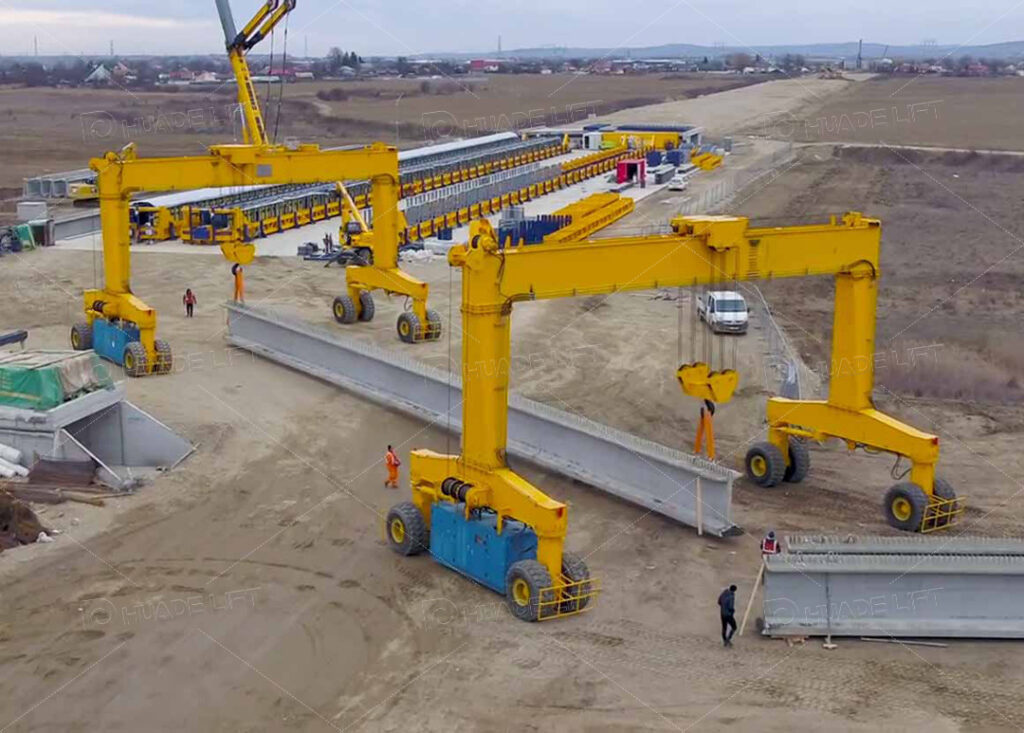
The single – girder rubber tyred gantry crane uses a single main truss girder as the main load – bearing structure. The girder usually adopts a box – shaped cross – section or truss structure and is connected to the traveling mechanism through two side legs. The overall structure presents a “portal” – shaped frame. The double – girder rubber tyred gantry crane, on the other hand, uses two parallel – arranged main truss girders, which are connected by cross – beams to form a closed – frame structure. This design distributes the load more evenly and significantly improves the structural rigidity.
The design differences between the two structures result in distinct performance characteristics: the single – girder structure pursues light – weight and economy, while the double – girder structure emphasizes heavy – load capacity and operational stability. In practical applications, this difference is directly reflected in the applicable scenario boundaries of the equipment – from intermittent operations in medium – and small – scale yards to continuous heavy – load operations in large – scale terminals, forming a complementary market positioning.
Design of Single Girder Rubber Tired Gantry Cranes
Structural Features
The core feature of a single – girder rubber tyred gantry crane is the use of a single main truss girder as the load – bearing body. The girder material is mostly low – alloy high – strength steel, which is formed into a box – shaped cross – section structure through welding, ensuring both structural strength and reducing self – weight. The two ends of the main girder are connected to the traveling trolleys through rigid legs. The connection nodes between the legs and the main girder are designed with stiffening rib plates to disperse stress concentration.
The trolley running mechanism adopts a suspended design, moving along the track on the lower flange of the main girder through rollers. The hoisting mechanism is integrated with the trolley to form a compact working unit. This structural layout makes the self – weight of the whole machine significantly lower than that of double – girder equipment of the same level, and the turning radius is relatively small, remarkably improving the site adaptability.
Advantages
The outstanding economy is a significant feature of single – girder rubber tyred gantry cranes. Their structure consumes less material, resulting in relatively low manufacturing costs. The equipment purchase price is usually lower than that of double – girder equipment of the same span. At the same time, the production cycle is short, which can quickly respond to market demands, especially suitable for projects with limited budgets. Excellent mobility also gives it more advantages in site adaptation. The whole machine has a light self – weight, resulting in a small ground bearing pressure. It can operate directly on a hardened concrete ground without special reinforcement. Moreover, the equipment has a small turning radius, and its scheduling flexibility in narrow sites is significantly better than that of double – girder equipment. In addition, the low operation and maintenance cost is also a major highlight. The simple structure reduces the number of failure points. Daily maintenance only needs to focus on the hoisting mechanism and the running wheel system. The annual maintenance cost is lower than that of double – girder equipment. The replacement of vulnerable parts is convenient, and the spare – parts inventory pressure is small.
Limitations
The load – bearing capacity of conventional single – girder rubber tyred gantry cranes is limited. The maximum lifting capacity is relatively restricted, and there are also certain limitations on the maximum span, making it difficult to meet the operational requirements of ultra – wide yards or heavy – duty goods. It shows weak performance in dynamic stability. When lifting eccentric loads or in windy weather, the deflection of the main girder is relatively large, and it is prone to shaking. Therefore, the running speed of the trolley needs to be limited during operation, which reduces the operational efficiency to a certain extent. In addition, the rigidity limitation of the single – girder structure makes its upgrade space limited. It is difficult to install an automated guidance system, and the lifting capacity cannot be increased through modification. The functional expansion ability during the equipment’s life cycle is weak.

Design of Double Girder Rubber Tired Gantry Cranes
Structural Features
The double – girder rubber tyred gantry crane adopts a parallel double – main – truss – girder structure. The two main girders are connected horizontally to form a rigid frame. The cross – section of the main girder is a variable – cross – section design (higher in the middle and lower at both ends), which not only ensures the load – bearing capacity in the middle of the span but also reduces the weight at the ends. The material of the main truss girder is low – temperature – toughness steel, which can adapt to a wide temperature working environment.
The legs adopt a “V – shaped” diagonal bracing design, forming a triangular stable structure with the main girder. The bottom of the legs disperses the load through large – scale traveling trolleys. The trolley running mechanism is located between the two main girders and moves along the upper – flange track through four groups of rollers. The hoisting mechanism adopts a double – drum design to improve synchronization and safety.
Advantages
The double – girder rubber tyred gantry crane has a strong heavy – load capacity. The lifting capacity of standard equipment is relatively large, and the span coverage is wide, which can meet the multi – layer stacking requirements of ultra – wide yards. Excellent operational stability is also an important advantage. The double – girder frame significantly improves the structural rigidity. The deflection of the main girder is small, and the amplitude is small during full – load operation. It can operate normally in an environment with strong winds. In addition, its automation adaptability is good. The rigid structure provides a stable foundation for the installation of sensors, facilitating the integration of intelligent systems such as automatic positioning, anti – sway control, and remote operation. Currently, most automated container terminals around the world use double – girder rubber tyred gantry cranes.
Limitations
The initial investment of double – girder rubber tyred gantry cranes is high. Since the manufacturing cost of the structure is higher than that of single – girder, the equipment purchase price is relatively high. Coupled with the foundation reinforcement cost, the overall investment pressure is great. At the same time, the site requirements are strict. The equipment has a large self – weight and high requirements for ground bearing pressure. A specially designed reinforced concrete foundation is required, which limits its application in temporary sites. In addition, the operation and maintenance complexity is high. The double – girder structure has many connection nodes, and the pre – tightening force of bolts and the weld status need to be checked regularly. The annual maintenance cost is higher than that of single – girder equipment.
Single Girder VS Double Girder Rubber Tired Gantry Cranes
Cost Analysis
In terms of cost, single – girder rubber tyred gantry cranes have obvious advantages. Their procurement cost is relatively low. This is because the single – girder structure is more concise in material use, and the production process is relatively simple. There is no need to perform high – precision parallelism adjustment and connection reinforcement on two main girders as in the case of double – girders. Therefore, the manufacturing cost is relatively low, and the equipment purchase price is usually lower than that of double – girder equipment of the same span. The installation and commissioning costs are also relatively small. The single – girder structure has fewer components and a lighter weight. The hoisting and installation processes are more convenient, requiring less manpower and equipment investment, and the installation period is shorter. Since it has low requirements for the ground, the single – girder rubber tyred gantry crane has a light self – weight, resulting in a small pressure on the ground. It can operate directly on a hardened concrete ground without basically any additional foundation treatment costs, saving a significant amount of upfront investment. In long – term use, the annual maintenance cost and energy consumption cost of single – girder rubber tyred gantry cranes are also lower than those of double – girder rubber tyred gantry cranes. Their simple structure reduces the number of failure points. Daily maintenance only needs to focus on the hoisting mechanism and the running wheel system. The replacement of vulnerable parts is convenient, the spare – parts inventory pressure is small, and the light self – weight also reduces power consumption.
On the other hand, the procurement cost of double – girder rubber tyred gantry cranes is relatively high. The double – girder structure requires more steel, and the requirements for the material quality and processing accuracy of the main girders are higher. The connection and stability structure of the two main girders also increase the manufacturing cost, so the equipment purchase price is higher. The installation and commissioning are more complex. The double – girder equipment has a large weight and many components. Larger hoisting equipment is required during installation, and the parallelism and stability of the two main girders need to be ensured. The commissioning process is also more cumbersome, and the cost increases accordingly. At the same time, a high amount of foundation treatment costs need to be invested. The double – girder rubber tyred gantry crane has a large self – weight and high requirements for ground bearing pressure. A specially designed reinforced concrete foundation is required, and sometimes geological reinforcement treatment is even needed, which undoubtedly increases the upfront construction cost. The annual maintenance cost and energy consumption cost are also at a relatively high level. The double – girder structure has many connection nodes. The pre – tightening force of bolts and the weld status need to be checked regularly. The maintenance procedures are numerous and difficult, and the equipment needs to drive a heavier structure during operation, so the energy consumption is naturally higher.
Performance Parameter Comparison
In terms of performance parameters, the lifting capacity, span range, and lifting height of single – girder rubber tyred gantry cranes are relatively limited. Due to the load – bearing capacity of the single – girder structure being restricted by the strength and stiffness of a single main girder, its maximum lifting capacity is relatively limited, making it difficult to meet the hoisting requirements of ultra – heavy goods. The span range is also small, unable to cover an overly wide working area, and the lifting height is also limited to a certain extent. In some scenarios that require high – altitude operations, it may not meet the requirements. The working level is moderate, mainly suitable for medium – intensity operations, and it has weak adaptability to high – intensity and continuous operations. The running speed of the trolley is also slow. This is because the single – girder structure has poor stability at high speeds. To ensure operational safety, the running speed of the trolley has to be restricted, thus affecting the operational efficiency to a certain extent.
Double – girder rubber tyred gantry cranes perform better in these aspects. They have a larger lifting capacity. The double – girder structure, through the joint load – bearing of two main girders, disperses the load, greatly improving the load – bearing capacity of the equipment, and can easily handle the hoisting tasks of heavy or even ultra – heavy goods. The span range is wider, which can cover a wider working area, meeting the operational requirements of large – scale yards, terminals, and other places. The lifting height is higher, being able to adapt to a higher working space and providing the possibility for some special high – altitude hoisting operations. The working level is higher, with stronger durability and reliability, and can adapt to high – intensity and long – time continuous operations. The running speed of the trolley is also faster. The double – girder structure has good stability and can still maintain good smoothness at high speeds, thus improving the operational efficiency and meeting more onerous operational requirements.
Applicable Scenario Mapping
Single – girder rubber tyred gantry cranes are more suitable for “light – load, flexible, and low – cost” operational requirements. In medium – and small – scale sites, their small size and flexible scheduling performance can fully play a role without being restricted by the narrow site. For intermittent operations, the performance of single – girder rubber tyred gantry cranes is sufficient to meet the requirements without causing waste of equipment resources. Projects with limited budgets also tend to choose single – girder rubber tyred gantry cranes, which can ensure basic operational capabilities while controlling costs.
Double – girder rubber tyred gantry cranes match “heavy – load, continuous, and high – reliable” scenarios. Large – scale hubs have extremely high requirements for the load – bearing capacity and operational efficiency of equipment. Double – girder rubber tyred gantry cranes can be competent for the rapid loading, unloading, and transfer of a large amount of goods. Long – time continuous operations pose a great test to the stability and durability of equipment. The rigidity and strength of the double – girder structure enable it to operate stably under such working conditions. Projects with clear automation upgrade requirements are also more suitable for choosing double – girder rubber tyred gantry cranes. Their structure provides a stable foundation for the installation and operation of automated systems, facilitating the realization of intelligent operations.
Operation and Maintenance Differences
In terms of operation, single – girder rubber tyred gantry cranes are relatively easy to operate. Due to their simple structure and relatively low performance parameters, operators can easily get started, and the requirements for operating skills are not high, with a short training period. However, during the operation process, it is necessary to always pay attention to the stability of the equipment, especially when lifting heavier or eccentric loads, and operate carefully to avoid safety accidents caused by excessive shaking.
The operation of double – girder rubber tyred gantry cranes is relatively more complex. Since the equipment has powerful performance and more functions, operators need to master more operation skills and precautions, and the training period is longer. However, the double – girder rubber tyred gantry crane has good stability. Even when performing some more complex actions during the operation process, the equipment can still maintain good smoothness, providing operators with a safer and more comfortable operation experience.
In terms of maintenance, the maintenance of single – girder rubber tyred gantry cranes is relatively simple. The simple structure results in few failure points. Daily maintenance mainly focuses on a few components such as the hoisting mechanism and the running wheel system. The maintenance procedures are few and the difficulty is low, and the requirements for the professional level of maintenance personnel are not high. Moreover, the replacement of vulnerable parts is relatively convenient. The universality of spare parts is strong, and procurement and inventory management are relatively easy.
The maintenance of double – girder rubber tyred gantry cranes is more complex. The complex structure leads to more connection nodes and more components, and there are more parts that need to be maintained, such as the connection bolts of the main girders, welds, and double – drum hoisting mechanism. The maintenance procedures are cumbersome and difficult, and the requirements for the professional level of maintenance personnel are high. At the same time, the accuracy requirements of some key components are high. The replacement and debugging are difficult, the specificity of spare parts is strong, the procurement cost is high, and inventory management is more complex.
Safety Comparison
Single – girder rubber tyred gantry cranes have certain limitations in terms of safety. Due to their relatively weak structural stability, when lifting heavy loads, eccentric loads, or in case of strong winds, they are prone to shaking and deflection, increasing the safety risks of operations. Once overloading or improper operation occurs, the single – girder structure may deform or even be damaged due to excessive stress, triggering safety accidents.
Double – girder rubber tyred gantry cranes have higher safety. The double – girder structure forms a stable frame with good rigidity. It can maintain good stability under various operating conditions. Even when lifting heavy loads or in adverse weather conditions, it is not easy to produce excessive shaking and deflection. Moreover, double – girder rubber tyred gantry cranes are usually equipped with more complete safety protection devices, such as overload protection, limit protection, anti – sway devices, etc., which can further ensure operational safety.
How to Choose the Right Design for Your Operations
Equipment selection needs to be based on a systematic assessment of one’s own operational needs. It is recommended to analyze from multiple dimensions. First, consider the load characteristics. Clearly define the maximum single – piece weight, the distribution of regular loads (uniform / eccentric), and the daily hoisting frequency. Operations with a lower frequency are suitable for single – girder, while those with a higher frequency are recommended to choose double – girder. Second, pay attention to the site conditions. Measure the maximum span requirements of the operation area, the ground bearing capacity (based on the geological survey report), the width of the passage and the turning – radius limitations, and select the appropriate equipment according to the actual site conditions. Also, consider the operation cycle. For short – term projects, the economy of single – girder can be considered, while for long – term operations, the full – life – cycle cost advantage brought by the durability of double – girder needs to be evaluated. In addition, the development plan is also important. It is necessary to reserve a certain space for business growth. If a large increase in throughput is expected in the future, the upgrade potential of double – girder is more advantageous.
Conclusion
Single girder and double girder rubber tyred gantry cranes serve different operational needs. Single girder rubber tyred gantry cranes are cost-effective, lightweight, and highly flexible, making them suitable for smaller yards, limited budgets, and medium-intensity operations. Double girder rubber tyred gantry cranes, on the other hand, offer higher lifting capacity, wider spans, and stronger stability, making them ideal for large-scale terminals, continuous heavy-duty work, and automation upgrades. The right choice depends on project size, load requirements, budget, and long-term operational goals.
