
Introduction
As the construction industry accelerates its transition toward greater efficiency and sustainability, modular construction has emerged as a new trend due to its unique building methodology. Portal cranes, serving as core equipment tailored to the material handling demands of modular construction, are expanding their application from logistics and port sectors into the construction industry, addressing numerous pain points associated with traditional handling equipment.
Overview of Modular Construction
Core Concept
Modular construction is a modern building approach where primary structural components are prefabricated in factories. Once these components meet quality standards, they are transported to the construction site for assembly. This model breaks the limitations of traditional on-site pouring, reshaping construction workflows by combining standardized factory production with efficient on-site assembly.
Advantages
Construction Schedule
Modular construction employs a parallel workflow of factory prefabrication and on-site preparation, eliminating the linear constraints of traditional construction sequences. This parallel operation effectively mitigates common schedule delays caused by weather fluctuations and poor workflow coordination, fundamentally ensuring timely project delivery.
Cost Optimization
The factory-prefabricated standardized production model significantly enhances material utilization and reduces waste generated by on-site processing. Simultaneously, modular construction substantially shortens construction cycles through parallel operations, effectively lowering ongoing costs such as labor and equipment rentals, thereby achieving comprehensive cost optimization control throughout the entire process.
Environmental Protection
Construction waste generated during the prefabrication phase of modular buildings can be centrally recycled and sorted within the factory, eliminating the disorderly disposal of waste common at traditional construction sites. On-site construction significantly reduces wet operations and cutting processes, effectively controlling noise and dust pollution. This approach fully aligns with the green transformation requirements for the construction industry under the “dual carbon” goals.
Material Handling Challenges
However, the efficiency of modular construction heavily relies on the transportation and on-site handling of prefabricated components. These components are typically large and heavy, making traditional handling equipment like standard forklifts and fixed cranes often inadequate for meeting the dual demands of “flexible mobility + precise positioning.” This process has become a key bottleneck limiting further efficiency gains in modular construction.
What is a Straddle Carrier?
Basic Definition
A straddle carrier is an off-road device specifically designed for transporting large, heavy loads. Its core structural feature involves four high support legs straddling the load, utilizing a lifting mechanism on the top crossbeam to lift and move the load. Unlike traditional lifting equipment, straddle carriers not only possess lifting capabilities but can also move autonomously with the load, eliminating reliance on tracks or fixed bases. They combine the lifting functionality of a crane with the mobility flexibility of a truck.
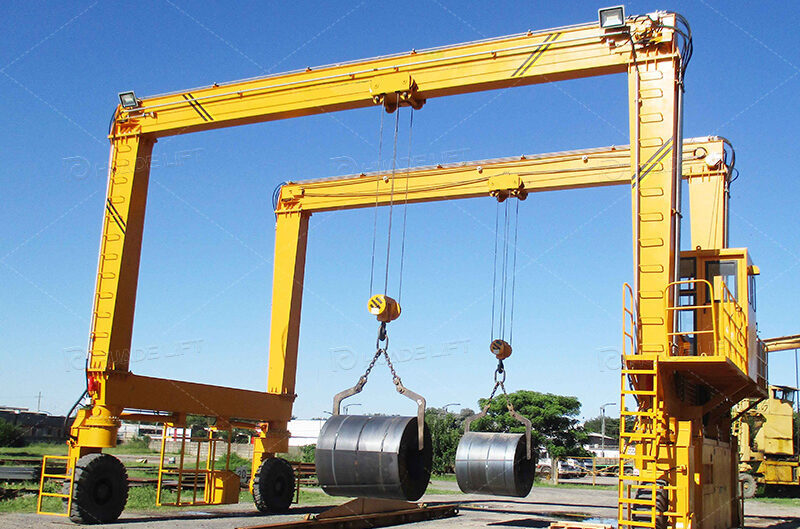
Straddle carrier
Application Scenarios
Before entering the modular construction sector, straddle carriers were primarily used in logistics and port industries for handling international standard containers. At port terminals, they unload containers from cargo ships to storage yards or transfer them to freight trucks. In container yards, they enable stacked storage to optimize space utilization. Within industrial parks, they transport large industrial equipment or heavy raw materials, serving as critical logistics assets.
Types of Straddle Carrier Applications in Modular Construction
Modular Building Relocation
For modular buildings requiring complete relocation—such as temporary office spaces, makeshift classrooms, and emergency shelters—straddle carriers enable seamless transportation without dismantling the structures. Their robust load-bearing capacity and stable mobility ensure structural integrity during relocation, eliminating time and cost wastage from disassembly and reassembly while enhancing building reusability and flexibility.
Transportation of Prefabricated Building Modules
Straddle carriers undertake the critical task of transporting large prefabricated modules (such as walls, floor slabs, and roof modules) from manufacturing facilities to construction sites. During transit, their stable support structures and precise control capabilities ensure modules arrive undamaged and ready for subsequent assembly.
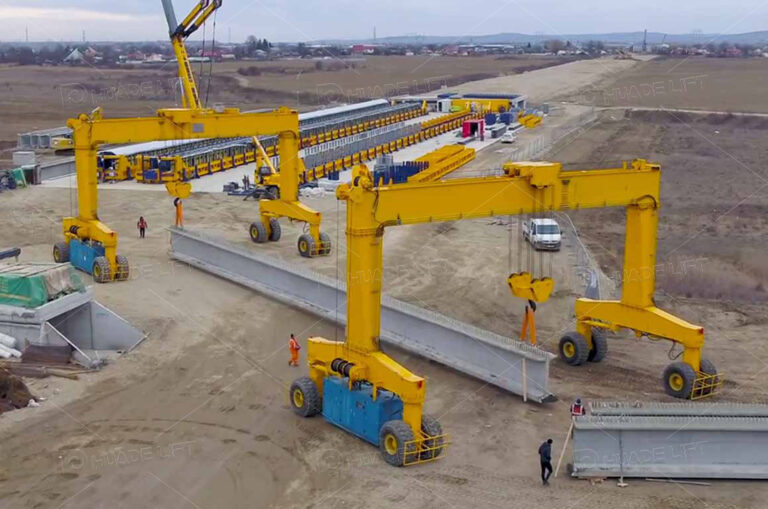
Transportation of Prefabricated Building Modules
Transporting Precast Concrete Panels
Straddle carriers are also extensively used for handling and positioning precast concrete panels. These panels, commonly employed for building facades, walls, and structural supports, are characterized by their substantial weight and large dimensions.
Equipped with specialized clamping or support devices, straddle carriers can stably transport concrete panels and place them precisely at designated construction locations. This minimizes damage during handling, safeguarding construction quality and schedule.
On-site Placement of Modular Units
Straddle carriers can directly transport prefabricated modular units to designated locations on construction sites and achieve precise placement. During placement, advanced positioning systems and operational controls enable the carrier to install modules accurately onto precast foundations according to architectural specifications. This reduces manual adjustment requirements, enhances assembly precision and efficiency, and ensures structural stability.
Heavy Equipment Handling at Construction Sites
At modular construction sites, straddle carriers transport various heavy equipment and large prefabricated components, such as generators, large machinery, and heavy structural elements required for construction. Their robust load capacity and agile mobility effortlessly navigate complex site conditions, delivering equipment and components precisely to designated workstations to ensure seamless deployment and operation of construction machinery.
Offshore Modular Transport
In offshore construction projects (e.g., offshore oil drilling platforms, offshore wind farms), straddle carriers transport prefabricated modular units to ships or offshore platforms. Facing challenging maritime conditions, their stable performance and reliable safety systems ensure modules arrive safely at offshore work sites despite waves, wind, and other factors, meeting the construction demands of offshore modular buildings.
How Straddle Carriers Revolutionize Efficiency and Versatility in Modular Construction Material Handling
Enhancing Material Handling Efficiency
Leveraging their exceptionally rated load capacity, straddle carriers can integrate and transport multiple heavy prefabricated components in a single operation. This highly efficient handling model fundamentally reduces material loading/unloading and transportation cycles by significantly decreasing handling frequency, substantially boosting overall operational efficiency.
Furthermore, its omnidirectional mobility technology and positioning system eliminate the need for repeated recalibration caused by positioning errors in traditional handling methods. This minimizes workflow handover delays, ensuring efficient circulation of building components throughout the entire construction process and providing reliable progress control for modular construction projects.
Enhanced Operational Versatility
With its exceptional engineering design and system integration capabilities, the cross-transport vehicle adapts seamlessly to diverse operational scenarios. In modular construction, it integrates effortlessly across conventional construction sites, port terminals, and offshore projects.
Through standardized interfaces, it rapidly switches between specialized lifting attachments and telescopic brackets, enabling safe transport of loads ranging from small prefabricated components to hundred-ton modules. This integrated solution effectively eliminates resource redundancy associated with multi-device coordination, boosting overall equipment utilization while significantly enhancing project logistics scheduling flexibility and responsiveness.
Optimizing Site Space Utilization
With its stacking storage capability, the straddle carrier redefines prefabricated component storage through a vertical storage model. This vertical storage concept breaks free from traditional flat storage limitations, extending components into the spatial dimension and drastically reducing ground footprint. This transforms construction sites from cluttered chaos into organized order.
Simultaneously, these vehicles eliminate dependence on fixed pathways typical of conventional handling equipment. Their agile maneuverability allows seamless navigation through complex construction environments. This freedom from pathway constraints not only liberates vast areas previously occupied by traditional pathways but also creates expansive operational space for other construction phases like concrete pouring and steel structure installation. This facilitates smoother coordination between site operations and drives overall construction efficiency.
Key Benefits of Using Straddle Carriers in Modular Construction
Efficiency Enhancement
Straddle carriers significantly reduce transportation and placement time for prefabricated modules. By handling multiple heavy components in a single lift, they minimize handling operations and reduce reliance on manual labor. Their stable performance and precise operation also decrease downtime caused by equipment failure or operator error, ensuring continuous and smooth construction processes to accelerate overall project progress.
Safety Assurance
Straddle carriers provide operators with precise control over heavy modules, enabling flexible material positioning to ensure accurate placement. Their stable structural design and comprehensive safety systems minimize accidents like material drops or equipment collisions, reducing personnel injury risks and fostering a secure construction environment.
Space Optimization
The straddle carrier’s efficient material handling capabilities organize storage and transportation on-site, reducing congestion caused by material accumulation. Strategic space planning allows workers to access required materials more conveniently, avoiding cluttered workspaces. This boosts productivity while mitigating safety hazards stemming from disorganized sites.
Enhanced Flexibility
The straddle carrier operates effectively across diverse environments—from confined urban construction sites to offshore specialized project locations. It adapts to transporting modular units of varying types and sizes, fulfilling diverse operational requirements through simple attachment changes. This eliminates the need for dedicated equipment per task, boosting versatility and cost-efficiency.
Cost Savings
Mechanized material handling reduces reliance on manual labor, cutting labor costs. Simultaneously, the straddle carrier‘s efficient operation minimizes construction delays, avoiding additional expenses from extended timelines, such as increased equipment rental fees and overtime labor costs. Furthermore, its low failure rate and straightforward maintenance requirements reduce repair expenses, contributing to overall project cost savings.
Straddle Carrier vs. Crane for Modular Construction
| Comparison Metrics | Straddle Carrier | Cranes |
| Installation Time | No complex installation required; ready for immediate use upon arrival | Require foundation construction and equipment assembly, resulting in extended installation time |
| Operational Flexibility | Self-propelled with crab-walk and in-place rotation capabilities for navigating confined spaces | Rely on fixed bases or tracks, limiting mobility and restricting operational radius |
| Single Lift Cost | Simple operation with minimal labor requirements, resulting in lower per-operation costs | Require specialized operators and numerous ancillary devices, leading to higher per-operation costs |
| Site Requirements | Requires no dedicated workspace and has relatively low ground leveling demands | Demand dedicated operational zones and equipment parking areas, with stringent ground load-bearing requirements |
Applications Where Straddle Carriers Excel Over Cranes
In construction sites with limited space, straddle carriers offer multiple advantages over cranes:
Advantages in Confined Space Operations
In modular construction projects with restricted space, such as in city centers, straddle carriers can effectively avoid conflicts with other construction equipment thanks to their flexible mobility. Cranes, constrained by their operational radius, struggle to efficiently handle material handling tasks in tight spaces.
Short-Distance, High-Frequency Transport Efficiency
For scenarios requiring frequent short-distance transport of prefabricated modules, straddle carriers eliminate the need for repeated repositioning, enabling rapid task completion with significantly higher operational efficiency than cranes.
Temporary Storage Advantages
During modular construction’s temporary storage phase, the stacking capability of straddle carriers substantially saves floor space—an advantage unavailable to cranes.
Scenarios Where Straddle Carriers and Cranes Collaborate to Boost Project Efficiency
In large-scale modular construction projects, cranes can unload prefabricated modules from transport vehicles into temporary on-site storage areas. Cranes’ high lifting heights and heavy load capacities suit long-distance, high-altitude handling needs.
Subsequently, straddle carriers precisely transport stored modules to assembly locations on the construction site, leveraging their strengths in short-distance, high-precision positioning. This collaborative operation maximizes the functional characteristics of both equipment, achieving peak efficiency throughout the entire modular construction material handling process.
Choosing the Right Straddle Carrier for Modular Handling
Core Selection Factors
Load Capacity Range
Select a straddle carrier with appropriate load capacity based on the maximum weight of modular construction prefabricated components. Ensure the equipment can stably support all types of prefabricated modules and avoid overload operations.
Lifting Height
Select a straddle carrier with sufficient lifting height based on the required stacking layers of prefabricated modules and spatial height constraints at the construction site to ensure smooth module stacking and assembly operations.
Tire Type
Select tire type based on site ground conditions. For muddy or rugged terrain, choose off-road tires with strong traction and slip resistance. On flat, hardened surfaces, standard rubber tires may be used to reduce equipment operating costs.
Power Source
Select the power type based on the project’s environmental requirements and the energy supply conditions at the construction site. If the project has strict carbon emission requirements and charging facilities are available on-site, choose a pure electric straddle carrier. If the energy supply at the construction site is unstable or continuous operation for extended periods is required, a hybrid straddle carrier is a more suitable choice.
Terrain Adaptability
Consider site topography—including slope presence and ground leveling—to select a straddle carrier with corresponding terrain capability, ensuring stable operation in complex conditions.
Equipment Customization
Due to variations in the dimensions and shapes of prefabricated components across different modular construction projects, standard-model straddle carriers may not be fully compatible.
Therefore, during the selection process, emphasize the customization of the straddle carrier. Adjust parameters such as the support leg spacing and the clamping method of the lifting mechanism based on the specific dimensions of the prefabricated modules. This ensures the equipment perfectly matches the module handling requirements, enhancing both operational safety and efficiency.
Equipment Maintenance and Operator Training
When selecting a straddle carrier, prioritize equipment with ease of maintenance and low maintenance costs. Opt for units with simple structures and readily replaceable wear parts to minimize future maintenance complexity and expenses. Additionally, operator proficiency directly impacts both operational efficiency and safety.
Therefore, choose equipment suppliers that provide comprehensive operator training services. This ensures operators master the equipment’s operating techniques, safety protocols, and daily maintenance methods, thereby safeguarding stable equipment operation and workplace safety.
Conclusion
From transporting prefabricated components to on-site placement, the straddle carrier overcomes the limitations of traditional equipment through its “straddle + mobility” capabilities, addressing the three core challenges of modular construction: space, efficiency, and safety.
In terms of efficiency, their high mobility and stacking capabilities optimize material flow and storage, streamline sequential processes, and significantly reduce assembly cycles. Regarding safety, their stable structures, protective systems, and remote operation minimize accident risks, fortifying safety defenses.
As industry-transforming work mode innovators, cross-transport vehicles drive the realization of modular construction’s core value. With technological evolution, they will become a key pillar supporting the industry’s high-quality development.
