
In the global logistics and industrial sectors, the efficient operation of ports, container yards, and large-scale production bases relies heavily on various heavy-duty lifting equipment. Among these, rubber-tired cranes stand out as core equipment for connecting cargo loading/unloading, stacking, and short-distance transfers, thanks to their unique mobility advantages. From large-scale operations at container terminals to handling heavy components within industrial parks, the operational efficiency of rubber tyre gantry cranes directly determines the turnover speed of the entire logistics chain. They play an irreplaceable role in reducing corporate operating costs and enhancing supply chain competitiveness.
However, within the overall performance system of rubber tyre gantry cranes, tires—as the sole load-bearing components connecting the equipment to the ground—are often overlooked by some practitioners. In reality, tires are not only the foundation for the crane’s mobility but also a critical factor in ensuring operational stability, safety, and long-term efficiency. Imagine if, during peak container handling hours, a tire blowout suddenly immobilizes the crane. This would not only halt operations but could trigger chain reactions like cargo delays and terminal congestion, with economic losses mounting by the hour. More critically, tire failure can destabilize the crane’s center of gravity, potentially causing overturn accidents that pose lethal threats to both operators and equipment. Therefore, thoroughly understanding tires’ pivotal role in crane operations and mastering professional methods for tire selection, maintenance, and performance optimization have become essential priorities for port operators, logistics enterprises, and industrial production managers.
Tire Types for Rubber Tired Cranes
Rubber-tired cranes operate in diverse environments—from level concrete docks to gravel-strewn temporary yards—each demanding distinct tire performance characteristics. The industry primarily employs two tire types: pneumatic tires and solid rubber tires. These differ fundamentally in structural properties, suitability, and operational costs, necessitating scientifically informed selection based on specific operational requirements.
Pneumatic Tires
Pneumatic tires utilize compressed air as an elastic medium, forming a sealed air chamber through the combination of inner and outer tubes. Their structural design fully addresses the cushioning and load-bearing requirements of heavy equipment. In terms of characteristics, the tire carcass employs a multi-ply cord reinforcement structure paired with a highly elastic rubber tread. This configuration enables the tire to withstand both the equipment’s own weight and cargo loads while absorbing vibrations and impacts during operation through the deformation of the air chamber. This cushioning property is particularly crucial when handling precision instruments, fragile goods, or containers with surface-sensitive cargo, effectively minimizing vibration impacts on cargo and reducing damage rates.
Solid Rubber Tires
Solid rubber tires feature an integrated solid structure, primarily composed of high-hardness, high-abrasion-resistant rubber vulcanized in molds. They can bear heavy loads without relying on air pressure. Their core advantages lie in exceptional durability and low maintenance: the tire body lacks an air chamber, completely eliminating the risk of punctures and air leaks. Even when operating in harsh environments filled with gravel or metal debris, they effectively resist cuts and impacts from sharp objects. Additionally, the tread employs a specialized wear-resistant compound, delivering significantly higher abrasion resistance than pneumatic tires. Under equivalent operational intensity, this results in substantially extended service life and markedly reduced tire replacement frequency.
In terms of load-bearing capacity, solid rubber tires demonstrate superior performance. Through optimized cross-section design and reinforcement layer distribution, solid tires achieve higher load capacity per unit area than pneumatic tires, making them particularly suitable for rubber tyre gantry cranes handling super-heavy containers or industrial components. Additionally, solid tires eliminate the need for regular tire pressure checks, puncture repairs, or inner tube replacements. Routine maintenance involves only clearing debris from the tread surface, significantly reducing upkeep.
Core Differences between the Two Tire Types
In terms of load capacity, solid rubber tires, with their solid structure and reinforced carcass design, are better suited for ultra-heavy-duty applications. Pneumatic tires, however, perform better in conventional heavy-duty operations and can adapt to varying load requirements through tire pressure adjustment.
In terms of durability, solid tires significantly outperform pneumatic tires in abrasion resistance and puncture resistance, offering longer service life in harsh environments. However, on smooth surfaces, pneumatic tires can maintain good durability with proper maintenance, and their shock-absorbing properties provide superior protection for equipment and cargo.
Regarding cost, pneumatic tires have lower initial purchase costs but incur higher maintenance expenses and frequent replacement costs. Solid tires have higher initial costs but offer extended service life and minimal maintenance, resulting in lower overall costs over time.
Maintenance requirements differ significantly: pneumatic tires necessitate regular pressure checks, puncture repairs, and inner tube replacements, creating complex operational workflows. Solid tires require only basic cleaning and visual inspections, making them easier to maintain and better suited for high-intensity, continuous operation scenarios.
Mobility of RubberTyre Gantry Cranes
The core distinction between rubber tyre gantry cranes and rail-mounted gantry cranes or fixed cranes lies in their high mobility enabled by tires. This characteristic frees them from the constraints of rails and fixed bases, allowing free movement across vast work sites and significantly enhancing operational flexibility and coverage. To understand how tires impact rubber tyre gantry crane mobility, an in-depth analysis is required across three dimensions: equipment structure, operating principles, and tire design.
Structure and Operating Principle of the RubberTyre Gantry Crane
The rubber tyre gantry crane primarily consists of five major components: the main girder, outriggers, hoisting mechanism, trolley travel mechanism, and tire travel mechanism. The main girder serves as the core load-bearing structure, supporting the weight of the hoisting mechanism and trolley. The outriggers connect the main girder to the tire travel mechanism, transferring the total weight of the equipment to the ground. The hoisting mechanism uses wire ropes and hooks to lift and lower cargo. The trolley travel mechanism drives the hoisting mechanism to move horizontally along the main beam, enabling horizontal cargo transfer. The tire travel mechanism is crucial for the crane’s mobility—it drives the tires via motors, coordinates with the steering mechanism to adjust direction, and propels the entire unit for longitudinal movement within the worksite, ultimately achieving three-dimensional cargo transfer.
In this process, the performance of the tire travel mechanism directly determines the crane’s mobility efficiency. As the executive component of the travel mechanism, tires must simultaneously fulfill three functions: traction, load-bearing, and steering. During traction, they must provide sufficient pulling force to move the equipment and cargo. During load-bearing, they must evenly distribute the equipment’s weight and the load to prevent excessive ground pressure from damaging the site. During steering, they must flexibly adjust angles to ensure precise turning even in confined spaces.
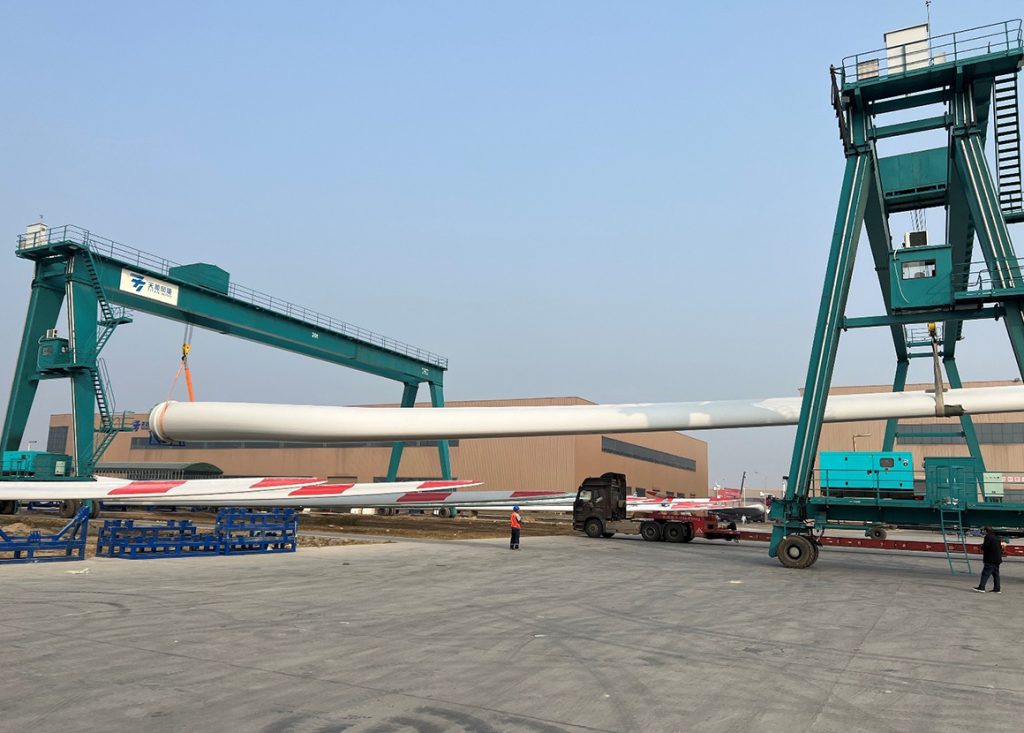
Rubber Tyred Gantry Crane for Wind-Energy
Impact of Tire Design on Heavy-Load Transport and Site Adaptability
In heavy-load transport scenarios, tire structural design is critical. First is tread width—a wide tread design increases the tire’s contact area with the ground, evenly distributing the weight of the equipment and cargo to reduce ground pressure per unit area, preventing concrete cracking or pitting.
Second is the carcass structure—tires with multi-ply steel cord reinforcement layers effectively enhance tensile strength and impact resistance, preventing bulging or rupture under heavy loads. Additionally, reinforced sidewalls improve lateral support, preventing tire rollover due to centrifugal forces during turns and enhancing driving stability.
For agile site operations, steering performance and tread pattern design are critical. The compatibility between steering mechanisms and tires directly impacts turning radius. Tires with independent steering enable zero-turn capability, allowing rubber tyre gantry cranes to maneuver flexibly in narrow passages and significantly improve site utilization. Tread pattern design must adapt to ground conditions: On dry, level concrete surfaces, shallow tread patterns reduce rolling resistance and increase travel speed. On wet or muddy terrain, deep tread patterns enhance drainage and traction, preventing tire slippage and ensuring reliable equipment operation.
Tire Adaptability to Ground Conditions
Rubber tyre gantry cranes operate across diverse terrains—from smooth concrete docks and level asphalt yards to gravel-strewn temporary sites and even waterlogged areas after rain. Each surface imposes distinct demands on tire performance. A tire’s ability to adapt to complex environments directly determines the crane’s operational range and safety, primarily through air pressure adjustment, tread design, and rubber compound selection.
Tire Adaptability on Different Surfaces
On smooth, hard surfaces like concrete and asphalt, tires primarily need to maintain stable contact area and low rolling resistance. Here, uniform tread contact distributes the equipment’s weight across the surface, preventing localized overpressure. Simultaneously, the smooth tread maintains an optimal friction coefficient with the hard ground—providing sufficient traction without excessive resistance that would increase energy consumption. In such conditions, both pneumatic and solid tires can operate normally. However, pneumatic tires offer superior shock absorption, reducing equipment vibration and providing better structural protection for the main beam and outriggers.
On slightly uneven surfaces—such as areas with small pits, bumps, or loose gravel—the tire’s cushioning and impact resistance become critical. Pneumatic tires adapt to minor ground undulations through air chamber deformation, maintaining good tread contact with the surface to prevent severe equipment jolts. In contrast, solid tires’ high rigidity can cause localized tread suspension on uneven surfaces, leading to uneven stress distribution. This not only accelerates tread wear but may also induce equipment vibration, compromising operational stability.
On wet or waterlogged surfaces, tire traction is paramount. In such conditions, the drainage capability of the tread pattern directly determines traction. Deep-tread tires rapidly expel water trapped between the tread and the ground through their grooves, reducing the impact of water films on friction and preventing slippage. Conversely, shallow-tread tires have weaker drainage, making them prone to forming water films that diminish traction and increase the risk of equipment loss of control. Additionally, the anti-slip properties of the rubber compound affect adaptability. Treads made with special formulations offer superior anti-slip performance on wet surfaces.
Impact of Key Tire Parameters on Terrain Adaptability
Tire pressure is a core parameter affecting terrain adaptability. For pneumatic tires, excessive pressure increases carcass rigidity and reduces cushioning, intensifying vibrations on uneven surfaces. Simultaneously, reduced contact area between the tread and ground increases pressure, accelerating tread wear and potentially damaging surfaces. Conversely, underinflation causes excessive tire deformation, increasing rolling resistance and power consumption while risking structural damage to the sidewalls from excessive compression, thereby shortening tire life. Therefore, tire pressure must be adjusted according to ground conditions—slightly higher pressure on smooth surfaces reduces resistance, while lower pressure on uneven terrain enhances cushioning.
The impact of tread design on ground adaptability primarily lies in pattern configuration and depth. Beyond variations in depth, the arrangement of tread blocks also influences performance: transverse patterns offer superior drainage for wet conditions; longitudinal patterns minimize rolling resistance on dry, level surfaces; while block patterns with intersecting grooves combine drainage and wear resistance, making them suitable for complex, variable terrain. Furthermore, tread depth must be adjusted based on operational intensity and ground abrasiveness. On gravel-heavy surfaces, deep tread patterns prevent stone embedding in grooves, thereby avoiding tread damage and extending tire lifespan.
The material properties of rubber compounds also directly influence a tire’s ground adaptability. Highly elastic rubber enhances cushioning performance, making it suitable for uneven surfaces; high-abrasion-resistant rubber boosts tread durability for rough terrain; while anti-aging rubber extends service life in outdoor operations by reducing degradation from UV exposure and rainwater. Selecting the appropriate rubber compound for each operating scenario maximizes tire adaptability and longevity.
Tires and Safety Considerations
Safety remains the paramount principle in rubber tyre gantry crane operations. As the sole component connecting the equipment to the ground, the performance and condition of tires directly impact load balance, stability, and operational safety. Tire failure not only halts operations but can also trigger severe accidents such as equipment overturns or cargo drops, resulting in casualties and substantial property damage. Therefore, thoroughly understanding the role of tires in safety assurance and establishing a scientific maintenance system are core prerequisites for safe rubber tyre gantry crane operations.
Professional Tire Safety Maintenance Process
To ensure tire safety performance, a systematic and standardized maintenance process must be established, covering three key phases: daily inspections, periodic maintenance, and specialized testing.
Daily inspections form the foundation of maintenance and must be performed by operators before each operation: First, conduct a visual inspection, focusing on checking the tread for cracks, bulges, punctures, or embedded foreign objects; inspect the sidewalls for cuts, aging, or cracking; and verify the secure connection between the rim and tire. Second, for pneumatic tires, use a professional tire pressure gauge to verify pressure meets the equipment manual’s specified range. Simultaneously, inspect the valve stem for leaks and ensure the valve cap is intact. Finally, observe tire wear patterns: check if tread depth has fallen below the safety threshold and if wear is uniform. If uneven wear or irregular tread surfaces are detected, promptly investigate the cause.
Regular maintenance must be performed at fixed intervals by professional technicians: First, tire cleaning—use a high-pressure water jet to remove debris from the tread and grooves to prevent damage from trapped particles. Second, carcass inspection—visually and tactilely examine the tire body for internal damage. A bulge in the tread may indicate a broken cord layer, requiring immediate removal and replacement. Third, inspect the wheel hubs and tighten the connecting bolts to prevent tire misalignment and imbalance caused by loose bolts. Fourth, analyze wear patterns to identify equipment anomalies—excessive center tread wear may indicate overinflation, while uneven sidewall wear suggests underinflation, necessitating targeted operational adjustments.
Specialized inspections are required for extreme environments or major operations, such as after typhoons, heavy rains, or before handling super-heavy cargo. A technical team must conduct a comprehensive performance assessment: using specialized equipment to evaluate structural strength.
Tires and Operational Efficiency
As the core operational component of tire-mounted cranes, tire quality directly determines the upper limit of equipment operational efficiency. In high-intensity environments like ports and yards, tire performance impacts overall operational rhythm across multiple dimensions—including work speed, site adaptability, and energy consumption. Simultaneously, tire stability directly correlates with equipment downtime and maintenance costs. Understanding the relationship between tire quality and operational efficiency, and implementing scientific performance optimization strategies, is a critical pathway for enterprises to reduce operating costs and enhance operational benefits.
The Deep Impact of Tire Quality on Crane Speed, Maneuverability, and Energy Consumption
Tire quality influences crane operating speed through two key aspects: rolling resistance and power transmission efficiency. Premium tires utilize low-rolling-resistance rubber compounds and optimized tread structures, effectively reducing friction between the tread and ground during operation. This enables higher travel speeds with the same power output. In contrast, inferior tires exhibit uneven tread rubber hardness and insufficient carcass structural strength. During operation, they are prone to excessive tread deformation or carcass distortion, significantly increasing rolling resistance. Even when the equipment’s drive system operates at full load, travel speed will decrease substantially. This is particularly evident during long-distance cargo transfers, where operational time is markedly extended.
Regarding maneuverability, a tire’s steering responsiveness and grip control are paramount. High-quality tires utilize high-rigidity rubber in the sidewalls, combined with precise tread contour design. This maintains stable tread contact during turns, preventing steering lag or deviation caused by sidewall deformation. Additionally, premium tread patterns feature scientifically calibrated traction, delivering ample lateral friction during low-speed turns to prevent slippage. This enables precise steering in confined spaces, reducing adjustment frequency and enhancing operational continuity. In contrast, inferior tires often suffer from insufficient sidewall rigidity and flawed tread designs. During turns, they are prone to tread slippage or equipment “oversteer,” not only increasing operational difficulty but also risking collisions with surrounding cargo or equipment, thereby compromising work efficiency.
Conclusion
As the “feet” of the rubber tyre gantry crane, tire performance permeates the entire operational lifecycle of the equipment, serving as the core determinant of its functionality, safety, and efficiency. In terms of maneuverability, tires grant equipment the flexibility to move beyond track constraints, with their design and quality directly impacting adaptability across different terrains and operational speed. Regarding safety assurance, tires play a critical role in load balancing and preventing overturns; high-quality tires and scientific maintenance form a vital defense against accidents. Regarding operational efficiency, tire quality determines equipment downtime frequency and maintenance costs. Optimizing tire performance can significantly reduce operational expenditures and enhance corporate profitability.
However, in actual operations, tire importance is often overlooked—some enterprises opt for substandard tires or cut maintenance budgets to reduce short-term costs, ultimately leading to frequent equipment failures, rising operational expenses, and even safety incidents. Therefore, a shift in mindset is essential: tire management must be integrated into overall equipment operational strategy, prioritizing scientific tire selection and professional maintenance. Whether in ports, yards, or industrial facilities, organizations should establish comprehensive tire management systems tailored to their specific operational environments. Through proper selection, standardized maintenance, and scientific operation, tire performance can be maximized and service life extended.
Finally, tire management is a systematic endeavor requiring a blend of specialized knowledge and practical experience. When encountering challenges in tire selection, maintenance, or performance optimization, promptly consult crane industry experts. Professional teams can provide customized tire solutions tailored to your enterprise’s specific needs—including tire type recommendations, maintenance process design, and operational optimization advice. This approach helps resolve tire management pain points, enabling safe, efficient, and cost-effective rubber tyre gantry crane operations while laying a solid foundation for your company’s long-term development.
