
Over the past decade, Vietnam has emerged as one of Southeast Asia’s fastest-growing infrastructure and manufacturing markets. From the advancement of national strategic transportation projects like the Lao Cai-Hanoi-Hai Phong cross-border railway and the North-South high-speed rail, to port expansions at Ca Mau Port, prefabricated component factory capacity increases, and the intensive implementation of wind power projects, Vietnam’s demand for construction machinery has experienced explosive growth.
Among these, the Rubber Tired Gantry Crane (RTG Crane) has become an essential piece of equipment for port yards, bridge construction, and heavy component lifting. Its core advantages—requiring no tracks and offering flexible operation—have driven sustained market demand growth.
For most Vietnamese buyers, “RTG crane price in Vietnam” is the foremost concern before procurement. Drawing on expertise from professional manufacturers and international project experience, this article systematically analyzes Vietnam’s RTG crane price ranges, cost structures, comparisons between imported and locally sourced solutions, and strategies to reduce overall procurement costs while ensuring safety and performance. It provides comprehensive procurement decision-making guidance for Vietnamese buyers, incorporating the latest market dynamics in Vietnam through 2025.
What is a Rubber Tyred Gantry Crane (RTG Crane)?
A rubber-tired gantry crane is a gantry crane that operates without rails, relying on rubber tires for mobility. Compared to rail-mounted gantry cranes (RMG), RTGs offer greater flexibility. They eliminate the need for pre-laid tracks and can be freely relocated across different areas based on operational requirements. This makes them particularly suitable for projects with frequent site changes or requiring multi-area coordinated operations, effectively reducing civil engineering costs and shortening project deployment cycles.
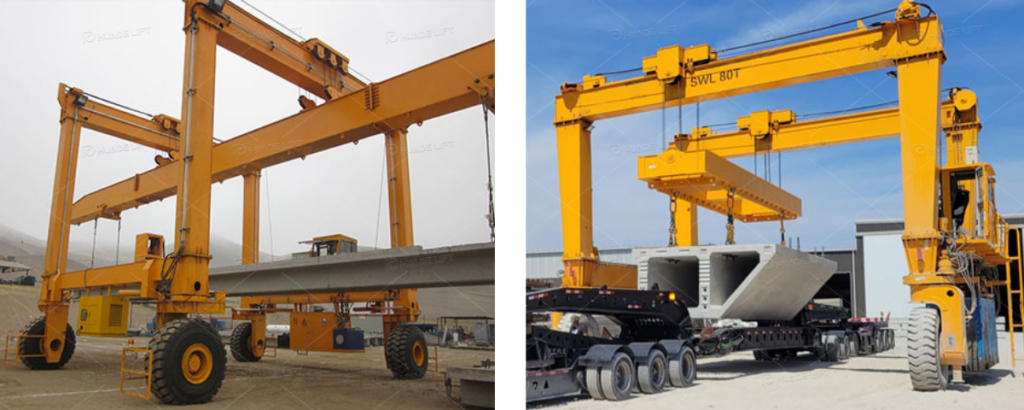
Core Working Principle of RTG Cranes
RTG cranes achieve heavy lifting and material transfer through the coordinated operation of four core systems:
Gantry Steel Structure: As the primary load-bearing component, it supports the main girder and the entire operational weight. Its strength directly determines the equipment’s load capacity.
Hoisting Mechanism: Comprising motors, reducers, and steel ropes, it performs vertical lifting and lowering of heavy loads, serving as the key system for operational efficiency.
Trolley System: Moves horizontally along the main girder, enabling positional adjustments of heavy loads across the span to precisely align with work points.
Rubber-Tired Travel System: Utilizes specialized engineering rubber tires, driven hydraulically or mechanically for longitudinal movement, adapting to diverse ground conditions.
Its primary advantages include: eliminating track installation, reducing civil engineering costs, enabling rapid deployment, and offering flexible operational range adjustments to suit Vietnam’s infrastructure projects characterized by multi-point, highly mobile work requirements.
Common Application Scenarios in the Vietnamese Market
Aligned with Vietnam’s current infrastructure and industrial development priorities, RTG cranes are primarily deployed in these core scenarios:
Ports and Inland Container Depots (ICDs): Handling container loading/unloading and storage operations at major ports like Cai Mep. Demand for port-grade RTGs has surged in recent years with Vietnam’s growing import/export trade.
Road and bridge construction projects: Used for lifting and transporting heavy components like precast beams and steel box girders in major transportation projects such as the North-South Expressway and cross-border railways;
Precast concrete beam and tunnel segment production bases: Supports production lifting, storage, and transportation of precast components to meet the scaled construction demands of infrastructure projects;
Steel structure manufacturing and yards: Supporting production assembly, finished product storage, and loading/transportation of steel components to bolster Vietnam’s manufacturing upgrade;
Wind power equipment and heavy modular component lifting: As Vietnam’s new energy sector expands, demand for lifting heavy components like wind turbine towers and nacelles increases, driving broader adoption of high-tonnage RTGs.
Overview of Rubber Tyred Gantry Crane Prices in Vietnam (2026)
Based on actual transaction data from the Vietnamese market in 2025, RTG crane prices in Vietnam exhibit significant variation. Core differences stem from lifting capacity, span, duty cycle, power configuration, and customization levels. Based on recent transaction data for Chinese RTG exports to Vietnam (e.g., a 40-ton RTG exported from Taicang Port to Vietnam valued at approximately $1.25 million per unit), the following represents the current market reference price ranges.
Price Range by Lifting Capacity (Reference)
| Lifting capacity range | Common applications | Price range (USD) |
| 20–40 tons | Pre-fabricated component factories, small steel structure factories, inland small storage yards | 80,000 – 150,000 |
| 50–100 tons | Bridge construction, port branch storage yards, wind power equipment hoisting | 150,000 – 300,000 |
| Over 100 tons | Large port main storage yards, heavy industrial production lines, large wind power projects | 300,000 – 600,000+ |
Price Variations Across Different Application Scenarios
Construction-type RTG: Structural design prioritizes mobility and cost control, typically operating at A5 duty cycle. Suitable for short-term infrastructure projects, it offers relatively lower pricing at approximately $80,000–$120,000 for the 20–40 ton capacity range.
Port-Grade RTG: Designed for high-frequency, continuous operation, typically rated at A7. Features high-reliability motors, anti-sway systems, and intelligent scheduling functions. Significantly higher priced, with 40-ton port RTGs costing $120,000–$150,000 per unit.
Precast plant-specific RTGs: Emphasize operational stability and precise positioning, requiring adaptation to standardized precast component production processes. Typically rated at A6, their pricing falls between construction-type and port-grade models, with 50-ton units costing approximately $180,000–$220,000.
Key Factors Influencing Rubber Tyred Gantry Crane Pricing in Vietnam
The core of RTG crane pricing lies in “application suitability.” Differences in parameter configurations directly cause cost fluctuations. For Vietnamese buyers, clarifying the following key factors can prevent cost wastage from over-specification or operational inefficiencies from under-specification.
Lifting Capacity and Span
Greater lifting capacity and wider spans cause material costs and manufacturing complexity to increase exponentially:
Significantly higher steel consumption: Main beams and end beams require higher-strength alloy steel, raising per-unit steel costs by 30%-50%;
Increased structural design complexity: Long-span equipment necessitates additional anti-buckling and anti-torsion structures, elevating design and simulation testing expenses;
Higher manufacturing and inspection costs: Heavy-tonnage equipment requires more precise machining equipment, and pre-delivery processes like load testing and non-destructive testing become more intricate.
For example: For a 50-ton RTG, the price difference between a 20-meter span and a 30-meter span can reach 15%–25%; increasing the span from 30 meters to 40 meters can raise the price by 30%–40%.
Lifting Height and Duty Class
Lifting Height: Higher lifting heights necessitate corresponding increases in hoist system wire rope length, drum size, and motor power, driving up costs. For a 50-ton RTG, raising the lifting height from 12 meters to 22 meters increases hoist system costs by 20%-30%.
Duty Cycle: Duty cycle ratings (A5/A6/A7) directly determine core component specifications. A7-rated equipment requires high-frequency operation-specific motors, gearboxes, and wire ropes, resulting in 25%-40% higher costs compared to A5-rated units.
In the Vietnamese market, distinct preferences exist for duty classes across different scenarios:
Infrastructure projects (bridge/road construction) predominantly select A5–A6 for moderate operating frequencies, balancing cost and reliability;
Port operations or high-frequency applications (e.g., container yards, continuous production precast plants) favor A7 to meet 24/7 continuous operation demands.
Power System Configuration
The power solution for RTG cranes directly impacts both initial procurement costs and long-term operational expenses. Currently, three main configurations dominate the Vietnamese market, each with distinct price differences:
Diesel-Generator Type
Offers the lowest initial purchase cost, ranging from approximately $80,000 to $120,000 for 20-40 ton models. Suitable for remote infrastructure projects with unstable power supply. However, long-term energy consumption and maintenance costs are high, and it fails to meet environmental requirements at some Vietnamese ports.
Fully Electric Type
Initial purchase cost is 15%-25% higher than diesel models, but energy consumption costs are only 1/3 to 1/2 of diesel types. Maintenance costs are low, and it aligns with Vietnam’s “green infrastructure” policy direction. Acceptance is rapidly increasing in ports and fixed industrial sites.
Hybrid Type
Combines diesel generation with lithium-ion battery storage, balancing flexibility and energy efficiency. Features the highest initial purchase cost (30%-50% higher than diesel models) and is suitable for projects with dispersed operational areas and environmental requirements.
Control Systems and Intelligence Levels
Control system sophistication directly impacts operational efficiency and complexity, driving significant price variations:
Basic Configuration (Driver Cab Operation): Lowest cost, suitable for simple work conditions;
Enhanced Configuration (Remote Control + Anti-Sway System): 10%-15% higher price, improves operational safety and flexibility, suitable for high-risk scenarios;
Smart Configuration (PLC Control System + Remote Monitoring + Fault Diagnosis): 20%-30% higher price, enables operational data visualization and remote maintenance, reduces labor costs, suitable for large ports, industrial plants, etc.
Note: Higher intelligence levels increase per-unit cost but significantly improve long-term operational efficiency and safety, lowering Total Cost of Ownership (TCO).
Customization and Environmental Adaptability
Vietnam’s climate—characterized by high temperatures, humidity, and rainfall—along with strong winds in certain regions and coastal salt fog environments, imposes unique demands on RTG crane environmental adaptability. Relevant customizations will directly impact quotations:
Corrosion-resistant coating upgrades: Coastal ports and salt fog areas require advanced coatings like fluorocarbon paint, increasing costs by 8%-12%;
Moisture-proof electrical system design: Sealing and moisture-proofing electrical cabinets, plus adding moisture-proof air conditioning equipment, is required for high-temperature/high-humidity environments, increasing costs by 5%-10%;
Enhanced wind resistance rating: Southern coastal areas of Vietnam require increased equipment wind resistance ratings (e.g., from Level 12 to Level 15), necessitating reinforced gantry structures, increasing costs by 10%-15%.
Comparison Between Chinese-Made RTGs and Locally Sourced Solutions in Vietnam
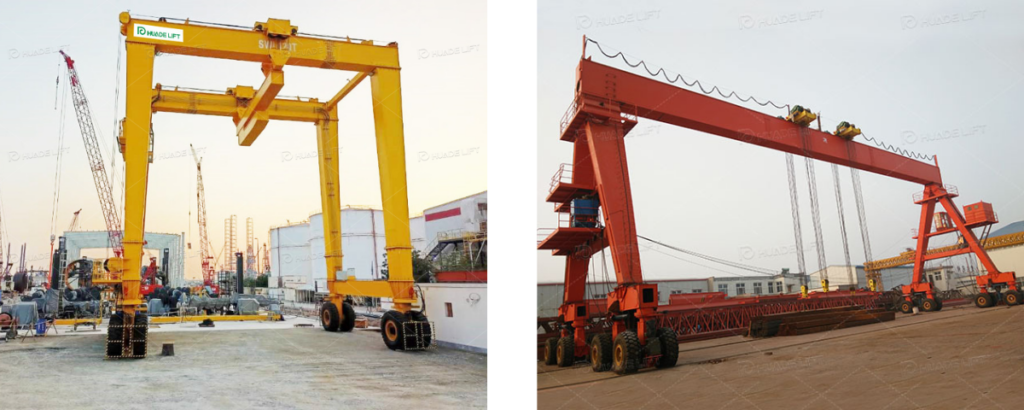
The current Vietnamese RTG market primarily relies on two major supply sources: direct imports of Chinese-made equipment from manufacturers like XCMG, Sany, and Runbang, and locally sourced or regional suppliers (e.g., from Thailand or Malaysia). Significant differences exist between these options in terms of pricing, configurations, and service offerings. Vietnamese buyers should make comprehensive selections based on their project requirements.
Chinese-Manufactured Rubber-Tired Gantry Cranes
Leveraging mature supply chains and economies of scale, Chinese-manufactured RTGs have become the mainstream choice in the Vietnamese market, with export volumes steadily increasing in recent years (e.g., Runbang Industrial’s RTGs have been exported in bulk to projects like Cai Mep Port in Vietnam).
Advantages:
Mature supply chain: Comprehensive core component support system enables end-to-end control from design to production, ensuring product reliability;
Competitive pricing: Mass production reduces unit costs, offering 15%-30% savings compared to local Vietnamese suppliers for equivalent configurations;
High customization capability: Tailored solutions for specific Vietnamese project conditions (e.g., high temperature/humidity, strong winds), enhancing adaptability;
Policy advantages: Leveraging the China-ASEAN Free Trade Agreement, Form E certificates of origin can be obtained to enjoy 0-5% tariff reductions, further lowering import costs.
Challenges:
Shipping and customs clearance cycles: The process from Chinese factories to Vietnamese project sites—including production, sea freight, and customs clearance—takes approximately 60-120 days, requiring advance planning;
Overseas Service Support: Select manufacturers with local service networks in Vietnam to avoid delayed after-sales responses.
Local or Regional Suppliers in Vietnam
Local Vietnamese suppliers primarily assemble equipment, relying on imported core components. Regional suppliers mainly act as agents for international brands like Komatsu and Hyundai.
Advantages:
Rapid service response: Local service centers enable swift equipment troubleshooting and spare part replacement;
Low communication barriers: Minimal language friction facilitates quick demand alignment, smoother contract execution, and after-sales coordination;
Short delivery cycles: Local inventory or nearby assembly typically reduces delivery to 30-60 days, ideal for urgent projects.
Limitations:
Limited equipment specifications: Primarily focused on conventional configurations in the 20-50 ton range; unable to meet demands for heavy-duty (100+ ton) or customized setups;
Higher costs for heavy-duty RTGs: Reliance on imported core components and high assembly costs result in prices 15%-30% higher than Chinese-manufactured units with equivalent specifications;
Slower technological iteration: Application of advanced technologies like intelligent systems and new energy lags behind Chinese manufacturers.
Comprehensive Comparison Table
| Project | China Made | Local Supply |
| Initial Price | Lower (15%-30% lower for the same configuration) | Higher |
| Customization Capability | Strong (Can adapt to complex working conditions and environments) | Limited (Mainly in conventional configurations) |
| Delivery Cycle | Medium (60-120 days, including production + shipping + customs clearance) | Shorter (30-60 days) |
| Long-Term Cost Performance | High (Low energy consumption, low maintenance costs, long lifespan) | Medium (High maintenance costs, expensive replacement of core components) |
| After-sales Guarantee | Relies on local brand service points (major brands have already covered) | Fast (local service teams respond promptly) |
| Policy Benefits | Can enjoy tariff reductions under the ASEAN Free Trade Agreement | No import tariff costs |
Hidden Costs Beyond Rubber Tyred Gantry Crane Pricing
Many Vietnamese buyers focus solely on equipment unit prices during procurement, overlooking hidden costs such as transportation, customs clearance, installation, and maintenance. In reality, Total Cost of Ownership (TCO) more accurately reflects true procurement expenses. Certain hidden costs can account for 15%-30% of the equipment unit price and warrant close attention.
Transportation and Logistics Costs
RTG cranes are classified as oversized and overweight cargo, incurring significant transportation and logistics expenses, primarily including:
Ocean freight: Shipping a single 40-ton RTG from major Chinese ports (e.g., Taicang, Ningbo) to Vietnamese ports (e.g., Ho Chi Minh City, Haiphong) costs approximately $5,000–8,000 USD. Larger-tonnage equipment requires disassembly for transport, incurring higher fees;
Oversized inland transport: Inland transportation from Vietnamese ports to project sites requires specialized heavy-lift vehicles and road permits, costing approximately $3,000–6,000 per unit;
Lifting and unloading fees: Port unloading and on-site installation require large crane rentals, costing approximately $2,000–4,000 per unit.
Note: Opting for “direct loading upon arrival” or “direct full-ship transport” can reduce port dwell time by approximately 90% and lower logistics costs by around 30%.
Tariffs and Taxes
Taxes and duties payable for importing RTG cranes primarily include:
Import Duty: Based on Vietnam’s HS Code, engineering machinery duty rates range from 0-10%. Presenting a Form E Certificate of Origin qualifies for China-ASEAN FTA tariff reductions, lowering the effective rate to 0-5%.
Value-Added Tax (VAT): Vietnam’s VAT rate is 10%, calculated on the taxable value (CIF price + duty).
Customs clearance service fee: Fees for local customs agents, approximately 1%-2% of the equipment’s CIF value.
Installation and Commissioning
RTG cranes require on-site installation and commissioning by specialized teams. Related costs include:
On-site installation: Gantry assembly, component alignment, wiring connections, etc. Installation costs per unit range from approximately $5,000 to $10,000 USD;
Load Testing: Conducting no-load and load tests per international standards to ensure performance compliance, costing approximately $3,000–5,000;
Operator Training: Providing project teams with equipment operation and routine maintenance training, costing approximately $2,000–3,000 per batch.
Long-Term Maintenance Costs
With an RTG crane’s lifecycle spanning 10-15 years, sustained maintenance expenses are significant:
Wear Part Replacement: Annual replacement of consumables like rubber tires, steel cables, and brake pads costs approximately 1%-2% of the unit price;
Core Component Maintenance: Periodic servicing of core components like motors and gearboxes every 2-3 years, with each session costing approximately $3,000-$8,000 USD;
Emergency Repairs: Emergency handling of equipment failures, involving spare parts transportation and repair team travel expenses. Costs are unpredictable; it is recommended to allocate an annual maintenance budget of 5%-10% of the equipment unit price.
How to Obtain the Most Cost-Effective Rubber Tyred Gantry Crane Price in Vietnam
Achieving “optimal cost-effectiveness” hinges on “precisely matching requirements + controlling end-to-end costs.” Considering Vietnam’s market characteristics and procurement experience, we recommend focusing on three key areas:
Define Actual Operating Requirements to Avoid Over-Specification
Before procurement, thoroughly analyze the project’s real-world operating conditions, including: maximum lifting capacity, working span, lifting height, operating frequency, and environmental factors (temperature, humidity, wind speed). This prevents blindly selecting high-spec configurations. For example:
Short-term infrastructure projects can opt for conventional configurations like A5 duty cycle and diesel power, without pursuing smart features;
For fixed factory operations with stable power supply, prioritize fully electric models to reduce long-term energy costs;
Non-coastal areas need not upgrade corrosion-resistant coatings, avoiding unnecessary expenses.
Core principle: Match actual usage frequency and load capacity, prioritizing “meeting requirements” over “pursuing high-end features.”
Prioritize Direct Manufacturers to Eliminate Middlemen
Some RTG suppliers in Vietnam are agents who mark up manufacturer quotes by 10%-20%. Opt for Chinese direct manufacturers with Vietnam project experience (e.g., XCMG, Sany, Runbang) for significant advantages:
Eliminate markups: Secure factory-direct pricing to reduce initial procurement costs;
More specialized technical solutions: Direct access to manufacturers’ technical teams enables customized project-specific configurations, avoiding mismatches from “generic setups”;
Comprehensive after-sales support: Leading manufacturers have established service networks in Vietnam (e.g., Zoomlion covers 28 provinces), providing localized installation, commissioning, and maintenance services.
Require a comprehensive quotation list with clear responsibility allocation
When procuring, request suppliers to provide detailed quotation lists to prevent hidden charges later. A complete quotation list should include:
Technical specifications: Clearly state core parameters like lifting capacity, span, lifting height, duty cycle, and power configuration;
Price breakdown: Equipment base price, spare parts cost, transportation fees, installation/commissioning charges, training expenses, etc.;
Delivery timeline: Specify production lead time, shipping duration, customs clearance period, and total delivery schedule;
Warranty terms: Define warranty period (typically 1-2 years), coverage scope (including labor/spare parts), and post-warranty service policies;
Responsibility allocation: Clearly designate responsible parties for transportation, customs clearance, installation, etc., to prevent disputes or buck-passing when issues arise.
Common Rubber Tyred Gantry Procurement Pitfalls Among Vietnamese Buyers
Based on procurement cases in the Vietnamese market, the following four major pitfalls must be avoided to prevent issues such as cost overruns and equipment failing to meet requirements:
Focusing solely on unit price while ignoring total cost of ownership
Some buyers opt for low-cost equipment from lesser-known brands. While initial costs are low, subsequent high energy consumption, maintenance expenses, and short lifespan result in a higher total cost of ownership.
Neglecting duty cycle ratings and safety standards
Selecting equipment with ratings below operational requirements (e.g., choosing A5-rated units for high-frequency operations) accelerates wear and tear, potentially causing safety incidents;
Underestimating installation and maintenance costs
Some buyers assume “equipment is ready upon delivery,” overlooking expenses for commissioning, operator training, and commissioning, resulting in delayed production;
Selecting non-standard components: Some niche brands use non-standard parts, making spare replacement difficult and costly, potentially disrupting normal operation.
Frequently Asked Questions (FAQ)
Q1: What is the typical price range for a RTG crane in Vietnam?
A: Prices vary significantly based on configuration, typically ranging from $80,000 to $600,000. Standard configurations for 20-40 ton models cost approximately $80,000–$150,000; 50-100 ton models range from $150,000 to $300,000; and models over 100 tons exceed $300,000.
Q2: Are Chinese RTG cranes reliable?
A: Yes. Chinese RTG manufacturers possess mature production technology and international project experience. For instance, Runbang Industrial’s RTGs have been exported in bulk to Vietnam’s Cai Mep Port and operate stably. Leading brands’ product quality fully meets Vietnam project requirements for safety and performance. We recommend selecting manufacturers with AEO certification and comprehensive overseas service networks.
Q3: What is the typical delivery lead time?
A: This depends on the supply source and configuration complexity. Directly manufactured and supplied from China with standard configurations takes approximately 60-120 days (including production, ocean freight, and customs clearance). Locally supplied in Vietnam with standard configurations takes about 30-60 days. Customized configurations require an additional 20-30 days production lead time.
Q4: Are electric RTGs more cost-effective?
A: Long-term savings are achievable. Electric RTGs require a 15%-25% higher initial investment than diesel models, but their energy costs are only 1/3 to 1/2 of diesel units. They also feature simpler maintenance and lower failure rates, typically recouping the price difference within 1-2 years. They are suitable for fixed sites with high-frequency operations.
Q5: What documents are required for importing RTGs?
A: Core documents include: Commercial Invoice, Packing List, Bill of Lading, Form E Certificate of Origin (for tariff reduction), Technical Specification Manual, and Quality Compliance Certificate. For used machinery, a Pre-Shipment Inspection Report is also required. We recommend confirming the latest policies with your customs broker in advance.
Q6: How can I reduce customs clearance costs for imported RTGs?
A: Costs can be minimized through the following approaches: 1. Apply for Form E Certificate of Origin in advance to qualify for tariff reductions; 2. Opt for “direct loading upon arrival” and “pre-clearance” modes to minimize port dwell time; 3. Engage local agents with heavy-lift clearance expertise to avoid demurrage fees due to documentation issues.
Summary
Overall, the price of rubber-tired gantry cranes in Vietnam reflects not just a simple figure, but a combination of technical solutions and long-term value. As Vietnam’s infrastructure market continues to heat up in 2026, RTG crane procurement must balance “workload suitability” with “cost control” to avoid the pitfall of focusing solely on unit price.
Get your exclusive RTG Crane quote and technical drawings for your Vietnam project now. Fill out the project requirements form, and our technical team will respond within 24 hours.
