
In industrial, logistics, and construction sectors, gantry cranes serve as critical equipment for heavy material handling, widely used in port loading/unloading, shipbuilding operations, factory assembly, and similar scenarios. However, different gantry crane types exhibit significant variations in structure, load capacity, and suitable applications. Understanding these differences is key for enterprises to select the right model, reduce costs, enhance efficiency, and ensure operational safety. This article analyzes their types, characteristics, and selection criteria to guide practitioners.
What is a gantry crane?
A gantry crane is a single-beam or double-beam bridge crane supported by independent legs and capable of movement via wheels or a rail system. Unlike traditional bridge cranes, it does not rely on building structures (such as factory columns or roof beams), eliminating the need for permanent track beams and support columns. This makes it particularly suitable for outdoor operations or as supplementary equipment beneath existing bridge cranes.
In terms of scale, large gantry cranes typically utilize ground-embedded tracks for movement, commonly found in fixed operational areas like ports and shipyards. Smaller portable gantry cranes rely on casters or wheels for flexible mobility, serving temporary lifting needs in workshop maintenance or small warehouses.
Components and Features of Gantries
The functionality of a gantry crane relies on the coordinated operation of five core components:
Main Beam (Single/Double Girder): The primary determinant of load capacity. Single girders suit light-to-medium loads (typically under 5 tons) and short-duration operations like workshop part handling. Double girders cater to medium-to-heavy loads (over 5 tons) and high-intensity continuous operations like port container handling.
Support Columns: Vertical structural supports directly determine crane stability. Their strength and spacing must be engineered according to load capacity.
Horizontal Beam (Gantry): Spans the crane’s width, providing the travel path for the trolley and serving as the primary load-bearing structure.
Trolley: Comprises a hoist and travel mechanism. The hoist lifts the load, while the trolley moves the hoist along the horizontal beam for precise load positioning.
Wheels: Provide mobility. Rail wheels ensure stable long-distance operation, while casters enhance maneuverability.
Gantry Crane Capacity
Load capacity is the core specification for selecting gantry cranes, with different load ratings catering to distinct operational needs:
Light-duty (1-5 tons)
1-2 tons: Compact size, typically single-girder portable design. Suitable for workstations, garages, and small warehouses, such as workshop parts handling and tool maintenance.
5 tons: Mainstay of light-duty models, available in portable or semi-permanent configurations with single or double girders. Ideal for frequent material handling in yards and small ports, such as loading/unloading small containers and machine tool components.
Medium-Duty Type (10-20 tons)
10-15 tons: Mainstream medium-duty models requiring no structural support, suitable for medium-load handling in machinery plants and assembly lines, such as large motors and heavy molds;
20 tons: Designed for both indoor and outdoor operations. Single-girder L-shaped models save space, while double-girder designs enhance stability. Commonly used for medium-to-large load lifting in steel structure manufacturing and logistics terminals.
Heavy-Duty Type (30 tons and above)
30 tons: Entry-level heavy-duty model with high durability and a wide span selection range. Suitable for handling heavy components in manufacturing and mining industries, such as mining machinery and large steel structures.
50 tons and above: Ultra-heavy-duty models, almost exclusively featuring double-girder or box-girder structures for exceptional stability. Used in large-scale infrastructure projects (e.g., bridge construction), port handling of extra-heavy containers, and shipyard hull transportation—serving as the “ballast” equipment for heavy industry.
How Does A Gantry Crane Work?
Gantry crane operation revolves around two core functions: “Lifting + Movement”:
Lifting Function: The hoist is driven by electric or manual motors, using wire ropes or chains wound around pulleys/drums to achieve vertical lifting of heavy loads with centimeter-level precision.
Horizontal Movement: The trolley travels along the horizontal beam (girder), moving the load left/right or forward/backward. Combined with rail-guided wheel movement, it covers large operational areas.
Height Adjustment: Certain portable or adjustable models utilize telescoping legs or hydraulic systems to modify height, effortlessly handling special scenarios like “passing through doorways, lifting to rooftops, or avoiding obstacles”;
Safe Placement: Upon load positioning, the hoist motor automatically decelerates. Combined with limit switches and braking systems, this ensures smooth load placement and prevents impact damage.
Different Types of Gantry Cranes
Gantry crane classification requires consideration of structure, mobility, and load capacity. Different types suit distinct operational scenarios, necessitating precise matching during selection.
Full Gantry Crane
As a quintessential heavy-duty lifting solution, the full gantry crane features a portal structure composed of dual rigid legs and a main girder (bridge frame). It achieves horizontal movement via a hoist trolley traveling along rails or a wheeled travel mechanism. This model offers exceptional structural stability and load-bearing capacity, with rated lifting capacities ranging from 5 tons to hundreds of tons. Its gantry height and span dimensions can be customized to project requirements, making it widely applicable for heavy-duty operations such as large-component hoisting and port cargo handling.
Semi-Gantry Crane
The semi-gantry crane employs an asymmetrical design: one side features rigid outriggers, while the opposite side is supported by H-beam rails or specialized guide rails anchored to building walls. This effectively combines the high space utilization of bridge cranes with the strong ground adaptability of gantry cranes. This innovative single-ground-support architecture significantly reduces foundation footprint, making it ideal for space-constrained industrial facilities and maximizing usable floor area within buildings.
Portable Gantry Crane
As a quintessential lightweight material handling solution, the portable gantry crane prioritizes lightweight construction and modular integration. Constructed from high-strength lightweight alloys with optimized structural design, the unit typically maintains a light-load-class mass for agile mobility. Equipped with high-wear-resistant rubber wheels or industrial-grade lockable swivel casters, it balances easy relocation with stable operation. Its rated load capacity covers light to medium-duty applications, meeting diverse material lifting requirements. Thanks to its modular component design, the equipment supports rapid standardized assembly/disassembly procedures, significantly enhancing transport convenience and space utilization. This makes it particularly suitable for temporary operations and applications requiring frequent relocation across multiple sites.
Adjustable Gantry Crane
The adjustable gantry crane enables flexible industrial operations through manual/electric adjustment of height, width, and span. Based on usage scenarios, it primarily falls into two categories: portable and fixed. Portable models feature modular, quick-assembly design for easy disassembly, ideal for temporary material handling. Fixed models incorporate intelligent adjustment systems enabling programmable multi-parameter control, allowing rapid mode switching based on production needs to optimize space utilization and operational efficiency.
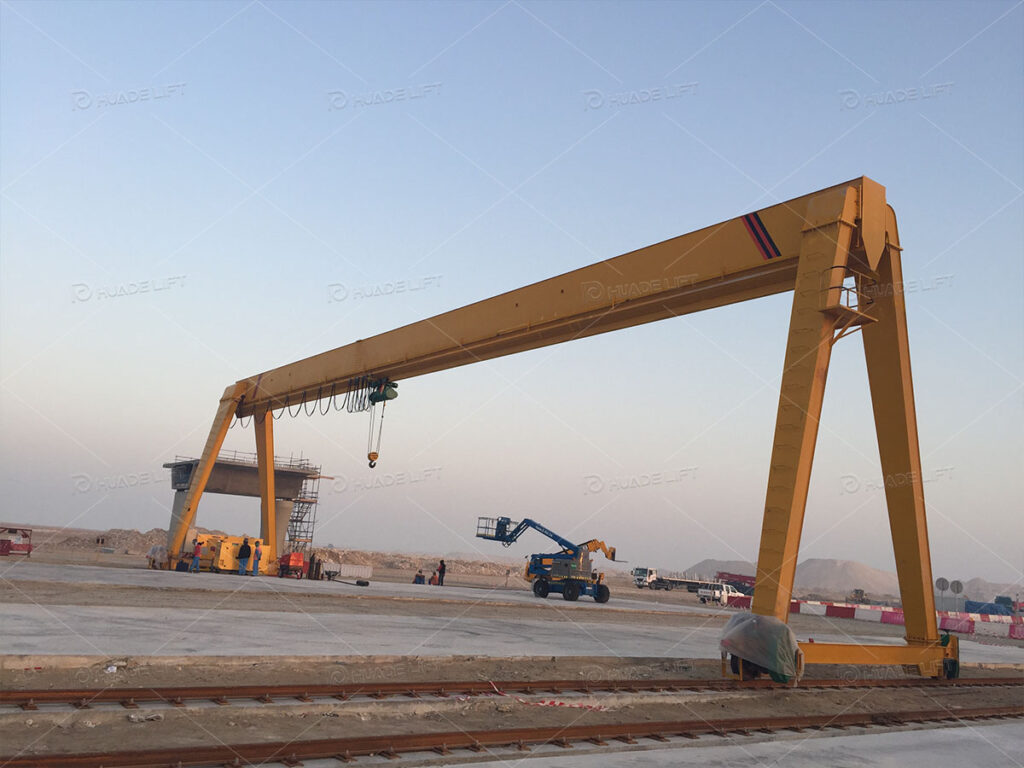
Single-Girder Gantry Crane
Single-girder gantry cranes are designed around a single main girder structure, with the hoist trolley operating along the lower flange rail of the main girder. Leveraging modular construction technology, this equipment features standardized installation processes and optimized overall weight, offering significant economic advantages over double-girder gantry cranes in construction cost control. Primarily suited for light to medium-duty load environments, it covers a wide range of rated lifting capacities, effectively meeting material handling requirements across diverse industrial scenarios.
Double-Girder Gantry Crane
The double-girder gantry crane features a dual-parallel main girder structure with a rated lifting capacity ranging from 5 to 500 tons and a typical bridge span of no less than 20 meters. Compared to single-girder designs, this model delivers exceptional stability through its unique mechanical configuration. Regarding trolley installation configurations, both overhead and under-mounted options are available. Users can flexibly select based on actual workspace height, effectively meeting application demands in various complex engineering scenarios.
Truss Gantry Crane
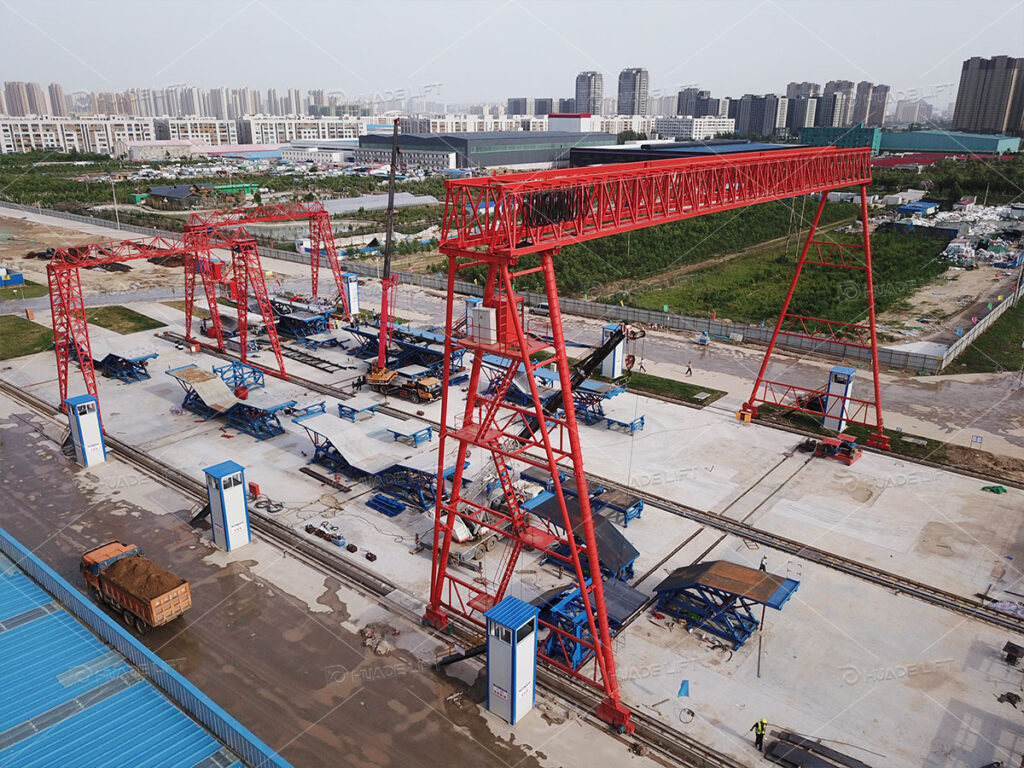
The truss gantry crane employs a truss-frame structural system. Its main girders and legs are constructed into a triangular frame structure using high-quality steel through professional welding techniques. This design achieves both lightweight construction and high strength. Aerodynamic simulations indicate a wind resistance coefficient reduced by over 40% compared to traditional box-beam structures. Leveraging this superior wind resistance, the crane is widely deployed in high-wind environments such as open-air ports and large cargo yards, ensuring stable equipment operation and enhanced workplace safety.
Box-Type Gantry Crane
The main girder of the box-type gantry crane adopts a fully enclosed box structure. With its outstanding rigidity design, it can achieve a maximum span exceeding 50 meters. This model typically has a rated lifting capacity exceeding 200 tons. The double-box structure can meet the lifting requirements for super-heavy objects exceeding 500 tons, making it suitable for hoisting operations of large equipment such as power plant turbine rotors.
L-Type Gantry Crane
The L-type gantry crane features a single-girder structural design integrated with an L-shaped rigid outrigger system, where the outriggers are arranged perpendicular to the main girder at a 90° angle. This configuration optimizes force transmission pathways, effectively suppressing load sway during lifting operations while significantly increasing the clearance height beneath the equipment. It demonstrates outstanding spatial adaptability and operational stability during the loading, unloading, and hoisting of long, narrow, and irregularly shaped materials such as industrial pipes, structural steel beams, and metal profiles.
U-Type Gantry Crane
The U-type gantry crane employs a combined structure of a double-girder bridge and U-shaped legs. Its unique lateral space design provides ample clearance for large equipment, including fully assembled vehicles, power transformers, and precast concrete components. Certain models feature extendable jib structures, further enhancing loading/unloading flexibility and operational coverage.
Uses Of Gantry Cranes
Construction Sites
Construction sites frequently require handling heavy materials like steel beams, concrete blocks, and lumber. Gantry cranes excel in these environments with their “high load capacity + flexible mobility,” enabling precise operations in confined spaces. For instance, during high-rise construction, gantry cranes can traverse edge rails to lift precast concrete elements directly from storage yards to construction floors. This reduces manual handling intensity, minimizes material damage, and lowers high-altitude work risks through precise positioning.
Ports and Shipyards
Ports and shipyards serve as the primary operational domains for gantry cranes. In ports, full-gantry or box-type gantry cranes enable rapid container loading, unloading, and stacking. A single unit can handle 20-30 standard containers per hour, significantly boosting port throughput capacity. In shipyards, truss gantry cranes and U-shaped gantry cranes respectively handle hull section transportation and large equipment (such as engines) hoisting. They withstand harsh outdoor wind conditions, ensuring stable shipbuilding cycles.
Manufacturing Plants
Within manufacturing plants (e.g., automotive factories, machine tool plants), gantry cranes serve as the core link in material handling processes. For instance, in automotive chassis assembly lines, semi-gantry cranes traverse production tracks to lift chassis components directly from warehouses to assembly stations, eliminating ground transport lanes. In machine tool factories, double-girder gantry cranes precisely position heavy machinery during installation, preventing equipment damage from manual handling.
Warehouses and Yard Storage
The core requirements for warehouses and yard storage are “efficient storage + rapid turnover.” Gantry cranes lift heavy goods (e.g., steel, large packages) onto high-level racks, boosting space utilization by over 50% compared to traditional forklifts. In outdoor yards, portable gantry cranes offer flexible mobility to handle temporary loading/unloading needs, preventing idle downtime of fixed equipment.
Advantages and Limitations of Gantry Cranes
Gantry cranes exhibit distinct strengths and weaknesses in industrial material handling, requiring careful selection. Their high mobility allows flexible movement across work areas via rails or wheels without requiring factory modifications, making them suitable for multi-station workshops and outdoor yards. Costs are lower than overhead cranes, eliminating the need for roof-mounted rails and structural reinforcement, thereby reducing corporate capital pressure.
They demonstrate strong outdoor adaptability, with corrosion-resistant coatings, sealed electrical cabinets, and waterproof motors protecting against harsh environments. Some models feature quick installation, adjustable span heights, and broad load capacities to meet diverse operational needs.
However, they demand high site requirements, necessitating hardened ground or track installation. Improper foundation treatment can lead to malfunctions. Outriggers and tracks occupy significant space, making installation challenging in confined areas. Outdoor operations are susceptible to wind interference, with strong winds potentially halting work. Travel speed and positioning accuracy fall short of bridge cranes, necessitating additional components for precision applications.
How to select gantry crane
Incorrect selection not only leads to equipment idling but may also cause safety incidents. Enterprises should conduct a comprehensive assessment from the following dimensions:
Determine Lifting Capacity Requirements
To determine lifting capacity, first establish the maximum load weight. This must encompass the load itself, the weight of any attachments, and dynamic loads such as swaying during lifting, while allowing a safety margin for unexpected conditions. Simultaneously, focus on the load center—the horizontal distance between the load’s center of gravity and the hook. If the load is off-center, it increases the moment force. In such cases, select a model with a stronger main beam or a specialized lifting trolley to ensure safe and stable operation.
Adapting to the Operating Environment
For outdoor operations, select models with corrosion-resistant coatings and sealed electrical systems (e.g., gantry cranes) to withstand rain and salt corrosion. For indoor operations with limited headroom, choose semi-gantry or low-height single-girder models. In dusty or flammable/explosive environments (e.g., chemical plants), use cranes with special sealing and explosion-proof designs to prevent electrical sparks from causing hazards.
Assess Mobility Requirements
For high-frequency, short-distance movement (e.g., workshop maintenance), choose portable trolley models. For fixed long-distance routes (e.g., port railways), select rail-mounted models. For non-fixed routes (e.g., construction sites), opt for rubber-tired self-propelled models. Also consider power sources: battery-powered units suit flexible mobility, while a fixed power supply suits long-term operations.
Accurate Measurement of Height and Span
Lifting height must cover the distance from the hook’s lowest position to the highest work point. For example, lifting to a 10-meter-high shelf requires a model with a lifting height exceeding 12 meters. Span must match the width of the work area to prevent the main beam from being too short to cover the span or too long, which compromises stability.
Matching Usage Frequency
For occasional use (e.g., 1-2 times monthly), select light-duty class models to reduce costs. For daily continuous operation (e.g., ports), choose heavy-duty class models with reinforced gearboxes and brakes. For 24/7 uninterrupted operation (e.g., major ports), opt for industrial-grade heavy-duty models and establish regular maintenance schedules with guaranteed spare parts availability.
Conclusion
Gantry cranes offer diverse configurations suitable for scenarios ranging from workshop maintenance to port heavy-duty applications. Each model—portable for flexibility, box-type for heavy loads, L-shaped for space efficiency—provides unique, irreplaceable value. The core principle for enterprise selection is choosing the “right fit.” Aligning equipment with operational scenarios, load requirements, and environmental conditions is essential for enhancing efficiency and ensuring safety.
Looking ahead, gantry cranes will integrate intelligent features like remote control and automated positioning, driving the industry toward unmanned, high-efficiency operations. However, “precise selection” remains the prerequisite for realizing equipment value. This article provides selection guidance for practitioners, helping enterprises reduce costs and boost efficiency.
