
In modern logistics, manufacturing, and port operations, the choice of handling equipment directly impacts efficiency, safety, and costs. Forklifts have long played an indispensable role in these scenarios. However, with technological advancements and increasing operational demands, rubber tyred gantry cranes (RTGs) are emerging as a new trend to replace forklifts.
This article will delve into why rubber tyred gantry cranes are emerging as an effective alternative to forklifts and how this transition can help businesses enhance efficiency while reducing operational costs and safety risks.
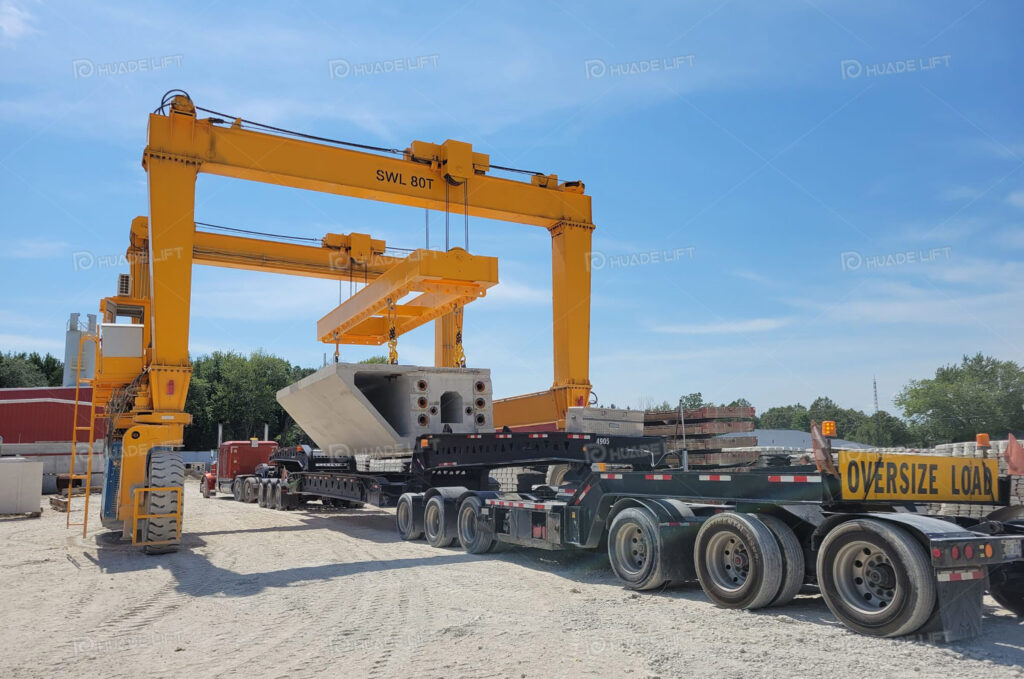
Introduction to Rubber Tyred Gantry Cranes
A rubber tyred gantry crane is a gantry crane mounted on rubber tires, combining advanced mechanical design and intelligent control technology to offer superior mobility and load-bearing capacity. Compared to traditional lifting equipment, it has seen significant improvements in structure and performance, enabling it to adapt to various complex operational environments. It serves as an efficient, safe, and flexible heavy-duty material handling solution, widely applied in scenarios such as container terminals, precast component factories, and wind turbine component storage yards.
High Mobility
Unlike track-mounted gantry cranes that rely on tracks for operation, the rubber tyred gantry crane’s travel mechanism uses specially designed rubber tires, enabling it to move freely on flat ground without track restrictions. The tires are made from high-strength, wear-resistant materials capable of withstanding heavy loads while providing excellent shock absorption, ensuring stability during movement. This high mobility makes it particularly suitable for dynamic yards or temporary work areas.
Powerful Lifting Capacity
The rubber tyred gantry crane was designed to handle heavy-duty cargo handling requirements, giving it powerful lifting capabilities. Depending on the model and specifications, it can easily handle lifting tasks ranging from 20 tons to 200 tons, far exceeding the limits of traditional forklifts.
This powerful lifting capacity enables it to be widely applied in the loading, unloading, stacking, and transportation of large components. In large shipyards, the rubber tyred gantry crane can precisely lift and position ship hull components weighing dozens of tons; at bridge construction sites, it can handle heavy precast bridge panels, providing strong support for the smooth progress of the project.
Highly Intelligent
With the rapid development of information technology, many modern rubber tyred gantry cranes are equipped with a series of advanced intelligent systems, such as GPS positioning, automatic obstacle avoidance, remote control, and automatic path planning functions, supporting automated operations and further reducing reliance on human labor.
The GPS positioning system can real-time obtain the device’s location information, ensuring the device does not deviate from the predefined route during operations; The automatic obstacle avoidance system uses sensors installed on the equipment to detect surrounding obstacles in real time and automatically adjust the travel path to prevent collisions; The remote control system allows operators to control the equipment from a control center away from the worksite, enhancing operational safety while enabling operators to work in a comfortable environment; The automatic path planning system automatically plans the optimal travel path based on the task and site conditions, improving operational efficiency.
Flexibly Adapts to Various Cargo Shapes
Rubber tyred gantry cranes can accommodate the handling of long, wide, tall, and irregularly shaped materials by replacing different types of lifting attachments (such as rotating attachments, dual-point attachments, L-shaped brackets, etc.), significantly expanding their application range.
For long, narrow goods like steel or wood, specialized long-goods lifting devices can be used; for irregularly shaped goods like large machinery housings, rotating lifting devices can adjust the angle of the goods to facilitate smooth handling; for goods with unstable centers of gravity, dual-point lifting devices ensure balance during handling. This flexibility enables the rubber tyred gantry crane to meet various complex handling requirements and play an important role in different industries and scenarios.
Limitations of Traditional Forklifts
Since their inception, forklifts have been widely used in logistics, warehousing, manufacturing, and other fields due to their flexible operation and broad application range. They can navigate narrow aisles and transport goods from one location to another, facilitating the movement of goods. However, in today’s rapidly developing modern industry, the limitations of forklifts have become increasingly evident in high-density, high-precision, and heavy-load handling tasks, making it difficult to meet the growing operational demands.
Operations Rely on Manual Labor, Limiting Efficiency
Traditional forklifts primarily rely on manual operation, with efficiency significantly influenced by factors such as the operator’s skill level, physical condition, and sense of responsibility. An experienced forklift operator can quickly and accurately complete cargo handling tasks, while novice operators may frequently make mistakes during operations, affecting overall workflow.
Additionally, in complex operational environments such as warehouses filled with goods, workshops with high foot traffic, or nighttime or poorly lit sites, forklift drivers’ visibility is often obstructed, making it difficult to precisely control vehicle paths and cargo positions. This not only reduces operational efficiency but also increases the risk of collisions or overturns.
Limited Lifting Capacity
Most standard forklifts have a rated load capacity between 3 and 10 tons, which is sufficient for handling lightweight cargo. However, for heavy cargo such as wind turbine towers, concrete precast components, or large containers, forklifts often struggle to handle the load. These heavy cargo items typically weigh dozens of tons or even hundreds of tons, far exceeding the maximum load capacity of forklifts.
If forklifts are overloaded to complete tasks, this not only causes severe damage to the mechanical structure of the forklift, shortening the equipment’s service life, but also significantly increases the likelihood of safety incidents.
Low Space Utilization Rate
In high-density stacking or narrow aisles, the forklift’s turning radius and stacking restrictions make it difficult to achieve maximum efficiency. Forklifts typically have a large turning radius, requiring multiple direction adjustments to complete turns in narrow aisles, which not only wastes time but also increases the risk of collisions with surrounding objects.
Additionally, when stacking goods, forklifts are limited by their lifting height and stability, resulting in relatively low stacking heights, typically around 3-4 layers, failing to fully utilize the vertical space in warehouses or yards. When multiple forklifts operate simultaneously, lack of effective coordination and path planning often leads to blockages, path crossings, and other issues, further reducing space utilization and operational efficiency.
High Labor and Maintenance Costs
Using forklifts requires a large number of drivers, and companies must not only pay drivers’ wages, bonuses, and benefits but also cover training costs to ensure they possess qualified operational skills. As labor costs continue to rise, this expenditure accounts for an increasingly significant portion of operational costs.
Additionally, as mechanical equipment, forklifts require regular maintenance and repairs, including replacing engine oil, filters, tires, and other components, as well as inspecting and repairing critical components such as engines and hydraulic systems. These maintenance tasks not only incur significant costs but also occupy the equipment’s operational time, affecting work progress. Furthermore, due to the complex operational environment of forklifts, which are prone to collisions and malfunctions, companies must also bear potential safety liability risks, further increasing operational costs.
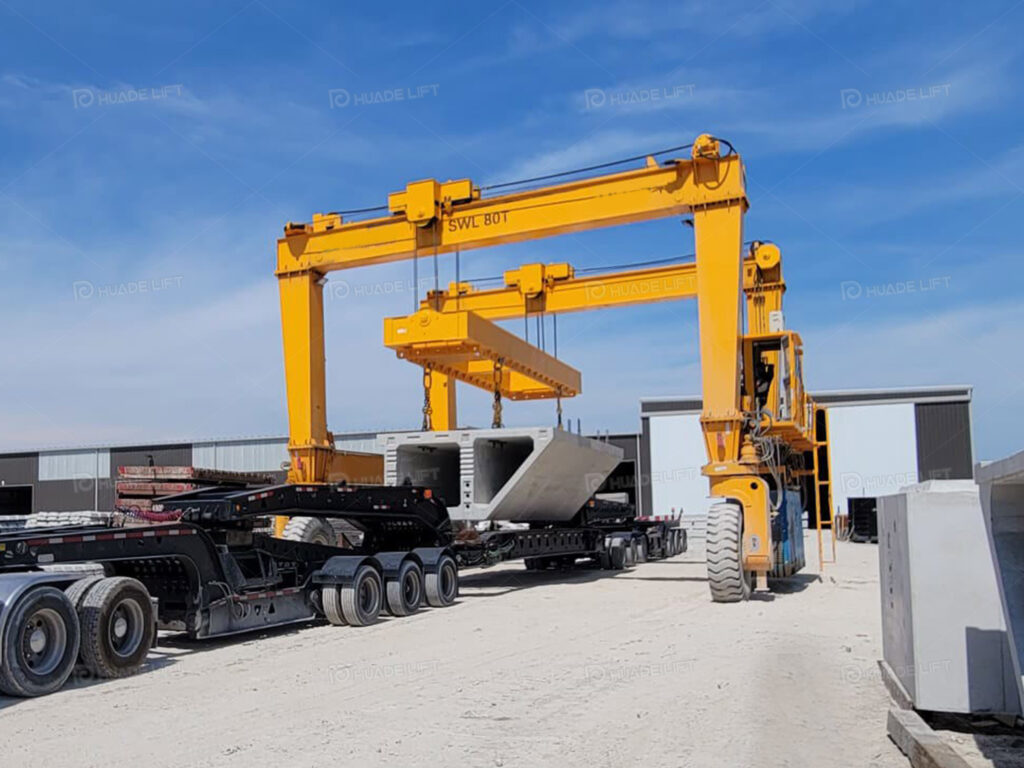
How Can a Rubber Tyred Gantry Crane Replace a Forklift?
One Rubber Tyred Gantry Crane Can Replace Multiple Forklifts
In many scenarios, the operational efficiency of one rubber tyred gantry crane can match that of 3–5 forklifts. This is because the rubber tyred gantry crane has a larger operational range and faster operational speed, enabling it to complete multiple tasks in a single operation that would otherwise require multiple forklifts working in coordination.
For example, in a precast concrete plant, the traditional workflow involves a forklift transporting precast components from the mold production area to a transfer zone, then another forklift moving them to the storage yard or loading area, requiring multiple transfers. This not only complicates the process but also wastes significant time and manpower. In contrast, a rubber tired gantry crane can directly lift large components from the mold production area to the storage yard or loading area without intermediate transfers, significantly simplifying the workflow and improving operational efficiency. Additionally, it reduces the number of vehicles required, simplifies vehicle scheduling and route management complexity, and makes the entire worksite more organized.
High-Density Stacking Capability
Forklifts have obvious limitations in high-altitude stacking. Due to structural constraints, stability significantly decreases when stacking heights exceed a certain range, increasing the risk of safety incidents. In contrast, rubber tyred gantry crane adopts a gantry structure design, which offers high stability and lifting height, enabling three-dimensional stacking up to 6–8 stories high.
This high-density stacking capability significantly improves space utilization, holding significant practical significance for regions with limited land resources or high warehousing costs. In container yards at large ports, using rubber tyred gantry cranes for high-density stacking allows more containers to be stored on a limited land area, reducing land occupation and lowering warehousing costs.
Reducing Human Involvement and Enhancing Safety
Automated RTG cranes significantly reduce human intervention by following pre-programmed paths and stacking logic. They can automatically complete tasks such as cargo handling and stacking according to pre-set operational plans, without requiring manual driving or operation. Additionally, in conjunction with video surveillance and sensor systems, operators can monitor the operational site in real-time from a remote control center, promptly identifying and addressing any issues.
This automated operation mode not only reduces errors and safety risks caused by manual operations but also enables the equipment to operate 24/7 without human supervision, significantly improving operational safety and efficiency. In harsh operational environments such as high-temperature, low-temperature, or dusty conditions, the advantages of automated rubber tyred gantry cranes are even more evident, as they can replace human labor in such environments, ensuring the health and safety of operators.
Precise Handling Reduces Cargo Damage Rates
Rubber tyred gantry cranes are equipped with precise lifting control systems, ensuring stable lifting equipment with minimal swaying. They can precisely manipulate cargo with unstable centers of gravity or complex shapes. Their control systems utilize advanced sensors and algorithms to monitor cargo position, orientation, and weight in real time, automatically adjusting lifting equipment movements based on this information to ensure cargo stability during handling.
In contrast, forklifts, due to operational limitations, often cause cargo to sway or tilt during handling, especially when handling unstable or complex-shaped cargo, which can lead to collisions or tilting, resulting in cargo damage. The precise handling capabilities of rubber tired gantry cranes effectively reduce damage caused by collisions or tilting, lowering cargo damage rates and saving costs for businesses.
Typical Cases of Reducing Reliance on Forklifts Using Rubber Tyred Gantry Cranes
Rubber tyred gantry cranes demonstrate significant advantages across various industries. Through real-world examples, we can clearly see how they reduce reliance on forklifts and bring tangible benefits to businesses.
Case Study 1: Transformation of a Container Yard
In traditional container yards, forklifts are the primary handling equipment, responsible for unloading containers from trucks and stacking them. However, this method has several issues: forklifts have limited lifting capacity and cannot handle overweight containers; operational efficiency is low, with each forklift able to handle only a limited number of containers per day; poor space utilization, with containers stacked haphazardly, not only occupying a large land area but also increasing the difficulty of subsequent transportation and management.
A port container yard introduced multiple rubber tyred gantry cranes to improve operational efficiency and space utilization. Once deployed, rubber tyred gantry cranes can directly lift containers without the need for multiple transfers, unlike forklifts. They have powerful lifting capacity, capable of easily handling containers of various specifications, including overweight containers. Additionally, rubber tired gantry cranes operate at high speeds, with each unit processing 3-4 times the number of containers per day compared to traditional forklifts.
Furthermore, the rubber tired gantry crane enables neat stacking of containers. Through precise positioning and control, the gaps between containers are minimized, resulting in more compact stacking and significantly reduced floor space requirements. Statistics show that after introducing the rubber tired gantry crane, the yard’s space utilization rate increased by over 50%, transportation time was reduced by 30%, and overall operational efficiency was significantly improved.
Case Study 2: Wind Power Manufacturing Company
Wind turbine towers and other components are large in size and have unique shapes, with lengths reaching tens of meters and weights exceeding hundreds of tons. Traditional forklifts are simply unable to handle such loads. In the past, wind power manufacturing companies typically relied on large mobile cranes for transportation, but these cranes have poor mobility, limited operational ranges, and high rental costs.
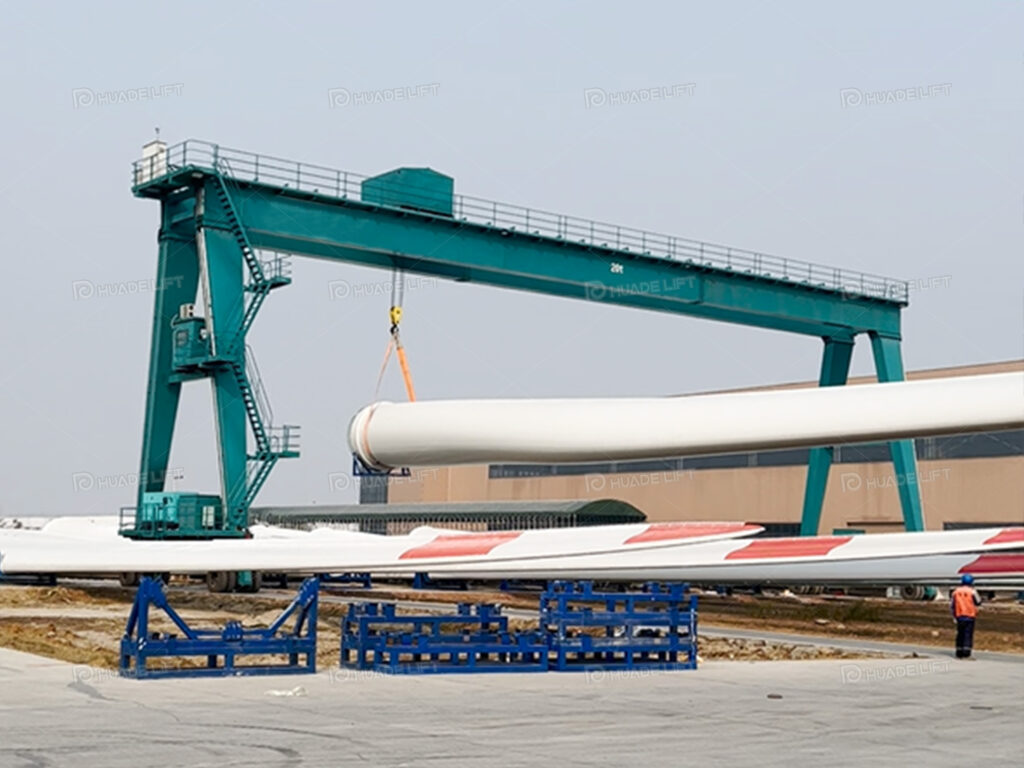
Rubber Tyred Gantry Crane for Wind Power
To address this issue, a certain wind power equipment manufacturer introduced a 90-ton rubber gantry crane. This rubber tyred gantry crane is equipped with specialized lifting equipment capable of accommodating the shape and weight requirements of wind turbine towers. It can move freely within the factory, transporting wind turbine towers from the production workshop to the storage yard, and then lifting them onto transport vehicles from the storage yard, with the entire process being smooth and efficient.
Since introducing the rubber gantry crane, the company has not only achieved efficient lifting of heavy objects but also significantly reduced the rate of loading and unloading accidents. According to company statistics, handling efficiency has improved by over 60%, saving millions of yuan annually in crane rental costs. Additionally, improved operational safety has reduced losses and compensation costs resulting from accidents.
Case Study 3: Precast Concrete Components Factory
In a precast concrete component factory, a large number of irregularly shaped concrete components need to be transported from the production workshop to the storage yard and then loaded onto vehicles for transportation. The original forklift handling method had numerous drawbacks: forklifts have limited lifting capacity and cannot handle large precast components; operational efficiency is low, requiring multiple forklifts to work in coordination and multiple personnel to coordinate efforts; and human operational errors can easily cause component damage.
To address these issues, a certain precast concrete component factory introduced a rubber tyred gantry crane (RTG). The RTG crane is equipped with a remote control system, allowing operators to remotely control the equipment from a control center, enabling single-person remote operation. It can directly lift precast components from the production workshop to the storage yard or loading area without intermediate transfers, significantly simplifying the operational process.
After introducing the rubber tyred gantry crane, the factory’s handling efficiency increased by over 40%, and the damage rate of components decreased by 30%. Additionally, the demand for forklift drivers was reduced, lowering labor costs. Due to the improved operational efficiency, the factory’s production capacity was fully utilized, enabling it to take on more orders and generating significant economic benefits for the company.
Economic Benefits of Replacing Forklifts with Rubber tired Gantry Cranes
Although the initial investment cost of a rubber tired gantry crane is relatively high, from a long-term operational perspective, it can bring significant economic and operational benefits to the company, making it a device with long-term investment value.
Reducing Operational Costs
The overall operational cost of a rubber tired gantry crane over its lifespan is significantly lower than a system relying on multiple forklifts. First, in terms of labor costs, a single rubber tyred gantry crane typically requires only 1-2 operators, while completing the same workload may require 3-5 forklifts, each of which needs a driver, resulting in significant savings in labor costs.
Second, in terms of energy consumption costs, rubber gantry cranes primarily use electric drive or hybrid power systems, which are more energy-efficient than diesel forklifts. Especially during prolonged operations, electricity costs are far lower than diesel expenses. Additionally, RTG cranes have longer maintenance intervals and lower maintenance costs, whereas forklifts, due to their complex structure and harsh operating environments, require more frequent maintenance and thus have higher maintenance costs.
Furthermore, rubber tired gantry cranes have high operational efficiency, reducing cargo turnaround time and lowering inventory costs. Overall, although the initial investment for rubber tyred gantry cranes is higher, they offer long-term economic returns by reducing labor, fuel, and maintenance costs.
Improving operational efficiency and throughput
A single rubber tyred gantry crane can handle hundreds of tons of material daily, far exceeding the combined capacity of multiple forklifts. This is because rubber gantry cranes have faster lifting speeds, higher operating speeds, and a larger operational range, enabling them to complete a large volume of handling tasks in a short time.
Especially in scenarios involving bulk materials and high-frequency operations, such as ports and large warehouses, its high-efficiency performance plays a decisive role in enhancing overall production capacity.
Additionally, the automated operation mode of rubber tyred gantry cranes reduces the impact of human factors on operational efficiency, ensuring operational continuity and stability, thereby further improving operational efficiency and throughput.
Aligning with environmental protection and sustainable development objectives
As global emphasis on environmental protection and sustainable development continues to grow, businesses increasingly prioritize environmental performance when selecting equipment. Rubber gantry cranes primarily utilize electric or hybrid power systems, significantly reducing exhaust emissions compared to diesel forklifts and minimizing environmental pollution.
Additionally, rubber tyred gantry cranes operate at lower noise levels, causing minimal disturbance to surrounding environments and personnel during operations, thereby meeting environmental standards. Furthermore, automated lifting operations reduce resource waste caused by human error, improving resource utilization efficiency and aligning with sustainable development principles.

Technology Integration and Future Trends
Integration with AGV and AMR Systems
In modern yard management, rubber tyred gantry cranes can collaborate with automated guided vehicles (AGVs) and autonomous mobile robots (AMRs) to create a highly automated logistics ecosystem. This collaborative mode fully leverages the advantages of each device, forming an efficient logistics handling chain.
Through centralized control system coordination and management, information sharing and collaborative work between rubber tired gantry cranes, AGVs, and AMRs can be achieved, ensuring smooth operation of the entire logistics system. In the event of sudden situations such as cargo backlogs or equipment failures, the system can promptly adjust the operational tasks of each device to ensure the continuity of logistics operations.
Integrated Intelligent Scheduling System
By integrating the WMS warehouse management system with the crane control system, real-time dynamic monitoring of the yard, cargo position optimization, and path minimization for scheduling can be achieved, further enhancing operational efficiency. The intelligent scheduling system can reasonably plan and arrange the operations of rubber tyred gantry cranes based on information such as cargo type, quantity, and in/out times.
In terms of real-time dynamic monitoring, the intelligent scheduling system can use sensors and cameras installed at various locations in the yard to obtain real-time information on cargo storage locations, status, and the operational status of rubber tyred gantry cranes, and display this information on the control center’s screens, enabling operators to monitor the overall yard conditions at any time.
The storage location optimization function can allocate the most reasonable storage locations for each batch of cargo based on cargo characteristics and storage requirements, thereby improving warehouse space utilization. The path optimization feature plans the shortest travel route for the rubber tired gantry crane based on its current location, operational tasks, and yard traffic conditions, reducing idle time and energy consumption while improving operational efficiency.
AI Vision and Collision Avoidance Technology
Some high-end RTG cranes are equipped with AI vision recognition and LIDAR technology, enabling automatic identification of cargo, personnel, and obstacles to achieve comprehensive intelligent protection. AI visual recognition technology uses high-definition cameras and image recognition algorithms to quickly identify and analyze cargo characteristics such as shape, size, and color, accurately determining cargo type and attributes to provide a basis for subsequent handling and storage.
When personnel are detected, the system promptly issues warning signals and controls the rubber tyred gantry crane to slow down or stop operation to prevent collisions. For obstacles such as other equipment, shelves, or walls, LIDAR technology can precisely detect their location and distance, issue early warnings to operators, and automatically adjust the crane’s travel path or operational movements to ensure operational safety.
Conclusion
In today’s rapidly accelerating trend toward logistics automation and efficiency, rubber tyred gantry cranes are emerging as the preferred solution to replace traditional forklifts. It not only offers higher load capacity and operational efficiency but also demonstrates significant advantages in terms of intelligence, safety, and long-term economic benefits.
If companies aim to gain a competitive edge in the upcoming wave of manufacturing and logistics upgrades, selecting the appropriate rubber tired gantry crane system will be a crucial step toward achieving cost reduction, efficiency improvement, and the transition to a smart factory.
For customized rubber tyred gantry crane solutions tailored to industry applications, please contact us for technical support and product recommendations.
