
Rubber Tyred Gantry Cranes (RTG Cranes) are the core loading and unloading equipment in container terminals and other scenarios. Their operational stability, flexibility, and lifespan depend on the wheel set configuration. The wheel set performs core functions such as bearing and distributing loads, and a proper selection can adapt to the site, reduce costs, and extend the equipment’s lifespan.
The Role of Wheels in Rubber Tyred Gantry Cranes
Load Distribution and Ground Pressure Control
The total weight of the rubber tyred gantry crane and the load it carries are transmitted to the ground through the wheel sets. The number of wheel sets directly affects the load distribution and ground pressure.
The more wheel sets there are, the more evenly the load is distributed, and the lower the unit ground pressure becomes. This can prevent ground damage and is particularly suitable for sites with low ground strength. At the same time, uniform load distribution can also prevent individual wheel sets from overloading, reducing the probability of tire and wheel axle damage.
Stability Assurance in Lifting Operations
The stability of lifting operations is crucial. Rubber tyred gantry cranes frequently lift heavy containers, increasing the number of wheel sets can expand the supporting area, stabilize the overall center of gravity, and reduce the risk of tipping, suppressing body shaking.
In addition, Rubber tyred gantry cranes with high wheel set configurations are often equipped with auxiliary safety devices to enhance operational stability.
Balancing Mobility and Steering Accuracy
Modern rtg rubber tyred gantry crane wheel sets are equipped with independent steering mechanisms and multi-mode steering systems, which can compensate for the insufficient mobility of multi-wheel sets.
Devices with fewer wheel sets are more flexible and convenient for turning in narrow spaces; while multi-wheel set devices have a slightly larger turning radius, they can achieve lateral movement, in-place rotation, and other actions with advanced steering technology.
Impact on Operational Efficiency
The operational efficiency of rubber tire gantry cranes depends on the stable performance of the wheel sets. With a larger number of wheel sets, the pressure on individual tires and wheel axles is smaller, and wear is slower, reducing equipment downtime.
Uniform load distribution enables the crane to move more smoothly, avoiding body jolts that cause operational interruptions.
Furthermore, multi-wheel set configurations have redundancy, and even if a single wheel set temporarily fails, other wheel sets can temporarily support it to ensure smooth operation.
Maintenance Considerations Related to Wheel Sets
The number of wheel sets affects the difficulty and cost of maintenance. The more wheel sets there are, the more components (such as bearings, wheel axles, and tires) that need regular inspection and maintenance.
However, multi-wheel set configurations also have maintenance advantages. The tires wear more evenly, and long-term maintenance costs can be reduced.
It should be noted that the steering and drive systems of multi-wheel set cranes are more complex, requiring professional maintenance. HuadeLift has optimized the disassembly and assembly structure of the wheel sets to enhance maintenance convenience and reduce the burden on maintenance personnel.
Cost-related Considerations
In terms of initial investment, the more wheel sets there are, the higher the manufacturing cost. However, one should not only consider the initial investment; multi-wheel set configurations can reduce ground damage, lower the frequency of tire and wheel axle replacements, and reduce safety accidents.
Therefore, the selection of wheel set configuration should be based on one’s own operational needs, and a full life cycle cost analysis should be conducted to achieve the optimal long-term cost performance.
Understanding Ruuber Tyred Gantry Crane Wheel Configurations
The wheel sets of rubber tire gantry cranes are usually located on the supporting legs of the entire machine. Their core functions are twofold: one is to support the entire machine’s weight and the load it carries; the other is to enable the equipment to move flexibly in the storage yard.
Different wheel set configurations of rubber tyred gantry cranes differ in performance and application scenarios. Commonly, they can be divided into three types: four-wheel, eight-wheel, and multi-wheel configurations.
The four-wheel configuration of rubber tire gantry cranes has a smaller overall size and a compact structure, suitable for scenarios with lighter loads and smaller operating spans. The eight-wheel configuration is the most widely used type, balancing load capacity and mobility, and meeting the needs of most conventional container operations.
Multi-wheel configuration is mainly used for large rtg rubber tyred gantry cranes, capable of carrying larger loads and adapting to longer operating spans. It is typically applied in large container terminals, heavy storage yards, and other scenarios with higher requirements for equipment performance.
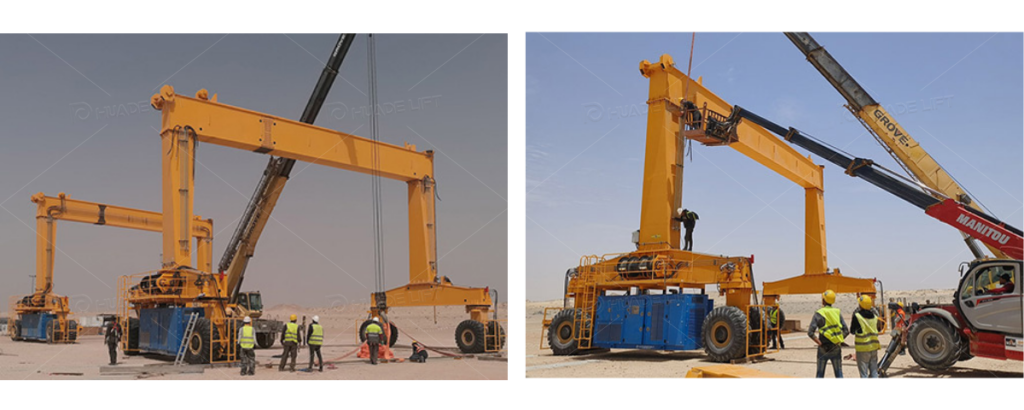
Common Wheel Arrangement Configuration Types
Four-Wheel Configuration
The four-wheel configuration is the simplest type in rubber tyred gantry cranes, with one tire at each corner forming symmetrical support. Its advantage lies in its simple structure and low manufacturing cost.
The small number of wheel sets makes the equipment lighter in weight, suitable for lighter operation scenarios; the simple structure reduces the number of fault points and the workload.
However, the four-wheel configuration has obvious shortcomings: fewer support points result in uneven load distribution and high ground pressure, which is prone to damage and may cause the crane to shake or even tip over when lifting heavy objects.Therefore, it is mainly used for small storage yards and light cargo handling, and is not suitable for large-scale container-intensive operations.
Six-Wheel Configuration
The six-wheel configuration is based on the four-wheel configuration and adds two sets of wheel sets, resulting in a more uniform supporting structure, which is a medium configuration between four-wheel and eight-wheel.
Compared to the four-wheel configuration, it has a larger supporting area and more uniform load distribution, which can reduce ground pressure and the probability of damage, and better suppress the body shaking during medium-load lifting.
In terms of maneuverability, although it is slightly more complex than the four-wheel configuration, with a reasonable steering design, its flexibility does not significantly decrease.
Its disadvantage is that the load capacity is limited and it cannot adapt to heavy, long-span operations; the addition of wheel sets makes the steering and maintenance system slightly more complex, and the maintenance cost slightly increases. It is mainly used for medium-sized yards and medium-load handling.
Eight-Wheel Configuration
The eight-wheel configuration is the most widely used rtg rubber tyred gantry crane wheel configuration at present, with four sets of wheel groups on each side for symmetrical support.
Its load distribution is uniform, which can significantly reduce ground pressure and avoid ground damage, reducing the cost of site maintenance; the expanded supporting area significantly improves stability.
In terms of maneuverability, although there are more wheel sets, with the help of synchronous steering, full-wheel steering and other technologies, it is suitable for operations in open or narrow areas of container yards.
The disadvantage of the eight-wheel configuration is its complex structure, high manufacturing cost and maintenance cost, but it is still the preferred choice for regular container operations. HuadeLift’s conventional rtg rubber tyred gantry crane also mostly adopts this configuration, which can meet customer’s regular needs and control operating costs, and has been widely recognized.
Twelve-Wheel and Multi-Wheel Configurations
Twelve-wheel and multi-wheel configurations are mainly used for heavy rubber tire gantry cranes, with multiple sets of wheel groups on each side for symmetrical support.
The core advantage of these configurations is their extremely strong load-bearing capacity and stability.
Multi-wheel configurations can evenly distribute the load, protecting the ground and extending the lifespan of tires and axle; the expanded supporting area significantly improves stability and can adapt to extremely high, long-span and heavy operation requirements.
In terms of maneuverability, although there are more wheel sets, with the help of synchronous steering, lateral movement and other technologies, it is suitable for dense operations in large container terminals and heavy storage yards; some equipment is equipped with independent drive steering systems, providing more precise positioning.
Its disadvantage is complex structure, high initial investment, and the need for professional personnel and specialized equipment, mainly used for large container terminals and heavy storage yards with extremely high requirements for load and stability.
Advantages of Multi-Wheel Arrangements
For scenarios requiring handling heavy loads and long-span operations, rubber tire gantry cranes with multi-wheel configurations have irreplaceable advantages. These advantages not only manifest in operational performance but also bring long-term operational benefits for enterprises.
Stronger Load-Bearing Capacity
One of the core advantages of multi-wheel configurations is their extremely strong load-bearing capacity. By evenly distributing the entire machine’s weight and the lifting load to multiple wheel groups, it can effectively reduce the pressure on a single wheel group, avoid damage to the wheel group and tires due to overload, and easily handle heavy container lifting and long-span operations.
Longer Lifespan of Tracks and Equipment
Multi-wheel configurations can significantly reduce the unit pressure on the ground and tracks, reduce wear and tear, extend their lifespan, and reduce maintenance costs for the site and tracks. At the same time, the uniform load distribution can also reduce wear on the crane’s structure and avoid deformation caused by excessive force in a certain area, extending the overall machine’s lifespan.
More Stable Operation Experience
Multi-wheel configuration is usually combined with the bogie suspension system, which can effectively absorb ground irregularities and vibrations, reduce the jolting during the crane’s movement, improve the operator’s working experience, prevent cargo damage, and reduce the vibration damage to the equipment structure and the occurrence of faults.
Higher Operational Safety
Multi-wheel configuration can expand the support area of the crane, lower the center of gravity of the entire machine, reduce the risk of tipping and shaking during lifting operations, and even maintain better stability even when encountering external factors such as wind force outdoors, providing more reliable protection for the operators and the equipment.
Stronger Site Adaptability
The rubber tyred gantry crane with multi-wheel configuration, through advanced steering systems, can adapt to complex site conditions such as curved tracks and track deviations, and can also operate normally in poorly-conditioned storage yards; some equipment is equipped with independent control wheel group motors, which can achieve more precise positioning and movement, suitable for operations in narrow areas.
Reduction of Equipment Structural Stress
Uniform load distribution can effectively reduce the stress on the main beam, support legs, etc. of the crane structure, avoid structural bending and deformation, extend the equipment’s service life, reduce the frequency and cost of structural maintenance, and ensure the long-term stable operation of the equipment.
Heavy-Duty Rubber Tyre Design Features
The performance of the wheel group of rubber tyred gantry cranes not only depends on the number and configuration of the wheel group, but is also closely related to the design of the rubber tires. The rubber tires used in heavy rubber tyred gantry cranes are not ordinary industrial tires, but are specially designed to meet the operation requirements of the cranes.
High Carrying Capacity
The tires of rubber tyred gantry cranes need to bear the weight of the entire machine and the lifting load, as well as the dynamic impact force during movement. Therefore, they must have a high carrying capacity. Such tires usually adopt a high-level structure, with reinforcing ribs for reinforcement, and the rubber material is specially blended to have strong compressive and wear resistance, capable of adapting to long-term high-intensity operations.
Optimized Ground Contact Design
Compared with steel wheels, rubber tires have a larger ground contact area, which can effectively reduce ground pressure, protect the storage yard from damage, and improve the stability of the crane’s movement. The shape of the tire contact surface is optimized to better fit the ground, reduce slipping, improve movement accuracy and safety, and the elasticity of the rubber material can absorb ground vibrations, reducing equipment structural wear.
Interaction Between Tire Selection and Wheel Configuration
The tires and wheel group configuration of rubber tyred gantry cranes are mutually coordinated and influencing as a whole. A reasonable combination of the two can fully exert the equipment’s performance, while an improper combination will lead to performance degradation, accelerated tire wear, and increased maintenance costs.
Large-sized tires with fewer wheel groups have strong maneuverability and are suitable for sites with high ground strength, but they have high ground pressure and fast tire wear; small-sized tires with more wheel groups can reduce ground pressure and wear, but increase mechanical complexity and maintenance costs, and affect maneuverability.
Soft rubber tires with multi-mode steering systems have good maneuverability and ground adaptability, but have poor wear resistance; hard rubber tires have strong wear resistance and long service life, but have poor maneuverability and ground adaptability. The choice should be based on wheel group configuration, site conditions, and load requirements to achieve the best coordination.
Wheel Configuration and Its Impact on Maneuverability
The maneuverability of rubber tire gantry cranes directly affects the operation efficiency, and wheel group configuration is one of the core factors affecting maneuverability. The number of wheel groups, steering methods, driving methods, etc., all have an impact on the movement performance of the crane.
Correlation between Wheel Group Number and Load Distribution
The wheel group number not only affects the load distribution but also indirectly affects maneuverability. With fewer wheel groups, the equipment weight is lighter, the steering is more flexible, and it is suitable for narrow sites; with more wheel groups, although the turning radius increases, the uniform load distribution can make the movement more stable, and the combination of an advanced steering system can make up for the lack of maneuverability.
Steering Methods and Turning Performance
The wheel sets of modern rubber tire gantry cranes have diverse steering methods, including front-back steering, full-wheel steering, lateral steering, and in-place rotation, etc. Front-back steering is simple to operate and suitable for regular movement; full-wheel steering can reduce the turning radius and is suitable for narrow areas; lateral steering enables lateral movement, improving the efficiency of operations in dense stacking areas; in-place rotation allows 360-degree rotation in limited spaces, enhancing the adaptability of the site.
Matching of Driving Wheels and Non-Driving Wheels
The wheel sets are divided into driving wheels and non-driving wheels. Driving wheels provide power, while non-driving wheels serve as supports. The more driving wheels there are, the stronger the traction force is, suitable for complex scenarios such as slopes and uneven ground, but it will increase energy consumption and mechanical complexity; when matching, it is necessary to combine the site conditions and operation requirements to balance traction force and cost.
Wheel Set Positioning and Moving Accuracy
The positioning accuracy of the wheel set directly affects moving accuracy and operational safety. Inaccurate positioning can cause equipment deviation and shaking, affecting efficiency and possibly damaging the ground and equipment. Precise wheel set positioning enables the crane to maintain a stable route during long-distance movement, reducing rolling resistance and tire wear, and improving the positioning accuracy of lifting and positioning.
Wheel Sets: A Core Component That Drives Rubber Tyred Gantry Crane Cost
The wheel set is a core component of rubber tyred gantry cranes. Its configuration not only affects the equipment performance but also directly determines the initial investment and long-term operating costs. Many enterprises overlook this when selecting, which can easily lead to cost overruns in the later stage.
Impact of Wheel Set Quantity on Cost
The more wheel sets there are, the higher the initial investment will be, as more wheel set components, stronger supporting structures, and more complex steering and driving systems are required. However, multi-wheel set equipment has lower long-term operating costs, reducing tire replacement, site maintenance, and fault maintenance costs. When selecting, it is necessary to balance the initial investment and long-term operating costs.
Impact of Wheel Set Size and Material on Cost
Large-sized wheel sets can improve the load distribution effect, but the manufacturing cost, installation cost, and later replacement cost are higher; forged steel wheel sets have high strength, good wear resistance, and long service life, but the manufacturing cost is higher than that of ordinary cast steel wheel sets. Special materials with wear resistance and corrosion resistance need to be used in harsh environments, although the cost is high, it can reduce faults and replacement frequencies, and is more cost-effective in the long run.
Impact of Wheel Set Load Requirements on Cost
For heavy loads, continuous high-intensity operations, or poor ground conditions, dedicated wheel set load distribution systems, including load balancing devices and high-capacity bearings, are required, which will increase manufacturing costs and maintenance costs; for scenarios with lighter loads and good ground conditions, no such systems are needed, which can effectively control costs.
Factors to Consider When Choosing Wheel Number
There is no fixed standard for selecting the number of wheel sets for rubber tyred gantry cranes. The core is to combine one’s own operation requirements and site conditions, and comprehensively consider various factors to select the most suitable configuration.
Load Capacity Requirements
Load capacity is the core consideration factor. It is necessary to clearly determine the rated lifting load of the crane plus the machine weight to determine the total load that the wheel set needs to bear. For heavy loads, additional wheel sets are needed to distribute the load, while for lighter loads, fewer wheel sets can be selected to control costs. Do not choose a configuration with insufficient wheel sets to save costs, as this may lead to equipment failures and safety accidents.
Operating Scenarios and Environment
On low-strength ground sites, more wheel sets are needed to distribute pressure; narrow sites are suitable for equipment with fewer wheel sets; outdoor, heavy-duty operation scenarios require more wheel sets to enhance stability and load capacity. In harsh environments, more durable wheel set materials and more wheel sets are needed to extend the equipment’s service life.
Wheel Set Material and Hardness
High-quality materials and appropriate hardness can enhance the bearing capacity and wear resistance of the wheel set, reducing the demand for wheel sets. For heavy-duty operations, forged steel wheel sets are suitable and can be appropriately reduced in number; cast steel wheel sets have lower costs but poorer performance, and more wheel sets are needed to ensure the load-bearing capacity; the hardness needs to be reasonably selected to avoid being too brittle or wearing out too quickly.
Maintenance Requirements and Cost
The more wheel sets there are, the greater the maintenance workload and cost will be. More maintenance personnel and spare parts need to be equipped. If the maintenance capacity is limited and cost control is desired, fewer wheel sets can be chosen; if there is a strong maintenance capability and high operational requirements, multiple wheel sets can be selected, while the convenience of purchasing spare parts should also be considered.
Conclusion
The configuration of the rubber tyred gantry crane’s wheel set is the key factor that affects the performance, safety and operating costs of the equipment. Different configurations have their own advantages and disadvantages. The selection should take into account the operational requirements, site conditions, etc., and aim to achieve the best cost-performance ratio.
