
Within the grand landscape of modern logistics and port operations, rubber tyre gantry cranes undoubtedly serve as the “steel backbone” of container terminals and yards. These colossal machines navigate yards with remarkable agility, leveraging hundreds of tons of lifting capacity to precisely load, unload, and stack containers. Like skilled dancers on a bustling logistics stage, they perform a symphony of efficiency and precision. Their presence directly impacts container turnover efficiency, port throughput, and the smooth operation of the entire supply chain, making them critical equipment for ensuring the unimpeded flow of global trade and logistics.
Why Soil Conditions Form the Foundation of Rubber Tyre Gantry Crane Installation
Soil conditions are considered the bedrock of rubber tyre gantry crane installation because they permeate every stage from setup to long-term operation, fundamentally ensuring safety, efficiency, and longevity. Neglecting soil conditions is akin to building castles on shifting sands—even the most advanced equipment becomes a potential safety hazard and efficiency bottleneck.
The Direct Link Between Soil Conditions and Stability
Soil structure plays an irreplaceable core role in supporting the crane’s weight distribution. A rubber tyre gantry crane itself often weighs hundreds of tons, and when lifting a fully loaded container, the total load becomes staggering. These loads are not concentrated at a single point but are dispersed through the rubber tyre gantry crane’s multiple tires and transmitted to the soil surface. At this point, the stability of the soil structure becomes critically important. High-quality soil structure features tightly bound particles that form a robust load-bearing framework. This framework disperses immense loads uniformly deep into the ground like ripples on water, ensuring pressure at every soil point remains within its bearing capacity. This prevents sudden subsidence or collapse in localized areas due to excessive stress.
Soil plays a decisive role in preventing the rubber tyre gantry crane from tilting or shifting during operations. When turning, lateral thrust is generated; during lifting, upward pull and lateral sway forces occur; and during braking, forward inertial forces are produced. These complex and variable forces require the soil to provide sufficient counteracting forces through interaction with the rubber tyre gantry crane’s tires to achieve equilibrium. Firm soil acts like an invisible giant hand, firmly “gripping” the rubber tyre gantry crane’s tires to prevent unnecessary movement under these forces.
Soil Conditions and Mobility
Soil type and compaction level are critical variables affecting smooth rubber tyre gantry crane movement, collectively forming the “road conditions” foundation for rubber tyre gantry crane mobility. Different soil types possess distinct engineering properties, significantly impacting rubber tyre gantry crane movement.
Well-compacted soil provides nearly ideal travel conditions for rubber tyre gantry cranes. The compaction process mechanically expels air and moisture between soil particles, arranging them more densely and significantly reducing porosity. Such soil exhibits high load-bearing capacity and deformation resistance. When crane tires traverse it, settlement is minimal and rolling resistance remains stable. Whether moving in straight lines or executing agile turns, the rubber tyre gantry crane maintains a steady posture, precisely following the predetermined route—greatly enhancing operational efficiency.
Additionally, uneven or unstable ground poses multifaceted challenges to rubber tyre gantry crane maneuverability. Traveling over undulating terrain subjects the rubber tyre gantry crane body to severe jolts and vibrations. This not only accelerates wear and fatigue of structural components, shortening equipment lifespan, but also compromises operator precision, increasing error risks during container handling. Simultaneously, unstable ground may suddenly collapse locally as the rubber tyre gantry crane passes, causing a sudden tire sinkage that disrupts the rubber tyre gantry crane’s balance. This can lead to equipment damage and safety incidents.
The Relationship Between Soil Conditions and Safety
Soil failure under heavy loads represents one of the most devastating safety hazards in rubber tyre gantry crane operations. Soil bearing capacity has finite limits; when the combined weight of the rubber tyre gantry crane and its load exceeds this capacity, irreversible structural damage occurs. Initial signs may appear as minor settlement, but sustained loading rapidly accelerates this process, leading to significant collapse.
Suitable soil conditions form the first and most critical line of defense for rubber tyre gantry crane operation safety. They provide continuous, stable support, ensuring the rubber tyre gantry crane maintains a steady posture under all working conditions—whether stationary parking, dynamic movement, or lifting heavy loads. Stable soil conditions minimize equipment failures caused by ground issues, reducing the probability of damage and thereby decreasing operational interruptions due to repairs. More critically, it creates a safe working environment for on-site personnel, allowing them to operate equipment under relatively stable conditions and significantly lowering the risk of safety incidents triggered by soil-related problems.
Key Points
The immense loads generated by tire-mounted gantry rubber tyre gantry cranes during operation impose stringent demands on the soil’s uniform load-distribution capacity. These loads are not static but fluctuate continuously with rubber tyre gantry crane movement, load lifting, and lowering. During lifting, loads surge abruptly; during movement, load distribution shifts as tire contact points with the ground change. The soil must adapt to these dynamic changes, uniformly transferring loads to deeper soil layers.
The benefits of thorough soil preparation are comprehensive and long-lasting. Conducting thorough soil surveys, improvements, and compaction before rubber tyre gantry crane installation establishes a solid foundation. This not only ensures stable rubber tyre gantry crane performance over extended operation, reducing downtime for soil-related repairs, but also lowers maintenance costs. A stable soil environment minimizes structural wear and fatigue, extending equipment lifespan. Long-term, this saves substantial expenses on replacements and repairs, significantly enhancing operational economics.

Key Soil Factors to Evaluate Before Installation
Soil Bearing Capacity
Definition and Importance of Soil Bearing Capacity
From an engineering mechanics perspective, soil bearing capacity refers to the maximum vertical load per unit area that soil can withstand without structural failure and within acceptable settlement limits. It is the most critical indicator for assessing soil’s ability to support a tire-mounted gantry rubber tyre gantry crane, analogous to a bridge’s weight limit for vehicles.
Consequences of Insufficient Soil Bearing Capacity
For tire-mounted gantry rubber tyre gantry cranes, insufficient soil bearing capacity triggers a chain reaction of consequences. First, the rubber tyre gantry crane experiences excessive settlement under its own weight and load, causing the structure to tilt and disrupting normal operations. Second, uneven settlement subjects structural components to additional stress, accelerating equipment aging and damage. Most critically, severely inadequate bearing capacity may directly cause soil collapse, triggering major safety incidents such as rubber tyre gantry crane overturns.
Methods for Measuring Soil Bearing Capacity
In practice, various methods exist for measuring soil bearing capacity. The static cone penetration test is a common in-situ method. It involves driving a conical probe into the soil at a controlled rate and measuring the required penetration resistance to indirectly determine the soil’s bearing capacity. This method offers advantages such as high efficiency, low cost, and minimal soil disturbance. Load tests represent a more direct and precise approach. By applying graded loads to soil layers at predetermined depths and observing settlement, the soil’s ultimate bearing capacity is determined from the load-settlement relationship curve. However, load tests are costly and time-consuming, typically reserved for critical projects or areas with uncertain soil properties.
Moisture and Drainage
Influence of Soil Moisture on Soil Properties
Soil moisture content, the amount of water present in soil, is a critical factor affecting soil strength and stability. Water acts as a “plasticizer” for soil, significantly altering its physical and mechanical properties.
Effect of Moisture on Sandy Soils
For sandy soils, a small amount of moisture can increase cohesion between particles, enhancing soil compaction and bearing capacity. However, excessive moisture fills the pores between particles, reducing friction and decreasing shear strength. Under rubber tyre gantry crane loads, saturated sandy soils may experience a sudden surge in pore water pressure, causing particles to lose effective contact and exhibit liquid-like flow—a phenomenon known as soil liquefaction—virtually eliminating bearing capacity.
Effect of Moisture on Clay Soils
Clay soils exhibit heightened sensitivity to moisture. Water causes clay particles to swell, weakening inter-particle cohesion, increasing plasticity, and significantly reducing strength. When clay soil moisture content exceeds the liquid limit, it transitions to a fluid state incapable of bearing any load. Even within the plastic limit range, clay soils become soft, undergoing substantial compressive deformation under rubber tyre gantry crane loads, compromising rubber tyre gantry crane stability.
Importance and Measures of Drainage Systems
A well-designed drainage system is crucial for controlling soil moisture and maintaining optimal soil performance. It promptly removes excess water from the soil, preventing water accumulation. For sites, common drainage measures include surface drainage and subsurface drainage. Surface drainage utilizes slopes, ditches, and swales to quickly divert surface runoff away from the site, preventing rainwater from infiltrating the soil. Subsurface drainage utilizes facilities like blind drains and drainage pipes to lower the groundwater level, expel pore water from the soil, and enhance the soil’s effective stress and bearing capacity.
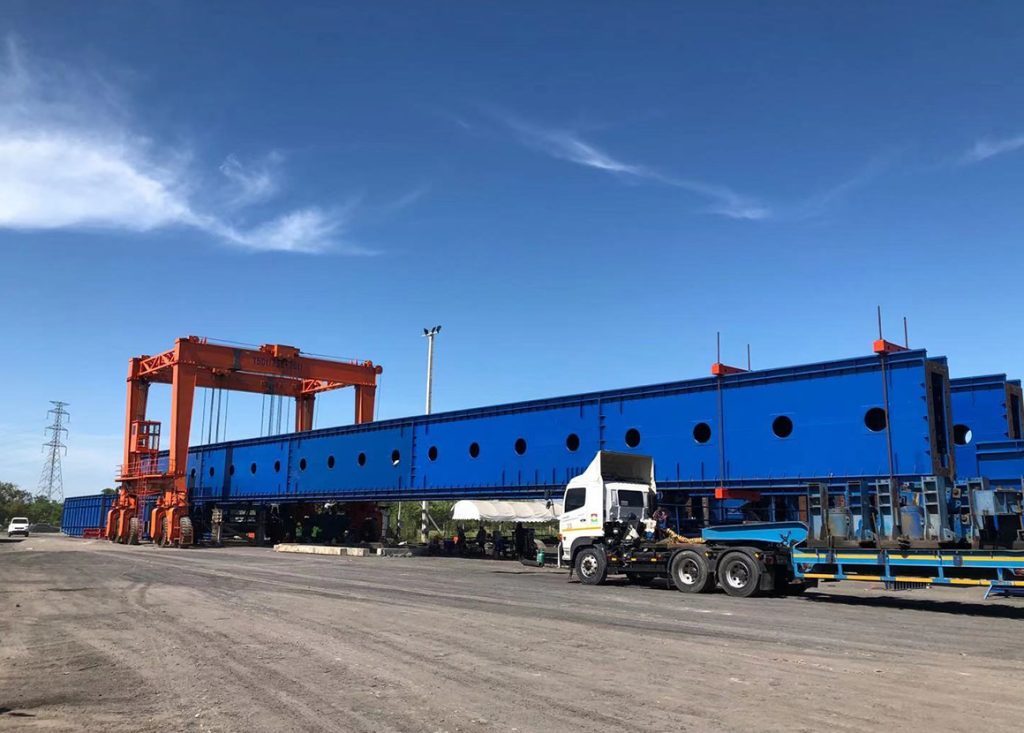
Rubber Tyred Gantry Crane for Transporting Steels
Best Practices for Operators in Different Application Scenarios
Different application scenarios impose varying requirements on the operation of tire-mounted gantry rubber tyre gantry cranes and soil management due to differences in working environments, load characteristics, and soil conditions. Operators must adopt corresponding best practices based on specific circumstances.
Industrial Construction Projects
In industrial construction projects, tire-mounted gantry rubber tyre gantry cranes are frequently used to transport large or heavy prefabricated components such as steel structures and concrete elements. These components impose significant instantaneous loads on the soil due to their substantial weight and volume. Therefore, a comprehensive assessment of the project site’s soil conditions—including bearing capacity and uniformity—must be conducted prior to rubber tyre gantry crane deployment. For areas with poor soil conditions, such as soft ground foundations, temporary ground reinforcement measures are required.
Common temporary ground reinforcement methods include laying compacted gravel, steel plate pads, or specialized road base boxes. Gravel placement enhances soil bearing capacity and drainage; steel plate pads and road base boxes distribute loads over a larger area, reducing soil settlement. During operations, operators must closely monitor ground changes. If significant settlement, heaving, or rubber tyre gantry crane maneuvering difficulties occur, operations should cease immediately. Work may resume only after implementing additional reinforcement measures. Additionally, rubber tyre gantry crane travel routes and work zones should be strategically planned to avoid prolonged stays or heavy operations in areas with poor soil conditions.
Precast Concrete Yard
Within precast concrete yards, tire-mounted gantry rubber tyre gantry cranes repeatedly lift and stack heavy, irregularly shaped precast concrete components. These components impose significant repeated soil loads. Therefore, ensuring the soil can withstand such cyclic loading is critical. During preliminary planning, conduct thorough soil testing and assessment. Determine the required bearing capacity based on the weight and stacking method of the precast components, and implement corresponding soil improvement measures.
For areas with frequent rubber tyre gantry crane operations, such as component storage and loading/unloading zones, consider reinforced ground surfaces or concrete pads. Ground reinforcement can be achieved through soil compaction or the addition of stabilizers; concrete pads offer higher load-bearing capacity and abrasion resistance, effectively withstanding repeated pressure from rubber tyre gantry cranes and precast components. During daily operations, avoid prolonged repetitive rubber tyre gantry crane operations at the same location to minimize soil fatigue damage. Additionally, conduct regular inspections of the ground surface, promptly repairing cracks, settlement, and other issues to ensure the soil remains in optimal working condition.
Conclusion
In summary, soil conditions form the fundamental guarantee for the safe and efficient operation of tire-mounted gantry rubber tyre gantry cranes, and their importance cannot be overstated. From rubber tyre gantry crane stability and mobility to operational safety, equipment lifespan, and operational costs, soil conditions play a critical role. They are not only the foundation for rubber tyre gantry crane installation but also a key factor throughout the entire operational process.
Neglecting soil conditions carries immense risks, potentially leading to severe accidents such as rubber tyre gantry crane tilting or overturning, resulting in casualties and significant property damage. Simultaneously, it impairs operational efficiency, increases equipment maintenance costs, and shortens the equipment’s service life. Conversely, making reasonable investments in soil preparation—through detailed surveys, scientific improvements, and effective maintenance—provides a solid and stable foundation for the rubber tyre gantry crane, significantly reducing various risks.
