
Introduction
In recent years, the global energy landscape has undergone profound transformation, with solar energy emerging as a key focus for development as a clean, renewable resource. The International Energy Agency forecasts that by 2030, new photovoltaic installations will account for over half of global renewable energy capacity, driving accelerated large-scale power plant construction.
Efficient and safe hoisting of structural components—including steel frameworks and photovoltaic mounting systems—is critical for large-scale PV power plant construction. Traditional equipment like crawler cranes and tower cranes faces limitations in confined spaces, complex terrain, and high operational costs.
Against this backdrop, rubber-tyred gantry cranes have emerged as a vital choice for PV plant construction. Their flexible site adaptability, efficient lifting and transport capabilities, and eco-friendly advantages have led to widespread adoption in global projects, earning recognition from EPC contractors and renewable energy enterprises.
What is a Rubber Tyred Gantry Crane?
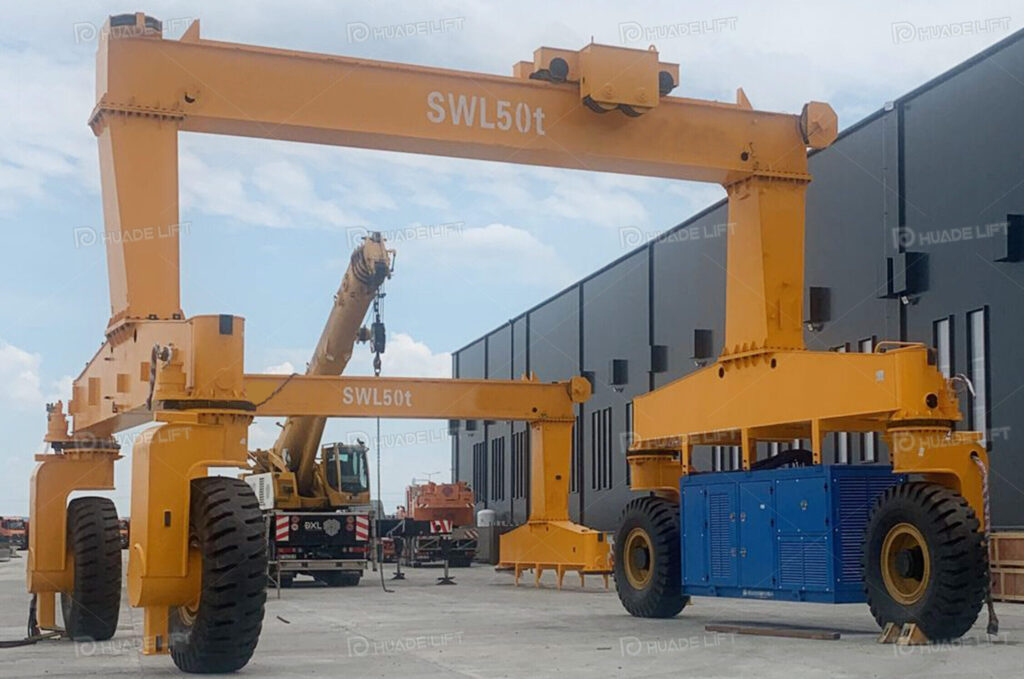
A rubber tyred gantry crane is a mobile gantry crane equipped with rubber tires. Powered by diesel engines, electric motors, or hybrid systems, it can move freely without fixed rails. Compared to traditional rail-mounted gantry cranes, it offers broader applicability, unrestricted by track laying, and provides greater flexibility and convenience.
Typically composed of a gantry structure, hoisting mechanism, travel system, steering system, and electrical control system, its rubber tires enable operation across diverse terrains—including deserts, tidal flats, and construction roads.
Core Requirements for Photovoltaic Power Plant Construction
Large-Scale Component Hoisting and Transportation
The scaled nature of photovoltaic power plants necessitates the installation of vast quantities of solar panels—ranging from thousands to tens of thousands. Each row of panels must be precisely aligned with pre-set mounting points, as significant deviations directly impact subsequent power generation efficiency. Simultaneously, auxiliary materials like steel components and photovoltaic mounting structures are equally substantial in volume. The entire process—from off-site transportation to on-site delivery, followed by hoisting from storage areas to installation stations—is interconnected. This places multiple demands on the hoisting equipment: not only must it possess stable lifting capacity to ensure that groups of modules or heavy steel components remain stable and level during lifting and movement, but it must also deliver efficient operational performance. This enables rapid completion of the “lift-move-position” cycle, preventing delays in the overall construction schedule caused by insufficient efficiency of individual equipment.
Challenges of Complex Construction Environments
To maximize power generation efficiency, photovoltaic power plants are often located in areas with excellent sunlight but harsh natural conditions, such as vast deserts, barren Gobi regions, and severely saline-alkali tidal flats. These terrains present extreme complexity: desert surfaces are often soft shifting sands where vehicles easily become stuck; Gobi landscapes are littered with sharp gravel and feature irregular shallow pits and gullies; saline-alkali soils exhibit high corrosivity, causing significant wear on equipment components. Conventional lifting equipment often struggles in such environments: crawler cranes sink easily on soft ground, requiring frequent steel plate reinforcement, and rescue operations after sinking are time-consuming and labor-intensive; rail-mounted gantry cranes cannot be deployed at all due to the lack of hardened ground and rail infrastructure. Even if some equipment can operate with difficulty, frequent failures due to terrain vibrations or corrosion severely disrupt construction continuity.
Efficient Construction and Cost Control
Photovoltaic projects commonly face dual pressures of “large scale and tight schedules.” Large-scale ground-mounted solar power plants, in particular, often require installing components across thousands or even tens of thousands of acres within months to capture the optimal power generation window. If contractors fail to complete large-scale hoisting operations within the stipulated timeframe, they not only risk penalties for delays but also incur significantly increased costs due to ongoing labor and equipment rental expenses. More critically, intense competition in the PV industry means even minor fluctuations in construction costs can impact overall project profitability. Therefore, selecting lifting equipment that balances efficiency and cost has become essential: the equipment must enable continuous, high-efficiency operation while minimizing unnecessary downtime and relocation time. Simultaneously, it should reduce investments in auxiliary equipment, site modifications, and post-installation maintenance, controlling construction costs from a full lifecycle perspective.
Advantages of Rubber Tyred Gantry Cranes in PV Projects
Flexible Site Adaptability
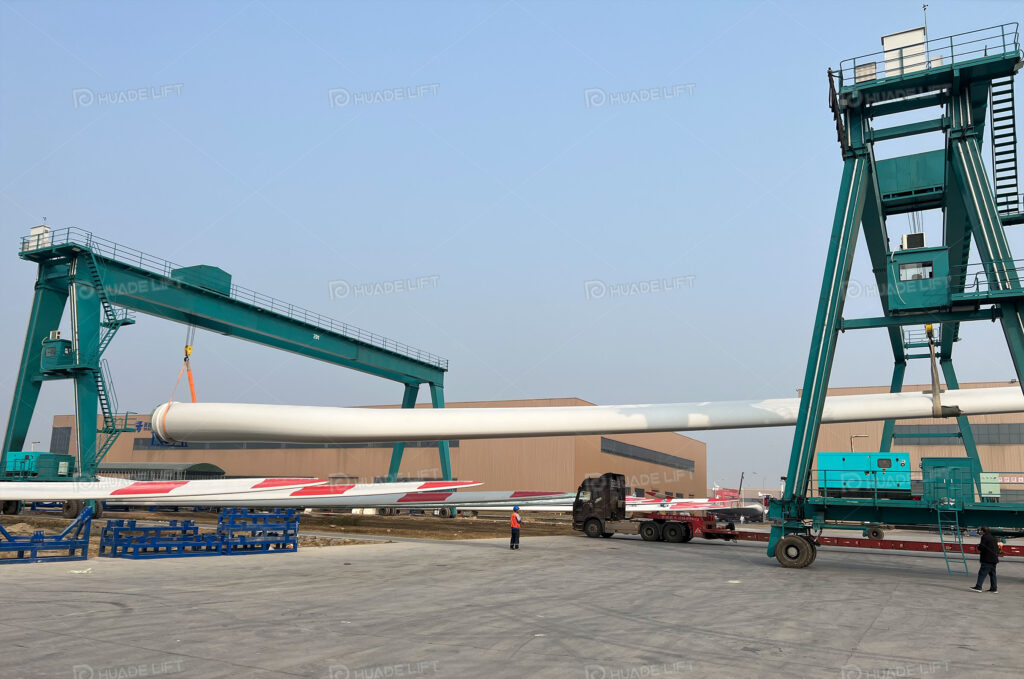
Rubber Tyred Gantry Cranes (RTGs) utilize rubber-tired chassis. The cushioning properties of their tires enable smooth operation on unpaved terrain common in PV sites, maintaining stability even over slight undulations or scattered gravel. Completely free from track constraints, RTGs eliminate the need for pre-planned track laying or dedicated hardened work platforms. This makes them exceptionally adaptable for photovoltaic projects characterized by wide-spread deployment across complex environments like wastelands and slopes. In narrow construction zones with dense support structures, the RTG’s agile steering system enables precise positioning. It can navigate effortlessly between multiple rows of photovoltaic supports with minimal turns, avoiding collisions with installed components. This significantly reduces operational disruptions and enhances construction efficiency.
High-Efficiency Lifting Capability
Rubber-tyred gantry cranes comprehensively address all lifting requirements in photovoltaic projects. They reliably handle everything from large photovoltaic racks and load-bearing steel beams to precast concrete foundation blocks and grouped solar panel assemblies. Certain models boast robust lifting capacities sufficient for handling various heavy components encountered in projects. Crucially, its span can be flexibly customized to match the spacing of PV mounting structures, enabling simultaneous coverage of multiple workstations. This significantly reduces the need for frequent equipment relocation between areas. Unlike crawler cranes requiring repeated repositioning, RTGs can continuously lift and transport multiple batches of components, substantially shortening the operation time per construction unit and accelerating the overall project timeline.
Reduced Construction Costs
Employing rubber tyred gantry cranes in photovoltaic projects substantially reduces reliance on traditional equipment like crawler cranes and tower cranes. Integrating lifting and transport functions, a single RTG performs “point-to-point” operations from component storage areas to installation sites without requiring additional transport vehicles. This eliminates multiple equipment rental fees, fuel consumption costs, and associated labor expenses. Furthermore, RTGs require no track laying, enabling straightforward deployment. After simple on-site inspections, they can be immediately operational. Post-project dismantling eliminates the need to remove track infrastructure, substantially saving time on preliminary preparations and final cleanup, indirectly reducing project duration costs.
Environmental Protection and Green Construction
The photovoltaic industry centers on green and low-carbon development principles, making environmental performance during construction a key focus. Today, some rubber-tyred gantry cranes have been electrified or converted to hybrid power, eliminating reliance on traditional fuel during operation. This significantly reduces fuel consumption and exhaust emissions while lowering noise pollution during construction. Such environmental attributes not only align closely with the eco-standards of new energy photovoltaic projects—avoiding conflicts with project philosophies—but also help construction companies fulfill green construction commitments, further enhancing their social responsibility image in the new energy sector.
Practical Application Cases and Industry Practices
Middle East Desert Photovoltaic Power Plant Projects
Desert photovoltaic power plants in the Middle East represent a global benchmark for large-scale solar construction. However, the construction environment here is exceptionally challenging—the surface consists primarily of loose sandy soil, frequently accompanied by sandstorms. Contractors commonly utilize rubber-tyred gantry cranes (RTGs) as the core equipment for lifting photovoltaic mounting structures and components in such projects. Traditional crawler cranes easily sink into soft sand when traversing deserts, necessitating frequent steel plate laying for passage and often causing delays due to vehicle entrapment. In contrast, RTGs feature larger ground contact areas via rubber tires with specially designed tread patterns that effectively distribute equipment weight and enhance traction, enabling stable operation even on undulating sandy terrain. During sudden sandstorms, RTGs can swiftly relocate to temporary shelters, preventing equipment damage from prolonged exposure and ensuring construction progress remains unaffected by harsh conditions.
Photovoltaic Power Plant Project in Northwest China’s Gobi Desert
During the construction of large-scale ground-mounted photovoltaic power stations in China’s northwest Gobi Desert, rubber-tyred gantry cranes demonstrated exceptional adaptability, becoming one of the construction team’s preferred equipment choices. The northwest Gobi Desert features extreme diurnal temperature variations, with nighttime cold potentially causing equipment component contraction and daytime intense sunlight accelerating mechanical wear. The terrain is predominantly hard, gravel-strewn ground, with some areas featuring shallow pits and gullies. The RTG’s chassis suspension system provides excellent shock absorption and adaptability, enabling it to navigate gravel and shallow pits with ease. Simultaneously, its hydraulic and electrical systems are optimized for extreme temperatures, ensuring stable operation in environments with drastic thermal fluctuations. More importantly, addressing the dense component layout and high lifting demands of Gobi solar plants, the RTG’s customizable span covers multiple rows of supports. This enables the simultaneous lifting and positioning of entire groups of components, facilitating batch operations. Compared to traditional equipment, this significantly shortens construction timelines, helping multiple Gobi solar projects achieve grid connection ahead of schedule.
These case studies across diverse climates and terrains demonstrate that rubber-tyred gantry cranes precisely address complex environmental challenges in PV construction. Their stability, efficiency, and adaptability make them indispensable equipment throughout the construction and operation phases of solar power plants, providing reliable reference for equipment selection in global renewable energy projects.
Comparison with Other Lifting Equipment
Rubber-tyred gantry cranes offer distinct advantages over crawler cranes, tower cranes, and rail-mounted gantry cranes in photovoltaic projects:
Compared to crawler cranes: Crawler cranes offer high mobility but come with high costs and slow relocation times. Rubber-tyred gantry cranes are more flexible, enabling rapid movement and lifting operations.
Compared to tower cranes: Tower cranes suit high-rise construction but are unsuitable for large-area, low-height PV power plants. RTGCs’ operational range better aligns with PV plant requirements.
Compared to rail-mounted gantry cranes: Rail-mounted gantry cranes require tracks, involve cumbersome deployment, and suit long-term fixed operations. RTGCs are track-independent, deploy rapidly, and offer greater flexibility.
Overall, RTGCs offer superior cost-effectiveness for large-scale, complex terrain construction scenarios like PV power plants.
Future Development Trends
As global PV installation capacity continues to expand, demand for lifting equipment will grow accordingly. RTGCs will evolve in the following directions:
Electrification and New Energy Drives
Increasing adoption of electric or hybrid-powered equipment to align with green construction principles.
Intelligent and Automated Systems
Future RTGCs will incorporate advanced intelligent control systems enabling remote monitoring, autonomous operation, and smart scheduling.
Modular Design
To adapt to diverse PV construction requirements, equipment span, height, and lifting capacity will be more readily customizable per project specifications.
Global Application Expansion
With the worldwide growth of the solar industry, RTGCs will see increased deployment in solar projects across more countries and regions, becoming critical infrastructure for renewable energy development.
Conclusion
In photovoltaic power plant construction, rubber tire gantry cranes have become the industry’s preferred lifting solution due to their flexibility, robust lifting capacity, cost advantages, and eco-friendly characteristics. Whether deployed in deserts, Gobi regions, tidal flats, or hilly terrain, these cranes demonstrate exceptional adaptability and efficiency.
As photovoltaic projects expand in scale and the new energy industry continues to develop, rubber-tyred gantry cranes will play an increasingly vital role. They not only reduce costs and enhance efficiency for construction companies but also contribute to global energy transition and sustainable development.
