
Introduction
Global economic development has fueled growth in international trade, driving up port container throughput and raising material handling demands for smart manufacturing. This has created an urgent need for efficient, intelligent lifting equipment.
Rubber-tyred gantry cranes have become critical equipment in ports and factories due to their flexible handling within confined spaces and compatibility with smart systems. Driven by green initiatives in recent years, RTGs have integrated electrification and intelligent technologies, transforming them from container yard equipment into high-end machinery for multiple industries. They are now widely adopted in ports, logistics, and new energy sectors to enhance efficiency, reduce costs, and achieve sustainable development.
This article explores RTG applications in smart ports and factories, detailing their core advantages, operational scenarios, cutting-edge technologies, and value in safety compliance and cost optimization. It aims to assist relevant industries in understanding equipment selection and deployment.
What is a Rubber Tyred Gantry Crane?
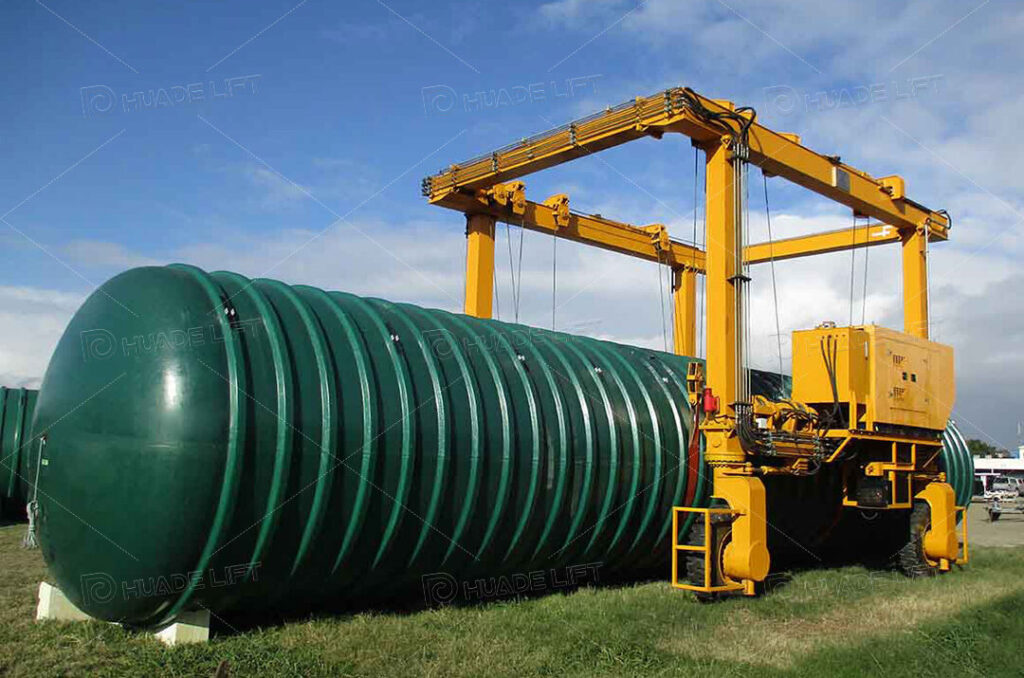
A Rubber Tyred Gantry Crane is a crane utilizing rubber tires for mobility. Compared to traditional fixed gantry cranes, RTGs offer superior maneuverability, requiring no fixed tracks and enabling flexible movement across different work zones.
Typical application scenarios include port container yards, inland freight hubs, prefabricated component factories, and large-scale factory workshops. Its mobile tire chassis enables operation on concrete or hardened surfaces without fixed track constraints, significantly enhancing site utilization.
Historically used primarily for container stacking and handling in port terminals, RTGs have expanded into diverse industries including modular construction, photovoltaic renewable energy, bridge construction, and smart manufacturing facilities, becoming core equipment across multiple sectors.
Core Structural Features
The overall structure of a Rubber Tyred Gantry Crane typically includes:
Gantry Structure: Composed of two vertical columns and an overhead beam, ensuring overall crane stability.
Rubber-Tired Chassis: Enables flexible mobility, adapting to diverse terrains and operational environments.
Lifting System: Commonly powered by electric or hydraulic drives, allowing selection of specialized attachments (e.g., container spreaders, steel clamps, precast beam lifters) based on cargo type.
Drive and Control System: Traditionally diesel-powered, with recent shifts toward electrification (E-RTG) and hybrid configurations. Equipped with intelligent PLC control and anti-sway systems.
Core Advantages
Mobility and Flexibility
Unlike rail-mounted gantry cranes, RTGs operate independently of fixed tracks, enabling rapid movement between work zones. This makes them particularly popular in space-constrained factories or yards. For instance, at container terminals, RTGs can swiftly switch between multiple yard areas, enhancing overall scheduling efficiency.
High Load Capacity and Stability
Rubber Tyred Gantry Cranes are engineered for heavy-duty lifting applications. Modern RTGs typically offer lifting capacities ranging from 40 to 100 tons, with customized models exceeding 150 tons—sufficient for handling containers, steel structures, precast concrete components, and other heavy cargo.
Customizability and Intelligence
With advancements in smart technology, RTGs have evolved beyond traditional cranes into deeply customizable intelligent equipment. Many manufacturers offer personalized configurations, such as:
Electric Drive Systems (E-RTG): Reducing fuel consumption and carbon emissions.
Remote Control and Unmanned Operation: Supporting 5G low-latency control to reduce reliance on on-site operators.
Smart sensors and anti-sway systems: Enhance lifting precision and safety.
Integration with digital platforms: Enable seamless connectivity with port Terminal Operating Systems (TOS) and factory Manufacturing Execution Systems (MES).
Energy Efficiency and Environmental Protection
While traditional diesel RTGs offer robust power, they exhibit high fuel consumption and emissions. The increasingly adopted electric RTGs (E-RTGs) and hybrid RTGs, powered by battery packs or cables, significantly reduce energy consumption and operational costs while meeting green development requirements for ports and factories.
Application of Rubber Tyred Gantry Cranes in Smart Ports
Optimizing Container Yard Management
In modern port operations, container yards form the core of the entire logistics chain. With global container throughput continuously rising, port operators must achieve higher efficiency and lower operational costs within limited yard space.
Rubber Tyred Gantry Cranes play an irreplaceable role in yard management. They enable multi-tiered container stacking within yards and can be rapidly redeployed as needed. For instance, when vessels arrive, RTGs can swiftly retrieve targeted containers from high stacks, reducing vessel waiting times and mitigating port congestion risks.
Compared to traditional forklift-dependent methods, RTGs significantly enhance vertical utilization of yard space. Forklifts face height and tonnage limitations, whereas RTGs enable higher-level stacking and operate smoothly within narrow yard lanes. This capability substantially reduces reliance on forklifts and manual labor, making yard management more efficient.
Digitalization and Automation Integration
Within the context of smart port development, RTGs are no longer merely lifting machinery but intelligent devices deeply integrated with port information systems such as Terminal Operating Systems (TOS).
Through automatic identification systems, RTGs can scan container numbers and locations during handling and upload data in real time to port systems. This enables port operators to track the position and status of every container instantly, facilitating digitalized scheduling.
Furthermore, some advanced RTGs now support unmanned and remote operation. Leveraging the low-latency capabilities of 5G networks, operators can control multiple RTGs simultaneously from remote control centers, coordinating operations across different yard areas. This not only boosts efficiency but also significantly reduces safety risks associated with on-site operations.
In pilot projects at certain automated ports, unmanned RTGs have become the norm. For instance, major international hub ports like Shanghai Yangshan Port and Rotterdam Port are extensively deploying automated RTGs to achieve round-the-clock, high-efficiency port operations.
Energy Conservation and Sustainable Development
Ports represent a significant source of energy consumption and carbon emissions. As global environmental standards tighten, green ports have become an industry trend. Against this backdrop, electric RTGs (E-RTGs) are gradually replacing traditional diesel RTGs.
Powered by cables or battery packs, E-RTGs significantly reduce fuel consumption and carbon dioxide emissions. Industry statistics indicate that electric RTGs consume over 60% less energy than traditional diesel models while substantially lowering noise pollution and improving the working environment within port areas.
This green upgrade not only helps port operators reduce long-term energy costs but also aligns with international shipping industry policies for carbon reduction. For instance, emission reduction targets proposed by the International Maritime Organization (IMO) are accelerating ports’ adoption of more environmentally friendly equipment. The electrification of Rubber Tyred Gantry Cranes has thus become a crucial component of smart port development.

Applications of Rubber Tyred Gantry Cranes in Smart Factories
Modular Production and Material Handling Support
Within smart factories, particularly in industries involving modular production, Rubber Tyred Gantry Cranes offer indispensable value. Many factories require the handling and installation of large components such as steel structures, mechanical parts, and concrete modules during production.
Traditional cranes are often confined to fixed locations, making it difficult to meet the flexible scheduling demands between multiple workstations. RTGs, however, leverage the mobility of rubber tires to move effortlessly between different production lines, enabling cross-area material handling. This is particularly crucial for modular construction companies, precast concrete plants, and large equipment manufacturers.
For instance, in a large precast component manufacturer, the Rubber Tyred Gantry Crane can transport freshly demolded concrete beams directly from the production area to the curing zone, then proceed to the loading zone—all without requiring forklifts or rail-mounted cranes. This capability significantly boosts production efficiency.
Smart Logistics and Workshop Automation
The core of a smart factory lies in the high automation of logistics and production. Rubber Tyred Gantry Cranes can seamlessly integrate with a factory’s MES (Manufacturing Execution System), AGVs (Automated Guided Vehicles), and warehousing systems to form a complete closed-loop logistics system.
When a production line requires a large component, the MES system can directly instruct the RTG to specify the lifting target and location. After completing the task, the system records and feeds back data in real time, ensuring perfect synchronization between logistics and production processes.
This model not only reduces the complexity of manual operations but also prevents production line stoppages caused by untimely material supply, thereby enhancing the overall capacity utilization of the factory.
Safety and Precision
Within factories, lifting operations often involve precision equipment or extremely valuable components, making safety and precision paramount. Rubber Tyred Gantry Cranes are typically equipped with advanced anti-sway systems, intelligent sensors, and automatic alignment technology to maintain stability during lifting and prevent safety hazards caused by swaying.
Additionally, modern RTGs integrate operational monitoring systems that track real-time parameters such as load weight, oil temperature, and battery charge, enabling early warnings of potential risks and reducing equipment failure rates. This intelligent safety mechanism aligns with smart factories’ demand for high-standard production safety.
More importantly, remote control functionality eliminates the need for operators to enter the lifting site directly, significantly reducing risks associated with human-machine interaction. This not only enhances personnel safety but also lowers accident rates and insurance costs.
Technological Convergence and Innovation Trends in RTG Cranes
Application of AI and Big Data
With advancements in artificial intelligence, rubber tire gantry cranes are evolving from passive executors to proactive optimizers. Equipped with smart sensors and data acquisition modules, RTGs collect real-time operational data including lifting speed, energy consumption, task frequency, and equipment health status.
Processed through big data platforms, this data enables analysis of crane operational efficiency and generates optimization strategies. For instance, in port yards, AI algorithms can automatically plan lifting routes based on container arrival/departure schedules, minimizing unnecessary movement and waiting time. In industrial applications, AI can also dynamically assign RTG tasks according to production line rhythms, enhancing overall logistics efficiency.
Furthermore, predictive maintenance is emerging as a new trend. Through big data models, systems can detect potential failures in advance and schedule maintenance before issues occur, preventing unexpected downtime. This approach not only extends equipment lifespan but also reduces repair costs.
5G and Remote Control
The application of 5G technology is revolutionizing RTGs. Compared to traditional wired or Wi-Fi networks, 5G offers ultra-low latency and high bandwidth, enabling real-time remote control.
In port operations, operators can simultaneously monitor and control multiple RTGs from a remote command center, enabling coordinated multi-crane operations. Even when cranes are located kilometers away in yard areas, control signals maintain millisecond-level response times. This not only boosts operational efficiency but also reduces the need for operators to enter high-risk environments.
In smart factories, 5G networks also enable seamless communication between RTGs and other automated equipment like AGVs and robotic arms, forming a true “smart factory ecosystem.” This multi-device collaborative operation model streamlines production processes, virtually eliminating the need for manual intervention.
Electrification and Hybrid Development
Driven by energy transition and environmental pressures, electrified RTGs (E-RTGs) and hybrid RTGs have become mainstream industry trends. While traditional diesel-powered units offer robust power, they present significant shortcomings in fuel consumption and emissions.
Electric RTGs, powered by external cables or battery packs, substantially reduce CO₂ emissions and operational noise. For instance, ports adopting E-RTGs have achieved over 60% annual fuel savings while cutting carbon emissions by more than half.
Hybrid RTGs switch between battery and diesel engine power, ensuring operational continuity while lowering overall energy consumption. This solution is particularly suitable for ports and factories without comprehensive cable infrastructure, serving as a practical transitional choice balancing environmental sustainability and operational feasibility.
Rubber Tyred Gantry Crane Selection Guide
Selecting the appropriate rubber-tyred gantry crane for smart ports or factories is crucial for enhancing efficiency and controlling costs across diverse operational scenarios.
Assessing Operational Environment and Requirements
First, clearly define the fundamental needs of the operational setting. Ports typically prioritize container yard efficiency and vessel loading/unloading speed, while factories emphasize production line flexibility and material handling precision. Therefore, a comprehensive assessment of site size, cargo types, and operational frequency should precede selection.
Technology and Functional Configuration Selection
Core configurations for rubber-tyred gantry cranes include:
Rated Lifting Capacity and Span: Determines the scale of cargo it can handle.
Power System: Diesel, electric, or hybrid—directly impacting operational costs and environmental performance.
Intelligent Modules: Such as automatic positioning systems, remote monitoring systems, and AI scheduling platforms, which significantly enhance application value.
In smart ports, high-precision positioning and automated scheduling functions are typically prioritized; in smart factories, emphasis is placed on flexible handling and seamless integration with production line systems. Implementation Path and Supplier Selection
During equipment implementation, enterprises should advance in phases:
Requirement Research and Feasibility Analysis — Identify business pain points and objectives.
Equipment Selection and Customized Design — Configure appropriate parameters based on actual needs.
Pilot Operation and Optimization — Validate equipment performance through limited-scale deployment.
Full-Scale Rollout and Long-Term Maintenance — Ensure stable system operation while continuously refining based on feedback.
Supplier selection is equally critical. Premium suppliers not only deliver high-performance rubber-tyred gantry cranes but also provide robust after-sales service, technical support, and training programs, enabling enterprises to realize the equipment’s long-term value.
Conclusion
In smart ports, it enhances container turnover efficiency through automation and remote monitoring, reducing reliance on manual labor and traditional forklifts. In smart factories, it flexibly adapts to diverse production demands, enabling high-precision material handling.
Looking ahead, with the implementation of technologies like 5G, artificial intelligence, and blockchain, rubber-tyred gantry cranes will gain enhanced data interaction and autonomous learning capabilities, becoming core nodes in smart logistics systems. Simultaneously, safety and compliance remain industry focal points, driving greater emphasis on reliability and standardization in equipment intelligence.
Evidently, their application in smart ports and factories represents not only efficiency and cost optimization but also a crucial foundation for a safer, greener, and smarter future.
