
In logistics warehousing, port terminals, industrial manufacturing, and other sectors, heavy cargo handling and stacking form core operational processes. Crane selection directly impacts operational efficiency, running costs, and safety factors. Rubber Tyred Gantry Cranes (RTGs) have emerged as a viable option for enterprises due to their unique advantages, though they are not universally applicable. This article analyzes how to scientifically determine RTG suitability for operational needs by examining their definition, strengths and weaknesses, and compatibility factors.
What is a Rubber Tyred Gantry Crane
RTGs are heavy-duty terminal handling equipment indispensable in shipping, logistics, and industrial sectors. They primarily lift, transfer, and stack heavy cargo such as containers and steel. Its core structure comprises a chassis, a gantry crane, and a wheeled mobile platform: the chassis provides stable support for safety, the gantry crane is the core for lifting and moving cargo, and the wheeled platform grants mobility, adapting to various surfaces like roads and railways.
RTGs excel in mobility, equipped with specialized steering systems enabling multi-directional travel and rotation. They navigate narrow spaces with agility, making them suitable for congested industrial sites and ports. Lifting capacity varies significantly by model, with large RTGs capable of handling hundreds of tons. Their hoisting systems combine winches and chain blocks for reliable mechanical design. Practical advantages include compact storage (via telescopic axles), ergonomic operator cabins, rational component layout, and dedicated maintenance platforms that simplify servicing.
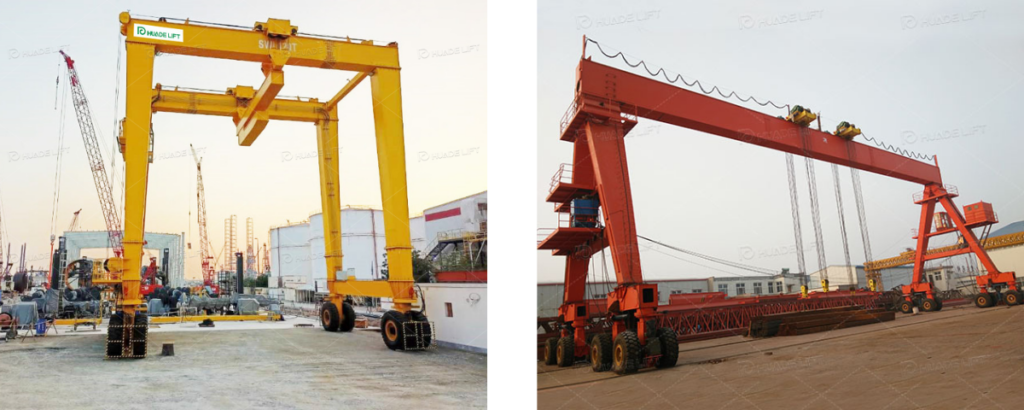
High-strength RTG crane structure designed for heavy-duty handling tasks.
Advantages of Using Rubber Tyred Gantry Cranes
Exceptional Mobility and Flexibility
The absence of rail constraints is central to RTG flexibility. Powered by rubber tires, they move freely within the work area, rapidly adjusting positions based on cargo location and operational needs to expand coverage—particularly suited for dispersed cargo scenarios. Equipped with a specialized steering system, they can move forward, backward, sideways, and rotate 360 degrees, enabling agile obstacle avoidance in confined spaces or complex layouts. This makes them ideal for congested, topographically challenging industrial sites and docks.
Outstanding Environmental and Energy Efficiency
Amid stricter environmental regulations, modern RTGs predominantly utilize electric power instead of diesel engines, reducing exhaust and noise pollution at the source to meet stringent environmental requirements in ports and industrial parks. Electric RTGs consume less energy than diesel counterparts, offering significant long-term cost advantages while eliminating management costs and safety risks associated with diesel storage and refueling, thereby enhancing economic efficiency.
High Operational Efficiency and Precision
Advanced guidance systems and agile maneuverability enable RTGs to rapidly reach cargo positions, shortening lifting preparation times and reducing vehicle/vessel waiting periods to boost operational throughput. Equipped with sophisticated electronic control systems, sensors, and visual aids, they precisely control cargo lifting, movement, and placement, minimizing collision and drop risks while handling precision and high-value goods.
Comprehensive Safety Assurance System
RTGs prioritize safety, featuring wind anchoring and wind speed monitoring for open-air environments like ports to ensure stable operation during high winds. Additionally, comprehensive safety devices—including collision warning (distance alert), emergency braking (sudden stop), and load monitoring (overload prevention)—safeguard personnel and operations.
High Maintenance Accessibility and Adaptability
Compared to rail-mounted cranes, RTGs feature a streamlined structure with optimally positioned core components. Maintenance personnel can swiftly access critical areas, while dedicated service platforms enhance repair convenience and safety, minimizing downtime. Their operational adaptability is exceptional—handling diverse cargo like containers and steel without requiring tracks. They operate effectively on level surfaces, simple sites, and even partially uneven terrain, with tire buffering ensuring stable movement.
Limitations Should Consider Before Choosing an Rubber Tyred Gantry
While RTGs offer significant advantages, inherent limitations may conflict with operational requirements, potentially leading to inefficiency and increased costs. Key considerations before implementation include:
High Demands on Ground Conditions and Load-Bearing Capacity
The combined weight of the RTG and lifted cargo exerts substantial ground pressure, necessitating compliance with load-bearing standards to prevent collapse or tilting on soft or unhardened surfaces. Surface flatness must be adequate to prevent potholes or steep slopes from causing equipment jolts, which compromise accuracy and accelerate component wear. Adapting sites for RTGs often requires specialized modifications (e.g., concrete hardening, drainage optimization), increasing upfront investment. This limitation is more pronounced for temporary sites or businesses with limited renovation space.
Energy Consumption and Long-Term Operating Costs Demand Close Attention
Operating costs vary significantly across different power types: Diesel RTGs are highly susceptible to fuel price fluctuations and require additional investment for environmental upgrades. Electric RTGs have low energy costs but demand substantial upfront investment in supporting infrastructure like charging stations. Additionally, hidden costs such as tire replacement (frequent changes on rough surfaces or during high-intensity operations, with specialized tires being costly), engine oil maintenance, and core component upkeep also impact operational budgets.
Tires, steering, and drive components require high maintenance
Tires, as core mobility components, suffer accelerated wear and bulging from prolonged heavy-load operation. Uneven surfaces or frequent steering further hasten deterioration; delayed replacement risks blowouts and drifting. Steering mechanisms experience high-frequency wear on gears and hydraulic systems, while drive system components like motors and transmissions are prone to failure under sustained heavy loads. These parts require specialized tools and personnel for maintenance, entailing short intervals and high costs. Neglected upkeep prolongs downtime.
Storage Density and Throughput Limitations
Compared to RMG (Rail-mounted Gantry Cranes), RTG’s gantry structure and travel requirements occupy yard space. Goods stacking necessitates reserved aisles, preventing ultra-dense storage. When yard area is limited, utilization rates are low. Regarding throughput, efficiency is susceptible to workflow coordination issues; scattered cargo or frequent command switching increases idle travel time. A single unit has limited operational range, requiring additional equipment purchases to boost throughput—a costly approach that diminishes competitiveness against rail-mounted equipment in large-scale, high-throughput scenarios.
Operational Factors That Determine RTG Suitability
RTG suitability hinges on multiple factors including site conditions, operational requirements, and equipment coordination. Only when performance aligns precisely with needs can advantages be leveraged and benefits maximized.
Site Area and Layout
Site size is the primary consideration. Insufficient space restricts maneuverability, negates mobility advantages, and creates safety hazards. In larger, dispersed cargo areas, RTGs’ freedom of movement enables efficient coverage. For well-organized layouts with clearly defined cargo zones, RTGs optimize routes to boost efficiency. In cluttered, irregularly shaped areas, its multi-directional steering effectively navigates obstacles. However, dense obstructions and narrow aisles limit flexibility, requiring comprehensive evaluation of site dimensions alongside RTG parameters like minimum turning radius and mast width.
Expected Workload and Daily Capacity
RTGs excel in medium-to-low throughput scenarios. When daily handling volumes are stable and a single unit suffices, deployment enables efficient operations. When multiple units are required due to excessive load, precautions must be taken against equipment collision conflicts, scheduling challenges, and operational chaos. Concurrently, attention should be paid to workload fluctuations and peaks. While stable operation occurs within rated capacity, prolonged overloading accelerates wear and shortens lifespan. Conversely, significantly exceeding actual demand leads to resource idleness and increased costs. Select the appropriate model based on a combination of long-term average and peak workload requirements.
Types and Combinations of Vehicles and Equipment Interacting Within the Yard
RTGs must coordinate with equipment like container trucks and forklifts. Compatibility depends on equipment dimensions, travel routes, and alignment with the RTG’s operational range. For instance, mismatched truck docking positions and lifting radii increase adjustment time, while frequent forklift traffic through aisles heightens collision risks—both reducing efficiency and safety. In scenarios with numerous devices and complex processes, a robust scheduling system is essential to ensure seamless coordination. RTGs can flexibly adjust positions to adapt to progress but require sufficient operating space to prevent congestion. Conversely, when equipment layouts are fixed and processes standardized, rail-based equipment offers greater collaborative advantages, limiting the flexibility of RTGs.
Safety, Environmental, and Noise Requirements
Safety standards vary by application. Industries like ports and chemicals impose strict requirements on RTG wind resistance, lightning protection, and explosion-proof capabilities, necessitating corresponding equipment. Non-compliance renders them unsuitable. For environmental and noise considerations, urban core areas and residential zones require low-emission, low-noise models like electric RTGs. In remote or low-environmental-requirement scenarios, diesel RTGs may be considered due to lower acquisition costs, but future retrofitting risks due to regulatory upgrades must be weighed. Certain environments may have specific regulations regarding equipment light pollution or electromagnetic interference, which should be evaluated during selection.
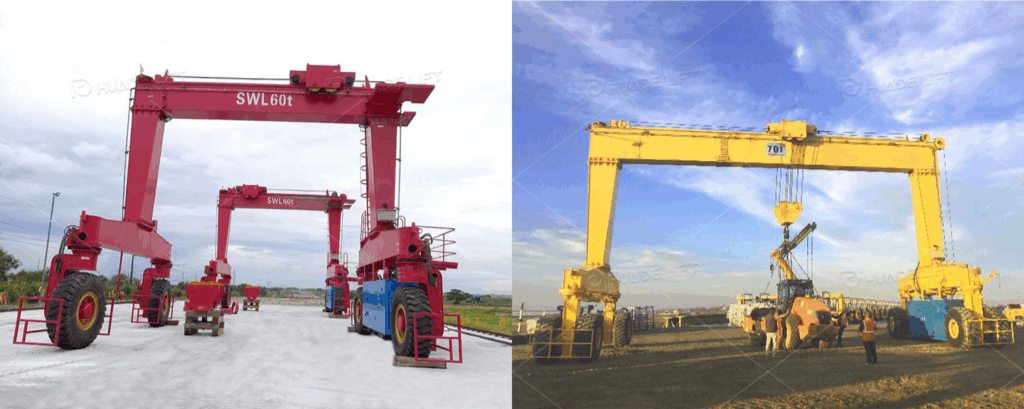
RTG crane structure displaying its steel frame, wheels, and hoisting system.
Common Mistakes When Choosing a Rubber Tyred Gantry Crane
Many companies fall into pitfalls due to misperceptions about equipment, their own needs, or costs, resulting in mismatched equipment and scenarios that undermine efficiency. These issues must be avoided.
Neglecting Ground Requirements
Some companies focus solely on lifting capacity and efficiency, assuming “the site can accommodate it,” which can lead to serious problems: Insufficient ground bearing capacity can cause subsidence, cracking, or even equipment overturn. Poor surface flatness accelerates tire and suspension wear, increasing maintenance costs. Ground conditions also impact operational precision—uneven surfaces cause lifting sway, raising cargo damage risks. Therefore, comprehensively inspect ground bearing capacity, flatness, and drainage before selection. If standards are not met, develop renovation plans in advance.
Underestimating Operating Costs
Using purchase price as the sole criterion is a common misconception. Total Cost of Ownership (TCO) encompasses acquisition costs, energy consumption, maintenance, and spare parts replacement—often totaling significantly more than the initial purchase price. For instance, diesel RTGs may have lower acquisition costs but incur higher long-term expenses for fuel, exhaust treatment, and engine maintenance. Electric RTGs, while requiring higher upfront investment for purchase and charging infrastructure, offer lower energy consumption and maintenance costs, proving more economical over time. Focusing solely on purchase price can lead to uncontrolled later costs and reduced return on investment.
Inappropriate Size Selection
RTG dimensions like mast height and reach must precisely match operational requirements. Oversized units increase purchase, energy, and maintenance costs, wasting resources. Undersized units fail to meet lifting and operational range needs, drastically reducing efficiency or even rendering tasks impossible. Improper sizing also causes site compatibility issues, such as insufficient mast height for stacking requirements. Core parameters like maximum cargo weight, stacking height, and site width must be considered for precise equipment sizing.
Neglecting Site Layout
Focusing solely on RTG flexibility while ignoring operational space assessment risks efficiency and safety issues. Despite multi-directional travel capability, ample space is required for turning and lifting. Narrow aisles, numerous obstacles, or dense cargo can obstruct movement, increasing idle time and reducing efficiency. Insufficient operating space further escalates safety risks, such as collisions during turns in narrow aisles or restricted lifting angles causing cargo sway and potential falls. Prior to selection, simulate the RTG’s travel and operational range using site layout diagrams to ensure adequate space.
Lack of Long-Term Planning
Given the extended lifespan of RTGs, focusing solely on current needs may result in future incompatibility and hinder growth. For instance, selecting a smaller capacity model to handle initial low-volume operations may necessitate repurchasing equipment after business expansion. Site expansions may also render existing equipment’s operational range inadequate, requiring additional investment. Lack of planning may also cause equipment to become incompatible with future regulations. For example, currently compliant diesel RTGs may require retrofitting or even replacement due to upgraded environmental regulations. Equipment selection should align with long-term corporate strategy, choosing models with upgrade potential and compliance with future regulatory trends.
Comparison of Rubber Tyred Gantrys with Other Material Handling Systems
To determine RTG suitability, compare it with mainstream equipment like rail-mounted gantry cranes (RMG) and straddle carriers to identify strengths and weaknesses for comprehensive decision-making.
Differences in Mobility and Flexibility
RTGs and straddle carriers offer significant mobility advantages, whereas RMG mobility is constrained. RTGs operate without rail restrictions, enabling free movement and multi-directional travel—ideal for scenarios with dispersed cargo or frequently adjusted layouts. STS units are more compact and agile, capable of short-distance cargo transfers and maneuvering in confined spaces, but they have limited lifting capacity and operational range. RMG’s fixed-track dependency restricts its operational area, requiring costly additional track laying for expansion. Therefore, choose RTG for high mobility requirements, complex sites, or frequent layout adjustments; RMG offers superior stability for fixed operational zones and concentrated cargo.
Differences in Investment, Operating Costs, and Lifespan
Initial investment: RTG purchase costs fall between RMG and straddle carriers. RMG requires track systems, resulting in the highest initial investment. Straddle carriers have lower purchase costs but limited lifting capacity and operational efficiency. RTG requires no tracks, offering controllable costs that exceed those of straddle carriers.
Operating costs: RTGs offer moderate energy and maintenance expenses. Electric RTGs consume less energy than diesel RMG; RMG track systems have low maintenance costs, with core upkeep focused on lifting mechanisms; RTG tire and steering system maintenance costs exceed RMG’s but remain lower than straddle carriers. Regarding service life, RMG boasts the longest lifespan (20+ years) due to structural stability and minimal moving-part wear; RTG follows (15-20 years); STS has the shortest lifespan (10-15 years) due to frequent load-bearing movements. For long-term stable operations, RMG is more economical; for controlling initial investment, RTG or STS may be more suitable.
Ideal Scenarios for Each Equipment Type
RMG suits large ports/logistics parks with fixed operational zones and concentrated cargo. Its rail system enhances storage density and throughput, making it ideal for high-value/precise cargo handling requiring stability and accuracy, as well as long-term, large-scale operations. Straddle Carriers (SCVs) suit small-to-medium container terminals/warehouses. Their low acquisition cost meets medium-to-low throughput demands, excelling in short-distance transfers and confined spaces with complex routes, offering greater flexibility than RTGs. RTGs serve the “middle ground” scenarios—medium-scale operations requiring flexible layout adjustments with demands for both mobility and stability. Examples include medium-sized ports, integrated logistics parks, and large manufacturing facilities.
Practical Checklist for Rubber Tyred Gantry Cranes Selection
Based on the preceding analysis, this checklist covers core dimensions including site conditions, operational requirements, costs, and planning. Enterprises can use it for evaluation to ensure scientifically sound selection.

RTG crane equipment with rubber tires.
Ground Preparation & Load-Bearing Capacity
Is the site ground hardened? Is the hardening material high-strength, such as reinforced concrete?
Does the ground load-bearing capacity meet standards (calculated based on equipment weight and maximum lift capacity)? Is there a professional inspection report?
Does ground flatness meet RTG requirements? Are there significant pits, slopes, or subsidence?
Is the drainage system adequate to prevent rainwater accumulation and ground softening?
If the ground fails to meet standards, is there a clear renovation plan with budget and timeline?
Required Stacking Height and Storage Density
Maximum stacking height of goods: Does the RTG mast height suffice (including safety clearance)?
Target storage density of the site: Can the RTG operating mode achieve this? Are differences compared to RMG equipment acceptable?
Goods dimensions (e.g., containers): Does the RTG reach cover multi-row stacking requirements?
Cargo stacking layout: Are sufficient travel and operating aisles reserved for RTGs?
If storage density is a core requirement, has the comprehensive cost difference between RTGs and other high-density equipment been evaluated?
Budget and Long-Term Operating Costs
Does the initial budget cover RTG procurement, transportation, installation, site modifications, and charging infrastructure (for electric models)?
Has the full lifecycle cost been calculated, including energy consumption, tire replacement, maintenance, spare parts, and labor?
Compare long-term costs of diesel vs. electric RTGs to select optimal type;
Have energy and maintenance cost volatility risks been considered with contingency plans?
Is the equipment ROI calculation reasonable and aligned with expectations?
Future 3-5 Year Expansion Plans
Projected business growth over 3-5 years: Does RTG capacity reserve redundancy (to match increased throughput and heavier cargo demands)?
Site expansion plans: Can the RTG’s operational range cover new areas or support multi-device coordination?
Future regulatory trends: Is the selected RTG compliant and capable of upgrades?
Operational mode adjustments (e.g., handling diverse cargo types): Does the RTG’s adaptability meet requirements?
Corporate diversification plans: Can the RTG accommodate new operational scenarios?
Conclusion
RTGs offer both flexibility and stability, yet they are not “universal equipment.” Their suitability depends on precisely matching their performance to operational requirements. When selecting equipment, enterprises must comprehensively evaluate factors such as site conditions, workload, and costs, aligning equipment capabilities with core operational objectives. RTGs are optimally suited for medium-scale operations, variable site layouts, incremental investments, and scenarios involving multiple cargo types. In such contexts, they balance flexibility and cost, providing enterprises with efficient and economical material handling solutions.
