
Introduction
In modern logistics and port warehousing, rubber-tired gantry cranes (RTG cranes) have become core equipment due to their flexible mobility. Their wheel system configuration is the key enabler that frees them from track constraints and allows for flexible deployment. As the pivotal point connecting the crane to the ground, the wheel system not only bears the full weight of the equipment and load but also directly determines operational efficiency, safety performance, and operating costs. Its rationality must be highly coordinated with tire selection.
Tires lay the foundation for wheel system functionality, while wheel system structure determines the efficiency of tire performance conversion. From four-wheel, six-wheel, to eight-wheel and higher configurations, different wheel systems significantly impact core crane metrics like maneuverability and load capacity. This article analyzes wheel system configuration types, their synergistic mechanisms, and multidimensional performance effects, starting from the fundamental role of tire selection, to provide reference for practitioners.

RTG crane lifting containers and materials with high stability and mobility
Tire Selection as the Foundation of Rubber Tyred Gantry Mobility
All movement and operations of RTG cranes rely on stable tire-ground contact. Tire performance parameters directly determine the full utilization of wheel system configurations, serving as the first line of defense for safe and efficient equipment operation. They play an irreplaceable foundational role in bearing dynamic loads, adapting to complex terrain, and maintaining traction performance.
Load-bearing Performance and Deformation Control
During RTG crane operations, tires endure dual pressures from the equipment’s weight and lifted loads, with particularly complex forces during load movement and steering. High-performance industrial tires control deformation through structural optimization, preventing increased rolling resistance, energy consumption, and reduced steering precision—essential for stable wheel system function.
Tires must be selected based on the crane’s rated load capacity to prevent excessive deformation that could cause wheel set misalignment or abnormal stress on the boom, ensuring controllable dynamic operation.
Ground Pressure and Terrain Adaptability
Surface strength varies significantly across different environments. Tire width, diameter, and structure determine a crane’s ground pressure. Optimal ground pressure is crucial for balancing equipment performance and surface protection. Wide treads distribute pressure to safeguard sensitive surfaces, larger diameters enhance adaptability on uneven terrain, and hard rubber reduces wear on indoor floors.
Precise matching of tire parameters to surface conditions significantly reduces ground damage risk—particularly vital for newly constructed surfaces and long-term heavy-load sites.
Traction Performance and Complex Terrain Adaptability
RTG cranes frequently operate in challenging conditions like dust and moisture, making tire traction a core safety factor. Tread patterns and rubber compounds determine grip levels, directly impacting steering precision, braking response, and micro-positioning accuracy.
Deep treads enhance dust clearance in dusty environments, while shallow treads or smooth tires suit polished indoor surfaces, ensuring rolling stability and operational safety.
Temperature Resistance and Service Life
During prolonged RTG crane operations, tires generate heat through friction and compression. Extended travel distances or frequent steering accelerate temperature rise, leading to rubber aging, reduced elasticity, and even blowout failures.
Rubber compounds with superior temperature resistance delay thermal damage. In hot climates or long-distance routes, selecting heat-resistant tires reduces failure rates, extends replacement intervals, and balances safety with cost efficiency.
Types of Wheel Configurations in Rubber Tyred Gantry Cranes
Wheel arrangements are designed based on operational load, spatial constraints, and efficiency requirements, creating distinct advantages through the allocation of wheel sets and their layout. Currently, RTG crane wheel systems are primarily categorized into three types: four-wheel, six-wheel, and eight-wheel or more configurations, each with clearly defined application scenarios.
Four-Wheel Configuration
The four-wheel configuration features a symmetrical “two front, two rear” layout. Its simple structure reduces equipment weight and steering complexity, making it widely used in small-to-medium RTGs.
Its core advantages lie in compactness and high maneuverability. By minimizing wheel sets, it reduces steering resistance, enabling small turning radii and responsive handling. This configuration suits light-load, small-batch operations in compact warehouses or narrow freight yards while lowering manufacturing costs and maintenance complexity.
Six-Wheel Configuration
The six-wheel configuration employs a “front two, center two, rear two” three-axle layout. By increasing the number of wheel sets, it enhances load-bearing capacity and stability. This is the mainstream configuration for medium to large RTG cranes, widely used in medium to heavy-duty scenarios such as container terminals and large freight stations.
The central wheel set evenly distributes the load across three axles, reducing stress on individual wheels. It also extends the wheelbase for enhanced stability and reduced risk of rollover. In high-traffic, high-load demand scenarios, this configuration balances efficiency, load capacity, and safety.
Eight-Wheel and Above Configurations
Eight-wheel and higher configurations achieve extreme load dispersion through four or more wheel sets, specifically designed for super-heavy lifting. They meet specialized load requirements for large industrial components, heavy containers, and similar applications.
Multiple wheel sets significantly reduce individual wheel load intensity, preventing tire and axle damage. They also optimize weight distribution, ensuring stability during super-heavy lifting operations and minimizing overturn risks. This configuration serves as the core safeguard for super-heavy operations in heavy industrial workshops and large ports.
Steering System and Wheel Set Positioning Design
Wheel system performance must align with steering systems and wheel set positioning: Four-wheel configurations often employ all-wheel or front-wheel steering to enhance agility; six-wheel and larger setups frequently utilize multi-mode steering like crab steering or diagonal steering to improve maneuverability in large-scale operations.
Precise calibration of positioning parameters—such as track width and wheelbase—ensures synchronized wheel rotation, minimizes uneven wear, and reduces steering resistance, serving as a critical safeguard for optimal wheel system performance.
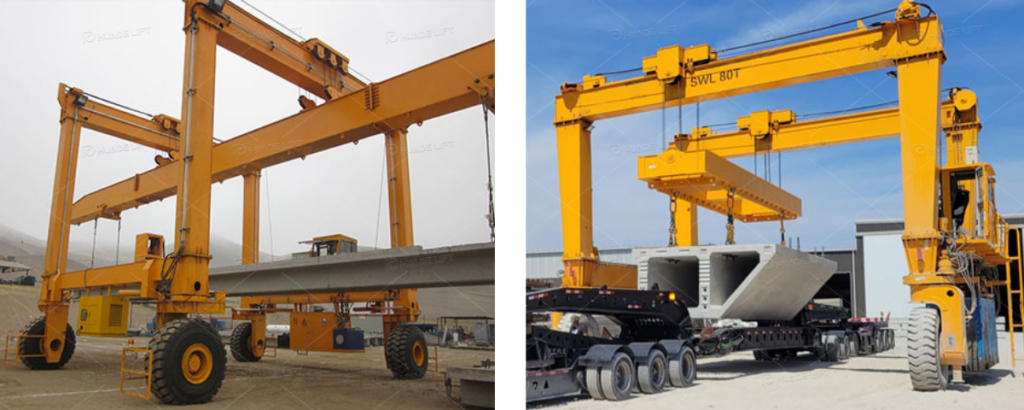
RTG crane transporting heavy precast beams for construction projects
Interaction Between Tire Selection and Wheel Configuration
Tires and wheels form an integrated ground contact system, where compatibility determines equipment adaptability and efficiency. A wheel system cannot leverage its advantages without tire performance, while tires struggle to deliver performance without wheel support. Their synergy fundamentally balances “performance demands” with “operational constraints.”
Balancing Maneuverability and Ground Conditions
Large tires + fewer wheels suit high-intensity rapid deployment on firm surfaces; Small tires + multiple wheels distribute pressure for soft terrain but offer reduced agility.
Mobility vs. Wear Resistance Trade-off
Soft tires + multi-mode steering enhance compact space flexibility but wear faster; hard tires + fixed steering extend lifespan but lack lateral maneuverability.
Core Scenario Matching:
Port hard surfaces prioritize large tires + six-wheel configuration;
Indoor confined spaces select soft tires + four-wheel full-wheel steering;
Heavy-duty operations on soft ground use small tires + eight-wheel configuration.
Impact of Wheel Configuration on Performance
Wheel configuration directly influences crane performance by altering parameters such as weight distribution and steering resistance, thereby shaping differentiated capabilities. This configuration significantly determines the crane’s suitability and competitiveness in lifting scenarios, notably affecting core metrics like maneuverability and load-bearing capacity.
Mobility
Mobility manifests in turning radius, response speed, and spatial clearance:
Four-wheel configurations feature fewer wheel sets and shorter axle spacing, enabling agile steering. Ideal for confined spaces like small workshops or narrow aisles, they facilitate rapid positioning and maneuvering.
Multi-wheel configurations have larger turning radii and slower response due to more wheel sets and longer axle spacing. However, this can be mitigated through multi-mode systems like crab steering, enhancing utilization in large-scale yards. Compact scenarios favor fewer wheels, while open areas can leverage advanced steering systems for efficient deployment.
Load Distribution and Load Capacity
Load capacity is determined by wheel load distribution: Four-wheel configurations concentrate loads on front and rear wheel sets, subjecting individual wheels to high stress. They are suitable only for light-load scenarios, where overloading can cause tire deformation and axle bending.
Multi-wheel configurations reduce stress per wheel by distributing load. Six-wheel setups decrease single-wheel pressure by approximately 30% compared to four wheels, with eight-wheel configurations offering further optimization. This load dispersion not only increases the load capacity ceiling but also reduces wear on vulnerable components, making it essential for heavy-duty applications like ports and heavy industry.
Stability
Stability is the foundation of operational safety. Multi-wheel configurations enhance stability by extending wheelbase and axle distance while evenly distributing load, thereby resisting lateral forces and overturning moments.
During steering and braking, extended wheelbase reduces rollover risk; during lifting operations, balanced wheel sets counteract eccentric forces. Four-wheel configurations with short wheelbases face heightened stability risks in strong winds or uneven terrain. In heavy-load and high-altitude lifting scenarios, the stability advantages of multi-wheel configurations are irreplaceable.
Speed and Efficiency
Operational efficiency correlates with travel speed and maneuverability: The four-wheel configuration’s lighter weight and reduced resistance enable rapid acceleration and deceleration, making it ideal for short-distance, high-frequency operations in small ports and warehouses, boosting turnaround efficiency.
The multi-wheel configuration’s heavier weight and complex structure result in greater travel resistance and limited speed. However, it enables single-lift operations under heavy loads, eliminating multiple transfers and delivering superior long-term comprehensive benefits. The impact of wheel configurations on efficiency lies in selecting the “high-efficiency mode” that matches load characteristics.
Impact on Crane Frame Structure
Wheel layout determines frame stress distribution: Four-wheel configurations concentrate loads at front and rear ends, creating a “heavy ends, light center” frame beam that is prone to long-term fatigue damage. Multi-wheel configurations evenly distribute loads through central wheel sets, preventing localized stress concentration.
Uniform load distribution reduces frame fatigue damage, minimizes deformation and cracking, and extends equipment lifespan. In heavy-duty crane design, matching the wheel system to the frame is a core consideration, with multi-wheel configurations being a key method for optimizing frame load distribution.
Analysis of Energy Consumption and Efficiency
Multi-wheel configurations feature more wheels and higher resistance, resulting in greater energy consumption over identical distances compared to four-wheel setups, with this disadvantage becoming more pronounced during long-distance travel. Four-wheel configurations exhibit lower resistance and reduced energy consumption for short-distance movements, making them suitable for scenarios involving frequent starts and stops.
However, in heavy-load scenarios, the total energy consumption of a single lift using a multi-wheel configuration may be lower than multiple transfers using a four-wheel setup. Hybrid or electric RTG cranes require even greater optimization of wheel and tire selection to enhance energy efficiency.
Performance Across Terrain Conditions
Performance differences stem from pressure distribution and traction: On soft ground, multi-wheel configurations disperse pressure, reduce ground pressure, prevent sinking, and ensure mobility through cumulative traction. On hard surfaces, four-wheel setups minimize steering resistance for rapid positioning.
On medium-hard asphalt, six-wheel configurations balance load capacity and maneuverability. The core principle of wheel system selection is matching pressure distribution and traction performance to ground load-bearing capacity and surface smoothness.
Indirect Impact on Operating Costs
Wheel systems influence total lifecycle costs: Multi-wheel configurations have higher initial procurement costs, but load distribution across wheels reduces replacement and overhaul expenses for wear parts. Four-wheel configurations have lower initial costs, but faster tire and axle wear leads to higher long-term replacement expenses.
Multi-wheel configurations feature complex maintenance structures and higher labor costs; four-wheel configurations offer simpler maintenance. The high stability of multi-wheel setups reduces downtime losses. Selection should be based on total lifecycle cost assessment rather than solely pursuing the lowest initial cost.
Operational Conditions That Affect Design Choices
Wheel system selection requires a “scenario-adaptive” logic, integrating core conditions such as terrain, travel distance, operational space, and maintenance strategies to identify the most cost-effective solution that meets requirements.
Terrain and Surface Quality
Terrain and surface quality are primary factors:
Outdoor gravel or soft surfaces require multi-wheel configurations + deep-tread tires for enhanced adaptability.
Indoor smooth, hardened surfaces suit four-wheel configurations + smooth, hard tires to protect flooring and improve precision.
Medium-hardness asphalt surfaces may opt for six-wheel configurations based on load, balancing maneuverability and load capacity.
Daily Travel Distance and Route Characteristics
Long-distance scenarios (cross-area dispatch, long-haul transfers) accelerate equipment wear and energy consumption. Prioritize multi-wheel configurations with wear-resistant tires to distribute wear and reduce energy use. Short-distance scenarios (warehouse loading/unloading, workshop transfers) involve frequent steering. Four-wheel configurations with agile steering systems are better suited, improving responsiveness and lowering costs.
High straight-line ratios favor multi-wheel stability, while frequent turns rely on four-wheel agility.
Steering and Lateral Movement Frequency
Compact spaces (steel workshops, precision assembly areas) require frequent steering and micro-positioning. Both four-wheel and six-wheel configurations necessitate multi-mode steering systems (all-wheel steering, crab steering, etc.). Four-wheel setups achieve tight turning radii, while six-wheel setups enable lateral movement.
Open spaces (container terminals, open-air yards) involve minimal steering, prioritizing multi-wheel configurations for load capacity. Steering systems emphasize stability and reliability, such as eight-wheel configurations with fixed steering modes.
Maintenance Strategy and Total Lifecycle Cost
Large enterprises with ample maintenance resources (port groups, heavy manufacturing plants) suit multi-wheel configurations. Professional teams can control maintenance costs, with “preventive maintenance” strategies detecting faults early. Stable performance minimizes downtime losses.
Small-to-medium enterprises with limited maintenance resources (small freight terminals, regional warehouses) should opt for four-wheel configurations. Their simpler structure requires no specialized maintenance, and a “repair-on-failure” strategy suffices. Total lifecycle costs must factor in procurement, maintenance, and downtime losses. Multi-wheel configurations are optimal for long-term projects, while four-wheel setups offer greater flexibility for short-term projects.
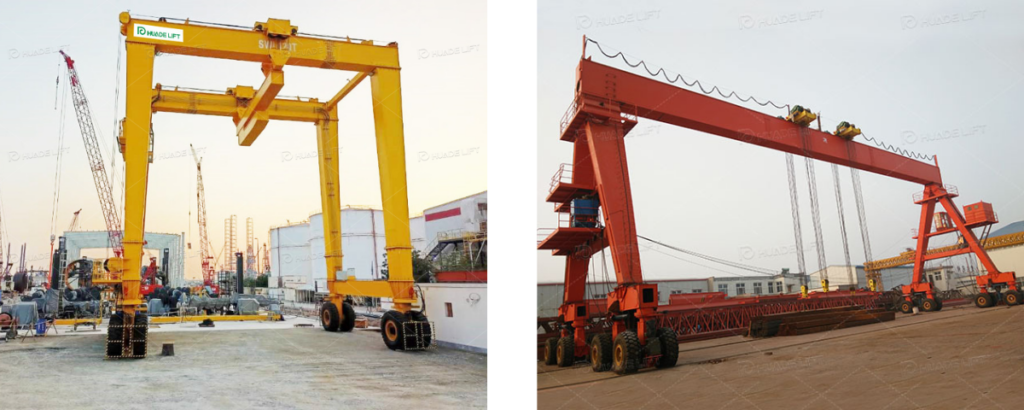
Rubber tyred gantry crane used for steel products, equipment parts, or pallet loading
Factors to Consider When Choosing Wheel Number
The number of wheel sets determines the crane’s core performance. Selection must integrate factors such as ground conditions, workload, site layout, budget, and environmental safety to establish quantitative criteria, rather than simply pursuing a higher quantity.
Ground Conditions at the Work Site
The core ground conditions are bearing capacity and strength. By combining inspection data with the equipment’s dead weight and load, the minimum contact area is calculated to determine the number of wheel sets:
On soft ground, increase wheel sets to reduce ground pressure.
On hard ground, reduce wheel sets to maintain maneuverability.
On aged pavement, a multi-wheel configuration reduces damage.
On new pavement, select based on load requirements.
For open-air sites, consider load capacity reduction due to rainwater erosion; a multi-wheel configuration provides performance redundancy.
Container Throughput and Load Characteristics
Operational volume and load characteristics directly impact efficiency and safety: High-volume hub ports require multi-wheel configurations for heavy-load efficiency; smaller regional freight terminals benefit more from four-wheel setups.
Select eight or more wheels for heavy loads, six wheels for fluctuating light-to-medium loads, and four wheels for sustained light loads. Increase wheel sets for stability during high-lift operations.
Site Layout and Operational Space
Core layout considerations are width, aisle width, and stacking density: Compact warehouses and narrow aisles require four-wheel configurations with small turning radii; open yards prioritize heavy-load handling, where multi-wheel setups offer superior performance.
Prioritize four-wheel flexibility in obstacle-dense areas; choose multi-wheel stability for fixed routes. Reserve performance headroom for wheel sets when planning expansions to avoid equipment underperformance.
Budget and Total Lifecycle Cost
Adequate budgets should prioritize multi-wheel configurations for superior performance and longevity; constrained budgets may opt for four-wheel setups to meet basic requirements. However, evaluate total lifecycle costs rather than focusing solely on initial investment.
Multi-wheel setups have higher initial costs but lower maintenance and downtime losses, while four-wheel setups exhibit the opposite trend. Multi-wheel configurations prove more economical for projects exceeding 10 years, whereas four-wheel setups offer greater cost advantages for short-term projects.
Environmental Conditions and Safety Requirements
Environmental and safety requirements are mandatory: Multi-wheel configurations enhance rollover resistance in high-wind areas and improve braking and anti-skid performance in rainy regions. Industry standards mandate multi-wheel configurations for certain heavy-load applications.
Multi-wheel configurations are required in high-traffic areas to increase safety redundancy. Wheel selection must first meet environmental safety constraints before considering performance and cost.
Maintenance Considerations
Tailor maintenance strategies to reduce failures, extend lifespan, and ensure optimal wheel system performance. Maintenance priorities, approaches, and cost control vary significantly across configurations.
Maintenance Focus and Core Component Management
Four-wheel configurations require concentrated maintenance: Regularly inspect tire wear/pressure, axle bearing lubrication, and steering linkage joint tightness to prevent blowouts and component damage.
Multi-wheel configurations demand more complex maintenance: Beyond routine checks, ensure multi-axle synchronization, hydraulic steering system sealing integrity and pressure stability, and brake system balance. Regularly calibrate wheel alignment parameters to minimize uneven wear.
Differentiated Maintenance Strategy Development
Four-wheel configurations employ “scheduled preventative maintenance + post-failure repairs”: Monthly routine inspections, with major failures addressed through simple replacements after occurrence to reduce costs.
Multi-wheel configurations require “full-cycle preventive maintenance”: Establish maintenance logs, monitor critical parameters biweekly, replace wear parts at fixed intervals, utilize real-time sensor alerts, and deploy professional maintenance teams for eight or more wheels.
Maintenance Cost Control and Efficiency Enhancement
Multi-wheel maintenance cost control: Bulk spare parts procurement reduces purchasing costs; trained personnel shorten repair times; basic maintenance extends component lifespan.
Four-wheel maintenance costs focus on tires: Regular tire pressure checks and alignment prevent uneven wear; selecting compatible materials enhances durability; replace run-flat tires before critical wear thresholds. Both require adherence to “prevention first” to avert major losses with minor investments.
Conclusion
Optimal wheel system configuration requires a three-dimensional evaluation framework: “scenario-performance-cost.” First, analyze site conditions to define constraints. Next, determine core performance based on load and efficiency requirements. Finally, select the optimal solution through total lifecycle cost analysis, while aligning maintenance strategies to maximize advantages and extend service life.
As RTG cranes evolve toward heavier lifting capacities and greater intelligence, wheel system configurations will become more specialized—incorporating features like smart monitoring and modular maintenance. However, “needs alignment” remains paramount. Operators and purchasers must thoroughly understand their requirements and the wheel system’s mechanisms to make scientifically informed choices that maximize equipment value and support efficient enterprise operations.
