
In construction scenarios such as bridges, rail transit, and urban infrastructure, the transport and installation of heavy precast beams are core construction processes. As specialized equipment designed specifically for bridge construction, girder transporters effectively address industry challenges such as the transport, alignment, and compatibility of heavy beams, making them an indispensable core component of modern infrastructure projects.
What is a Girder Transporter
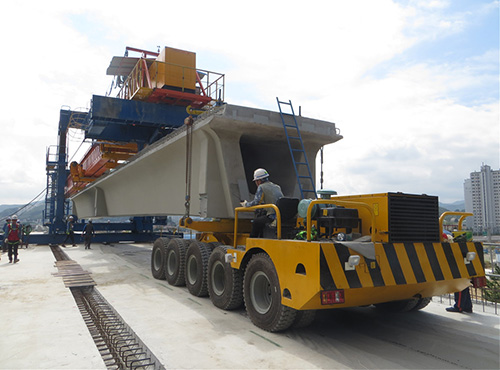
A girder transporter is specialized transport equipment developed specifically for prefabricated bridge construction. It is primarily used for the on-site transportation and precise positioning of various precast beams, such as box girders and T-beams. Unlike ordinary construction transport vehicles, the design philosophy of a girder transporter is fully aligned with the construction requirements of heavy-duty precast components.
The equipment’s overall structure, hydraulic system, and travel system are all engineered to meet construction standards for heavy loads, high stability, and high precision. As a key piece of equipment linking the precast yard to the erection site within the prefabricated bridge construction system, it directly impacts the progress and quality of the main bridge construction.
How Girder Transporters Handle Heavy Girders
Precise Loading and Hydraulic Leveling
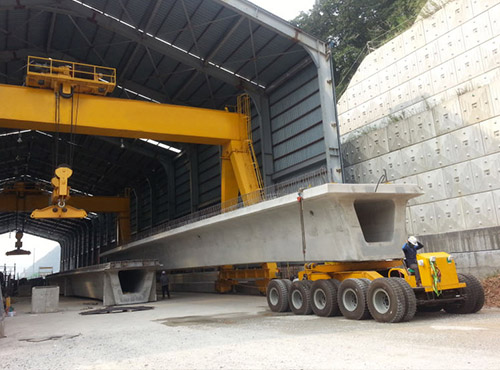
The beam loading process for girder transporters is carried out in coordination with standard gantry cranes on-site, forming a standardized, low-risk construction workflow. After precast beams have completed curing and met quality standards at the precast yard, they are gently lifted by a gantry crane and slowly lowered onto the girder transporter’s dedicated transport platform.
Throughout the operation, dedicated personnel monitor and calibrate the alignment to strictly ensure that the girder’s centerline coincides with the centerline of the girder transporter’s platform, thereby preventing eccentric loading of the girder from the outset. Once centerline alignment is complete, workers adjust the position of the support blocks on the transport platform based on the girder’s dimensions and weight.
The evenly spaced support blocks distribute the beam’s dead weight, ensuring the load is evenly distributed across the equipment frame and preventing excessive localized pressure that could damage the beam structure or equipment components. Once the blocks are properly positioned, operators secure the beam firmly to the transport platform with specialized straps to prevent slippage or swaying during transport.
Once the securing process is complete, the girder transporter’s hydraulic system is activated to make fine adjustments to the equipment’s overall posture, laying a solid foundation for stable transport.
Low-Speed Stable Transportation and Monitoring
The core principle of heavy-duty girder transport is stability rather than speed—this is also the key feature that distinguishes girder transporters from conventional transport equipment. Under typical construction conditions, low-speed operation minimizes vibration and reduces internal stress changes in the beam.
During the entire transportation process, the equipment will avoid operations such as sudden acceleration and emergency braking. Rapid starting and stopping will generate huge inertial forces, causing uneven force distribution on the bridge structure. In the mild cases, this may lead to slight displacement of the bridge beam; in severe cases, it can cause cracking of the concrete structure, thereby affecting the service life of the bridge.
The monitoring system installed on the girder transporter will remain in operation throughout the process, continuously collecting core data such as the vehicle’s posture, load pressure, hydraulic parameters, and driving status. The system will automatically compare against standard construction parameters. If it detects issues such as loosened straps, excessive vehicle tilt, or abnormal hydraulic pressure, it will immediately issue an alert signal.
After receiving the warning, the operators can immediately stop the machine for inspection. They can then identify and address the potential hazards before resuming the operation. This effectively avoids safety accidents caused by running with faults and ensures the safety of each transportation operation.
Precise Positioning and Return Operations
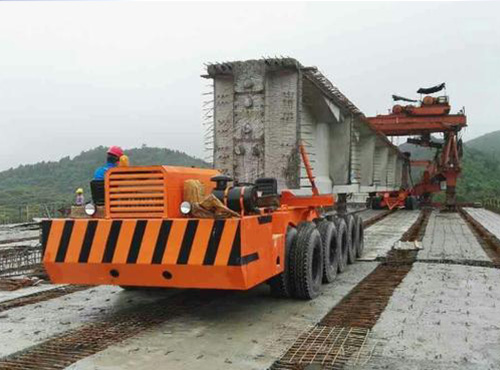
When the girder transporter with the girder arrives at the erection operation area, it officially enters the alignment and handover stage. The operators use wireless remote control equipment to make precise adjustments to the position of the vehicle body at the millimeter and centimeter levels, ensuring a close match between the operation radius of the bridge erection machine and the installation requirements.
Once precise alignment is achieved, the beam launcher’s lifting mechanism secures the beam and raises it slightly, allowing workers to remove the securing straps and support blocks, thereby successfully completing the beam handover. The entire handover process eliminates the need for repeated equipment repositioning or secondary calibration, significantly reducing manual labor and improving the efficiency of the beam-laying sequence.
After the beam is unloaded, the girder transport can quickly leave the core operation area, avoiding occupying the construction work surface and hindering the progress of subsequent girder erection operations. The equipment does not need to stay idle for a long time throughout the process and can directly return to the prefabrication plant to await the next round of beam loading and transportation tasks.
This repetitive operation mode enables the three major processes of prefabrication, transportation and erection to form a closed-loop circulation, solving the problems of equipment idleness and process disconnection in traditional construction, and ensuring the steady progress of bridge construction.
Useful Girder Transporter Functions on Sites
Hydraulic Lifting and Control Mechanism
The hydraulic system is the core power and control unit of the girder transporter. It is mainly composed of hydraulic cylinders, winches, hydraulic pipelines, control valve groups, etc., and is responsible for core operations such as lifting the girder, leveling the vehicle body, and correcting the posture. This system can meet the lifting operation requirements of hundreds-ton heavy precast girders and comply with the construction load standards of mainstream bridge projects.
During the operation, the system precisely controls the lifting speed, maintaining a uniform and stable working state throughout the process, without generating instantaneous impact forces, and avoiding surface cracking and internal structural damage caused by impact loads.
Adjustable Support and Stabilization Devices
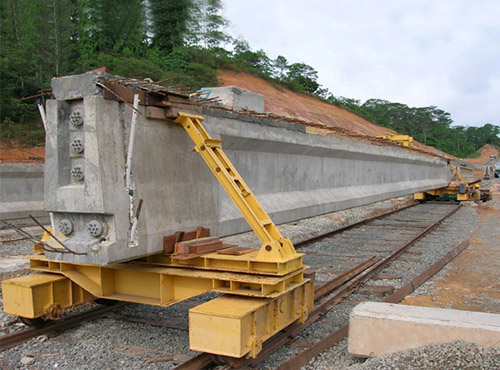
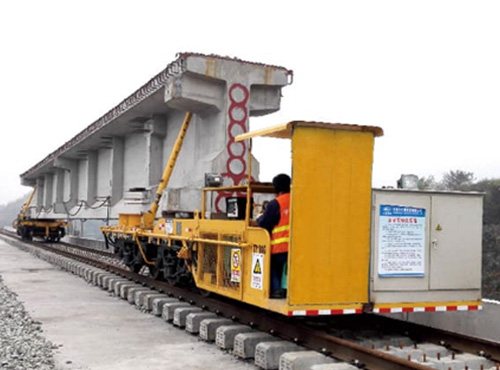
The girder transporter is equipped with a complete set of adjustable support and stabilization devices, including hydraulic fixtures, mechanical locking components, and special beam support frames, etc. These components form a complete structure that is suitable for the construction needs of different specifications of box beams and T-beams.
The construction personnel can flexibly adjust the spacing and height of the support frame according to the length, width, and weight parameters of the beam, and also adjust the clamping force of the fixture accordingly. The targeted adjustment method can make the support structure perfectly fit the force characteristics of the beam, achieving full-scale stable fixation.
Flexible Mobility and Steering System
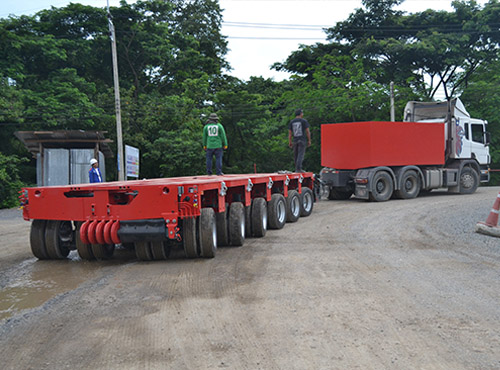
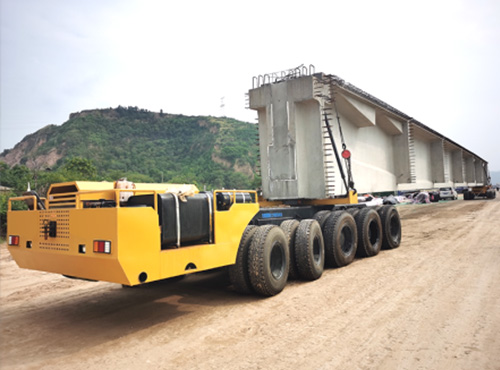
The girder transporter adopts a multi-axis wheel group layout design. Multiple sets of wheels evenly distribute the load of the entire vehicle and the girder, effectively reducing the pressure exerted by the equipment on the construction surface. This design not only protects the temporary construction surface, preventing collapse and damage, but also enhances the driving stability of the equipment under heavy load conditions.
The equipment is equipped with a dual technology system of full-wheel steering and independent steering. It can flexibly switch the steering mode according to the space of the construction site. Some models are equipped with a traction control system, which can detect changes in the road friction coefficient in real time and automatically adjust the driving force of each wheel group. Even in complex terrains such as muddy, gravel, and uneven surfaces, it can still maintain smooth driving, and has extremely strong site adaptability.
Improving Safety Through Girder Transporter Control
Multi-Layered Protection Systems
Construction safety is the core focus of bridge engineering. The girder-lifting machine is equipped with a dual safety system consisting of hydraulic anti-tilt protection and intelligent braking protection, providing comprehensive support for the stability of heavy-load transportation operations. During key working conditions such as starting, turning, braking, and descending slopes, the protection system will intervene and regulate throughout the process.
The hydraulic anti-tilt system can promptly correct the vehicle’s tilt angle, balance the center of gravity of the vehicle and the girder, and prevent risks of side tilting and imbalance under heavy-load conditions. The braking protection system can adjust the braking force according to the load weight and driving speed, achieving smooth braking.
The control system will monitor core data such as the girder’s posture, load distribution, and vehicle balance degree in real time 24 hours a day. Once any parameter abnormalities occur, it will trigger an early warning and lock down any dangerous operations of the equipment. From the operational level of the equipment, it avoids human operational errors and safety risks caused by sudden changes in road conditions, protecting the safety of on-site construction personnel and the equipment.
Intelligent Control for Safe Operations
The girder transporter is equipped with a wireless remote control system. Operators can complete all the operation tasks such as moving, turning, positioning, and adjustment from a safe distance away, thus avoiding the dangerous areas of heavy-load operations and enhancing the safety of personnel operations.
The intelligent safety system is equipped with an automatic calibration function. During the operation, it can automatically correct deviations in movement and posture without the need for repeated manual fine-tuning. At the same time, it has intelligent path planning capabilities, which can adjust the driving trajectory autonomously according to obstacles at the construction site, road width, and operation range, adapting to complex construction environments.
Adapting Girder Transporters to Different Conditions
Bridge Construction
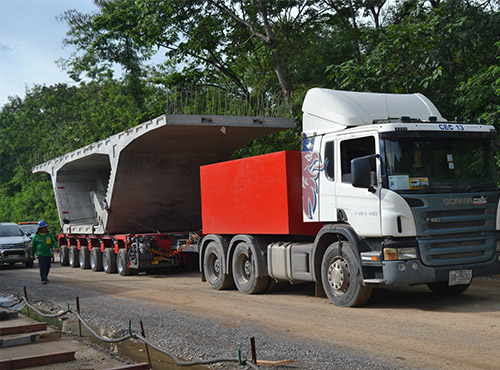
In conventional highway and railway bridge construction, precast beams are heavy, require long transport distances, and involve frequent handling, placing stringent demands on equipment stability and load-bearing capacity. As the core transport equipment, the girder transporter handles the on-site transport and precise positioning of heavy precast girders throughout the entire process, supporting the rapid assembly of the bridge’s main structure.
The heavy-load stability performance and precise positioning capability of the equipment can meet the high-precision requirements of the main bridge construction, effectively guarantee the construction quality of bridge assembly and erection, and is the fundamental guarantee for the smooth progress of the main bridge project.
Metro Rail Projects
Construction of elevated sections of urban subways is mostly located in core urban areas, where construction space is limited, surrounding buildings are densely packed, and pedestrian traffic is heavy, placing extremely high demands on the flexibility and safety of construction equipment.
With its advantages of tight turning radius, precise positioning, and stable low-speed operation, the girder transporter is perfectly suited for the construction of elevated subway beams in urban environments. They can complete girder transport and alignment operations within confined spaces without occupying excessive urban road space, thereby minimizing the impact of construction on city traffic and residents’ daily lives.
Highway Construction
In highway network expansion and upgrade projects, a large number of overpasses, elevated bridges, and interchange bridges need to be constructed in bulk. Such projects involve long construction stretches and varied site conditions, with significant differences in road surface smoothness and available working space.
The girder transportation can adapt to various road conditions such as outdoor open-air construction, temporary paved roads, and un-paved roadbeds. It can stably complete the transportation operations of prefabricated girders for various highway bridges, supporting the efficient implementation of the highway network interconnection project.
Urban Infrastructure Development
In the construction of modern high-rise buildings, commercial complexes, and urban facilities, prefabricated construction methods are increasingly adopted, requiring the on-site transport and assembly of a large number of precast concrete beams.
Beam transporters are not limited to bridge construction; they are also suitable for urban prefabricated building construction scenarios, enabling the stable transport of large prefabricated components and helping to advance urban infrastructure projects in a standardized and efficient manner.
Modernization of Railways
Projects such as the modernization, expansion, and renovation of railway networks, the construction of new railway lines, and the building of railway overpasses impose construction precision and safety standards that far exceed those of ordinary projects. Railway bridge beams have uniform specifications, high load standards, and an extremely low margin for error during construction.
With their high-precision operation, multiple safety safeguards, and stable heavy-load capacity, girder transporters fully comply with railway infrastructure construction standards. They ensure zero-deviation execution of girder transport and installation processes, thereby supporting the upgrading and renovation of railway infrastructure.
Choosing a Girder Transporter for Site Needs
Load Capacity and Weight
Load capacity is the core criterion for selecting a girder transporter. It directly determines whether the equipment can meet project construction requirements and also affects the equipment’s service life and construction safety. When selecting a model, the actual maximum weight of the precast beams at the construction site must serve as the benchmark.
It is strictly prohibited to select equipment with a rated load capacity that exactly matches the actual weight of the beams. A sufficient load margin must be reserved. Off-site construction and long-term heavy-load operations subject the equipment to consistently high loads. Equipment without a safety margin will operate at full capacity for extended periods, accelerating wear on core components such as the hydraulic system, travel mechanism, and transmission, and increasing the likelihood of equipment failure.
Reasonable load capacity selection not only ensures construction safety but also reduces equipment operation and maintenance costs while extending the equipment’s service life.
Tire and Chassis Suspension
Different construction surfaces and work intensities require different tire configurations. Proper selection ensures a smooth ride and maximizes tire service life. Solid rubber tires offer the widest range of applicability and provide a stable ride, making them suitable for most conventional construction scenarios with level, paved surfaces.
The suspension system automatically compensates for pressure caused by ground deformation, disperses impact forces during travel, reduces localized stress on the tires, significantly slows tire wear, and ensures a smoother ride for the entire vehicle.
Steering System Selection
The spatial conditions of the construction site and driving routes are key factors in selecting a steering system. Different steering modes are suited for distinctly different scenarios, so the choice must be made based on a comprehensive assessment of the project’s actual conditions.
When selecting a system, one must not focus solely on load-bearing parameters. Steering agility must also be considered to ensure the equipment operates smoothly across the entire worksite.
Braking Systems Selection
The braking system is central to ensuring safe equipment operation and must be selected based on the girder transporter’s load rating and construction conditions to eliminate safety hazards such as insufficient braking or brake failure.
For light-load conditions and small precast component transport equipment, a basic parking brake is sufficient to meet operational needs and ensure stable parking and locking. Medium-load construction equipment can be equipped with an inertia braking system, which relies on the girder transporter’s own weight to achieve smooth braking, making it suitable for routine transport operations.
For 100-metric-ton-class heavy-duty beam transporters, an independent air braking system should be selected. This system does not rely on external equipment and can independently deliver stable braking force, providing fast response and uniform braking force under heavy loads, with safety far exceeding that of ordinary braking modes.
Regardless of load rating or construction scenario, a parking brake is an essential feature.
Application Scenarios and Site Conditions
Outdoor construction environments are complex, with equipment constantly exposed to intense sunlight, rain, and wind and sand erosion. When selecting a model, prioritize those equipped with full-machine protective structures. Sealed piping and protective body structures prevent component aging and pipe corrosion caused by sun and rain, enhancing the equipment’s suitability for outdoor use.
Road surface conditions also require careful consideration. On smooth, paved surfaces, solid rubber tires are the preferred choice, as they provide a smooth ride, low noise, and minimal wear. For uneven, gravelly, or unpaved subgrade surfaces, pneumatic tires offer better cushioning and shock absorption. In high-intensity, heavy-load construction scenarios, ultra-elastic tires are universally recommended to ensure long-term, stable equipment operation.
By considering the construction environment, load intensity and road conditions, and matching the equipment configuration accordingly, the girder transporter can be adapted to the entire construction cycle requirements of the project, while also taking into account the construction efficiency, safety and the service life of the equipment.
Conclusion
As a core supporting equipment for modern bridges and infrastructure projects, Huadelift’s girder transporter, with its mature hydraulic control, flexible traveling and steering capabilities, comprehensive safety protection, and diverse scene adaptability, has addressed the pain points in the transportation and construction of heavy precast girders. From the standardized girder lifting and transportation process, to the high-precision alignment and erection and to the customized selection suitable for multiple scenarios, the girder-lifting machine provides comprehensive support for the safe, stable, and orderly progress of infrastructure projects.
