
Understanding the Role of a Girder Transporter
Whether it’s highway or railway bridges or large-scale municipal infrastructure projects, girder transportation is an essential process that cannot be bypassed.
In the past, many construction sites used flatbed trucks equipped with cranes to transport beams. While this method may seem straightforward, it actually presents numerous challenges in practice. Loading beams onto flatbed trucks requires a large amount of workspace, and when temporary access roads on-site are limited, it’s difficult for vehicles to turn around or maneuver. It is difficult to distribute the load of the beams evenly across the truck bed, resulting in excessive localized stress that not only damages the vehicle but also causes hidden damage to the beams. Coordinated operations involving multiple pieces of equipment, combined with frequent crossover work by on-site personnel, also pose significant safety hazards. As bridge spans continue to increase and the weight and dimensions of precast beams keep growing, traditional transport methods are no longer sufficient to meet the actual needs of projects.
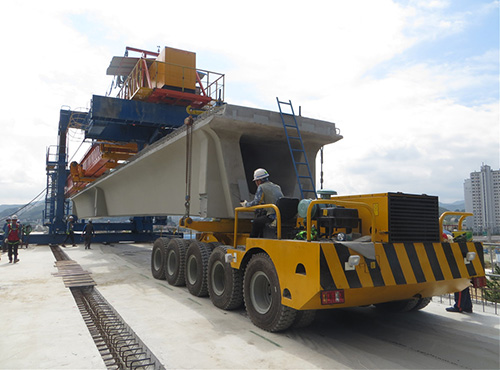
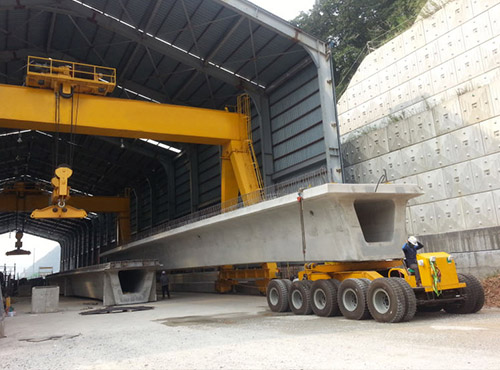
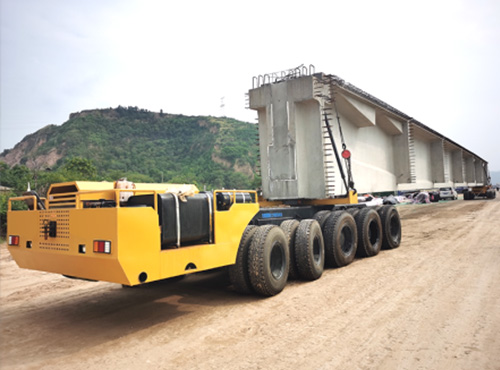
Girder transporter was developed specifically to address the transportation of such heavy-load components. It can transport finished girders directly from the precast yard to the girder-laying site and offers greater adaptability to site conditions. When handling large-tonnage, oversized precast components, it ensures stable transport, reduces the need for intermediate transshipment, and minimizes on-site construction risks.
Composition of Girder Transporters
Girder transports are heavy-duty specialized transport equipment. The entire system does not operate as a single component but relies on the coordinated interaction of multiple systems to transport heavy-load beams. Each system performs its specific function, and a failure in any part will directly affect the operation of the entire machine.
Chassis and Frame Structure
The chassis and the frame constitute the main load-bearing components of the entire equipment. All the loads will eventually be transferred to the frame. During production, most of them are made of high-strength steel that has undergone strengthening treatment.
During transportation, the frame continuously bears the heavy pressure exerted by the beam and must also withstand repeated impacts caused by road bumps. If the steel lacks sufficient strength, it is prone to deformation and cracking after prolonged use. A well-designed frame structure can maintain structural integrity under long-term heavy loads and complex road conditions, thereby extending the equipment’s service life.
Power System
The power system mainly consists of a diesel engine, a transmission system and a drive axle. Under heavy-load conditions, the weight of the girder itself can often reach tens or hundreds of tons, and in addition to the equipment’s own weight, sufficient traction is required to move the entire machine.
The temporary roads at the construction site are uneven in height and some sections have slopes. The power output needs to be able to adapt to such complex road conditions. The torque output by the engine is transmitted through the transmission mechanism to the drive axle, providing power reserves for the entire vehicle’s movement. Inconsistent power output will result in difficulty starting and insufficient climbing power, causing hindrance to the on-site transportation.
Braking System
The braking system of a heavy-duty vehicle differs significantly from that of a standard vehicle, as inertia increases markedly with load. Girder transports generally employ an air brake system, supplemented by an emergency braking line and control module.
During normal driving, the air-brake provides reliable braking force. In case of pipeline failure or unexpected situations, the emergency braking module can intervene to lock the vehicle and prevent it from skidding. In heavy-load conditions, slow braking response or insufficient braking force is a very dangerous hazard.
Steering System
Most of girder transporters are equipped with hydraulic steering systems. Temporary construction site roads are often narrow, and some routes feature continuous curves. The steering mechanisms of ordinary vehicles struggle to maneuver in such confined spaces.
Hydraulic steering can achieve large-angle steering and the turning trajectory is controllable. In the internal area of the prefabrication site and the narrow construction areas around the bridge position, the equipment can also adjust its driving posture without having to widen the construction roads on a large scale.
Suspension and Multi-Axle Load-Bearing System
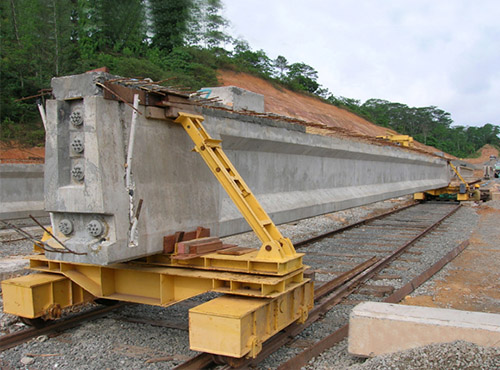
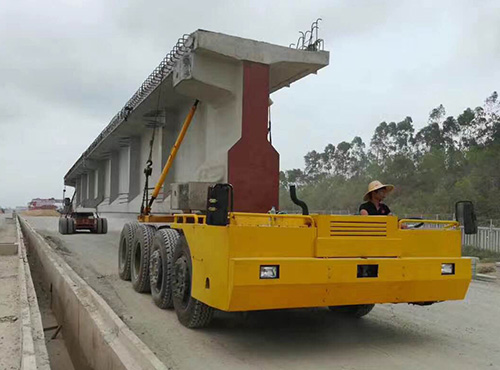
The combination of multiple axles and a suspension system is a critical design feature of girder transporters. The weight of the beam is transmitted to each axle via support pads.
The multi-axle design distributes the total weight, reducing the pressure on individual axles and tires, as well as minimizing the pressure exerted on temporary road surfaces. The suspension absorbs vibrations caused by road bumps, reducing the impact on the beam during travel and lowering the risk of component cracking. In construction environments with potholed roads, this structure significantly improves ride smoothness.
Operations of Girder Transporters
Pre-Operation Inspection
Before the formal transfer operation begins, the parameters of the beams to be transported must be obtained, and the weight, length, width and height must be verified. These data should be compared with the rated load of the girder transport and the size of the platform. It is absolutely not allowed to operate with an overloaded load.
Overloading will cause the frame, axles and tires to bear pressures beyond their design limits. In the short term, problems may not be apparent, but this can easily create hidden risks of structural damage. If the beam dimensions exceed the platform’s range, scrapes and collisions are likely to occur during transit.
Once the parameters have been confirmed, a comprehensive inspection of the entire girder transporter must be conducted. First, check the oil level in the hydraulic system, because insufficient oil will affect the leveling action and then inspect all hydraulic pipe joints to see if there is any leakage.
Next, test the sensitivity of the braking response and measure the tire pressure. Abnormal tire pressure will change the force exerted on the entire vehicle, causing it to veer during driving. At the same time, check for any wear or tear on the fixing straps and whether the appearance of the load-bearing pads is intact. The position of the pads should correspond to the design load-bearing points of the beam. If they are misaligned, it will cause local stress concentration on the beam.
Precise Girder Loading and Hydraulic Leveling
Beam loading is generally completed at the precast yard with the assistance of a gantry crane. The gantry crane smoothly lifts the beam and slowly lowers it onto the girder transport’s loading platform.
Special personnel on-site are responsible for alignment, ensuring the beam’s centerline is aligned as closely as possible with the transport vehicle’s centerline. Once the beam is in position, adjust the placement and height of the pads to ensure even load distribution. Then, tighten the specialized straps to securely fasten the beam to the platform, preventing it from shifting during transport.
Once securing is complete, the hydraulic system is activated to make minor adjustments, leveling the entire girder transporter. Since the construction site ground may have slight elevation differences, failure to level the girder transporter would subject the beam to additional internal stress from the start, and subsequent road vibrations would amplify these issues.
Stable Transportation and Full-Process Monitoring
Girder transporters must travel at low speeds throughout the journey, with operating speeds typically limited to 5 kilometers per hour or less under normal conditions. Under heavy loads, the faster the speed, the greater the impact force caused by bumps, and the higher the risk of girder displacement.
When encountering curves, downhill slopes, or uneven road surfaces, the speed must be reduced even further. Throughout the operation, it is best to avoid sudden acceleration and emergency braking. Under the influence of inertia, sudden braking and acceleration will cause the beam to experience sudden changes in force, and in severe cases, the beam may slip.
During operation, the monitoring system continuously collects data such as the girder transporter’s posture, load, and hydraulic pressure. Once any abnormalities such as loose straps or excessive vehicle tilt are detected, the girder transporter will issue a warning. When the operator receives the signal, they should immediately stop the girder transporter, investigate the problem and handle it before continuing the transportation.
Precise Positioning and Return Operation
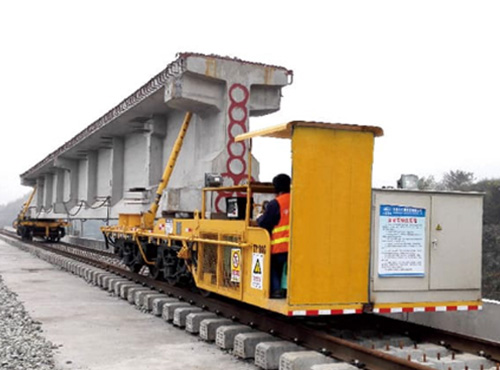
After the girder transporter arrives at the beam-laying area, the operator uses remote control to fine-tune its position. Coordinating with the operational range of the beam-laying equipment, centimeter-level positioning is achieved to ensure the beam’s placement meets installation requirements.
Once positioning is complete, the girder-laying crane hooks onto the girder and lifts it slightly. On-site personnel remove the straps and load-bearing pads, completing the girder handoff. The entire handoff process does not require repeated repositioning of the girder transporter, reducing processing time.
After unloading is complete, the girder transporter departs the work area and returns to the precast yard to prepare for the next girder loading and transport, maintaining the continuous workflow rhythm at the construction site.
Safety Considerations for Girder Transporter Operations
Requirements for Operators
Personnel in all positions involved in the operation must hold the corresponding valid certifications. Drivers, on-site signalers, and operators may not be allowed to work if their certifications are incomplete.
Heavy-load transfer is a high-risk operation. If the personnel have not received systematic training, they are not familiar with the equipment performance and risk points, and the probability of incorrect operation will significantly increase. The construction site needs to clearly define the responsibilities of each position and prevent unlicensed personnel from operating.
Safety Inspections of Equipment and Site
In addition to checking the frame and inspecting the hydraulic and braking components, the moving parts of girder transporter also need to be checked. Ensure that the tire pressure is normal, the engine coolant is sufficient, the steering mechanism rotates smoothly, and all steering adjustment components are intact.
The driving path of the girder transporter should also be checked in advance. Clear away obstacles such as scattered building materials and stones on the road surface. Focus on evaluating the ground’s bearing capacity. If the ground’s bearing capacity is lower than the tire’s ground pressure, reinforcement treatment must be carried out in advance. Holes and raised sections should be leveled.
Beam Loading and Securing
When the beam is lowered onto the girder transporter’s platform, its center of gravity should align as closely as possible with the girder transporter’s longitudinal centerline, with any deviation limited to within 20 millimeters. For installation on curved sections, a slight offset of the girder’s center is permitted, but it must not exceed the equipment’s allowable range.
Between the beam and the pad blocks, a hard plate or a fiber rubber pad should be placed. The pad is used to separate the concrete beam and the metal support, avoiding hard contact that could scratch or damage the concrete corners of the beam.
After the beam is positioned, the beam is reinforced and supported using tension rods and manual hoists. If the reinforcement is not done properly, there is a risk of the beam tipping over when the vehicle is jolted.
Safety Control Procedures for Transportation
During the transportation process, the on-site personnel must not arbitrarily adjust the tightening status of the straps, levers, and hoists. When passing through bad sections of the road, reduce speed in advance and do not rush through the potholes.
If the vehicle tilts, makes abnormal noises, or triggers an alarm during the operation, immediately stop the vehicle at a flat and safe location. Personnel should confirm the safety of the environment before conducting the inspection and should not stay and repair on slopes or soft ground. It is not recommended to carry out maintenance work directly under the beam while the equipment is heavily loaded.
Key Factors for Choosing Right Girder Transporters
Load Capacity and Weight
Load capacity is the primary consideration when selecting girder transporters. The rated load capacity of the selected equipment must exceed the actual weight of the beam. When selecting equipment, it is recommended to allow for some load capacity margin and do not choose equipment that is exactly at its rated load capacity.
For some projects, the weight of the bridge structure exceeds 100 tons. Ordinary standard models are unable to handle this, and a heavy-load version specifically designed for this purpose needs to be selected. If the load margin is insufficient, the equipment will operate at full load for a long time, and the component wear rate will accelerate.
Application Scenarios and Site Conditions
The girder transporter’s operating environment influences the selection process. For outdoor construction sites, the equipment must be weather-resistant, with enclosures and piping capable of withstanding exposure to sun and rain.
Road surface conditions must also be taken into account. On smooth, paved surfaces, solid rubber tires provide a better operating experience. On unpaved construction sites with many potholes, pneumatic tires adapt better to uneven terrain and produce less vibration during travel. Super-elastic tires, on the other hand, are suitable for extreme heavy loads or high-intensity ground conditions.
Dimensions of Girder Transporter
The overall dimensions of the equipment must match the size of the components and the site’s access conditions. A larger loading platform can accommodate larger components but may encounter access difficulties in narrow precast yards or around bridge sites.
For extra-long or oversized components, customized loading platform solutions can be selected. Loading platform height is also a key consideration. Low-platform versions facilitate easier loading and unloading of beams. In some situations where height differences exist, models equipped with lifting mechanisms are more suitable.
Tire and Chassis Suspension Configurations
Different tires are suited for different scenarios. Solid rubber tires provide a smooth ride and are suitable for most standard operating conditions. Pneumatic tires are better suited for outdoor, unpaved surfaces, and super-elastic tires are designed for heavy-load, high-intensity applications.
If the wheels are equipped with a swing or universal joint suspension system, they can counteract deformation caused by uneven ground, disperse impact forces, reduce localized stress on the tires, extend tire service life, and provide a smoother ride for the entire vehicle.
Steering System Selection
Space is limited at construction sites, and steering capability directly determines whether the equipment can navigate smoothly. Turntable steering is suitable for tight-radius turns. Axle steering offers better stability during long-distance straight-line travel.
For projects with confined work spaces and complex routes, all-wheel steering is more practical. When selecting a system, make a comprehensive assessment based on on-site routes and component lengths. Do not prioritize load-carrying capacity over steering capability.
Braking System Selection Criteria
Braking configurations should be based on the total load. For light-duty equipment, a parking brake is sufficient to meet basic needs. For medium loads, inertia braking can be selected.
For heavy-duty beam transporters, an air brake system is a more reliable choice, as it does not rely on the tractor’s braking system and can independently apply braking force. Regardless of load size, a parking brake must never be omitted. It is used to lock the vehicle when parked to prevent rolling.
Structural Material
Depending on project requirements, various auxiliary devices can be selected. Rain covers protect components from weather damage. Column structures are used to secure tubular components. Lift platforms are used for operations involving height differences. Additionally, multi-tiered loading platforms and special support structures for sensitive components can all be selected as needed.
For the main frame, steel is the preferred choice for heavy-duty applications. In medium-load scenarios, aluminum alloy is an attractive option due to its lighter weight. For long-term outdoor use, the equipment must undergo anti-corrosion treatment, as rain and sunlight accelerate metal corrosion. Inadequate anti-corrosion measures will shorten the equipment’s service life.
Conclusion
Girder transporters play a critical role in the transportation of bridge beams during precast bridge construction. While the performance of the equipment itself is certainly important, the overall success of a project depends on proper equipment selection, standardized operating procedures, and the consistent implementation of safety controls.
Many on-site accidents are not caused by equipment quality issues, but rather by errors in initial equipment selection, inadequate inspections, and improper operator procedures. Familiarity with the equipment’s structure, strict adherence to operating procedures, and selecting the right model based on project conditions can reduce equipment failures, component damage, and safety incidents, ensuring the smooth progress of road and bridge projects as well as various infrastructure projects.
