
Precast concrete is widely used in modern construction due to its advantages such as standardized factory production and shorter construction cycles. However, its characteristics—such as heavy weight, irregular shapes, and high installation precision requirements—pose significant challenges during handling. Rubber tyred gantry cranes (RTGs) offer a unique solution to these challenges, making them the ideal choice for this application.
What is a Rubber Tyred Gantry Crane?
Basic Definition and Working Principle of RTG Cranes
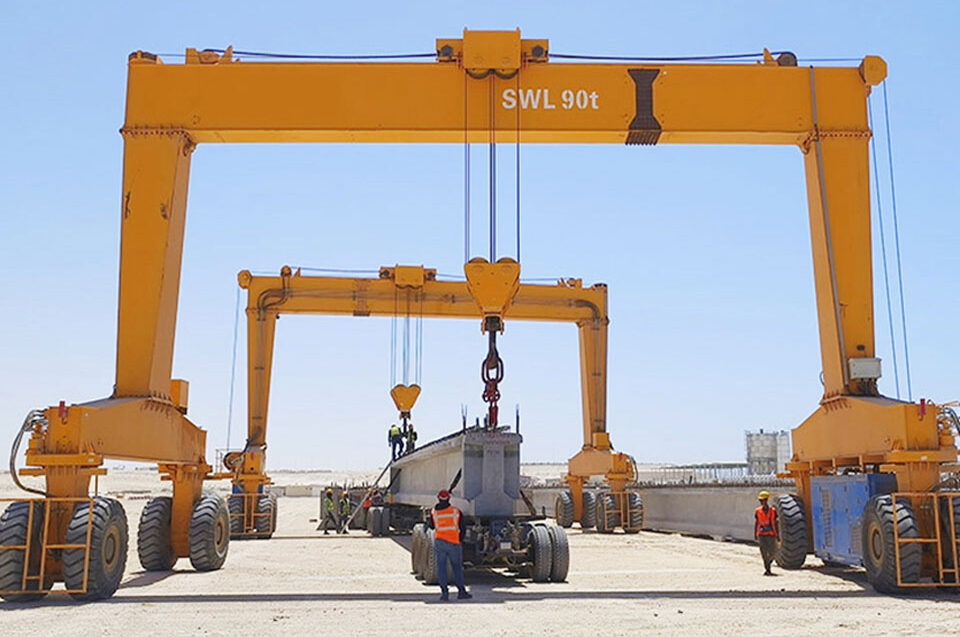
A rubber tyred gantry crane is a mobile lifting device composed of a gantry frame, a base beam, and rubber tires. It is powered by a diesel generator set or an external power source, and uses a hoisting mechanism to lift heavy objects vertically, a running mechanism to control horizontal movement, and some models also feature a rotating mechanism to adjust the angle of the cargo, enabling flexible operation on various types of terrain.
Differences from Traditional Gantry Cranes, Crawler Cranes, and Forklifts
Traditional gantry cranes rely on fixed tracks, limiting their operational range; rubber tyred gantry cranes do not require tracks, offering greater mobility. Crawler cranes have slow movement speeds and exert significant ground pressure, while rubber tyred gantry cranes distribute pressure through their rubber tires, adapting to more ground types and moving faster. Forklifts have limited load capacity and lifting height, while rubber tyred gantry cranes can lift components weighing tens or even hundreds of tons, meeting high-altitude operation requirements.
Widespread Application of Rubber Tyred Gantry Cranes
In ports and container yards, rubber tyred gantry cranes are core equipment for container loading, unloading, and transshipment, enabling efficient cargo turnover. In construction, they can precisely lift precast beams, columns, and other components, adapting to various projects such as high-rise buildings and bridges to ensure smooth construction progress.

Challenges in Precast Concrete Handling
Requirements for the Handling and Storage of Large-sized Components
Large precast beams, bridge decks, and other components can weigh tens to hundreds of tons. Handling requires equipment with strong load-bearing capacity, and storage requires specialized support structures to prevent deformation. Additionally, precise position control is necessary to prevent collisions and damage.
Lifting Difficulties for Diverse Structures
Precast components have diverse structures: beams are slender, columns have varying cross-sections, and slabs and walls have large areas. Different components have varying center of gravity distributions, making the selection of lifting points and balance control challenging. Non-standard components require special lifting equipment and methods.
Site Constraints and Flexible Operation Requirements
Construction sites often have limited space due to materials and equipment, restricting operational areas. Traditional track-based equipment struggles to adapt flexibly, while precast component handling requires equipment that can quickly respond to varying lifting demands, demanding extremely high flexibility.
High Requirements for Precision, Safety, and Efficiency
The installation precision of precast components directly impacts the quality of the building structure, requiring equipment to precisely control component orientation; components are heavy, and accidents during handling can have severe consequences, necessitating robust safety protections; simultaneously, to ensure construction progress, equipment must also possess high operational efficiency.
Advantages of Rubber tired Gantry Cranes in Precast Concrete Handling
Strong Load-bearing Capacity
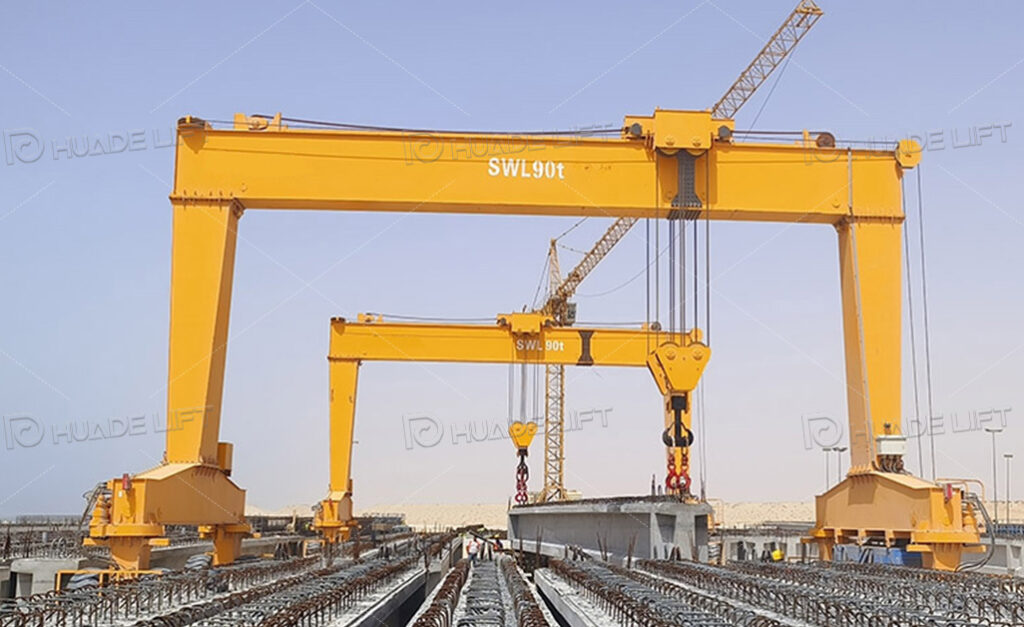
Rubber tired gantry cranes have a strong load-bearing capacity, easily meeting the lifting requirements for heavy components such as precast beams, bridge decks, and large walls. Their lifting capacity typically reaches tens of tons or even hundreds of tons. Through carefully designed lifting mechanisms and robust metal structures, they can stably lift these heavy precast concrete components. For example, in some large-scale bridge construction projects, rubber tired gantry cranes can lift precast bridge deck panels weighing over 80 tons and install them accurately at designated locations. This exceptional load-bearing capacity gives rubber tired gantry cranes an unmatched advantage in the precast concrete handling field, enabling them to handle various large-scale and heavy-duty component lifting tasks.
Flexible Site Adaptability
As mentioned earlier, the rubber tyred design of the rubber tired gantry crane provides excellent site adaptability. It can maneuver freely on uneven terrain, whether it’s the rugged, uneven surfaces commonly found on construction sites or areas filled with sand, gravel, or soil. The rubber tired gantry crane can operate stably in such environments. Compared to traditional gantry cranes that rely on fixed tracks, the rubber tyred gantry crane does not require significant time or cost to lay tracks, enabling quick relocation between different construction sites. In temporary construction sites or projects with complex and variable site conditions, the rubber tyred gantry crane’s flexible site adaptability can fully leverage its advantages, significantly improving construction efficiency and reducing construction costs.
Efficient Loading, Unloading, and Stacking
Rubber tyred gantry cranes demonstrate significant efficiency in loading, unloading, and stacking precast concrete components. Their travel mechanisms enable rapid movement, and their hoisting mechanisms feature high lifting speeds, significantly reducing operation time during loading and unloading. Additionally, the advanced control systems of rubber tyred gantry cranes enable precise positioning of lifting equipment, supporting rapid stacking and accurate positioning. During the stacking of precast concrete components, the components can be accurately placed in designated positions, improving the space utilization rate of the stacking yard. For example, in precast concrete component production plants, rubber tyred gantry cranes can quickly transport the produced components to the stacking area and stack them in accordance with specified sequences and methods, preparing them for subsequent transportation and use. This efficient loading, unloading, and stacking capability significantly improves the overall efficiency of construction projects.
Multi-functional Lifting Device Configuration
To accommodate precast concrete components of various shapes and structures, the rubber gantry crane can be equipped with multiple multi-functional lifting devices. For example, specialized lifting beams can be used to transport long, slender precast beams, with lifting points strategically positioned to ensure balance and stability during transportation. Rotating lifting devices are suitable for components that require angle adjustments during lifting, such as precast components with irregular shapes. Additionally, special lifting devices can be customized according to specific requirements to meet various complex lifting demands. This multi-functional lifting device configuration enables the rubber tyred gantry crane to flexibly handle diverse precast concrete components, enhancing the equipment’s versatility and applicability.
Safety and Stability
In terms of safety and stability, the rubber tyred gantry crane employs a series of advanced technologies and measures. The electric control anti-sway technology effectively reduces swaying of the lifting device during lifting operations. By monitoring the device’s posture in real-time via sensors and automatically adjusting the movements of the hoisting and travel mechanisms through the electric control system, it maintains stability. The automatic alignment system ensures the crane maintains straight-line travel during operation, preventing safety incidents caused by deviation. Additionally, the rubber tyred gantry crane is equipped with multiple safety devices such as overload protection, limit switches, and emergency braking systems, providing comprehensive safety assurance for lifting operations. In construction environments with strong winds, the stability of the rubber tyred gantry crane is also well-protected, ensuring smooth operation.
Environmental Protection and Energy Efficiency
As environmental protection requirements continue to rise, the rubber tyred gantry crane has demonstrated advantages in environmental protection and energy efficiency. Currently, electric rubber gantry cranes are increasingly being adopted. This type of rubber tyred gantry crane is powered by external electricity or batteries, significantly reducing exhaust emissions compared to traditional diesel-driven rubber tyred gantry cranes. In urban construction projects, E-RTGs effectively minimize pollution to the surrounding environment, aligning with urban environmental protection standards. Additionally, the energy conversion efficiency of electric drive systems is higher, reducing energy consumption and achieving energy-saving objectives. Some advanced E-RTGs are also equipped with energy recovery systems, which convert potential energy into electrical energy and store it during the descent of the lifting mechanism, further improving energy utilization efficiency.
Comparison of Rubber tyred Gantry Cranes with Other Handling Equipment
Comparison with Forklifts
While forklifts are widely used in some small-scale cargo handling scenarios, they have obvious disadvantages compared to rubber tyred gantry cranes when handling large, heavy precast concrete components. In terms of load capacity, forklifts typically have relatively small lifting capacities, usually only capable of handling a few tons of cargo, while rubber tyred gantry cranes can lift tens of tons or even hundreds of tons, easily meeting the lifting requirements for large precast concrete components. In terms of operating height, forklifts have limited lifting heights and generally cannot meet the requirements for high-altitude installation of precast components in construction projects. In contrast, the lifting height of rubber tyred gantry cranes can be designed according to actual needs, enabling them to lift precast concrete components to higher positions for installation.
Comparison with Crawler Cranes
While crawler cranes have strong lifting capacity and good stability, their mobility and site adaptability are inferior to those of rubber tyred gantry cranes. Crawler cranes move slowly, and transferring them between different construction sites requires significant time and effort. Additionally, crawler cranes exert substantial pressure on the ground, which may cause damage to soft or sensitive surfaces, limiting their application scope. Rubber tyred gantry cranes, on the other hand, rely on rubber tires, enabling faster mobility and quick relocation between different sites. Their tires effectively distribute pressure, making them adaptable to various ground conditions. Whether on the complex terrain of construction sites or the yard surfaces of ports, they can operate stably.
Comparison with Traditional Gantry Cranes
Traditional gantry cranes require fixed tracks to be laid on the ground to operate, which limits their operational range to the areas defined by the tracks. In situations where the site is constrained or frequent changes in operational positions are required, the use of traditional gantry cranes is significantly restricted. Rubber tyred gantry cranes, however, do not require fixed tracks and can move freely within the site using their rubber tires, quickly adapting to different work areas and task requirements. On construction sites, where site conditions are often complex and variable, the flexible deployment advantage of rubber tire gantry cranes can be fully leveraged, significantly improving construction efficiency. For example, in a construction project requiring the handling of precast concrete components across different areas, a rubber tyred gantry crane can easily move between areas to perform tasks, while a traditional gantry crane would need to reinstall tracks, which would consume a significant amount of time and cost.
How Customized Rubber tired Gantry Cranes Improve Handling Efficiency
Customized lifting devices based on the shape and weight of different precast components
Customized lifting devices are designed to fit irregular components, while high-strength lifting devices are used for heavy components with optimized lifting points to ensure safe and stable lifting and improve adaptability to different components.
Intelligent control systems enhance operational precision
Equipped with advanced intelligent control systems, combined with sensors to monitor component status in real time, precisely controlling lifting and movement actions, reducing installation errors, avoiding rework, and improving construction quality and efficiency.
Modular design adapts to different factories and construction sites
The crane is disassembled into independent modules such as metal structures and lifting mechanisms, which can be flexibly assembled and adjusted according to the type of components in the factory and the site conditions. For example, smaller modules can be selected for narrow sites, and high-load modules can be adapted for heavy-duty operations.
Technological Trends in Rubber tyred Gantry Cranes
The Potential of Automated RTG Cranes in Precast Component Handling
Automated rubber tyred gantry cranes can autonomously perform lifting and stacking operations via pre-set programs and sensors, integrate with other automated equipment to form a workflow, reduce manual operations, enhance operational efficiency and safety, and offer broad future application prospects.
Application of Electric and Hybrid-Powered RTG Cranes
Electric rubber tyred gantry cranes are zero-emission and low-noise, suitable for urban construction; hybrid rubber gantry cranes (Hybrid RTG) combine diesel engines and battery packs, using batteries for environmentally friendly operations under light loads and activating engines for power under heavy loads, while also recovering energy to reduce consumption. Both align with industry environmental trends.
Digital Management and Remote Monitoring
Modern rubber tyred gantry cranes are equipped with sensor networks and data acquisition systems that collect real-time operational parameters and transmit them to a monitoring center. Managers can remotely monitor equipment status and receive automatic alerts in case of abnormalities. The system can also develop preventive maintenance plans and analyze operational data to support equipment maintenance and production scheduling optimization.
Conclusion
Rubber tyred gantry cranes offer advantages such as high load capacity, flexibility, efficiency, and safety in precast concrete handling, making them more suitable for this application than other equipment. Customized design and technological trends toward automation and electrification further enhance their value, making them a significant investment option for companies seeking to enhance competitiveness in the context of construction industrialization and infrastructure development.
