
Today, ship operations at docks and shipyards are more frequent, with limited space and complex working conditions, while industry standards for safety and environmental protection continue to rise. Traditional lifting equipment has limited adaptability and struggles to meet the diverse demands of modern operations.
Marine travel lifts, with their flexibility and versatility, have become the core equipment in modern maritime operations. They can independently complete the entire process of vessel lifting, transportation, maintenance, and storage. Many buyers only focus on lifting capacity when selecting equipment, while neglecting factors such as structural design, safety features, and operational and maintenance costs. This often leads to mismatches between the equipment and on-site conditions, which can hinder the overall operational efficiency of the port.
What is a Marine Travel Lift
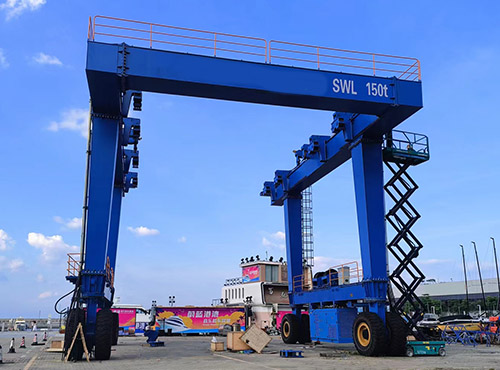
A marine travel lift is specialized lifting equipment used in ports, shipyards, and maritime engineering projects. They are mainly used for loading and unloading ships, transferring on and off the shore, and lifting during maintenance, serving as the foundational core equipment for various maritime sites.
Unlike ordinary lifting equipment, the marine travel lift features an integrated, mobile gantry structure that relies on the coordinated operation of its steel frame, hydraulic system, sling mechanism, travel and steering systems, and load-balancing mechanisms. The hull is supported by specialized slings and the hydraulic system is responsible for the lifting action. In conjunction with the walking wheels, it enables the transfer of the equipment on the site. During the operation, the load of the hull can be evenly distributed, protecting the structure of the vessel.
Compared to traditional rail-mounted gantry cranes, marine travel lifts do not require fixed tracks and are equipped with a complete travel and steering system. As long as the ground bearing capacity of the site meets the standards, the equipment can move freely within the factory area. The flexibility of operation and the adaptability of the site far exceed those of traditional equipment.

How Does a Marine Travel Lift Work
Marine travel lifts have a standardized operation procedure, with each step seamlessly connected. This ensures that the ship structure remains undamaged and the equipment operates stably. The complete operation process is divided into six stages.
Positioning the Marine Travel Lift
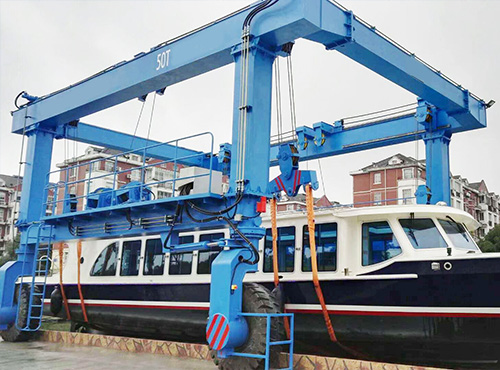
At the start of the operation, the marine travel lift moves directly above the vessel to position and dock. This wide-span equipment can accommodate vessels of varying widths and flexibly span both sides of the hull. Operators adjust the equipment’s position at low speed to precisely align the lifting slings with the vessel’s support points, ensuring even force distribution on the hull during lifting and preventing scratches to the hull or hidden structural damage.
Lowering and Adjusting the Lifting Slings
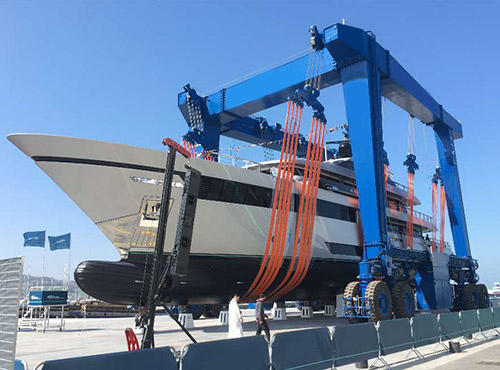
Once positioning is complete, the equipment lowers specialized lifting slings to the ship’s bottom. A marine travel lift is equipped with fiber lifting ropes and coated belts. Heavy-duty models can be paired with steel wire ropes, suitable for different tonnage ships. Operators adjust the position and spacing of the slings based on the ship’s shape and weight distribution. By distributing the load at multiple points, the pressure on the ship body is reduced, avoiding stress concentration that could cause deformation or damage to the paint surface.
Lifting the Vessel Out of Water
Once the slings are securely fastened, the winches on both sides of the equipment operate synchronously at a constant speed to slowly lift the hull, eliminating any swaying or tilting.
During the lifting process, the load monitoring, anti-sway, emergency stop, and synchronization control systems work in concert to calibrate the operational status in real time, preventing issues such as uneven lifting or hull displacement, and ensuring the vessel is lifted out of the water smoothly and remains stable in the air.
Transporting the Vessel
Once the vessel is suspended and stabilized, marine travel lift can autonomously transport the hull to the areas for maintenance, cleaning, storage, painting.
Unlike traditional cranes that require a relay of multiple pieces of equipment, the integrated mobile design enables the entire transfer process to be completed independently, simplifying dock operations and improving on-site efficiency.
Lowering and Securing the Vessel
Upon reaching the workstation, the marine travel lift lowers the vessel at a slow speed, placing the hull smoothly onto specialized blocks or supports. The support structure evenly distributes the hull’s weight, protecting the hull’s bottom structure and ensuring the vessel remains stable during repair, cleaning, and storage. Once it is confirmed that the hull is fully and evenly supported, the lifting slings are retracted, completing the vessel securing operation.
Returning to Operation Mode
After a single operation is completed, marine travel lift moves away from the work area and returns to its standby position. The entire process can be repeated cyclically, allowing a single unit to continuously perform lifting tasks for multiple vessels, meeting the high-frequency, continuous operational demands of modern docks and shipyards.
Types of Marine Travel Lifts
Marine travel lifts are primarily classified by their rated lifting capacity. Equipment with different capacities varies significantly in terms of structural complexity, site compatibility requirements, and suitable vessel types. The specific classifications are as follows:
Light-Duty Marine Travel Lifts
Light-duty marine travel lift features a simple structure and compact design, making them suitable for small and medium-sized recreational vessels. They are commonly used in settings such as yacht clubs and inland marinas. They support front-wheel or all-wheel steering and offer a choice between diesel and electric power modes. They have low ground load requirements and can operate on standard hardened marina surfaces.
Medium-Duty Marine Travel Lifts
Medium-duty marine travel lifts are the mainstream models on the market, suitable for conventional vessels such as sailboats, motor yachts, and small fishing boats. They are equipped with all-wheel steering, adjustable boom span, and flexible power modes, making them common equipment at commercial yacht repair marinas.
Heavy-Duty Marine Travel Lifts
Heavy-duty marine travel lifts are primarily designed for operations involving large vessels such as large yachts, commercial workboats, and ferries. They have complex structures and impose higher demands on dock infrastructure, requiring reinforced ground surfaces and widened launch ramps. Their procurement and long-term maintenance cost is higher than those of medium- and small-tonnage models.
Ultra-Heavy-Duty Marine Travel Lifts
There are no standardized, mass-produced models for ultra-heavy-duty marine travel lift and all units are custom-built for specific projects. They are suitable for specialized maritime projects such as large shipyards and superyacht marinas. Prior to customization, on-site surveys of operating conditions are required to optimize the hydraulic and travel systems accordingly. Some projects may require classification society certification, resulting in relatively longer delivery cycles.
When selecting marine travel lift, it is not sufficient to only consider the maximum lifting capacity. In addition to compatibility with existing vessel specifications, it is also necessary to check the ground bearing capacity of the wharf and the width of the factory access roads. Based on a comprehensive consideration of long-term business plans, the equipment should be selected to avoid problems such as mismatched equipment conditions and inability to upgrade in the future.
Key Components of Marine Travel Lifts
The operational stability, service life, and safety of the equipment do not depend on its appearance. The core lies in the material, structural design and processing technology of the key components. During production, HuadeLift enforces strict manufacturing and quality inspection standards for all core components to ensure they are suitable for long-term, high-frequency maritime operations.
Main Steel Structure
The steel gantry is the core load-bearing structure of marine travel lift. During operation, it continuously bears the weight of the ship and the impact of transportation. Due to the long-term and high-frequency operation, the stability of the structure is highly demanded.
Marine travel lift employs a fully welded gantry made of S355 high-strength structural steel, with all welds subjected to non-destructive testing to ensure the structure remains resistant to deformation and misalignment. The span of the gantry and the lifting height directly determine the size of the vessels that the equipment can be adapted to, and they are the key parameters for matching the working conditions of the wharf.
Hydraulic Lifting System
The hydraulic system serves as the power core for the equipment’s lifting operations. Comprising hydraulic cylinders, a power unit, a reservoir, and a control valve assembly, it is responsible for all lifting and lowering movements. In actual lifting operations, most vessels have uneven weight distribution, which often lead to deviations in the force on one side.
Marine travel lift is equipped with a synchronous control structure, combined with proportional valves and position feedback components. It precisely regulates the lifting speeds of each group of cylinders, controlling the error to the millimeter level. This ensures that the ship body rises and lowers horizontally throughout the process, avoiding damage to the ship body and structural damage caused by tilting.
Sling Lifting System
The slings come into direct contact with the hull and are critical components for protecting the hull and ensuring lifting safety. Marine travel lift comes standard with marine-grade polyester webbing slings, which are flexible and will not scratch the hull or paintwork. The marine travel lift is equipped with movable lifting beams, allowing for flexible adjustment of span and lifting points to accommodate different vessel widths and hull structures. Depending on the vessel’s tonnage, the equipment is configured with 2 to 4 sets of lifting beams, distributing the hull’s weight across multiple points to prevent localized stress concentration.
Lifting slings are consumable parts and it will experience wear, aging and corrosion over time. They must be inspected and replaced regularly before operations to mitigate lifting risks.
Traveling and Steering System
The steering system determines the equipment’s maneuverability and positioning accuracy. Standard front-wheel steering features a simple design and is suitable for well-organized, standard shipyards. All-wheel steering offers a smaller turning radius, making it ideal for docks with limited space and densely arranged vessels.
Marine travel lift’s high-end models feature a crab steering mode, allowing the wheels to move in the same direction to enable lateral movement of the equipment. This is extremely practical for positioning in tight workstations and moving vessels in densely packed areas, effectively improving space utilization at the dock.
Power Drive System
HuadeLift offers three proven power solutions of marine travel lift, which are suitable for different power supply conditions and operation scenarios of the docks.
The full hydraulic drive system provides independent power and does not require an external power grid, making it suitable for remote terminals with unstable power supplies.
The full electric drive system operates on the facility’s power grid. It produces no exhaust gas and is easy to maintain, making it suitable for newly constructed terminals with strict environmental regulations.
The hybrid system combines battery storage with a diesel generator, balancing low emissions with the ability to operate independently, making it suitable for long-distance transport and complex maritime conditions.
Safety Features of Modern Marine Travel Lifts
The maritime lifting operation environment is complex, and relying solely on manual experience can’t eliminate potential hazards in the operation. HuadeLift’s marine travel lifts integrate multiple protective mechanisms into both hardware and software design, establishing a robust safety defense at the equipment level. The core safety configurations are as follows:
Multi-Point Load Monitoring System
The equipment collects real-time load data from each lifting point and dynamically monitors the ship’s structural stress. For issues such as uneven loading, off-center loads, or overloads caused by uneven ship loading, the system can accurately identify anomalies and issue timely warnings, preventing dangerous operations and avoiding hull damage and equipment overload failures.
Hydraulic Anti-Sway Control System
During suspended cargo transfer operations, equipment start-up and shutdown, as well as ground vibrations, can cause the ship’s hull to sway. Through precise hydraulic control, this system suppresses the amplitude of hull sway, reducing the risk of the vessel colliding with dock facilities or equipment shifting out of position, thereby enhancing transfer stability.
Emergency Stop Function
As a standard safety feature, this device is designed to address various unexpected situations. In the event of unauthorized personnel entering the work area, vessel drift, or equipment malfunctions during operations, the operator can stop the system with a single button press, locking all equipment movements to quickly mitigate risks and prevent potential hazards from escalating.
PLC-Programmed Safety Constraints
Marine travel lifts integrate standardized operation procedures and safety interlock logic into the control system. Operations such as lifting, traveling, and limit switches are all program-controlled, reducing errors caused by human operational negligence and ensuring consistent and stable lifting operations every time.
Benefits of Marine Travel Lifts
Marine travel lifts are suitable for a wide range of maritime work sites and can meet the needs of vessel lifting, transshipment, and maintenance across various scenarios. HuadeLift equipment offers strong adaptability and comprehensive functionality, providing targeted solutions to common challenges in dock operations.
Exceptional Lifting Capacity
Marine travel lifts have a tonnage range covering small and medium-sized leisure vessels to large commercial vessels. They can be adapted to the majority of maritime operations and supports project-based customization, matching the individualized site conditions.
Flexible Operation
Marine travel lifts are equipped with traveling and steering system, eliminating the need for dedicated tracks. The layout of the factory can be flexibly planned, and precise positioning operations can be carried out even in small spaces, without being restricted by site renovations or business adjustments.
Adjustable Lifting Structure
The span of the lifting beam and the positions of the lifting points can be flexibly adjusted to distribute the load according to the hull’s shape, preventing damage caused by excessive localized pressure.
Dedicated Anti-Corrosion Design
Special anti-corrosion treatment is carried out for the seaside environment with salt fog, high humidity and ultraviolet rays, which can slow down the corrosion of the steel structure, reduce the frequency of maintenance, and extend the service life of the equipment.
User-Friendly Operation
The operation logic is in line with the on-site operation habits. The cab has a wide field of vision and the remote-control operation is convenient. Combined with the sound and light warning device, the equipment status is intuitive, reducing the fatigue of the operators during long-term operations.
How to Choose the Right Marine Travel Lift
Equipment selection directly impacts the long-term operational stability and operating costs of a port. Selecting equipment based solely on tonnage or price may lead to compatibility issues. Based on the actual working conditions, the following selection criteria can be referred to.
Appropriate Lifting Capacity
Selection should be based on the maximum weight of existing vessels, while allowing for business expansion over the next 3–5 years. If the equipment is designed to handle only current vessel tonnages, it will face capacity shortages and become unusable once larger vessels are added in the future.
Site Dimensions and Equipment Compatibility
Parameters such as the equipment’s gantry clear width, lifting height, and turning radius must be compared in advance to ensure compatibility with the terminal’s slipways, facility access roads, and gate dimensions. At the same time, the bearing capacity of the site’s ground must be calculated. Heavy equipment exerts greater pressure on the ground, and if the ground fails to meet the standards, settlement problems may occur.
Basic Safety Features
It is recommended that basic safety features—such as overload protection, load monitoring, and emergency stop—be included as standard equipment. Do not cut corners on safety hardware to reduce costs and this can help eliminate operational safety hazards at the source.
Maintenance and Operations
Given the high turnover rate among terminal operators, the equipment’s operating logic should be simple and intuitive. Additionally, the compatibility of the equipment components and the supply speed should also be confirmed. Equipment with simple operation procedures and easy-to-acquire components can effectively reduce the downtime due to failures.
On-Site Maritime Conditions
Coastal terminals are characterized by heavy salt fog and high humidity, which can easily corrode the equipment’s metal structures. When selecting marine travel lift, carefully verify the corrosion-resistant processes and coating configurations to ensure the equipment can withstand harsh maritime operating environments over the long term.
After-Sales Warranty and Support
Before purchasing, confirm the scope of the equipment warranty, the response time for on-site after-sales service, and the spare parts lead time. Ensure that all after-sales terms are clearly stipulated in the contract to guarantee stable support for the equipment’s long-term operation and maintenance.
Conclusion
The comprehensive operational capability of a marine travel lift does not depend on a single tonnage parameter. Instead, they are the result of the coordinated cooperation among the steel structure, hydraulic system, lifting equipment, movement, control and safety systems. This is the core reason why HuadeLift marine travel lifts have stable performance and are superior to ordinary equipment.
For many years, HuadeLift has specialized in the field of marine lifting equipment, researching and manufacturing every unit based on real-world operating conditions. The entire product line balances practicality, durability, and safety, providing highly adaptable and cost-effective ship lifting solutions for various shipyards and terminals.
