
The selection of container handling equipment directly determines the efficiency of site operations and operational costs. Container straddle carriers, with their feature of rail-free flexible operation and multi-purpose use, have become the core equipment in various container storage yards.
What Is a Container Straddle Carrier
Container straddle carrier is a highly versatile specialized handling machine widely used in modern yard logistics. It also serves as the primary operational equipment for many small and medium-sized and flexible container yards. Huadelift has deepened its expertise in the material handling equipment sector for many years and possesses mature technical expertise in the research, development, application, and on-site adaptation of container straddle carriers.
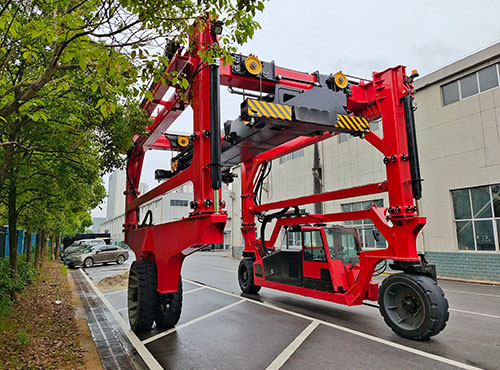
A container straddle carrier is a self-propelled container handling equipment that is equipped with a walking function and a gantry frame structure. The core structure of the equipment is a gantry frame. During operation, it stands entirely outside the container and will not grip or handle the goods from the side.
Container straddle carriers do not require fixed tracks and rely on rubber tires for full-range mobility. The built-in operation mode significantly reduces the risk of overturning and requires less space, allowing for normal operation even in yards with irregular layouts.
Container straddle carriers can independently perform multiple tasks, including container lifting, tiered stacking, short-distance yard transfers, and trailer loading and unloading. This integrated operational model makes it the preferred equipment for dynamic, flexible yards, and it is widely adaptable to various scenarios such as inland container yards and industrial logistics yards.

How Does a Container Straddle Carrier Work
Many industry professionals encountering container straddle carriers for the first time mistakenly believe that the operating procedures for this type of equipment are complex and difficult to master. In reality, the operational logic of a container straddle carrier is simple and clear, and the entire process is highly standardized. Operators can complete all tasks from the overhead cab without ever having to exit the vehicle to assist.
Precise Positioning
The operator maneuvers the vehicle at low speed so that the gantry frame fully covers the container to be handled, positioning the container at the center of the equipment’s frame. Stable and accurate alignment effectively prevents issues such as container misalignment and uneven load distribution, laying a safe foundation for subsequent lifting and transport.
Adjustment and Securing
The container straddle carrier is equipped with a telescoping lifting attachment that automatically adjusts its width to accommodate different standard container sizes on-site, such as 20ft and 40ft containers. Once the lifting attachment is aligned with the locking holes at the four corners of the container, a twist-lock mechanism secures a rigid lock, ensuring the container is fully secured to the attachment.
Steadily Lifting
Once locking is complete, the hydraulic or electric lifting system begins to raise the lifting device and the container. A container straddle carrier is equipped with a variable-frequency speed control system, ensuring uniform and controllable lifting speeds. The start and stop process is smooth without any shock. This design effectively protects the container structure and its cargo, preventing damage caused by jolts and shaking.
Flexible Maneuvering and Travel
Once the containers are raised to a safe working height, the operator maneuvers the equipment to the designated storage or loading/unloading area. Modern container straddle carriers are equipped with multi-wheel drive and omnidirectional steering systems, supporting straight travel, lateral travel, diagonal “crab” travel, and 360° rotation on the spot. Even in yards with narrow aisles and irregular layouts, the equipment can maneuver flexibly without requiring large turning spaces.
Precise Positioning and Resetting
Once the container straddle carrier reaches the target location, the container is slowly lowered to the ground or the trailer deck. After the container is securely positioned, the lifting attachment’s twist lock is released, and then the operator resets the attachment, completing a full operational cycle. The entire process is closely integrated, reducing the idle time caused by equipment alignment and waiting, ensuring smoother yard operations.
Structure of a Container Straddle Carrier
Container straddle carriers are capable of handling heavy loads, high-frequency operations, and complex site conditions, thanks primarily to their mature and robust overall structural design. Each core component is designed for a specific operational function, and the various structural elements work in concert to ensure the equipment’s long-term, stable operation. In the manufacturing process.
Portal Frame
The portal frame is the core load-bearing framework of the straddle carrier and also the basic structure for the equipment to perform cross-load operations. Standard portal frame spans range from 12 to 16 meters, fully covering the width of standard containers. Constructed entirely of high-strength steel through welding, the structure offers sufficient rigidity to handle heavy loads ranging from 30 to 80 metric tons.
Main Beam Structure
The main beam connects the portal frame’s support legs on both sides and primarily supports the hoisting mechanism and lifting attachments. A container straddle carrier features a box-section main beam design, offering outstanding resistance to twisting and deformation. This design distributes pressure during heavy-load operations, preventing localized overloads.
Hoisting Mechanism
The hoisting mechanism is the core power component that controls the lifting and lowering of containers. It is primarily available in two drive configurations: hydraulic winch and electric winch. Both drive types are equipped with variable-frequency speed control systems, allowing for smooth adjustment of lifting speed. The start-up and stopping processes are shock-free, effectively protecting the structural integrity of the containers.
Heavy-Duty Tires
Container straddle carriers are typically equipped with multiple large-diameter special tires, with the entire tire system supporting the full weight of both the machine and the cargo. The tires feature a low ground pressure design that prevents damage to concrete or asphalt surfaces in the yard caused by rolling. During operation, they cushion vibrations caused by road bumps, ensuring the stability of the containers while effectively extending tire service life and accommodating long-term, high-frequency operation.
Omnidirectional Steering System
The steering system determines container straddle carrier’s maneuverability on-site, supporting multidimensional movement—including forward, backward, lateral, and diagonal travel—while also enabling 360° rotation in place. In the narrow and irregularly-arranged storage yard, container straddle carrier can complete the position adjustment without having to make long-distance turns.
Power Unit
Currently, mainstream container straddle carriers come in two power configurations to meet the demands of different operational scenarios.
Diesel-hydraulic models deliver powerful output and are independent of the operating environment and supporting infrastructure, making them suitable for outdoor yards requiring heavy-load, long-duration continuous operations.
Full-electric models feature zero emissions and low noise during operation, making them ideal for modern intelligent yards with strict environmental regulations, while also offering lower daily energy consumption costs.
PLC Intelligent Control Cabinet
PLC control cabinet serves as the equipment’s intelligent hub, integrating all operational signals—including lifting, travel, and safety monitoring. During operation, it provides real-time feedback on key data such as load weight, lifting height, and travel speed, enabling operators to monitor the equipment’s status in real time.
Ergonomic Operator Cab
The operator cab is centrally located at the top of the mast and features panoramic windows with no blind spots. The interior features an adjustable seat and a high-definition digital display, with control buttons arranged in a centralized layout for simple and intuitive operation.
Safety Protection Devices
Safety features are essential for ensuring stable operation of container straddle carrier, and the machine comes standard with multiple protective devices. An overload sensor monitors cargo weight in real time, preventing structural damage and safety hazards caused by overloading.
Additionally, the vehicle is equipped with a twist-lock position monitor, collision prevention devices, and other safety features that continuously monitor operational status to prevent collisions and issues such as improperly secured locks, thereby ensuring the safety of the equipment, cargo, and personnel on-site.
Types of Container Straddle Carriers
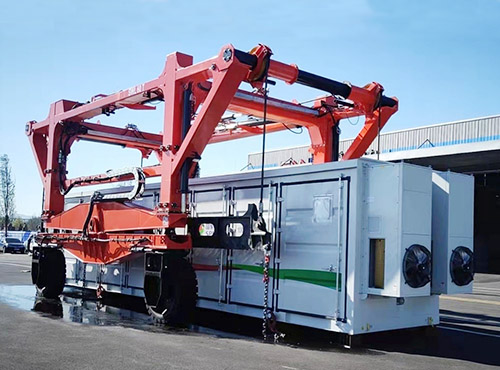
Container straddle carriers are generally classified into three categories based on their power source: diesel, hybrid, and full-electric. The operational performance, applicable scenarios, and maintenance costs of the three models are all different.
Diesel Container Straddle Carriers
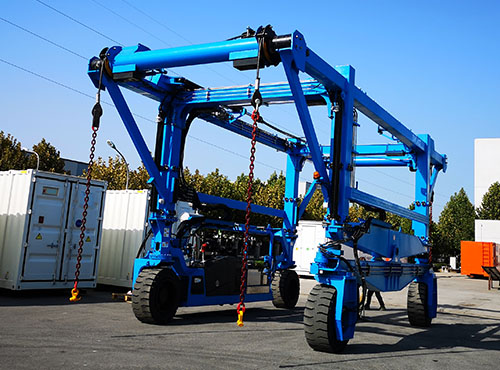
Diesel container straddle carriers are the traditional models with the longest history of industry use and the widest range of applications. Powered by diesel engines, they offer stable power output and ample power reserves, enabling them to handle high-intensity, uninterrupted continuous operations.
The most notable feature of this type of equipment is its strong adaptability to various environments. It requires no charging infrastructure and is not restricted by on-site power conditions. Whether in remote inland terminals, or high-intensity freight hubs, it operates reliably, making it the standard choice for heavy-load, high-frequency operations.
Hybrid Container Straddle Carriers
The hybrid model integrates a diesel engine, an electric motor, and a battery system, combining the long-range advantages of traditional diesel models with the energy-saving benefits of electric models. During operation, the vehicle can store excess energy through an energy recovery system and intelligently allocate power output.
Compared to pure diesel models, it features lower fuel consumption and exhaust emissions, as well as significantly reduced operational noise. At the same time, it avoids the range limitations of all-electric models, making it suitable for yards that are advancing green transformation but have not yet established a comprehensive charging infrastructure. It is the preferred transitional model during this period of operational transformation.
Full-Electric Container Straddle Carriers
Full-electric stackers use lithium-ion batteries as their primary power source, producing zero exhaust emissions throughout operation and generating extremely low operating noise. The equipment features a mature electronic control system, ensuring smoother start-stop and operating processes.
Daily maintenance is straightforward, as there is no need to replace diesel engine components such as engine oil or filters, resulting in lower long-term operating costs. These models are better suited for modern container logistics yards with strict environmental regulations, high levels of automation, and well-developed charging infrastructure.
Advantages of Container Straddle Carriers
In the daily operations of yards, a piece of equipment’s flexibility, adaptability, and cost-effectiveness directly impact overall operational efficiency. The reason container straddle carriers are widely used in various logistics scenarios lies in their ability to meet the core requirement of flexible yard operations, offering comprehensive advantages over traditional equipment.
Simplified Yard Operations
Traditional yard operations often require the coordinated use of multiple machines, such as cranes, forklifts, and transfer equipment, which can lead to delays and coordination gaps during equipment handoffs. Container straddle carriers integrate lifting, transfer, stacking, and loading/unloading functions into a single unit, enabling a single machine to complete the entire operation. This streamlines operational steps, reduces the complexity associated with multi-equipment coordination, and makes the daily rhythm of yard operations more stable and controllable.
Higher Yard Utilization
Due to limitations in turning radius and operating space, many traditional machines require wide operating aisles, resulting in significant waste of yard space. Container straddle carrier’s flexible steering mode allows it to navigate narrow aisles and irregular layouts.
Container straddle carrier can operate right up against stacks, requiring minimal aisle space. As a result, more containers can be stacked in a yard of the same area, effectively increasing the yard’s actual utilization rate.
Agile Flexible Condition Adaptation
Container straddle carrier’s tire-based travel system is not restricted by fixed tracks, allowing it to flexibly adjust its route based on cargo distribution and operational needs. Whether for short-distance round-trip container transfers or the relocation and inspection of loose cargo, it can respond quickly.
Lower Labor Costs
Traditional large-scale lifting equipment requires multiple people to coordinate positioning, lifting, and supervision, resulting in high labor costs. Container straddle carrier’s operation is highly integrated, allowing a single operator to independently complete the entire workflow.
While ensuring operational quality and safety, this streamlines staffing and reduces long-term labor costs for yard operations.
Heavy Duty Reliable Operation
Container straddle carrier’s high-strength steel frame, combined with a scientifically designed load-bearing layout, a stable hydraulic lifting system, and shock-absorbing tires, ensures that the frame remains stable and free from swaying or shifting even when fully loaded.
Container straddle carriers are designed to withstand the high-frequency, non-stop heavy-duty operations typical of yards over the long term. They offer strong adaptability to various operating conditions, a low failure rate, and effectively ensure the continuous operation of the yard.
Applications of Container Straddle Carriers
The application scenarios of container straddle carriers cover various fields such as water transportation, land transportation, industrial manufacturing, and engineering construction. They can be compatible with standard containers and also meet the handling requirements for large modular heavy goods.
Container straddle carriers can efficiently complete container transshipment, storage, and reloading operations, breaking down barriers between road and rail transport and improving the transshipment efficiency of inland logistics hubs.
Logistics Warehousing and Distribution Centers
Large-scale logistics warehousing facilities and distribution centers often use standard containers and mobile storage units to store goods.
With their flexible adaptability to different sites, container straddle carriers can meet the dynamic cargo scheduling needs of warehousing facilities and are well-suited for the daily operations of small- and medium-sized logistics hubs.
Industrial Manufacturing Yards
Various heavy industry manufacturing facilities handle large quantities of heavy-load cargo, such as large steel structures, prefabricated components, and shipping containers for large equipment. Due to their large dimensions and high weight, ordinary forklifts struggle to handle these items safely and stably.
Container straddle carriers can replace traditional lifting equipment to perform precise handling and stacking of heavy-load cargo within factory grounds, making them well-suited for routine heavy-load operations in industrial settings.
Large-Scale Project Sites
At mining, energy, and large-scale infrastructure project sites, there is often a need to transport oversized and heavy equipment modules and prefabricated components. These construction sites typically feature variable terrain and limited operating conditions, making traditional equipment poorly suited for such environments. Container straddle carriers, with their flexible, trackless operation, can efficiently handle the on-site transport of heavy modules, effectively optimizing material logistics and improving overall construction coordination efficiency.
Container Straddle Carriers Maintenance and Service
Container straddle carriers feature robust construction and low failure rates. However, long-term, high-frequency operation can cause wear and tear on core systems such as tires, hydraulics, and electrical components. Proper daily maintenance can effectively extend the equipment’s service life, reduce downtime caused by breakdowns, and lower long-term operating costs.
Tire Maintenance and Service
Tires are container straddle carrier’s core mobility components and are also the most easily overlooked wear-prone parts. The condition of tire wear directly affects the equipment’s steering precision, driving stability, energy consumption, and operational safety.
Daily maintenance does not require rotating tires on a fixed schedule. Instead, the rotation plan can be adjusted based on actual tire wear data. If uneven or irregular wear occurs on one side, promptly check the wheel alignment and inspect the equipment to identify the root cause of the problem.
During daily operations, operators should avoid sharp turns, sudden acceleration, and abrupt stops while the vehicle is heavily loaded. At the same time, sharp debris and metal fragments on the yard surface should be cleared regularly, and deep potholes should be repaired promptly to reduce external wear on the tires.
Hydraulic System Maintenance and Service
The hydraulic system handles core functions such as lifting, steering, and auxiliary braking. It is key to the equipment’s power output. Hydraulic pumps, control valves, cylinders, and filter assemblies are high-value core components. Any failure of them will directly cause equipment downtime and affect overall operational progress.
As part of routine maintenance, regularly check the cleanliness and viscosity of the hydraulic fluid, and promptly address issues such as water ingress, contamination, or deterioration in the hydraulic lines.
Regularly inspect the signal response and pressure balance of control valves to identify potential issues such as stuck spools or leaks. At the same time, replace hydraulic filters according to the maintenance schedule and check the tank’s seal integrity to reduce contamination-related failures in the hydraulic system at the source.
Electrical System Maintenance and Service
The electrical system is responsible for power distribution, signal transmission, safety interlocks, and PLC logic control. It serves as the control core of modern straddle carriers. The stability of the electrical system directly determines the equipment’s operational safety and efficiency.
Routine maintenance requires periodic inspection of wiring connections and cable protection to identify potential hazards such as aging, loose connections, or damage, thereby ensuring stable signal transmission. For equipment sensors, alarm devices, and safety interlock functions, sensitivity must be tested regularly to ensure proper early warning and shutdown in the event of a malfunction.
Conclusion
Container straddle carriers are flexible, trackless, and feature integrated functionality, making them suitable for a wide range of applications. They are capable of handling heavy loads while operating in an environmentally friendly and low-carbon manner. When maintained according to standard procedures for tires, hydraulics, and electrical systems, these vehicles operate reliably and can effectively reduce yard operating costs.
