
In ports, container yards, and industrial logistics, Rubber – Tyred Gantry (rubber tyred gantry crane) cranes play an indispensable and pivotal role. With their flexible mobility, they can efficiently handle the loading, unloading, stacking, and transferring of containers, serving as one of the core pieces of equipment to ensure the smooth operation of the logistics chain. However, in the process of selecting an rubber tyred gantry crane crane, a crucial parameter is often overlooked: ground clearance.
Ground clearance, seemingly just a simple dimensional indicator, is directly related to the actual performance of the rubber tyred gantry crane crane during operation. Many enterprises, when choosing a crane, tend to focus more on more intuitive performance parameters such as lifting capacity, span, and lifting height, and pay insufficient attention to ground clearance. In fact, proper ground clearance is a vital prerequisite for ensuring the efficient operation, safety, and adaptability of rubber tyred gantry crane cranes in diverse working environments. This article will delve into the critical significance of ground clearance in the selection of rubber tyred gantry crane cranes, aiming to enable industry practitioners to fully recognize the importance of this parameter and make more scientific and rational selection decisions.
What is Ground Clearance
Definition of Ground Clearance
The ground clearance of an rubber tyred gantry crane crane specifically refers to the vertical distance between the lowest point of the crane (which could be the chassis, undercarriage, or other key components) and the ground. This seemingly straightforward distance is a crucial metric for determining whether the rubber tyred gantry crane crane can operate normally in a specific site. It directly determines the likelihood of contact between the crane’s bottom components and ground obstacles during operation, serving as one of the fundamental parameters to ensure the safe operation and efficient performance of the equipment.
Technical Specifications
In the design of standard rubber tyred gantry crane cranes, the setting of ground clearance takes into account the overall performance of the equipment, the requirements of the operating scenario, and the general technical standards within the industry. The ground clearance of standard rubber tyred gantry crane cranes produced by different manufacturers may vary according to the equipment’s model, purpose, and design concept. These settings are not arbitrary but are based on rigorous mechanical calculations and actual working – condition tests. This ensures that the equipment not only meets the basic operational requirements but also has a certain degree of passability and safety. Although there is no unified and absolute standard range for ground clearance in the industry, there are relatively common technical specifications based on the typical operating scenarios and equipment specifications of rubber tyred gantry crane cranes, guiding manufacturers in equipment design and production.
Why Ground Clearance is a Critical Factor
Mobility and Maneuverability
In operational sites such as container yards, the ground conditions are often complex, with uneven surfaces, slopes, and railway crossings. An rubber tyred gantry crane crane with appropriate ground clearance can more easily navigate these complex terrains. When traveling on an uneven surface, sufficient ground clearance can prevent the bottom components of the crane from scraping against ground protrusions, ensuring smooth travel. When traversing a slope, proper ground clearance can prevent the bottom of the equipment from colliding with the slope surface, guaranteeing safe travel on the slope. And when crossing a railway crossing, a higher ground clearance enables the crane to smoothly straddle the height difference between the railway tracks and the ground, avoiding getting stuck on the tracks. This effectively enhances the mobility and maneuverability of the rubber tyred gantry crane crane within the operational site, reducing the occurrence of situations where the equipment cannot move normally due to terrain restrictions.
Safety Considerations
Safety is the top priority in crane operations, and ground clearance is closely related to the operational safety of rubber tyred gantry crane cranes. During operation, there may be various potential safety hazards on the ground, such as cables laid on the ground, manhole covers of drainage systems, and other low – lying ground structures. If the ground clearance of an rubber tyred gantry crane crane is too low, it is prone to collide with these ground facilities during movement. Such collisions may not only damage the ground facilities, affecting the normal operation of the site, but more seriously, they may damage the bottom components of the crane, such as the running gear and hydraulic pipelines. This could even lead to equipment failures, overturning, and other major safety accidents, resulting in casualties and huge property losses. Therefore, sufficient ground clearance is an important safeguard against such safety accidents.
Operational Efficiency
In the fast – paced logistics operation environment, operational efficiency is directly related to a company’s operating costs and economic benefits. A higher ground clearance can significantly improve the operational efficiency of an rubber tyred gantry crane crane. When the rubber tyred gantry crane crane needs to reposition between different work areas, sufficient ground clearance allows it to complete the area transfer more quickly without frequent equipment adjustments, such as lowering the lifting height or adjusting the travel route, thus reducing the time wasted during the transfer. At the same time, appropriate ground clearance can effectively prevent the equipment from being forced to stop due to ground obstacles, reducing downtime caused by equipment adjustments or dealing with ground obstacles, ensuring that the rubber tyred gantry crane crane can operate continuously and efficiently, and improving the overall operational efficiency.
Adaptability across Worksites
Different worksites, such as ports, railway freight stations, and industrial plants, have significantly different ground conditions. The ground at port terminals may be relatively flat, but there may be numerous tracks for handling equipment and underground pipelines. The ground at railway freight stations has railway tracks running through it, and the ground flatness may decline due to long – term use. The ground in industrial plants may have debris left over from the production process, equipment foundations, and ground joints of different materials. An rubber tyred gantry crane crane with a higher ground clearance can better adapt to these different ground conditions. Whether in the complex ground of a port, between the railway tracks of a railway freight station, or in the diverse ground environment of an industrial plant, a higher ground clearance enables the rubber tyred gantry crane crane to pass and operate smoothly. This allows the equipment to be flexibly deployed and used across multiple different worksites, greatly enhancing the flexibility and applicability of the rubber tyred gantry crane crane and reducing the cost for enterprises to purchase specialized equipment due to site changes.
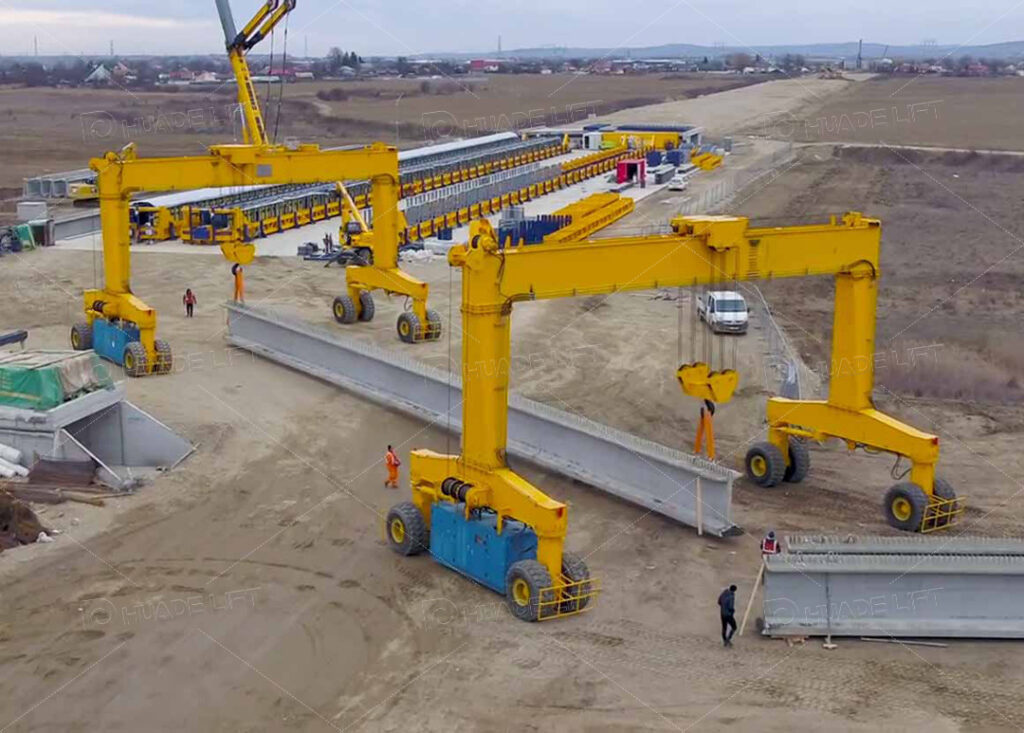
Comparing Ground Clearance in Different RTG crane Models
Rubber tyred gantry crane vs. Low – Clearance Customized Versions
The ground clearance of a standard rubber tyred gantry crane crane is designed according to common operating scenarios and general industry requirements, capable of meeting the basic operational needs of most ordinary container yards and ports, with strong versatility and universality. The low – clearance customized rubber tyred gantry crane crane, on the other hand, is designed and manufactured according to the specific requirements of a particular operating site. This type of customized rubber tyred gantry crane crane is usually suitable for operating environments with limited space height, such as indoor warehouses, underground logistics passages, or work areas surrounded by low – rise buildings and bridges.
By reducing its ground clearance, the low – clearance customized rubber tyred gantry crane crane can adapt to the limited space height, but this also restricts its passability and terrain adaptability. In sites with complex ground conditions or numerous obstacles, the use of the low – clearance customized rubber tyred gantry crane crane will be severely restricted, and it is prone to scraping and collision accidents between the bottom components and the ground. In contrast, although the standard rubber tyred gantry crane crane does not have an advantage in height, in most open operating sites, its ground clearance can better meet the equipment’s passability and safety requirements.
Rubber Tyred Gantry Cranes vs. Rail Mounted Gantry Cranes
Rubber – Tyred Gantry (rubber tyred gantry crane) cranes and Rail – Mounted Gantry (RMG) cranes are two common types of gantry cranes. They have significant differences in operating methods and structural designs, which also lead to different characteristics and requirements regarding ground clearance.
Rail – Mounted Gantry (RMG) cranes mainly move along the tracks laid on the ground, and their travel routes are strictly restricted by the tracks. Due to the presence of the tracks, RMGs have relatively lower requirements for ground clearance during design. The tracks ensure that the equipment can travel smoothly on a fixed route, and the ground around the tracks is usually leveled, with fewer large protrusions and obstacles. Therefore, RMGs do not require a high ground clearance to deal with complex terrain changes.
Rubber tyred gantry crane cranes, however, are characterized by track – less mobility and flexibility, being able to move and turn freely within the operational site. This flexible mode of movement exposes rubber tyred gantry crane cranes to more complex and diverse ground conditions, thus requiring a higher ground clearance. Sufficient ground clearance ensures that rubber tyred gantry crane cranes can avoid collisions with various ground obstacles during free movement, safeguarding the normal operation and safety of the equipment.
Key Considerations When Evaluating Ground Clearance
Project Site Survey
When evaluating the ground clearance of an rubber tyred gantry crane crane, a comprehensive and detailed survey of the project’s operating site is essential. Understand the overall layout and spatial structure of the yard to determine if there are any space – height restrictions. Analyze the terrain characteristics of the site, checking for slopes, depressions, protrusions, and other terrain changes. Identify the materials used for the ground surface. Different ground materials have different bearing capacities and flatness, such as concrete, asphalt, and gravel surfaces. All these factors will impact the travel and operation of the rubber tyred gantry crane crane.
Cargo Type
The type of cargo is an important factor influencing the selection of ground clearance for an rubber tyred gantry crane crane. For heavy containers, although their weight is mainly borne by the hoisting mechanism of the rubber tyred gantry crane crane, the overall stability of the equipment is crucial during the lifting and transferring process. A higher ground clearance may have a certain impact on the equipment’s stability. Therefore, when making a selection, a balance needs to be struck between ground clearance and equipment stability to ensure that the equipment can safely carry heavy containers while also having a certain degree of passability.
For oversized project cargo, which has large dimensions, it may occupy more space during transfer, and the distance between the bottom of the cargo and the ground may be small. If the ground clearance of the rubber tyred gantry crane crane is too low, during the transfer of such cargo, it is likely that the bottom of the cargo will collide with the ground or the bottom components of the crane will collide with the cargo. Therefore, when transporting oversized project cargo, an rubber tyred gantry crane crane with a higher ground clearance should be selected to ensure the smooth and safe transfer of the cargo.
Future Scalability
When selecting an rubber tyred gantry crane crane, one should not only consider the current operational needs but also fully take into account future scalability. If an enterprise plans to relocate the rubber tyred gantry crane crane to other operational sites in the future or use it in multiple different sites, then more caution is required when choosing the ground clearance.
Different operational sites have different ground conditions and environmental requirements. The ground clearance suitable for the current site may not be applicable to other sites. Therefore, when making a selection, an rubber tyred gantry crane crane with high adaptability and flexibility should be chosen, one whose ground clearance can meet the operational needs of multiple different sites or can be adjusted and modified to adapt to the requirements of different sites. This can prevent enterprises from having to purchase new equipment due to site changes in the future, reducing equipment investment costs and improving equipment utilization.

How Ground Clearance Impacts Maintenance and Lifecycle Costs
Reducing Wear on Undercarriage and Cables
The undercarriage and cables are important components of an rubber tyred gantry crane crane, and their normal operation directly affects the equipment’s operational efficiency and service life. A higher ground clearance can effectively reduce the contact and friction between the undercarriage, cables, and the ground. During the equipment’s travel, dust, sand, and debris on the ground are less likely to enter the undercarriage, reducing the wear rate of undercarriage components and the incidence of undercarriage failures.
At the same time, a higher ground clearance also keeps the cables away from the ground, avoiding friction and extrusion between the cables and ground obstacles, reducing damage to the cable sheath, and lowering the risk of cable short – circuits and electrical leakage. The reduction in wear of the undercarriage and cables not only reduces the maintenance difficulty of the equipment but also extends the service life of these components, saving the enterprise a significant amount of maintenance costs.
Reducing Repairs from Ground – Related Damages
A lower ground clearance makes it easier for the rubber tyred gantry crane crane to collide with various ground obstacles during operation, resulting in damage to the bottom components of the equipment, such as chassis deformation, damage to running wheels, and rupture of hydraulic pipelines. These repairs due to ground – related damages not only consume a large amount of repair time and labor costs but also require the replacement of expensive components, imposing a huge economic burden on the enterprise.
A higher ground clearance, however, can effectively avoid such collision accidents and reduce the repairs caused by ground – related damages. The reduction in the number of equipment repairs not only lowers the enterprise’s repair costs but also reduces the equipment’s downtime, ensuring that the equipment can operate continuously and stably, improving equipment utilization and the enterprise’s economic benefits.
Long – Term Cost Savings
Ground clearance has a significant impact on the service life of an rubber tyred gantry crane crane. A higher ground clearance can reduce the wear and damage of the bottom components of the equipment, lowering the incidence of equipment failures and thus extending the overall service life of the equipment. An rubber tyred gantry crane crane with a longer service life can create more value for the enterprise and also reduce the cost of the enterprise having to purchase new equipment due to premature equipment scrapping.
Although an rubber tyred gantry crane crane with a higher ground clearance may have a slightly higher purchase cost than one with a lower ground clearance during the initial selection, from the perspective of the equipment’s life cycle, an rubber tyred gantry crane crane with a higher ground clearance can achieve long – term cost savings for the enterprise by reducing maintenance costs and extending its service life. This long – term cost – saving effect is of great significance for the sustainable development and economic – benefit improvement of the enterprise.
Conclusion
In conclusion, ground clearance plays a vital role in the selection of rubber tyred gantry crane cranes and is a key factor that cannot be overlooked. It directly affects the mobility, maneuverability, operational safety, operational efficiency, and adaptability across different worksites of rubber tyred gantry crane cranes, and also has a profound impact on the equipment’s maintenance costs and life – cycle costs.
Appropriate ground clearance enables rubber tyred gantry crane cranes to move flexibly in complex operational sites, ensures operational safety, improves operational efficiency, adapts to different operating environments, reduces equipment maintenance costs, and extends the equipment’s service life, bringing significant economic benefits to enterprises. Therefore, when selecting an rubber tyred gantry crane crane, enterprises should fully recognize the importance of ground clearance, comprehensively consider factors such as operating site conditions, cargo types, future scalability, and equipment stability, and choose an rubber tyred gantry crane crane with an appropriate ground clearance.
Finally, it is recommended that enterprises cooperate with reliable rubber tyred gantry crane crane manufacturers. These manufacturers can provide customized ground – clearance solutions based on the specific needs of enterprises, ensuring that the provided rubber tyred gantry crane cranes can perfectly meet the operational requirements of enterprises, providing strong support for the enterprise’s logistics operations, and helping enterprises achieve sustainable development and continuous improvement of economic benefits.
