
The straddle carriers are indispensable heavy-duty transfer equipment in road and bridge construction, the wind power industry, and steel storage. They are mainly responsible for the loading, unloading, shifting, and stacking of large pieces of materials such as large prefabricated beams, steel structures, heavy molds, and steel coils. The operating condition of the straddle carrier directly affects the overall operation efficiency of the site.
Factory Acceptance Test (FAT) is the only core process before equipment shipment, which can comprehensively verify the assembly quality and operational performance of the entire machine under the complete working conditions of the manufacturer. This acceptance report is not only a paper certificate for the equipment to be qualified for delivery, but also the core basis for subsequent on-site debugging, daily operation maintenance, quality assurance accountability, and equipment rectification.
A rigorous FAT acceptance can identify most hidden problems in advance, significantly reducing the rectification costs and downtime after the straddle carriers is delivered, and is an indispensable key step in the equipment delivery process.
Why is the Factory Acceptance of 100T Straddle Carriers so Crucial?
Eliminate the Problem of Mismatched Custom Equipment
There is no universal standardized model for 100t straddle carriers. All of them are customized based on the customer’s site dimensions, the specifications of the operated goods, and the space for passage. Core parameters such as span, lifting height, rated load, walking speed, and tire specifications are all designed to match the specific operation scenarios.
If the meticulous post-shipment verification is skipped, when the straddle carrier arrives, it is found that the span is insufficient, the lifting height is not enough, the power is weak, etc., it is basically impossible to make on-site corrections and can only be returned to the factory for rework. This seriously delays the project schedule.
The FAT acceptance meeting strictly compares the purchase contract and technical agreement, checks the entire machine parameters and configurations item by item, to ensure that the delivered equipment fully meets the previous customization requirements, thus avoiding the problem of mismatch from the source.
Expose Concealed Manufacturing and Assembly Defects in Advance
The structural system of 100t straddle carriers is complex, covering multiple systems such as steel structure, lifting winch, hydraulic, electrical, and walking and steering. There are numerous components and complicated assembly processes. Processes such as manual welding, circuit layout, and bolt tightening are prone to produce subtle assembly errors.
Such defects cannot be detected when the straddle carrier is idle and stationary. For example, welding pores, micro-seepage of hydraulic pipelines, virtual connections of circuits, and insufficient pre-tightening force of bolts. These hidden problems do not affect the appearance of the equipment, but will cause abnormal sounds, shaking, oil leakage, sudden power outages and other faults during heavy-load operation.
The factory acceptance meeting simulates real operation scenarios such as no-load, half-load, full-load, and overloading through multiple working conditions to detect and rectify concealed manufacturing and assembly defects at the factory end. Factory internal debugging and rectification do not require disassembling the entire machine, and the cost and cycle are much lower than on-site rework.
Clearly Define the Quality Guarantee Responsibility Boundary
The quality guarantee period, free maintenance scope, and spare parts replacement standards for 100t straddle carriers in the industry are basically based on the FAT acceptance date as the starting point. The equipment status, test data, defect problems, and rectification results recorded during the acceptance process will be fully archived and retained.
After the straddle carrier is put into use, if there are structural, hydraulic, or electrical faults caused by non-human operation, the complete FAT report can clearly distinguish whether it is an off-plant quality issue or a fault caused by improper use and maintenance in the later stage. The lack of standardized acceptance records can easily lead to the shifting of responsibility between the supply and demand sides, increasing the communication and operation costs of enterprises.
What is a Straddle Carrier?
The Core Definition and Characteristics of Straddle Carriers
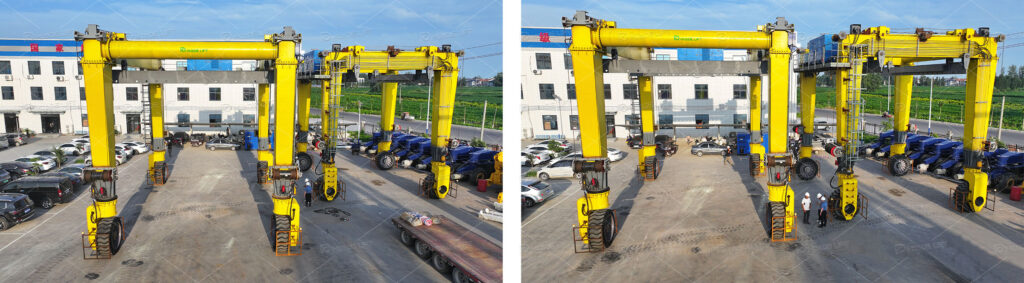
A straddle carrier is a mobile lifting equipment that relies on a portal steel structure for support and solid rubber tires for movement. The 100-ton specification falls under the category of large-tonnage industrial models, specifically designed for the transfer of heavy and large-sized materials.
Compared to traditional rail-mounted gantry cranes, its greatest advantage is that it does not require the laying of fixed tracks. The straddle carrier can freely move, turn on the spot, and precisely align in a hardened and flat site, with the operation range not being restricted by fixed tracks.
For factory areas and storage yards where the operation area is scattered, the site is not fixed, and the operation position needs to be frequently adjusted, this equipment’s flexibility and adaptability far exceed those of traditional rail-mounted gantry crane.
The Application Scenarios of Straddle Carriers
The straddle carriers are suitable for various heavy-duty operation scenarios due to their stable large-capacity capacity. In precast yards, they are mainly used for stacking and transferring prefabricated components, effectively improving the utilization rate of the storage yard.
In industrial manufacturing sites, straddle carriers can complete the loading and unloading, as well as the parallel transportation of large machines, molds, and steel structures. In steel storage bases, they are mostly used for stacking and transporting heavy steel plates, steel coils, and profiles, and are the core equipment for the turnover of heavy materials.
In addition, the straddle carriers are frequently used in wind power equipment sites, large-scale infrastructure projects, and construction machinery storage yards to meet the needs of short-distance and precise transfer of large equipment.
The Core Composition Structure of Straddle Carriers
The entire straddle carrier operates through the collaboration of seven core systems to ensure operational stability. The portal main steel structure is the load-bearing framework of the entire machine, directly determining the structural strength and service life of the equipment, and bearing all the operational loads.
The lifting and hoisting mechanism is responsible for the lifting and lowering of goods, and is the core working component; the walking drive system provides the mobile power, ensuring the smooth movement of the straddle carrier; the steering system controls the accuracy of the position, suitable for operations in narrow sites.
The electrical control system is the core of the equipment’s control, responsible for command transmission, execution, and fault warning; the hydraulic system provides power for lifting and steering actions; multiple safety protection devices are responsible for overload protection, limit braking, and avoiding operational safety risks.
The Significance of Factory Acceptance Test (FAT)
Unified Standardized Acceptance Criteria
There are significant differences in production processes, quality inspection standards, and commissioning procedures among different straddle carrier manufacturers. Without a unified FAT acceptance specification, equipment acceptance is entirely based on the manufacturers’ own judgment, which can easily lead to lax standards and the passing of defective equipment.
Standardized FAT acceptance strictly follows industry special equipment specifications, both parties’ contracts, and technical terms. From the appearance structure, component configuration to working condition tests and safety functions, each item has clear judgment standards, eliminating subjective and arbitrary acceptance.
Retain the Original Operation Data of the Straddle Carrier Before Factory Delivery
The FAT acceptance will fully record the core original data of the straddle carrier at the time of factory delivery, including lifting speed, walking speed, system working pressure, operating current, limit response parameters and other key information under different working conditions.
When the straddle carrier shows performance degradation or abnormal operation in the long term, maintenance personnel can compare the original factory data to quickly identify deviations, locate the faulty system, and determine the degree of equipment wear and tear, significantly improving maintenance efficiency and reducing maintenance difficulty.
Control the Final Quality of Equipment Delivery
Factory acceptance is the last quality checkpoint before equipment shipment and is the only opportunity for the purchaser to fully control and verify the equipment performance throughout the process. Once the straddle carrier is shipped out, the subsequent rectification, return, and debugging processes will become extremely cumbersome.
Passing the FAT (Factory Acceptance Test) inspection enables us to identify and rectify non-conforming items, address minor defects, and complete the missing documentation in advance. This ensures that the equipment on-site is in good condition, laying a solid foundation for subsequent on-site installation and acceptance, as well as long-term stable operation.
The Structural Framework of Factory Acceptance Report
Basic Information Registration
This is the preliminary content of the report, mainly used for later archiving and traceability. It records detailed information such as equipment model, rated lifting capacity, factory serial number, manufacturer, contract number, acceptance date, acceptance location, etc., as the core information.
At the same time, it will clearly define the core basis of this acceptance, including industry special equipment inspection standards, purchase contracts, technical agreements, equipment design drawings, etc., to ensure that the acceptance process is legal, compliant, and based on evidence.
Appearance and Steel Structure Verification
The focus is on checking the equipment appearance process and the quality of the steel structure, with the core being to detect welding defects. Check one by one whether there are problems such as pores, slag inclusions, incomplete penetration, cracks in the weld seams, and verify the welding seam grinding, anti-corrosion coating process to meet the standards.
In addition, it will also check the bolt tightening status, component alignment accuracy, tire condition, installation of protective guardrails, and check for any structural minor deformations. All flaws will be photographed and recorded, marking the location and severity of the problem.
Core Component Configuration Verification
This is mainly used to prevent the manufacturer from replacing low-quality components and reducing configuration standards. Check the brand, model, and parameters of the hoist, motor, hydraulic pump, control valve, electrical components, reducer, tire, etc., of the core components item by item.
At the same time, verify the material of the components, the list of supporting accessories, register the factory serial number and product certificate of the core components, to ensure that all configurations are completely consistent with the contract agreement, without private replacement or reduction of components.
Whole Machine Operating Condition Performance Test
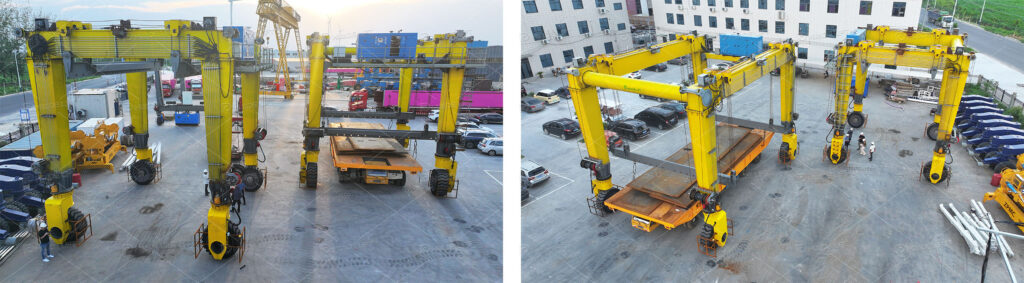
This is the core content of the FAT report, fully recording the operating data of the straddle carrier under all operating conditions. The test includes four core items: no-load operation, half-load operation, full-load rated condition, and short-term overload testing, covering all daily operation scenarios.
Record the running status of the straddle carrier during lifting, lowering, moving, and turning, test the system pressure, working current, operating noise, and equipment jitter, verify the stability and accuracy of the entire machine operation, and register and archive all data one by one.
Safety Protection Function Test
Safety devices are the top priority in the acceptance of large-tonnage lifting equipment. Focus on testing all safety functions such as lift height limit, walking limit, overload protection, torque limiter, emergency braking, fault alarm, hydraulic self-locking, etc.
Verify the triggering accuracy, response speed, and braking effect of each type of protection device to ensure that the straddle carrier can stop, power off, and lock in time in abnormal conditions, and prevent safety risks such as falling objects and overturning.
Problem Rectification and Acceptance Conclusion
Summarize all the problems found during the acceptance process, register them by category as minor flaws, general defects, and major hazards, clearly define the rectification standards, completion time, and responsible person for each problem, and recheck and close-loop after rectification.
Based on all verification, testing, and rectification results, issue the final acceptance conclusion, clearly indicating whether the straddle carrier is qualified for factory delivery. Finally, the acceptance personnel from both the supplier and the demander sign and stamp to confirm the effectiveness of the acceptance result, and officially archive and retain it.
Common Issues in Factory Acceptance Test (FAT)
Steel Structure and Appearance Process Defects
Welding issues are the frequent defects during acceptance. When manufacturers rush to complete the project, problems such as porosity, incomplete penetration, weld bulges, and slag inclusion in the weld seams are prone to occur. These problems do not affect the equipment operation initially, but long-term heavy-load operation can lead to weld cracking, causing structural safety hazards.
Inconsistent painting quality is also very common. Some areas have paint leakage, insufficient thickness, and run-off problems. Even some manufacturers use thick paint to cover welding defects. Later, the paint peeling will accelerate the rusting of the steel structure and shorten the equipment’s service life. At the same time, problems such as loose bolts, uneven tightening, and lack of anti-loosening treatment are also quite common.
Abnormal Operation of the Hydraulic System
Hydraulic faults are mostly exposed during load testing. The most common problem is micro-leakage and dripping of oil at the pipe joint. This is mainly caused by installation alignment deviations of the pipeline, insufficient tightening force, and substandard quality of sealing components. The problem is difficult to be detected in the no-load state, but the hidden danger will immediately become apparent when under full-load pressure.
In addition, unstable hydraulic pressure, sluggish lifting, and cargo shaking are also common problems. Some equipment also has the problem of rapid temperature rise of hydraulic oil and incomplete pressure relief. Long-term operation will cause insufficient power and malfunction of the straddle carrier.
Electrical Control and Wiring Defects
Electrical system problems mainly concentrate on the layout of the circuits and parameter debugging. Some equipment has messy wiring and loose cable fixation. After the straddle carrier moves and vibrates, faults such as circuit wear, loose connection, and short circuit are prone to occur.
Inadequate control system debugging is also very common. Delayed triggering of limit switches, insufficient sensitivity of overload alarms, and delayed response of operation instructions will directly affect the safety and accuracy of the operation. Some equipment also has problems of poor grounding and lack of circuit protection.
Insufficient Performance of the Walking and Lifting Systems
Insufficient equipment debugging will lead to equipment walking deviation, turning jamming, inconsistent walking speeds on the left and right, and greatly increase the difficulty of alignment in narrow spaces. Under heavy-load conditions, the equipment chassis shakes severely, and the walking stability cannot meet the operation requirements.
Common problems of the lifting system include unsatisfactory lifting speed, inconsistent lifting actions, insufficient lifting force for heavy loads, abnormal noise during full-load lifting, and power loss, which do not meet the performance standards stipulated in the contract.
Deviation in the Function of Safety Devices
Safety devices are the weak link in acceptance. Many equipment’s torque limiters have data deviations and inaccurate overload warning thresholds, failing to provide effective overload protection. Limit switches do not trigger promptly, and the travel range is too large, easily causing risks of equipment over-travel.
Slow emergency braking response, long braking distance, insufficient sensitivity of fault alarm function, inability to automatically warn of minor faults, and difficulty for operators to promptly detect potential hazards, easily leading to safety accidents.
Tips for Avoiding Pitfalls in Factory Acceptance Test (FAT)
Prioritize the Formulation of Acceptance Criteria
Before the acceptance, do not directly follow the manufacturer’s procedures for testing. Instead, review the purchase contract, technical agreement, and industry norms, and compile a checklist covering four dimensions: parameters, configuration, performance, and security.
Clarify the operational conditions and qualified thresholds for each test, and refuse for the manufacturer to substitute customized standards with general standards. All customized parameters must be cross-checked in writing. Any verbal commitments must not be accepted.
Participate in the Entire Factory Acceptance Process
Many manufacturers will complete all tests on their own and directly issue a qualified report, allowing the purchasing party to sign it directly. This acceptance method completely fails to detect potential hazards. The acceptance personnel must be present throughout the process and follow each test procedure.
Witness all no-load, load, and safety tests in person, verify the original data on-site, and do not directly accept the pre-prepared test reports from the manufacturer. Immediately stop the test if any abnormalities are found and require the manufacturer to investigate and rectify.
Attach Importance to Minor Flaws and Achieve Problem Closure
Many people overlook paint surface flaws, slight abnormal sounds, messy wiring, and minor deviations in limit positions, considering them not affecting the core use. However, minor hazards in heavy equipment will continuously expand over time and eventually evolve into major failures.
All problems discovered during the acceptance process, regardless of size, must be uniformly registered, subject to a deadline for rectification, and re-examined for confirmation. Try to complete all problem rectifications before leaving the factory. Compared to on-site disassembly and repair, on-site rectification within the factory incurs lower costs and shorter time consumption.
Retain Acceptance Documents for Traceability and Archiving
After the acceptance is completed, in addition to the formal acceptance report, also retain the original test data, on-site test videos, comparison photos before and after problem rectification, core component certificates, equipment drawings, operation manuals, and other materials.
All materials should be uniformly archived and backed up. Subsequent equipment operation, fault troubleshooting, quality assurance and protection, and on-site SAT acceptance can all be retrieved at any time to avoid disputes caused by missing documents.
Assign Professional Personnel to Conduct Equipment Acceptance
FAT acceptance is highly specialized, and non-professionals have difficulty identifying hidden defects and parameter deviations. Prioritize the arrival of technical or operation personnel familiar with lifting equipment and the on-site conditions for on-site acceptance.
If there are no corresponding professional personnel within the organization, the third-party special equipment inspection personnel can be entrusted to participate in the acceptance to ensure the professionalism and accuracy of the acceptance results.
From FAT to SAT: Acceptance is not the end
Many purchasers have misconceptions that once the FAT (Factory Acceptance Test) is passed, the equipment will be able to operate stably for a long time and no further verification is necessary. In fact, the FAT acceptance test is only the first checkpoint in the quality control of the equipment, and it is by no means the final-destination.
The FAT acceptance test is conducted in the factory’s standard site and under controllable working conditions, with stable environmental conditions. However, after the straddle carrier arrives at the site, there are certain differences in the flatness of the foundation, power supply environment, and working conditions compared to the factory test environment.
The vibration and jolting during the long-distance transportation of the straddle carrier may cause bolts to loosen, lines to shift, and components to misalign, generating new minor hazards. Therefore, after the straddle carrier is installed and debugged at the site, a SAT (Site Acceptance Test) on-site acceptance test must be carried out.
The SAT acceptance test combines the real operation site and actual working conditions to re-verify the equipment’s operating performance, safety functions, and site compatibility, and to identify any new problems caused by transportation and installation. Only when both the FAT and SAT acceptance tests are qualified can the straddle carrier be officially put into regular operation.
In simple terms, the FAT ensures the quality bottom line of the straddle carrier at the factory, while the SAT verifies the equipment’s adaptability at the site. The two acceptance tests work together to ensure that the straddle carrier can operate safely and stably for a long time.
Conclusion
The FAT (Factory Acceptance Test) inspection of the 100t straddle carrier is a crucial process in the delivery phase of heavy equipment, directly determining the quality of equipment delivery, the stability of subsequent operation, and the maintenance and operation costs. Unlike the simple acceptance of small equipment, the core of the acceptance of large-tonnage straddle carriers lies in verifying customized parameters, identifying hidden risks, determining quality assurance responsibilities, and retaining original operation data.
During the acceptance process, the five key areas for verification are the steel structure technology, hydraulic system, electrical circuits, walking and lifting performance, and safety devices. These are also the areas with high failure rates. Controlling the acceptance standards, witnessing the tests throughout the process, closing the loop to rectify problems, and fully retaining the relevant documents are the key to avoiding acceptance loopholes.
At the same time, it should be clearly understood that the factory acceptance is only the starting point of equipment quality control. It is necessary to combine with on-site SAT (Site Acceptance Test) acceptance to complete the full process of quality verification. Paying attention to every detail of the acceptance can ensure that the high-value heavy straddle carriers maintain a stable operation state, helping enterprises reduce maintenance costs, avoid safety risks, and ensure operational efficiency.
