
Container straddle carriers are the core loading, unloading, and transshipment equipment for container yards, inland logistics parks, and rail intermodal terminals. The appropriateness of equipment selection directly determines site operational efficiency, long-term operating costs, and production safety. When selecting equipment, many users focus only on superficial parameters such as rated tonnage and basic configurations, while neglecting suitability for actual operating conditions. This ultimately leads to wasted costs and frequent equipment failures.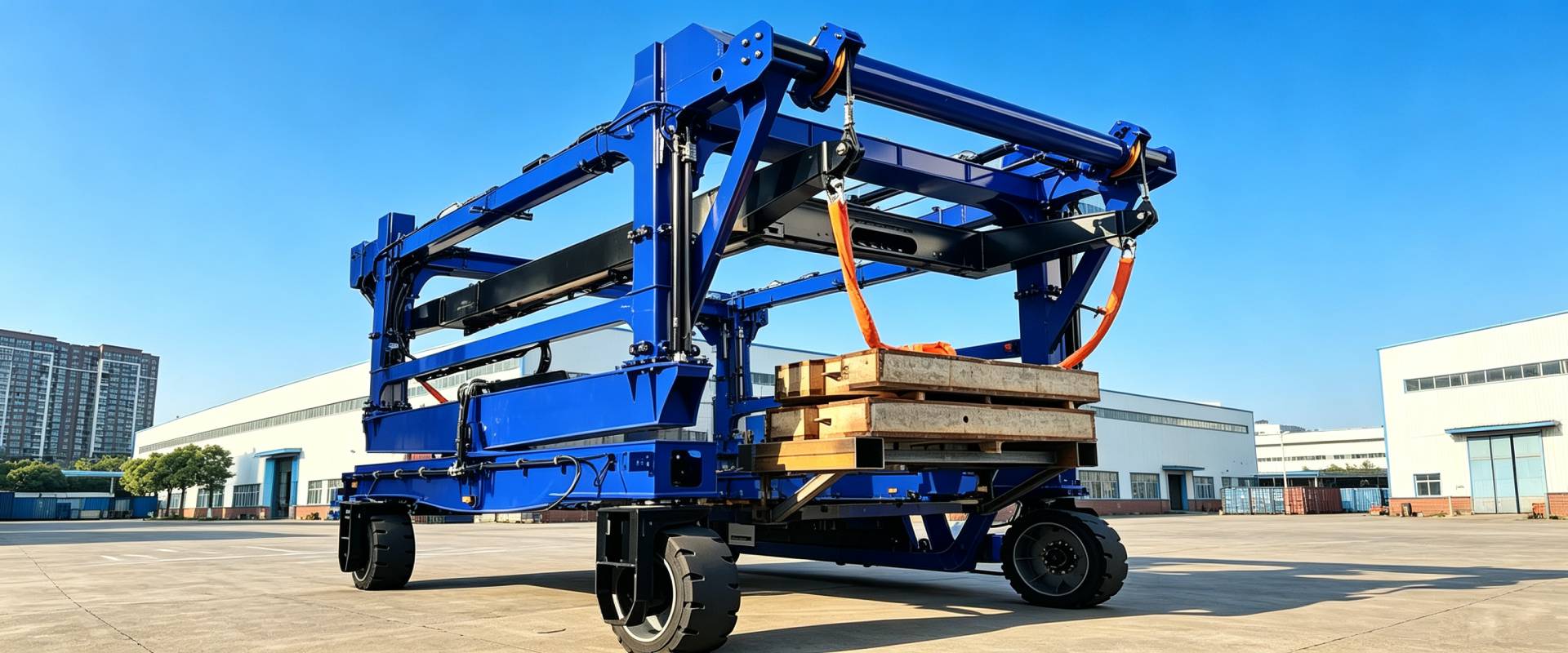
Choosing Container Straddle Carrier Capacity
Consider Actual Total Load
When determining whether a container straddle carrier is sufficient for a given application, one cannot rely solely on the rated lifting capacity specified by the manufacturer. The actual maximum total load at the job site is the key factor in selecting the appropriate capacity.
The total load consists of multiple components. In addition to the weight of the cargo itself, the weight of lifting gear, slings, lifting frames, and specialized clamps must also be accounted for. At the same time, a reasonable safety margin must be factored in to accommodate the variable operating conditions on-site. The equipment’s rated tonnage represents only the rated lifting capacity of the bare machine. Once various accessories are added, the actual effective load-bearing capacity is significantly reduced—this is a critical factor that must be prioritized during the selection process.
Matching Capacity to Application Scenarios
Container straddle carriers of different tonnages are designed for entirely distinct operational scenarios. Selecting the appropriate model based on specific needs is essential to balance operational efficiency and operating costs.
The 30–40 ton models are the mainstay of the light-duty lineup, suitable for routine light-duty container handling. These compact and agile equipments are ideal for short-distance transfers at small yards, indoor operations in enclosed environments, and the handling of routine cargo under stable conditions with uniform loads. They are highly suitable for small and medium-sized logistics yards.
The 60–70 ton models offer broader adaptability to various operating conditions and are classified as general-purpose heavy-duty models. They can handle the movement of heavy standard containers, precast components, steel structures, and other heavy loads, as well as mixed operations involving cargo of varying sizes and weights. Most complex transshipment operations at industrial yards can be completed using this tonnage class.
High-capacity models of 80 ton and above are primarily designed for specialized heavy-load scenarios. Whenever dealing with oversized cargo, high-frequency continuous operations, or complex conditions such as uneven ground or high operational resistance, professional operational assessments must be conducted to ensure that a high-capacity container straddle carrier is selected to guarantee operational stability and equipment service life.
Key Factors in Capacity Selection
Verify the actual total load by fully accounting for the weights of the cargo, lifting attachments, and accessories, along with safety margins, to ensure the equipment’s rated load capacity exceeds the maximum total operational load on-site.
Check the cargo’s external dimensions. Oversized, excessively tall, or off-center cargo—even if the overall weight is not high—can alter the equipment’s load-bearing conditions. In such scenarios, models with greater stability must be selected. Selection should not rely solely on weight parameters.
Verify the operational cycle. High-frequency, non-stop continuous operations place higher demands on the equipment’s structural strength, hydraulic system stability, braking performance, and tire wear resistance, requiring targeted configuration upgrades to accommodate the wear and tear associated with high-frequency operations.
Assess future expansion needs. If the yard plans to expand its range of cargo types or increase heavy-load operations, the selection process should allow for a certain tonnage margin and space for adapting the yard layout to avoid having to replace the equipment prematurely.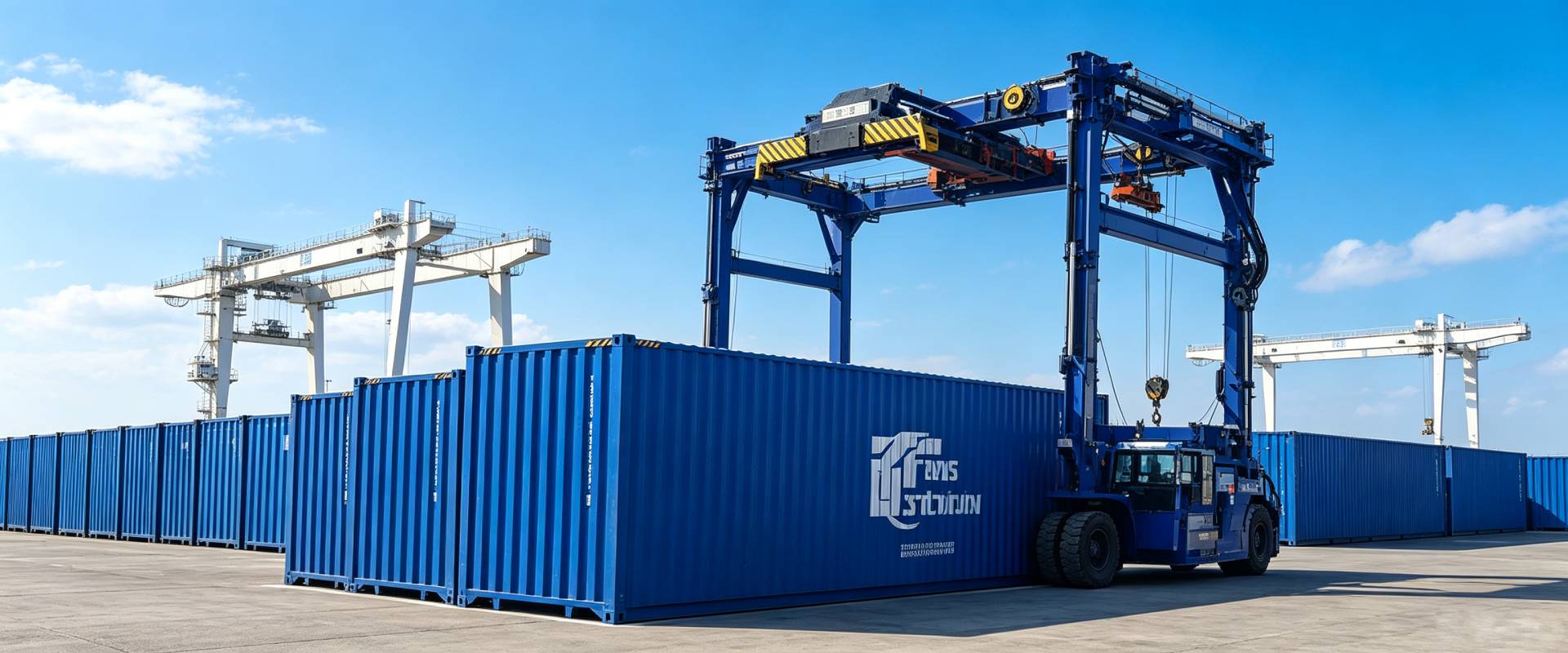
Power Options for Container Straddle Carrier
The powertrain determines a container straddle carrier’s operational range, environmental adaptability, operating costs, and environmental compliance—making it the second most critical parameter in the selection process, after load capacity. Container straddle carriers are available in three powertrain types: diesel, hybrid, and all-electric. None of these options is inherently superior. They are simply suited to different operational scenarios and business needs.
Diesel Container Straddle Carriers
Diesel models are the traditional type with the longest history of industry application and the widest adaptability. Their core advantage lies in their strong power stability. The equipment delivers ample power output and maintains stable performance during start-up, heavy-load operation, and hill climbing.
The operating range of these models is not limited by site infrastructure. With a full tank of fuel, they can operate continuously for extended periods, making them fully suited for the all-weather, high-intensity, and uninterrupted operational modes of container yards. Additionally, the equipment has minimal operational environment requirements and can operate normally in outdoor conditions ranging from high to low temperatures, as well as in rain, snow, and dusty environments.
Hybrid Container Straddle Carrier
The hybrid model employs a combined powertrain consisting of a diesel engine paired with an electric motor and battery, serving as the preferred solution for transitioning from traditional diesel models to all-electric models. During operation, the equipment utilizes an energy recovery system to store and utilize energy generated during braking and deceleration, effectively reducing energy consumption.
Compared to pure diesel models, hybrid container straddle carriers significantly reduce fuel consumption and exhaust emissions, while also producing noticeably less noise, thereby meeting the environmental protection requirements of most yards. At the same time, the vehicle’s range is comparable to that of diesel models, avoiding the limited range associated with all-electric models, and ensuring that operational stability and continuous operation remain unaffected.
All-Electric Container Straddle Carrier
All-electric container straddle carriers are a core component of modern, green, and smart container yards, with zero emissions and low noise levels as their key advantages. They produce no exhaust pollution during operation and generate extremely low noise levels, fully complying with stringent environmental protection standards.
The equipment features a simple mechanical structure with fewer wear-prone parts, making daily maintenance and operations straightforward. Long-term electricity costs are significantly lower than diesel fuel costs, resulting in a higher cost-effectiveness ratio over the entire lifecycle. Additionally, they are compatible with automated operation systems, aligning with the unmanned and standardized operational models of smart terminals.
Control System of Container Straddle Carrier
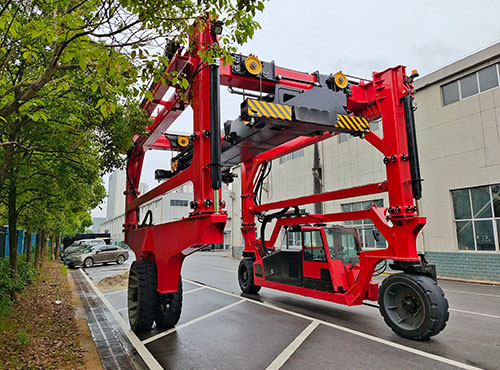
Control systems directly impact equipment operational precision, operational safety, and the physical strain on workers. Many users blindly pursue fully automated systems, only to find that—due to substandard worksites or inadequate maintenance—equipment capabilities remain underutilized, resulting in extremely poor cost-effectiveness. Huadelift’s container straddle carrier control modes can be precisely tailored to specific operational scenarios.
Basic Characteristics of Control Systems
Manual button control features a simple structure and low failure rate. It supports only basic start, stop, lifting, and travel operations, offering limited functionality and is suitable for simple, low-frequency operations.
Crane control via the in-cab control panel offers moderate precision and is suitable for routine, orderly container handling operations. It serves as the standard control method for traditional container yards.
The advantage of wireless remote control is its high flexibility. Operators can step out of the cab to observe cargo conditions up close, making it suitable for scenarios with limited visibility, off-center cargo, or situations requiring real-time monitoring of the lifting process.
Cab-based control offers greater comfort and is suited for prolonged, long-distance, and continuous outdoor operations. It reduces operator workload and is ideal for routine operations in high-frequency, large-scale yards.
Semi-automatic control systems feature positioning assistance, precise alignment, and safety limit functions. They reduce human operational errors, improve lifting and positioning accuracy, and lower the error rate.
Fully automatic navigation systems rely on sensors and route planning systems to achieve unmanned, automated transshipment and stacking operations, making them suitable for standardized, high-throughput, well-organized yards.
Control Solutions for Different Scenarios
For short-distance, simple, and infrequent operations, complex control systems are unnecessary. Manual control or basic wireless remote control fully meets these needs. Over-configuring automation features would only increase procurement and maintenance costs.
For high-frequency routine yard operations, prioritize cab-based control paired with a semi-automatic assistance system. Prolonged manual driving offers greater comfort, while positioning assistance enhances operational efficiency, making it suitable for the high-volume, standardized handling of containers.
For long-distance, cross-zone transport operations, cab-based control paired with route-assistance systems is recommended. Given the long travel distances and wide operational range, cab-based operation reduces operator fatigue and ensures operational stability during extended shifts.
For operations in confined spaces with limited visibility, prioritize wireless remote control. Operators can flexibly adjust their position to observe cargo and site obstacles from all angles, thereby avoiding safety risks caused by blind spots.
Spreader Options for Container Straddle Carriers
The spreader is the core component connecting the container straddle carrier to the cargo. Its specifications and performance directly determine the equipment’s cargo compatibility range and lifting safety. Improper spreader selection can lead to issues such as inaccurate container alignment, uneven force distribution on non-standard cargo, and inability to accommodate multiple cargo sizes, severely impacting operational efficiency.
Key Considerations for Selecting Spreaders
Standard telescopic spreaders are the mainstream standard-equipment accessories. They typically support telescopic adjustment for 20- to 40-foot standard ISO containers and are suitable for the vast majority of standard container handling scenarios.
Some yards handle the transshipment of 45-foot containers. When selecting container straddle carrier, one must not assume that standard spreaders support extension to accommodate 45-foot containers. It is necessary to separately verify the lifting device’s extension range, locking point positions, and load-bearing parameters to ensure compatibility with 45-foot container operations and avoid compatibility issues.
Additionally, check the locking precision and cushioning mechanisms of the lifting device. For yards with long-term, high-frequency operations, prioritize reinforced telescopic lifting devices that are wear-resistant and resistant to deformation to minimize malfunctions such as locking jams and positioning deviations.
Dual-Container Lift Requirements
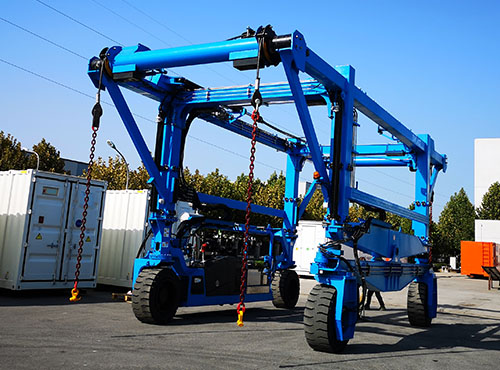
Dual-lifting devices support the simultaneous lifting of two 20-foot containers, significantly increasing yard throughput. They are suitable for high-frequency terminals where 20-foot containers are the primary cargo and handling volumes are extremely high.
Dual-container lifting imposes two mandatory requirements on the equipment. Dual-slings cannot be installed arbitrarily. First, the equipment must have sufficient load capacity to accommodate the combined load of two fully loaded containers while maintaining an adequate safety margin. Second, the frame’s clearance dimensions must meet standards. The internal span and height of the equipment’s frame must accommodate the space required for two containers placed side by side to prevent collisions or limit switch issues during the lifting process.
When selecting equipment, users must verify the overall specifications in advance to ensure that the load capacity and frame dimensions are compatible with the dual-container lifting configuration, thereby avoiding performance degradation caused by retrofitting at a later stage.
Selection for Non-container Applications
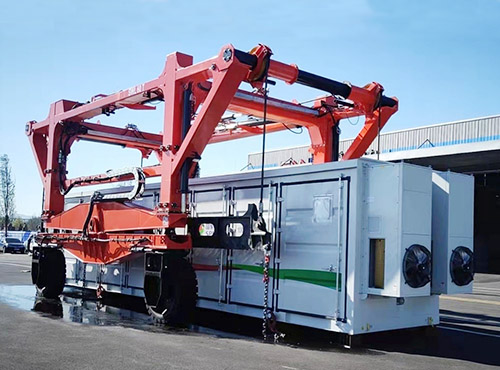
In addition to standard containers, many facilities need to handle non-standard cargo such as energy storage containers, and industrial modules. These cargoes have irregular shapes and offset centers of gravity, resulting in asymmetric loads during lifting.
Conventional standard lifting devices are designed only for standard containers with symmetric loads and cannot compensate for the eccentric loads of non-standard cargoes. Long-term use can lead to deformation of the lifting device and uneven stress distribution on the equipment, creating safety hazards.
For non-standard lifting scenarios, Huadelift offers custom-designed lifting devices and workholding fixtures. The customization process takes into account the cargo’s dimensions, center of gravity, weight, and load angles to optimize the lifting device’s structure and balance asymmetric loads. At the same time, the design is tailored to match the parameters of the lifting system to ensure the stability and safety of lifting operations.
Matching Container Straddle Carrier With Workplace
Container straddle carriers with identical configurations can perform very differently depending on the site. Selecting the right model based on the site’s operational patterns, transfer routes, and site conditions is essential to maximize equipment performance.
Inland Logistics and Intermodal Yards
The key characteristic of inland logistics parks and intermodal terminals is their complex transfer routes, which require coordination across multiple operational scenarios, including trucks, warehousing areas, and transfer stations. With a mix of cargo sizes and moderate operational frequency, the equipment must balance flexibility and versatility.
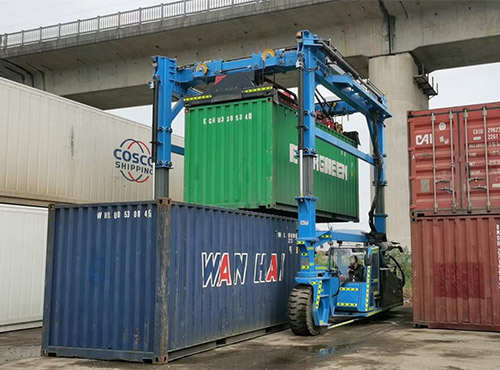
Such facilities do not require multiple specialized pieces of equipment. Instead, priority should be given to 30–70 ton general-purpose container straddle carriers equipped with standard telescopic lifting attachments and dual-control modes. This container straddle carrier can independently handle the entire process—from loading and unloading to transshipment and stacking—and is compatible with multi-equipment coordination scenarios, thereby reducing facility equipment costs.
Rail-Connected Container Yards
The core operations of railway container transfer yards involve high-frequency repositioning and cross-regional transport, requiring frequent switching between work areas—such as train loading and unloading points, truck transfer points, and temporary cargo storage zones—with frequent changes in yard zoning.
Equipment selection prioritizes maneuverability and flexibility, favoring models with lightweight bodies, agile steering, and rapid travel response. For powertrains, hybrid or diesel models can be selected based on environmental requirements to ensure continuous operation and accommodate the high-intensity, frequent-shifting workflow of railway yards.
Industrial Container Handling Projects
Industrial applications primarily involve the transshipment of specialized cargo such as energy storage containers, prefabricated equipment modules, and large industrial enclosures. These cargoes feature unusual dimensions, heavy loads, and irregular centers of gravity, requiring handling capabilities far exceeding those needed for standard containers.
There is no one-size-fits-all selection template for these scenarios. Customized selection is required based on specific cargo parameters, lifting heights, site and road conditions, transport distances, and operational frequency. By matching the appropriate load-capacity models, customizing non-standard lifting attachments, and adapting dedicated control modes, the safe transport requirements for special cargo can be met.
Large-Scale Project Sites
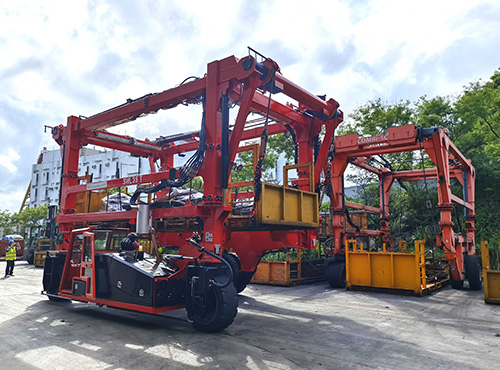
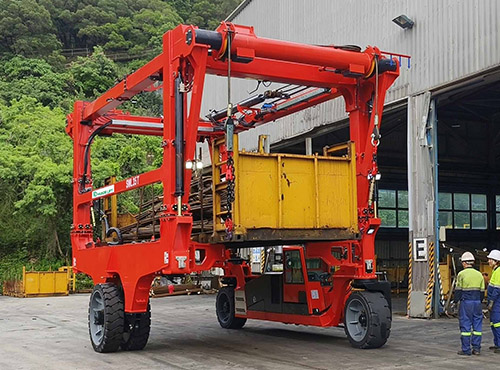
At mining, energy, and large-scale infrastructure project sites, there is often a need to transport oversized and heavy equipment modules and prefabricated components. These construction sites typically feature variable terrain and limited operating conditions, making traditional equipment poorly suited for such environments. Container straddle carriers, with their flexible, trackless operation, can efficiently handle the on-site transport of heavy modules, effectively optimizing material logistics and improving overall construction coordination efficiency.
Factors in Choosing Container Straddle Carrier Suppliers
Equipment specifications are only part of the selection process. A supplier’s service capabilities, spare parts system, and warranty policies directly determine the container straddle carrier’s operational and maintenance costs and uptime over the coming years. Only high-quality equipment paired with a comprehensive after-sales support system can ensure long-term, stable operations.
After-Sales Support and Spare Parts Pricing
The long-term operational and maintenance costs of container straddle carriers primarily stem from the replacement of wear-and-tear parts and routine maintenance. Tires, steel cables, hydraulic seals, and brake components are high-wear parts. Their purchase prices and delivery speeds directly impact operational progress.
When selecting a supplier, it is essential to request a quotation list for wear-and-tear parts in advance and compare the total lifecycle cost of spare parts. Huadelift has established a comprehensive spare parts warehouse with ample stock of core wear-and-tear parts, enabling a rapid response to replacement requests. Compared to manufacturers that rely on cross-border supply, this significantly shortens spare part lead times, reduces operation and maintenance costs, and prevents equipment downtime caused by parts shortages.
Local Service and Technician Availability
When selecting a manufacturer, it is crucial to verify the manufacturer’s capabilities and the availability of certified technical personnel. Huadelift is equipped with a professional, certified operation and maintenance team that provides on-site services such as repairs, troubleshooting, scheduled maintenance, and technical training. This ensures rapid resolution of operational issues and maintains high equipment uptime.
Warranty Terms and Performance Guarantees
The standard warranty period for container straddle carriers in the industry is 12 months, with the basic warranty covering only repairs for routine equipment failures.
Huadelift offers warranty services and, for sites with high-frequency, heavy-load operations, can provide performance-based maintenance agreements. These agreements use equipment uptime and operational stability as core performance metrics, delivering tailored maintenance support to minimize losses from equipment downtime caused by failures and adapt to high-intensity operating conditions.
Conclusion
Selecting a container straddle carrier is not simply a matter of matching specifications or choosing a tonnage. Rather, it is a systematic process that integrates operational loads, power requirements, control modes, lifting attachment configurations, operational scenarios, and after-sales support. By avoiding the misconception of selecting equipment based on a single parameter and instead focusing on actual operational needs and long-term operational planning, you can select the equipment with the highest compatibility and the best value for money.
