
Introduction
Marine travel lifts are core equipment for the daily operations of shipyards and docks, primarily responsible for critical tasks such as ship loading and unloading, maintenance and transport, and berth scheduling. The rationality of the equipment’s engineering design, operational stability, maneuverability and adaptability, long-term durability, and comprehensive safety features directly impact the overall operational pace of the dock, the safety of ship lifting operations, and the long-term operating costs of the facility.
How Marine Travel Lift Control Works
Gantry Structure
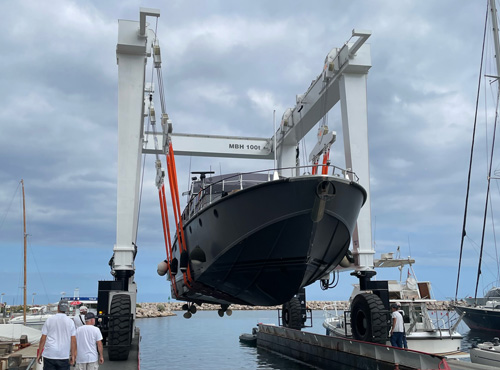
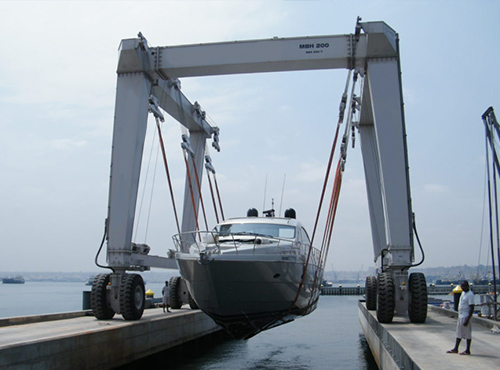
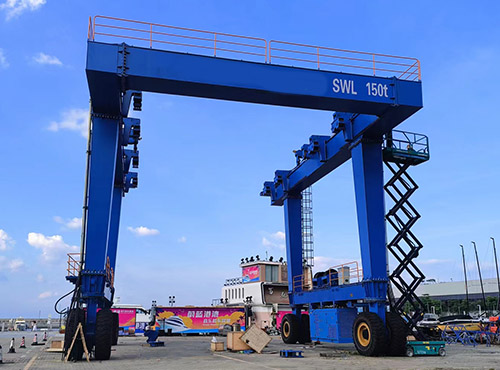
The gantry structure serves as the core load-bearing structure of a marine travel lift. The load capacity limit, structural rigidity and operational fault-tolerance space of the entire equipment are all determined by this framework. Marine travel lifts feature an integrated frame constructed from high-strength steel, ensuring structural strength from the ground up and adapting to the high-frequency, heavy-load operational scenarios typical of docks.
Power System
The power system provides the energy required for the entire operation cycle of hoisting, travel, and steering. Three different power systems—diesel, electric, and hybrid—are available to suit various operating conditions.
The diesel-powered version is suited for large shipyards and cargo terminals with heavy-duty, high-frequency operations. It delivers stable and abundant power output. During continuous lifting operations involving large-tonnage vessels, there is no power degradation. It does not rely on on-site power supply and is exceptionally well-suited for outdoor operations.
The electric-powered version emphasizes the advantages of low-noise and zero-emission operation, making it suitable for waterfront scenic areas and urban riverside docks. The machine operates quietly, causing no disturbance to the surrounding aquatic or on-site environments, and features relatively lower daily energy consumption costs.
The hybrid version can flexibly switch power modes according to the working environment. It relies on diesel power for heavy-load operations while using electric power for routine light-load tasks, striking a balance between operating costs and environmental compliance, making it suitable for comprehensive, multi-functional terminals.
Hydraulic Lifting System
The hydraulic lifting system is the core operational mechanism for vessel hoisting operations, determining the smoothness of the lift and the effectiveness of hull protection.
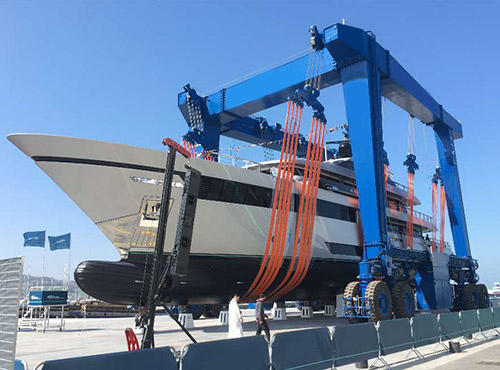
The entire lifting system consists of hydraulic cylinders, steel wire ropes, pulley blocks, and a lifting frame working in concert. The hydraulic system controls the lifting speed, while the steel wire ropes and pulley blocks distribute the load pressure, ensuring a uniform and smooth lifting process without sudden rises or drops.
Travel Control System
The travel control system determines marine travel lift’s adaptability to different sites and operational flexibility.
Straight-line mode is suitable for long-distance vessel transport and routine movement between berths, ensuring a smooth and stable travel path. Crab mode enables diagonal movement. At docks with densely packed berths and narrow passages, it allows the equipment to adjust its position without major turns, thereby avoiding surrounding equipment and berth obstacles. The in-place pivot mode features an extremely small turning radius, making it ideal for precise positioning in confined spaces.
When combined with the precision positioning mode, the equipment can perform millimeter-level fine adjustments even when fully loaded, meeting the high-precision operational requirements for ship launching, landing, and maintenance positioning, and resolving the issue of inaccurate positioning common in traditional lifting equipment.
Why Stability Matters in Marine Travel Lift
Load Distribution and Center of Gravity
Ships themselves are not symmetrical or uniformly loaded. The hull shape, internal equipment layout, and water and fuel storage levels of different ships all affect the overall center of gravity. This is the primary cause of safety hazards during dock lifting operations.
Operators can fine-tune the height and position of each sling based on the vessel’s actual dimensions and weight distribution, ensuring the total load is evenly distributed across the entire gantry frame. This operational approach mitigates various risks caused by shifts in the center of gravity.
Structural Design and Rigidity
The structural rigidity of the marine travel lift is the foundation for long-term stable operation.
The marine travel lift features a long-span structural design that provides a wider load-bearing coverage area. When lifting large-tonnage vessels, the load is evenly distributed across the entire frame and the traveling wheel system, preventing localized overloading.
Tire Configuration and Ground Contact
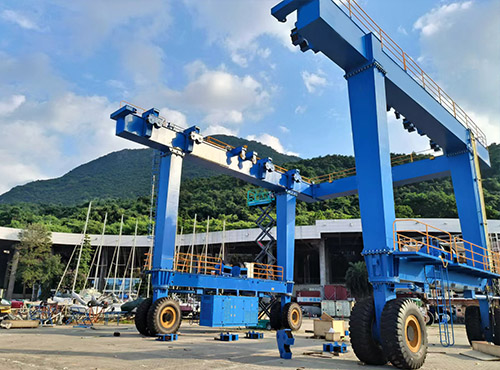
Unlike rail-mounted cranes, marine travel lifts rely entirely on tire contact with the ground to ensure stable operation. The condition of the tires directly determines the stability of the entire machine.
During operation, tire pressure across all four tires must remain balanced and consistent to ensure an equal load distribution across each set of tires, thereby preventing overloading or slippage on any single side. This also ensures that the tires maintain full contact with the ground at all times, eliminating situations where tires are suspended or only partially in contact with the ground.
Mobility Advantages of a Marine Travel Lift
Self-Propelled Movement
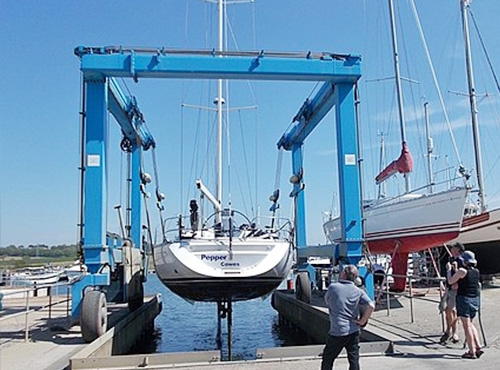
Marine travel lifts utilize a self-propelled structure, completely freeing them from the constraints of rails.
Marine travel lifts can move freely on compliant, paved surfaces within the dock area. After a vessel is lifted, there is no need for auxiliary transport equipment such as forklifts or trailers, so the vessel can be transported directly to maintenance areas, storage areas, or launching berths.
This integrated operation model simplifies workflows, reduces the cumbersome steps involved in coordinating equipment, and saves on infrastructure costs associated with track laying and foundation construction, making it suitable for both new terminals and retrofits of older facilities.
Flexible Steering Modes
Most terminals face challenges such as densely packed berths, narrow passageways, and limited operational space, making it difficult for conventional lifting equipment to achieve precise positioning.
The straight-line mode of marine travel lifts meets the need for smooth, long-distance transport. The equipment follows a regular path, making it suitable for routine operations in well-organized passageways. The crab-walk diagonal movement mode allows for lateral and diagonal fine-tuning of position without adjusting the marine travel lift’s orientation, making it ideal for scenarios with narrow gaps between berths.
The on-the-spot turning mode features an extremely small turning radius, allowing for easy U-turns and positioning even in compact, older terminals. This significantly improves space utilization, enabling efficient lifting and transport operations even in confined areas.
Faster Boat Launching and Retrieval
The marine travel lift integrates the full range of functions—lifting, travel, transport, and positioning—allowing the entire process of launching, transporting, and mooring a vessel to be completed in a single entry. The entire process requires no equipment handoffs, reducing waiting times between operations and minimizing operational risks.
For terminals with high passenger traffic and frequent vessel turnover, this integrated operation model can effectively increase daily throughput, reduce vessel waiting times, and improve overall terminal operational efficiency.
Adaptability to Different Boat Yard Layouts
Berth layouts, routes, and functional zones vary greatly across different terminals. Some expanded docks and special-shaped docks do not have regular operation channels, making fixed-track equipment virtually unusable.
Marine travel lifts are not restricted by fixed operating paths. Operators can flexibly adjust travel routes based on daily operational needs and site occupancy. Whether at a newly constructed, well-organized terminal or an older terminal with an irregular layout, the system can quickly adapt to operational requirements.
Reduced Infrastructure Requirements
Marine travel lifts have extremely low infrastructure requirements. As long as the surface consists of a reinforced concrete pavement or a hardened quay that meets standards, they can operate normally without the need for dedicated foundations or track facilities.
The equipment installation and commissioning cycle is short, allowing it to be put into use immediately upon arrival, significantly shortening the project’s time-to-production. At the same time, it eliminates routine maintenance tasks such as track maintenance, track alignment, and track derusting, effectively reducing the terminal’s long-term operating costs.
Durability in Marine Travel Lift Design
Structural Durability Design
Marine travel lifts are equipments subjected to high-frequency cyclic operations and must accommodate vessels of varying tonnages and sizes. Long-term operation can lead to structural wear and fatigue.
During the structural design phase of the marine travel lift, real-world terminal operating conditions were fully considered, and the overall force transmission logic was optimized to enhance the equipment’s resistance to off-center loads and lateral torsional forces. Even under typical operating conditions—such as frequent starts and stops, intermittent heavy loads, and eccentric lifting—structural deformation of the equipment is minimal.
Key load-bearing components have been reinforced to reduce component wear and structural fatigue caused by long-term repetitive operations. This lowers the frequency of equipment failures, extends the service life of the entire unit, and ensures equipment stability during high-frequency operations.
Material Selection and Corrosion Resistance
The water-adjacent operating environment at docks is unique. Seawater, salt fog, and humid moisture continuously erode the equipment’s metal structures. Ordinary steel is highly susceptible to rust, corrosion, and electrochemical degradation, which significantly shortens the equipment’s service life.
Huadelift specifically selects marine-grade aluminum for the core structure, paired with corrosion-resistant fasteners and specialized anti-corrosion components, to resist marine environmental erosion at the material level. The material itself possesses excellent rust resistance, aging resistance, and resistance to electrochemical corrosion.
This comprehensive anti-corrosion design effectively reduces equipment wear caused by salt fog and seawater splashes, minimizes the frequency of maintenance tasks such as rust removal, repainting, and component replacement, and ensures long-term, stable operation even under the harsh conditions of coastal and waterfront terminals.

Space Configuration Considerations
The durability of marine travel lifts depends not only on materials and structure but is also closely tied to site adaptability. If the equipment’s dimensions or operational range conflict with pedestrian walkways or berth layouts at the terminal, long-term operation is prone to scrapes and collisions, accelerating equipment wear and tear.
A well-planned operational layout not only ensures the safety of on-site personnel but also prevents frequent scrapes between the equipment and terminal structures or nearby vessels, thereby indirectly reducing equipment wear and tear and enhancing long-term operational stability.
Safety Built Into Marine Travel Lift
Overload Protection System
Overloading is the most common safety hazard in lifting operations and a leading cause of equipment damage and accidents. The marine travel lift is equipped with an overload protection system that monitors load data in real time throughout the entire lifting process.
When the lifting weight approaches the equipment’s rated load limit, the system automatically issues a warning prompt, alerting the operator to stop loading and verify the load. Once the rated load capacity is exceeded, the system immediately locks the hoisting mechanism and automatically shuts down the machine, preventing overloading.
Emergency Stop Button
The marina operating environment is complex, and emergencies such as personnel accidentally entering the work zone, sudden equipment malfunctions, or changes in a vessel’s attitude may occasionally occur, requiring rapid termination of operations to mitigate risks.
High-visibility emergency stop buttons are located at multiple key positions on the marine travel lift’s body. The buttons are clearly labeled and easy to operate, requiring no complex procedures. In the event of a sudden emergency, the operator can cut off all power to the operation with a single press, bringing the entire machine to an immediate halt and preventing the risk from escalating.
Redundant Braking System
The braking system is essential for ensuring the marine travel lift’s safe docking, positioning, and load stabilization. Unlike conventional single-brake configurations, the marine travel lift features a redundant braking design that provides dual protection.
During normal operations, the braking system ensures smooth docking and precise positioning, preventing the equipment from slipping. In the event of sudden power outages, power failures, or other exceptional circumstances, the braking system can still lock the equipment in place, firmly securing both the crane body and the vessel being lifted. This prevents slippage, collisions, and falls, significantly enhancing operational safety.
Limit Switches System
Excessive lifting heights or travel distances can easily cause the vessel to collide with dock canopies, guardrails, or shore-based facilities, resulting in damage to both the hull and the equipment.
The marine travel lift is equipped with dual-dimension travel limit switches that independently control lifting height and travel distance. When the equipment reaches preset safety limits, the system automatically halts the corresponding action, eliminating the risk of collisions caused by over-travel.
Limit parameters can be flexibly fine-tuned based on the marina’s dimensions and operational requirements to meet safety standards for different sites.
Audible and Visual Alarm System
Marinas are complex environments where personnel, equipment, and vessels operate simultaneously. During operations, it is essential to promptly alert nearby personnel to avoid hazardous areas.
When the marine travel lift starts up, lifts, moves, or turns to position itself, it simultaneously triggers audible and visual warning signals. These lights and sounds alert nearby staff to stay clear of the operational radius, thereby delineating a safe working zone.
These continuous warning signals effectively prevent safety incidents caused by personnel accidentally entering the work zone and help maintain orderly on-site operations.
Safety Interlock System
Many lifting safety incidents stem from improper operations, such as slings not being properly secured or lifting operations being initiated before personnel have evacuated the danger zone.
The marine travel lift is equipped with a safety interlock system that establishes multiple prerequisites for operation. The equipment can only initiate lifting, traveling, and other operational movements after the slings are precisely secured, the load is properly distributed, and personnel have evacuated to a safe area.
The system prevents non-compliant operations at the programmatic level, mitigates safety hazards caused by human error, and ensures that every lifting operation complies with safety standards.

Marine Travel Lift Selection
Boat Size and Weight
The marine travel lift’s load-bearing capacity is the core basis for selection. When selecting equipment, one should not simply match it to the tonnage of standard operational vessels. Instead, the selection must be based on the vessel with the largest tonnage and dimensions within the facility.
Consider the weight, hull width, and lifting height requirements of the largest vessel to match the corresponding rated load capacity and adjustable span of the equipment. At the same time, ensure sufficient safety margins to prevent accelerated equipment wear caused by long-term full-load operation.
Yard Layout
Differences in aisle width, turning radius, berth spacing, and available operating space vary significantly across terminals, directly determining the equipment’s maneuverability and adaptability.
For narrow berths and high-density terminals, prioritize models with multi-mode steering and a small turning radius to ensure flexible positioning. For shipyards with open spaces and large-tonnage vessels, select wide-span, heavy-duty models to increase the maximum load capacity per operation.
Before selection, conduct an on-site inspection of access routes, operational blind spots, and berthing areas to ensure the equipment can complete the entire workflow unimpeded once on-site.
Operational Frequency
Operational frequency directly impacts the rate of equipment wear and maintenance requirements. Suitable equipment configurations vary significantly between high-frequency and low-frequency operational scenarios.
Large shipyards, with high vessel throughput and a high average number of daily lifts, should prioritize highly durable models featuring reinforced structures, wear resistance, and low maintenance requirements to ensure long-term, stable, and uninterrupted operation.
Small private docks and low-frequency operation areas allow for the selection of cost-effective models while ensuring safety. This enables a balance between equipment performance and investment costs.
Environmental Conditions
Operating conditions at inland waterfront docks and coastal salt-fog docks differ significantly. Coastal sites pose a higher risk of corrosion and impose stricter requirements on equipment materials.
For coastal sites with high salt fog and humidity, prioritize models made of fully corrosion-resistant materials and equipped with corrosion-resistant components to enhance corrosion resistance and extend the equipment’s service life. For standard inland docks, conventional corrosion-resistant configurations are sufficient to meet basic operational needs.
Additionally, consider the site’s climate and road conditions to select the appropriate powertrain and tire configurations that are suited to the long-term operating environment.
Budget and Long-Term Costs
The selection of marine travel lifts should not focus solely on the initial purchase price. It must also comprehensively consider the total cost of ownership, including subsequent expenses such as energy consumption, maintenance, parts replacement, and depreciation.
Low-cost, low-specification equipment requires a lower initial investment but results in frequent maintenance, frequent breakdowns, and high energy consumption over the long term, which actually increases overall operating costs. High-specification, high-durability models require a slightly higher initial investment but feature low failure rates, low maintenance costs, and a long service life, offering better long-term value for money.
Huadelift can provide customized selection solutions based on customer budgets and actual operating conditions, balancing initial investment with long-term operating costs to meet the operational needs of terminals of various sizes.
Conclusion
The core value of marine travel lifts lies in their stable handling performance, flexible maneuverability, reliable durability, and comprehensive safety protection.
For shipyards and port operations, the selection of scientific equipment and the implementation of compliant engineering configurations are crucial for achieving safe production, reducing costs and increasing efficiency, as well as enhancing the operational capabilities of the sites. Huadelift focuses on the research and production of ship lifting equipment, developing solutions tailored to real-world conditions at various terminals. We provide exclusive, customized solutions based on different sites and operational requirements, ensuring the safety and success of marine lifting operations at terminals.
