
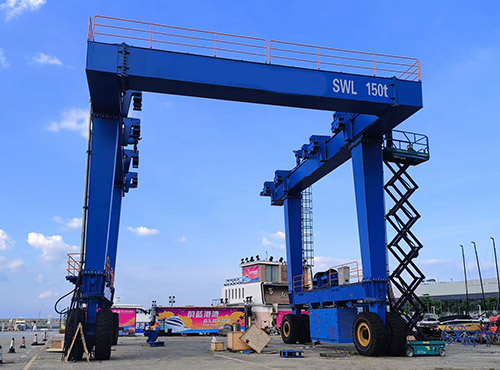
Marine travel lifts are integrated, specialized pieces of equipment designed for modern shipyard operations. They overcome the operational limitations of traditional fixed equipment, effectively resolving various practical challenges in shipyard operations and helping marinas and shipyards achieve standardized, low-cost, and high-throughput operations.
Workflow Optimization with Marine Travel Lift
Efficient Pre-Operation Launching Procedures
Marine travel lifts are equipped with a digital ship record database. Equipment operators can comprehensively record and archive the specific data for each partner vessel, including core information such as designated sling attachment points, ship center of gravity measurements, underwater attachment installation locations, and spreader beam adaptation parameters.
When the same model or the same vessel returns to the yard for subsequent operations, operators do not need to repeat surveys or debugging. They can directly retrieve archived parameters to complete equipment presets. All preparatory work can be completed before the vessel enters the lifting berth, truly achieving zero-delay preparatory operations and significantly shortening the launch preparation cycle.
Smooth Movement Saves Handling Time
Swaying of the hull during lifting and transfer is a key factor affecting operational efficiency.
The marine travel lift employs an integrated hydro-electric drive system equipped with soft-start and soft-stop mechanisms. The processes of starting, stopping, changing speed, and braking are all extremely smooth, effectively counteracting load sway during operations.
The hull remains stable throughout the entire process of lifting, transport, and lowering, significantly reducing the likelihood of positioning errors. When the vessel is lowered into the slipway slot, secondary adjustments are virtually unnecessary, effectively streamlining the operational process and reducing time spent on rework.
Accelerating Vessel Relocation Operations
Vessel return-to-yard and shore-based recovery operations are highly susceptible to marine environmental conditions.
Marine travel lift is equipped with standardized operating procedures that require operators to comprehensively verify on-site environmental data before positioning the equipment and initiating lifting operations. By adjusting the operation plan based on real-time tidal, wind, and current conditions, the system mitigates delays and operational risks caused by environmental factors, ensuring the vessel recovery operation is completed successfully on the first attempt.
In terms of operation, marine travel lift is equipped with an industrial-grade wireless remote control system, allowing a single operator to handle the entire process. This not only reduces labor coordination costs but also prevents operational errors caused by miscommunication among multiple personnel, significantly improving the overall efficiency of vessel positioning, lifting, and transport.
Streamlining Repetitive Handling Processes
Many shipyards lack fixed operational procedures, often resulting in repeated vessel repositioning and multiple lifting operations, which unnecessarily consume equipment operating hours and labor costs.
Leveraging the flexible operational characteristics of marine travel lifts, shipyards can establish standardized, one-way linear workflow routes. The fixed process is as follows: out-of-water lifting station → hull cleaning area → repair workshop or paint booth → dry storage area. The entire process is single-directional flow, without any intersections or return trips.

Marine Travel Lift Mobility in Vessel Handling
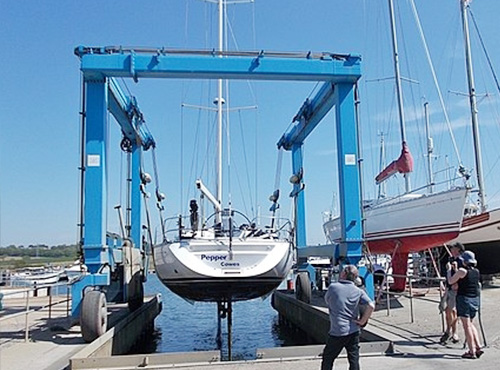
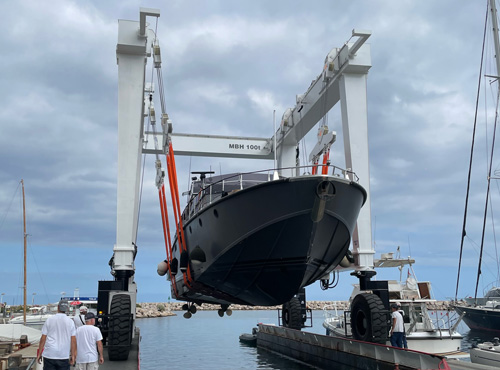
The marine travel lift features an integrated design that combines the two core functions of lifting and transport. The equipment is equipped with its own travel mechanism, eliminating the need for auxiliary equipment such as trailers or forklifts. After a vessel is lifted out of the water, it can be transported directly by the crane to cleaning, repair, and storage areas, completing the entire process in one stop.
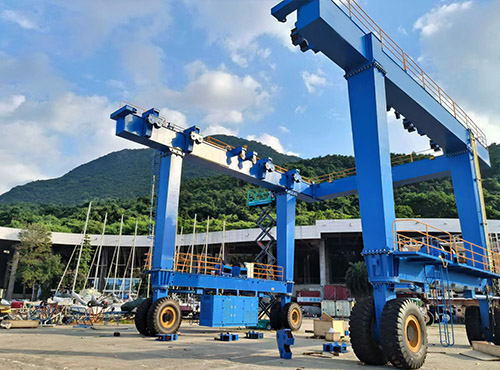
Equipped with heavy-duty rubber tires, a hydraulic drive system, a multi-mode steering mechanism, and a wide-span gantry frame, marine travel lift is perfectly suited for the uneven and complex layouts typical of shipyards and docks.
Self-Propelled Movement for Independent Operation
The marine travel lift features a fully automated self-propelled design, requiring no fixed tracks or external towing equipment, and can move freely throughout the entire facility. The equipment’s movement, steering, start and stop functions are fully autonomous and controllable, with an operational range covering the entire pier and yard, unrestricted by fixed infrastructure.
For older shipyards and compact piers, the equipment can be rapidly put into service without the need for site modifications or new infrastructure. This not only saves on capital investment for site renovations but also allows for flexible vessel scheduling, significantly reducing vessel transfer time.
Multi-Wheel Design for Stable Transportation
The marine travel lift features a dual-side, multi-wheel, evenly distributed layout that evenly disperses the combined weight of the vessel and the equipment onto the ground, effectively reducing ground pressure per unit area. It can ensure stable passage even on regular factory road surfaces and hardened dock floors, and is unlikely to encounter problems such as slipping, stalling or tilting.
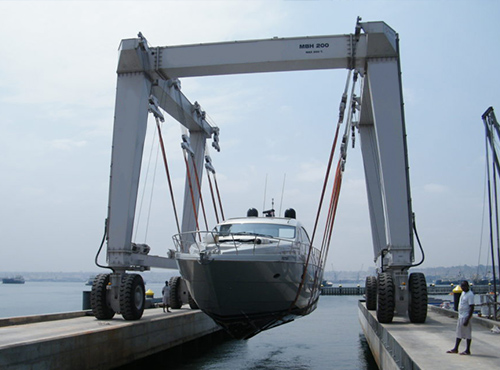
The multi-wheel load-bearing structure significantly enhances the safety and stability of operations. Even when transporting large yachts or commercial vessels weighing hundreds of metric tons, marine travel lift maintains smooth and fully controllable operation throughout the process, preventing hull swaying or equipment displacement, and ensuring continuous and efficient progress in heavy-load operations.
Flexible Steering Modes for Tight Maneuvering
The marine travel lift is equipped with a multi-mode intelligent steering system that allows for seamless switching between operating modes based on the work scenario, adapting to the demands of various complex work environments.
In straight traveling mode, all wheels are aligned to maintain a straight path, making it suitable for routine operations such as long-distance transport within shipyards and the transfer of vessels between land and water. This mode ensures efficient and orderly movement.
Crab steering mode allows all wheels to turn in the same direction, enabling the equipment to move sideways. This allows for precise alignment with warehouse shelves and maintenance workstations, solving the problem of difficult positioning in confined spaces and significantly improving the accuracy and efficiency of ship berthing and maintenance alignment.
In the carousel steering mode, the wheels on both sides of the vehicle rotate in opposite directions, enabling tight-radius turns in place without requiring a large turning radius. When operating in narrow aisles, along dock edges, or in compact factory areas, marine travel lifts can maneuver flexibly, completely eliminating operational blind spots and making it well-suited for high-density factory environments.
Improving Yard Capacity with a Marine Travel Lift
Maximizing Limited Space for Orderly Layouts
Insufficient shore-based operational space is the core issue limiting production capacity at most shipyards. Traditional fixed equipment has a fixed operational range, forcing vessels to be stacked around the equipment, resulting in a scattered and chaotic layout and severe waste of space. Consequently, the number of vessels that can be accommodated in a given area is extremely limited.
With the use of a marine travel lift, operators can flexibly reposition vessels within the yard, breaking free from the spatial constraints of fixed equipment. Vessels can be neatly arranged according to operational needs and storage cycles, eliminating the chaotic, scattered stacking patterns of the past.
This orderly and compact layout maximizes the use of idle space within the yard. Without increasing the existing site area, it significantly boosts the number of vessels that can be moored and stored, directly expanding the yard’s operational capacity.
Optimizing Yard Traffic Flow to Reduce Bottlenecks
A haphazard vessel stacking pattern easily leads to blockages in yard passageways, resulting in obstructed vessel entry and exit as well as scheduling difficulties. If a single vessel is positioned incorrectly, it can disrupt the workflow of an entire area, throwing the overall operational rhythm into disarray.
After the divisional planning of the marine travel lift, the ships in the factory are placed in an orderly manner and have clear divisions of labor. Each ship can independently complete operations such as water intake and outflow, hoisting, maintenance, and relocation, without any situations of mutual obstruction or blocked passageways.
Internal access routes and operational pathways within the facility are now much smoother, allowing for efficient equipment scheduling, vessel transfer, and personnel operations. This reduces operational delays at the site planning level and enhances the overall operational flow.
Maximizing Profitability in High-Density Facilities
The multi-dimensional steering, small-radius maneuvering and precise positioning of the marine travel lifts can perfectly adapt to high-density operation scenarios. Even when the ships are densely placed and the site space is limited, it can accurately complete the ship relocation, positioning and lifting operations.
Improved site utilization means the yard can accept more orders for vessel berthing, maintenance, and refit. Without the need for additional land or infrastructure expansion, this directly increases the yard’s order volume and overall revenue, helping shipyards reduce costs and improve efficiency.
Marine Travel Lift Design Supports Safer Vessel Movement
Multi-Point Load Monitoring System
Uneven stress distribution on the hull, uneven loading during lifting, and equipment overloading are the most common safety issues in shipyard operations. Manual visual assessment of stress conditions is highly prone to error, easily leading to hull deformation, structural damage, and equipment failure—resulting in operational shutdowns and rework.
Equipped with a multi-point load monitoring system, marine travel lift collects real-time load data from each lifting point and dynamically monitors the hull’s overall stress distribution. The system can accurately identify anomalies such as uneven stress distribution, shifts in the center of gravity, and localized overloads during the lifting process.
As soon as a safety hazard is detected, the equipment promptly issues a warning, allowing operators to immediately adjust the lifting configuration and avoid hazardous operations. This not only protects the ship’s structure from damage but also prevents equipment failures caused by overloading, thereby reducing safety incidents and losses resulting from rework and downtime.
Hydraulic Anti-Sway Control System
Factors such as equipment start-up and shutdown, ground vibrations, and wind interference can all cause a suspended ship to sway. When the hull sways significantly, it is highly prone to colliding with the dock, factory buildings, or surrounding equipment, resulting in hull damage and equipment displacement, which in turn leads to additional repair costs and project delays.
HuadeLift’s hydraulic anti-sway control system uses precise hydraulic power regulation to suppress hull sway in real time. It maintains a stable hull condition throughout the entire lifting and transfer process, significantly reducing the risk of collisions and displacement.
Stable handling ensures that each lifting and transfer operation meets standards on the first attempt, reducing the time spent on repositioning and troubleshooting, and guaranteeing that operations proceed efficiently, orderly and safely.
Emergency Stop Function
Ship lifting sites feature complex environments where unexpected situations—such as personnel accidentally entering the work area, unintended hull drift, or equipment component failures—frequently occur.
Emergency shutdown is a basic safety feature of the equipment, which is compatible with various emergency operation scenarios. In the event of any abnormality during operation, the operator can trigger the shutdown command with one click, and all the running mechanisms of the equipment will immediately be locked and braked.
The rapid braking mechanism can promptly curb the spread of risks, prevent minor hazards from escalating into safety accidents, and minimize various losses such as downtime, maintenance, and compensation caused by sudden problems, ensuring that the operation site is safe and controllable.
PLC-Programmed Safety Constraints
Human operational negligence and non-standardized operation procedures are the main causes of most operational errors and safety failures. The operational habits and proficiency of different operators vary, resulting in uneven operation quality. It is difficult to unify the operation standards.
Marine travel lift embeds standardized operating procedures and safety interlock logic into the PLC intelligent control system, with core operations—such as lifting, travel, and limit-switch braking—all controlled by the program. The system automatically prevents non-compliant operations, thereby avoiding operational errors caused by human negligence.

Advantages of Marine Travel Lift
High Site Adaptability
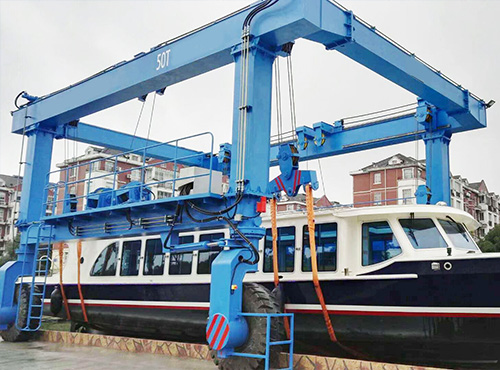
Equipped with a multi-wheel independent steering mechanism and a hydraulic travel system, marine travel lift offers greater adaptability to varying site conditions. Many older shipyards have uneven ground and passages of varying widths, making it difficult for conventional large-scale lifting equipment to access the site.
Marine travel lifts can maneuver and perform lifting operations within such complex environments, enabling ship hoisting and transfer operations in most shipyards without the need for large-scale ground hardening or renovation.
Heavy-duty Lifting Capacity
Marine travel lift’s carrying capacity can exceed several hundred tons, enabling it to handle the onshore and offshore transfer operations of large yachts and medium-sized commercial vessels. When undertaking maintenance and repair orders for large-tonnage vessels, there is no need to temporarily rent external lifting equipment, providing greater operational autonomy.
Marine-Grade Corrosion Protection
Dock environments are characterized by heavy salt spray and high humidity, making ordinary steel and electrical components prone to corrosion and deterioration. HuadeLift selects corrosion-resistant materials for the equipment’s core components and applies a weather-resistant anti-corrosion coating to the entire unit.
Hydraulic and electrical components have been optimized for maritime environments, ensuring structural stability, a lower failure rate, and a longer service life. This reduces the frequency of downtime for maintenance and prevents operational interruptions due to equipment failures during peak order periods.
Dual-Mode Operation for Greater Flexibility
Operation supports both cab control and wireless remote control modes. In open areas with good visibility, operators can control the equipment from the cab. In scenarios where the hull obstructs the view or when precise positioning at close range is required, they can switch to wireless remote control.
Operators can observe the work area from a 360-degree view around the ship’s hull, facilitating precise adjustments to the crane’s position. Switching between the two operating modes is simple, adapting to different work scenarios and making operation convenient for on-site personnel.
Low Infrastructure Needs Reduce Operating Costs
Traditional fixed launching equipment requires the construction of dedicated docks and hydraulic structures, entailing high upfront civil engineering costs. Marine travel lift does not require this type of large-scale infrastructure and can perform vessel launching, hoisting, and transshipment operations on standard paved waterfront areas.
For new dock construction or the renovation of existing shipyards, this solution reduces infrastructure budgets and minimizes ongoing expenses associated with the maintenance of hydraulic facilities.
Choosing the Right Marine Travel Lift for Efficient Operations
Lifting Capacity
Lifting capacity is the first parameter to confirm when selecting a model. The model must be matched to the weight of vessels routinely handled at the facility. One should neither simply pursue the highest tonnage nor select a model that is too small.
Proper tonnage matching not only avoids safety hazards caused by overloading but also prevents the wasteful underutilization of resources that occurs when large equipment is used to handle small vessels.
Selection should be based on the maximum weight of existing vessels, while allowing for business expansion over the next 3–5 years. If the equipment is designed to handle only current vessel tonnages, it will face capacity shortages and become unusable once larger vessels are added in the future.
Span and Lifting Height
The gantry span and lifting height must be determined based on the yard’s layout and the type of operations. Shipyards handling large yachts should prioritize models with a wide span to prevent the hull from scraping against the gantry frame on either side.
Yards primarily focused on hull repairs, refurbishment, and repainting require greater lifting clearance to allow workers to access the underside of the vessel for inspection and maintenance. Assess the site width and workstation heights in advance to customize the corresponding parameters, ensuring there are no space constraints once the equipment is installed.
Mobility and Steering System
At docks with limited space and densely packed workstations, steering performance directly impacts daily operational efficiency. When selecting a marine travel lift, prioritize those equipped with 360° full steering and multi-directional travel capabilities.
These models can move smoothly even on uneven paved surfaces, and their crab steering and carousel steering capabilities facilitate the maneuvering of vessels in narrow passages and densely packed storage areas. Sufficient maneuverability also minimizes constraints on future site planning.
Marine Grade Protection
Docks are constantly exposed to salt spray, rain, and sea winds. Without adequate protection, equipment will corrode rapidly. When selecting a model, pay close attention to the corrosion-resistant coatings and the weather resistance ratings of electrical components.
Corrosion-resistant coatings and waterproof, dustproof electrical components can withstand harsh coastal environments, delay metal corrosion, reduce component damage, and extend the equipment’s maintenance intervals.
Control and Safety System
Safety-related control systems are a critical aspect that must not be overlooked during selection. It is recommended to choose models that integrate wireless remote control, PLC control systems, and real-time load monitoring.
Load monitoring provides real-time insight into the forces acting on each lifting point, while the PLC system sets operational interlock limits. Combined with wireless remote control, this allows operators to remain at a safe distance from hazardous lifting areas. When integrated, the entire system balances operational convenience with workplace safety, making it ideal for standardized shipyard operations and maintenance.
Conclusion
The efficiency shortcomings of traditional shipyard operations stem fundamentally from the combination of four major issues: non-standardized processes, significant equipment limitations, low site utilization, and inadequate safety measures. HuadeLift’s marine travel lifts achieve a comprehensive upgrade of the entire shipyard operation chain by addressing four key dimensions: operational workflows, maneuverability, site utilization, and safety protection. They help major terminals and shipyards achieve a transformation toward efficient operations, standardized layouts, and intelligent management.
