
Ports, terminals and large logistics hubs have long faced site congestion, slow turnover of loading and unloading, lack of space in the yard and other pain points, cargo season, the ship needs to be quickly loaded and unloaded after docking, trucks queuing up for too long is likely to lead to poor supply chain connection, directly affecting the pace of operations.
Container straddle carrier to “straddle operation” design, get rid of the crane fixed rail and forklift operating radius limitations, one-stop to complete the container stacking, horizontal transportation and loading and unloading docking, eliminating the need to wait for multiple equipment connection, so that the flow of goods is smoother.
For enterprises, selecting the right container straddle carrier is not only to add equipment, but also to optimize the logistics process and enhance the core competitiveness of the key. The following will start from the actual application, dismantle the core value of cross-traffic vehicles, scene selection focus and full-cycle cost composition, to help enterprises avoid misunderstandings, so that every bit of investment is converted into actual operational efficiency.
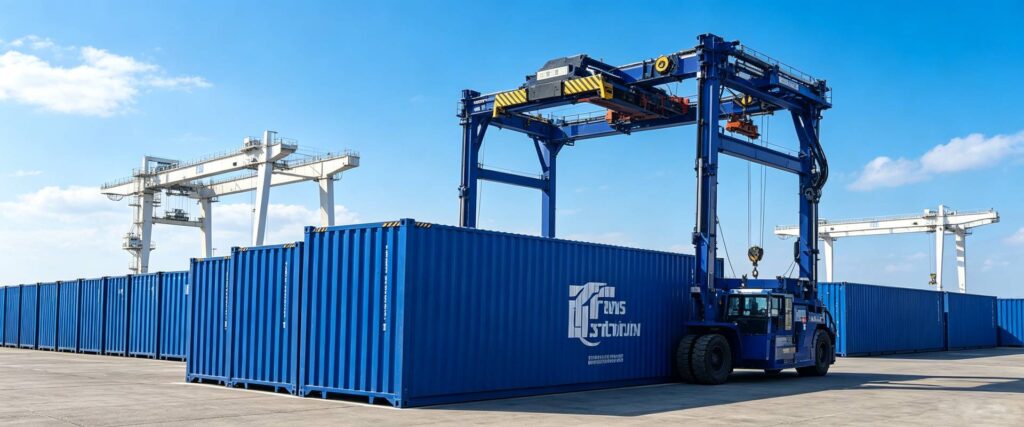
What is a Container Straddle Carrier?
Container straddle carrier is special equipment for container handling, the core feature is “straddle operation” – the main body straddles the top of the container, through the top lifting mechanism lifting and stacking, distinguishing from the crane’s fixed-point operation and forklift’s side insertion operation, the scope of operation and the flexibility has more advantages. Flexibility is more advantageous.
Its core advantages accurately match the needs of logistics scenarios:
- Decoupled crane operations, so that cranes focus on loading and unloading ships/vehicles, container straddle carriers independently undertake horizontal transportation and stacking in the field, parallel operations to reduce idle equipment, improve overall efficiency.
- Adapt to multiple scenarios and irregular sites, without the need for fixed rails or complex infrastructure, four-wheeled multi-angle steering system can be flexible in the narrow corridor turnaround, diagonal driving, to enhance the utilization rate of the site.
- A single device to cover the unloading of ships, the field transportation, the stacking of containers through the top lifting mechanism. The equipment covers the whole process of ship unloading, on-site transportation, stacking, loading and picking up, no need to coordinate multiple types of equipment, shortening the turnaround time of ships and trucks.
- It can safely stack standard containers in 3-5 layers, increasing the utilization rate of the site by more than 30%, and is suitable for ports and peripheral logistics parks around the city where the land resources are strained.
- It reduces the costs of purchasing multiple equipments and subsequent maintenance and parking, and the effect of saving in long-term operation and maintenance is obvious.
- The main body is made of Q355 and above grade high-strength steel. The main body is made of high-strength steel of Q355 and above, which can stably support 20-60 tons of rated load. High-end models are equipped with automation and remote control systems, which can reduce the rate of human error and the operators do not need to enter the high-risk areas, thus further reducing the risk of accidents.
- Modern trans-shipment trucks are mostly equipped with hybrid or purely electric power systems, which have significantly lower carbon emissions than traditional fuel equipment, reducing energy consumption and meeting the goal of carbon neutrality.
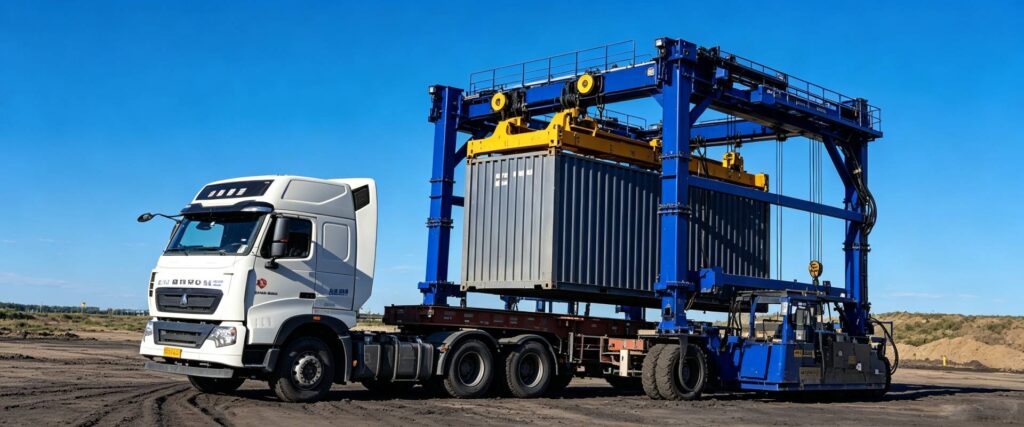
4 Core Application Scenarios of Container Straddle Carriers
Container Yard
The core demand is high throughput, fast stacking and efficient docking between ships and trucks, hundreds of containers of different specifications need to be handled every day, ships need to finish loading and unloading within the agreed window period, and trucks need to enter and exit the yard quickly to avoid congestion.
Selection priority attention to 20-60 tons capacity, suitable for 20 feet, 40 feet standard containers and 45 feet long containers; lifting height selection of 5-7.5 meters, to achieve 3-5 layers of safe stacking, maximize the use of yard space.
Automatic positioning, route planning and other automation functions are necessary to reduce manual errors, improve accuracy and efficiency, especially at night or in bad weather to ensure continuous operation.
The floors of terminals and yards are mostly hardened but easy to be damaged by long-term heavy loads. Choosing solid tires can reduce the pressure on the ground, and the wear-resistant and puncture-resistant performance is stronger, which reduces the frequency and cost of tire replacement.
Integrated Logistics Hub
The core demand is seamless and flexible scheduling of railroad, highway and storage multimodal transportation, with complex cargo flow paths and high requirements for equipment mobility and adaptability.
The four-wheel steering system is the key configuration, which supports in-situ turnaround and diagonal driving, and can flexibly shuttle in narrow passages, significantly saving operating time.
Travel speed is selected according to the size of the site: 7km/h unladen for large sites and long transfer distances, and low-speed stability for compact sites and short distances with frequent starts and stops.
The IoT tracking function can grasp the location of the equipment, load status, and remaining power (electric model) in real time, which is convenient for dynamic assignment of tasks and avoids idle equipment or operational congestion.
Large Warehouse/Distribution Center
The operating environment has compact space, narrow passages, and some floors have load-bearing limitations. The core demand is to access the goods efficiently and avoid damaging the floors and shelves.
It is recommended to choose a span of 3.2-4 meters to fit the distance between shelves and ensure the stability of the equipment; give priority to lightweight design to reduce the pressure on the ground to avoid the ground cracking and sinking.
Solid tires do not need to worry about flat tires, reduce downtime, and low noise, in line with the requirements of the indoor environment.
The model with lifting speed of 12mm/s and lowering speed of 16mm/s is suitable for high-frequency access demand, and the anti-swaying function can reduce container swaying and avoid collision with shelves or other goods.
Heavy Industry/Manufacturing
It mainly transports heavy loads such as steel coils and large machinery parts, and its core requirements are strong carrying capacity, durable structure, and suitability for the complex operating environment of factories.
Priority is given to the 45-60 tons rated load model, and the main steel is Q355 and above to ensure no deformation and cracking under heavy load for a long period of time.
Must have anti-tip, overload protection and other enhanced safety features to reduce the risk of heavy cargo tipping over and falling; maximum 5 ° climbing angle to adapt to the factory ramp, good heat dissipation system to meet the needs of continuous operation for a long time.
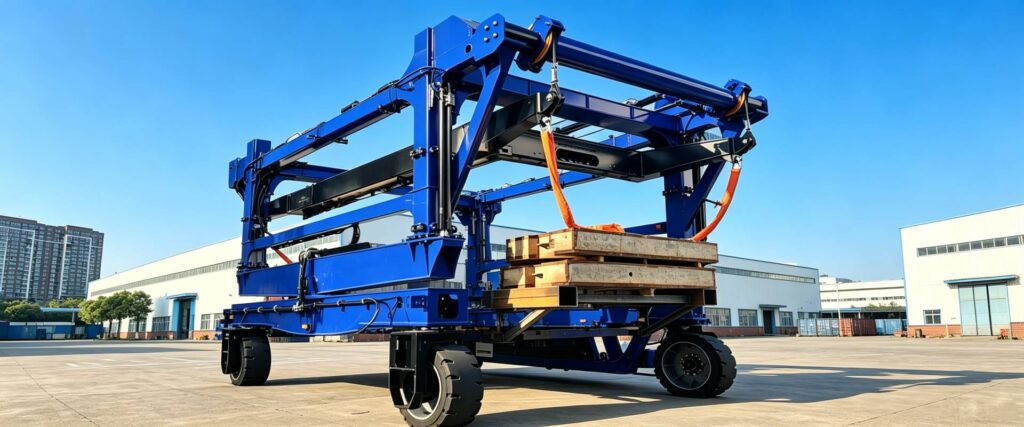
5 Key Dimensions of Container Straddle Carrier Selection
Business Adaptation
The core of the selection is to seamlessly integrate the equipment into the existing workflow to avoid high configuration waste or insufficient function.
Selection according to the daily throughput: the daily handling of less than 50 containers selected in the equal capacity of the basic models; more than 100 high-capacity, high-automation models, to avoid equipment bottlenecks.
Confirm the compatibility of the equipment with the existing loading and unloading, warehouse management system, support for IoT access can reduce the error of manual entry.
Cover their own main processing container size, to avoid “big horse-drawn cart” or “small horse-drawn cart”.
Environmental Adaptation
The site conditions directly restrict the play of the equipment, you need to plan the driving route and stacking area in advance, to confirm that the route width and turning radius are suitable for the equipment size; the ground in the stacking area needs to be level and load-bearing standards, sensitive or damaged areas need to be reinforced or adjusted routes.
Please ask professionals to test the ground load-bearing in advance; pay attention to the heat dissipation performance in high temperature areas, and choose cold-resistant batteries and hydraulic systems in cold areas.
Hardcore screening of technical parameters
The core parameters need to accurately match the requirements, refer to the following:
| Core parameters | Common range | Selection reference |
| Container size | 20’/40’/45′ HQ/OT | Covers its own main container types, avoiding frequent replacement of adapted accessories |
| Capacity | 20-60 Ton | Maximum daily weight + 10% margin to allow for redundancy |
| Span | 3.2M-5M | Warehousing 3.2-4M (adapted to shelving), Dock 4-5M (to ensure stability) |
| Lifting height | 3M-7.5M | 3 layers stacked 3-5M, 5 layers 5-7.5M, combined with site height restrictions |
| Travelling speed | 0-7Km/H | High speed for long distances, stability for short distances |
| Climbing angle | 5° maximum | Adapted to the actual slope of the site |
Mandatory remote control, safety alarm (overload / limit), four-wheel steering configuration; attention to the quality of steel and manufacturing process, you can ask the supplier to provide test reports.
Personnel and Security
Specialized training is required for the operation of cross-trucks, covering operating procedures, safety standards and basic maintenance, to ensure that operators can identify common faults and report them for repair in a timely manner.
Training costs increase with the complexity of the equipment, and the training cycle for high-end automated models is longer, so it is necessary to set aside the costs and time; establish safety protocols, delineate restricted areas for operations, avoid inclement weather operations, and regularly check safety devices; and equip operators with helmets, reflective undershirts, and other protective equipment.
Full Cost Cycle Consideration
Selection needs to account for the whole life cycle costs:
Purchasing costs include the base price of the equipment, international freight and tariffs (tariffs on imported equipment increase by 10-30%), sea freight is low but takes 1-2 months, air freight is fast but expensive; operation and maintenance costs involve the replacement of wearing parts (tires, hydraulic oil, etc.) and regular maintenance, and you need to check the supplier’s ability to supply spares and the local service network; the hidden cost of the loss of faulty downtime, Hidden costs include downtime loss, training opportunity cost, and after-sales response lag cost, which need to be evaluated in advance.
Explanation of Cost Components of Container Straddle Carriers
Explicit Costs: Equipment Selling Price (graded by capacity/configuration)
The 20-30 tons basic model is less expensive and suitable for small yard; 40-60 tons model has more complete configuration (e.g. perfect automation function, strong structural strength) and higher price, which is suitable for dock, heavy industry and other scenarios.
For the same capacity, the automation model is 15-20% more expensive than the manual model, and the hybrid/electric model is 20-30% more expensive than the fuel model, so you need to choose according to your needs; when purchasing, check whether the installation and commissioning fee is included to avoid extra expenses.
Hidden Costs
International transportation and tariffs are mandatory for imported equipment, with low cost and long lead time for ocean freight and high cost and short lead time for air freight, which need to be weighed according to the needs; tariffs vary according to national policies and can be up to 30%, so it is important to know the destination policy in advance.
Maintenance and spare parts costs are long-term core expenditures. Wearable parts need to be replaced regularly, niche or customized parts can double in price, and untimely supply can easily lead to downtime; training costs increase with the degree of automation, and additional configurations, such as security fencing and monitoring, need to be factored into the budget.
Cost Optimization Tips
Choose suppliers with comprehensive after-sales network to ensure fast supply of spare parts and door-to-door maintenance and reduce downtime; give priority to hybrid/electric models, which have higher initial purchase price but lower electricity and maintenance costs, are in line with environmental protection policies, and have a longer service life.
Optimize the operation process to avoid frequent starting and stopping, long-distance idling and overloading, and reduce breakdowns through regular maintenance; negotiate for installment payment, free maintenance and spare parts when purchasing to reduce the financial pressure.
Conclusion
Container straddle carrier selection is the essence of business needs, technical parameters and cost control of the three-dimensional balance, there is no absolute optimal equipment, only the most suitable for their own situation of choice.
Enterprises need to first clarify the operational scenarios and core requirements, and then according to the site conditions, throughput matching technical parameters, and finally accounting for the full cycle cost, to avoid waste of investment. As a large investment, the selection of uncertainty can consult a professional technical team to obtain customized solutions to avoid cost traps.
In the future, container straddle carriers will be fully automated, AI intelligent scheduling and more environmentally friendly direction, advance layout of new technologies can enhance the competitiveness of enterprises. If you need to compare specific model parameters or customized selection advice, feel free to contact the professional team for support.
