
Why Choosing the Right Material Handling Equipment Is Critical
In modern ports, logistics hubs, prefabricated construction, and wind power sectors, businesses often face a critical decision: should they invest in a Straddle Carrier or opt for a Gantry Crane? Both types of equipment have their advantages, and choosing the right one can significantly improve efficiency, reduce operational costs, and gain a competitive edge in the market.
This article will compare the two from multiple angles, including structural principles, application scenarios, cost analysis, technological trends, and safety, to help you find the solution that best fits your business needs.

What is a Straddle Carrier?
A Straddle Carrier is a self-propelled lifting device specifically designed for container and heavy-load transportation. It can “straddle” containers or cargo, lift goods from the ground using its built-in lifting mechanism, and move flexibly within the site.
This equipment is highly favored for its compact structure and flexible operation, particularly suitable for environments with limited space or complex site layouts.
Compared to traditional lifting equipment, Straddle Carriers offer the following significant advantages:
High mobility: Straddle Carriers use rubber tires and multi-directional steering systems, enabling them to maneuver freely in narrow spaces with exceptional adaptability. Even on unpaved work sites, they maintain good stability and operational efficiency.
Quick deployment: Unlike gantry cranes, which require significant time to construct tracks and foundations, straddle carriers can be put into use shortly after purchase, making them particularly suitable for temporary projects and emergency operations.
Environmental potential: With the global increase in carbon emission standards, manufacturers have introduced electric versions of straddle carriers, powered by lithium-ion batteries or hydrogen fuel cells, significantly reducing greenhouse gas emissions during operation.
Multifunctionality: In addition to container handling, straddle carriers have been applied in areas such as precast component transportation, wind turbine tower transportation, and large tank transportation, gradually achieving cross-industry applications.
The typical load capacity of this equipment is generally 40 to 60 tons, with some customized models capable of handling even larger loads.
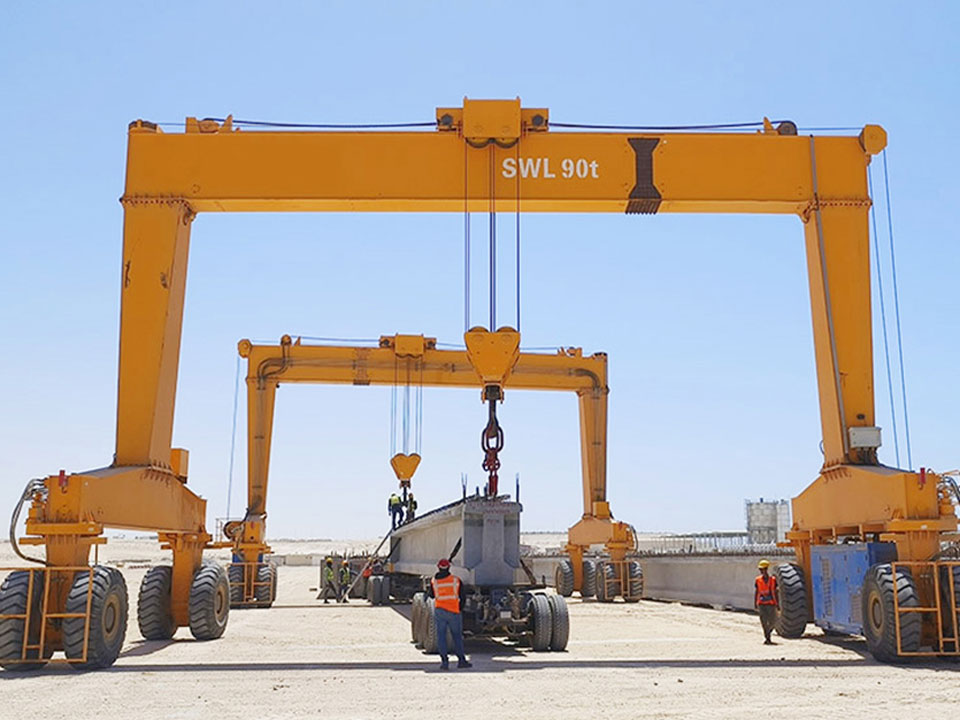
single girder gantry crane
What is a Gantry Crane?
A Gantry Crane is a large bridge-type lifting device widely used in ports, shipyards, steel mills, and railway freight stations. Its main structure includes a bridge frame, legs, and a crane operating system, enabling vertical and horizontal cargo handling by moving along tracks.
Its advantages are primarily reflected in the following aspects:
Exceptional load-bearing capacity: Some ultra-large gantry cranes can achieve lifting capacities of over a thousand tons, making them suitable for heavy-duty operations such as ship section lifting and bridge girder assembly. In such operations, the gantry crane can precisely control the lifting, lowering, and movement of cargo, ensuring operational safety and accuracy.
High stacking capacity: In port container yards, gantry cranes can efficiently complete high-density stacking operations, optimizing yard space utilization.
Stable structure: Since they operate on tracks or a solid foundation, the lifting process is smoother, making them suitable for large-scale, repetitive operations.
Suitable for continuous operations: Gantry cranes can operate efficiently for extended periods in fixed areas, particularly suited for large-scale operations in ports and heavy manufacturing industries.
However, the installation of gantry cranes typically requires significant upfront investment, including track laying and foundation construction, and offers limited flexibility. The construction cycle is lengthy, making them unsuitable for frequent changes in operational locations.
Performance Differences Between Straddle Carriers and Gantry Cranes
Flexibility
The primary advantage of straddle carriers lies in their flexibility. Their rubber-tired design combined with a four-wheel steering system enables them to maneuver effortlessly in narrow spaces, temporary construction areas, and complex terrains. Specifically, within channels as narrow as 10–15 meters, a Straddle Carrier can easily perform turning and reversing maneuvers. In temporary work areas, it can begin operations without the need for complex site leveling or foundation preparation. This makes it an ideal choice for multi-point distributed operations, sites with frequent adjustments or expansions, such as cargo transfer between different warehouses within large logistics parks, where it can flexibly adjust its operational route based on cargo distribution.
In contrast, the mobility range of a Gantry Crane is limited by tracks or tire paths, making it suitable for work in pre-planned fixed sites. Track-mounted Gantry Cranes can only move along the track direction, with a fixed operational range; tire-mounted Gantry Cranes can move within a certain range but require level ground, and their maneuverability and mobility are far inferior to those of a Straddle Carrier. While this fixed nature reduces flexibility, it offers significant advantages in terms of stability and precision when handling extremely large cargo, enabling repeated high-precision lifting operations within a fixed work area.
Load Capacity Comparison
Gantry cranes typically have higher load capacities, capable of lifting single pieces weighing over hundreds of tons, such as ship hull sections or bridge girders, and are commonly found in large shipyards and steel production facilities. For example, in large shipyards, Gantry Cranes can lift ship sections weighing 500-1000 tons and precisely position them through precise control. For industries requiring the handling of extremely heavy and large items, Gantry Cranes are indispensable, meeting their unique production needs.
Straddle Carriers are suitable for handling medium-weight cargo, such as containers, tanks, and prefabricated components. While their load capacity is lower than that of Gantry Cranes, they excel in flexible scheduling and high-frequency operational efficiency. At container terminals, Straddle Carriers can quickly complete the loading, unloading, and transfer of multiple containers, handling 20-25 containers per hour, significantly enhancing terminal operational efficiency.
Operational Efficiency
In a multi-point dispersed operational environment, straddle carriers can achieve a continuous “grab-transport-stack” operation mode, greatly improving turnover efficiency. Data shows that modern automated straddle carriers can handle 20 to 25 containers per hour and can achieve unmanned operation, path optimization, and all-weather operation. Using GPS positioning and AI path planning algorithms, it can select the optimal travel route, reduce idle time, and avoid collisions with other equipment and personnel, significantly improving container handling efficiency and reducing operational waiting time. In logistics parks, the Straddle Carrier can quickly navigate between different warehouses and container trucks, enabling seamless cargo transfer.
Gantry cranes are suitable for bulk loading and unloading in a single fixed work area. Although they can lift heavy cargo in a single operation, their overall operational flexibility and frequency are lower than those of straddle carriers. In fixed yards at ports, gantry cranes can repeatedly perform container stacking and loading/unloading operations according to predefined procedures, handling 15–20 containers per hour. Due to its fixed operational range, it does not require time to move between different workpoints, thus maintaining high efficiency in large-scale operations within a fixed area.
Straddle Carrier Application Scenarios
Straddle Carriers demonstrate exceptional applicability across multiple industries. They are not only the primary equipment at container terminals but are also increasingly being widely adopted in the following fields:
Ports and Container Terminals: At ports and container terminals, Straddle Carriers handle critical tasks such as transferring containers from ships to trucks, from trucks to storage yards, and within storage yards. They can maneuver flexibly across various areas of the terminal and coordinate with shore cranes for container loading and unloading operations. By integrating with the terminal’s management system, the Straddle Carrier can access real-time container information and operational instructions, enabling efficient scheduling and operations. For example, in some large container terminals, automated Straddle Carriers have achieved automatic integration with shore cranes and trucks, with the entire operation process requiring no human intervention, significantly enhancing the terminal’s automation level and operational efficiency.
Precast construction and bridge construction: In precast construction and bridge construction, straddle carriers are used to transport large precast concrete beams, bridge decks, and other precast components. These components are typically large in size, heavy in weight, and irregular in shape, making traditional transportation equipment inadequate for the task. Straddle carriers are equipped with specialized lifting and securing devices that can be adjusted according to the characteristics of the precast components, ensuring their stability and safety during transportation. Additionally, they can maneuver flexibly in the confined spaces of construction sites, precisely delivering precast components to designated installation locations, thereby shortening construction timelines and improving construction efficiency.
Wind power industry: With the rapid development of the wind power industry, the transportation of wind turbine towers and large steel structures has become a challenge. The Straddle Carrier, with its strong load-bearing capacity and stability, has become the ideal equipment for transporting wind turbine towers in the wind power industry. It can transport wind turbine towers up to 100 meters in length, securely fixing them in place through special support structures. During transportation, it effectively reduces swaying and vibration of the towers, preventing deformation and damage. At wind farm construction sites, the Straddle Carrier can unload towers from transport vehicles and transfer them to installation locations, working in conjunction with cranes to perform installation tasks, thereby enhancing the efficiency of wind farm construction.
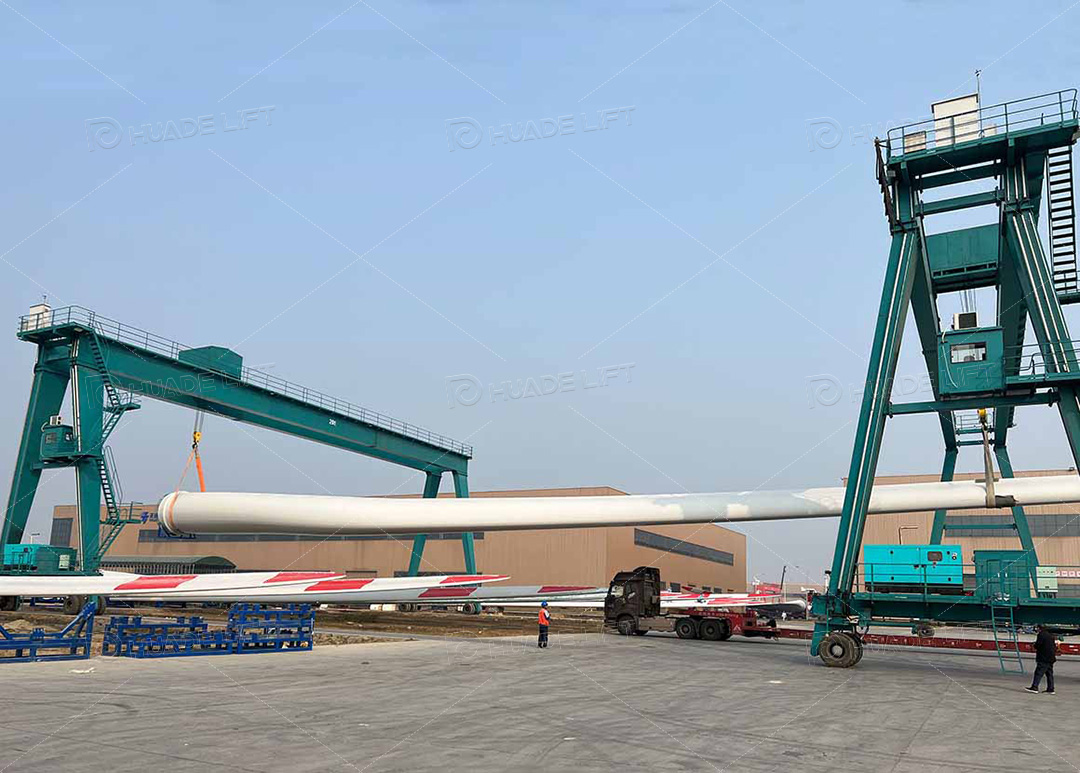
Straddle Carrier used in wind power
Emergency Engineering: In emergency engineering scenarios, such as rapidly establishing temporary logistics channels after natural disasters, the Straddle Carrier plays a crucial role. It can respond swiftly to perform loading, unloading, and transportation of rescue supplies in complex on-site environments. For example, in earthquake-affected areas where roads are severely damaged and traditional transport equipment cannot access, Straddle Carriers can navigate through rubble and uneven terrain to promptly deliver rescue supplies to the disaster zone, providing strong support for rescue operations.
Their high mobility and versatility make them the preferred choice for an increasing number of industries.
Application Scenarios for Gantry Cranes
Gantry Cranes are the preferred equipment for fixed workplaces, particularly for handling oversized and heavy cargo. Typical applications include:
Shipyards: In shipyards, Gantry Cranes are used to lift ship hull structures, supporting the construction of large vessels. Ship hull structures are typically massive in size and weight, with individual sections weighing hundreds of tons or even thousands of tons. Gantry cranes, with their exceptional load-bearing capacity and precise control capabilities, can accurately position these hull sections for welding and assembly. During shipbuilding, gantry cranes are also used to lift large equipment such as engines and propellers, ensuring that all components of the vessel are installed smoothly.
Port Fixed Yard: In port fixed yards, gantry cranes are used for large-scale container loading, unloading, and stacking operations. Port container yards are typically large in area and require efficient stacking equipment to maximize space utilization. Gantry cranes can stack containers up to 6-8 layers high, with neat and orderly stacking for easy management and scheduling. By connecting to the port’s information management system, gantry cranes can stack containers in designated locations based on their destination, weight, and other information, improving yard operational efficiency and space utilization. Additionally, gantry cranes can operate continuously to meet the port’s high volume of container handling demands.
Heavy Manufacturing Plants: In heavy manufacturing plants such as steel mills and machinery factories, gantry cranes are used to handle heavy equipment or large metal components. In steel mills, gantry cranes can lift heavy items such as molten steel ladles and steel ingots, which are high-temperature and heavy, requiring extremely high standards for equipment safety and stability. Gantry cranes have a stable structure and can withstand high temperatures and heavy loads, ensuring safe operation. In machinery factories, they can handle large machine tools and heavy mechanical components, facilitating machinery assembly and production.
Railway freight stations: At railway freight stations, gantry cranes are used for bulk cargo loading and unloading, especially for fixed-route transportation. Railway freight stations have fixed routes and stations for cargo transportation, and gantry cranes can perform cargo loading and unloading operations for freight trains within fixed operational areas. For bulk goods such as coal, ore, and steel, gantry cranes can efficiently complete loading and unloading tasks, improving the efficiency of railway freight transportation. For example, at a certain railway freight station, a gantry crane can load and unload dozens of tons of coal per hour, meeting the transportation needs of bulk goods.
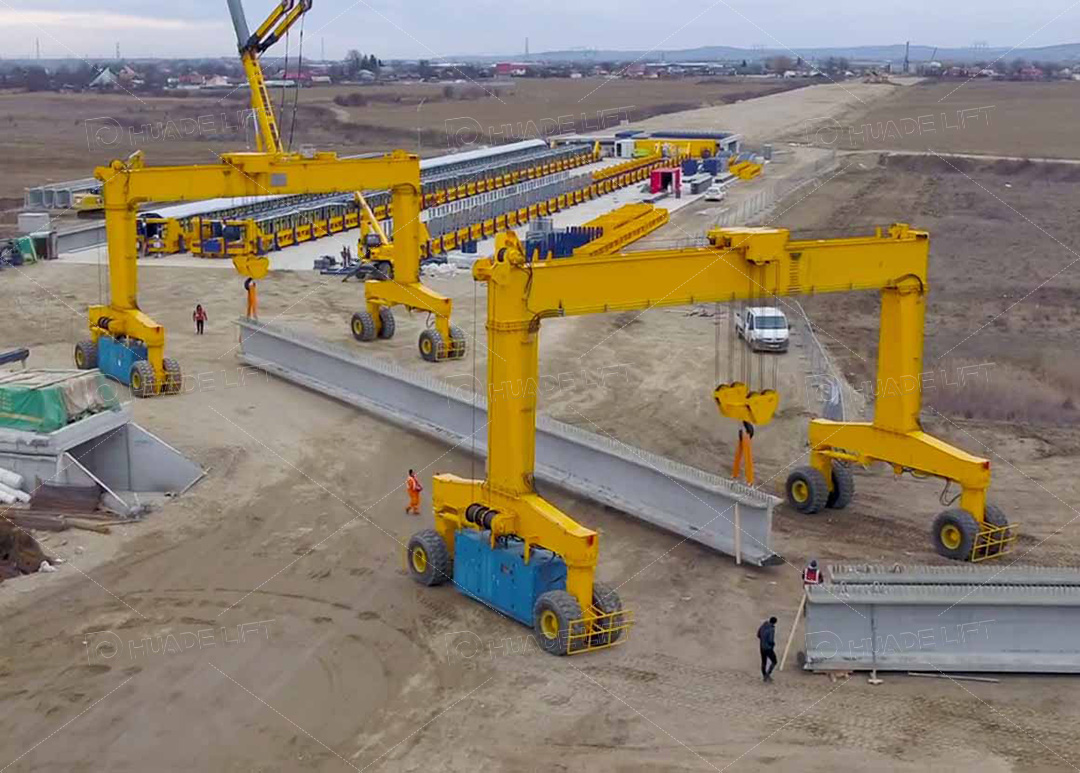
If your business site is fixed and requires handling of oversized cargo, a gantry crane is a cost-effective long-term investment.
Which is more cost-effective: a straddle carrier or a gantry crane?
Initial Investment Costs
Straddle carriers do not require tracks or complex infrastructure, resulting in lower upfront costs. They are suitable for businesses with limited budgets or those requiring rapid deployment.
Gantry cranes require higher infrastructure costs, including foundations and tracks. They are suitable for long-term operations at fixed sites.
Operational and Maintenance Costs
The operational costs of a Straddle Carrier primarily include fuel consumption (or electricity), hydraulic system maintenance, and tire maintenance. Overall maintenance is relatively straightforward, making it suitable for high-frequency use.
Gantry Cranes have higher maintenance costs, particularly for track maintenance, steel structure inspections, and electrical system repairs. Regular major inspections are required for long-term use.
Return on Investment
If a company needs to quickly adapt to market changes or expand its operational area, the straddle carrier offers a shorter payback period and higher flexibility. The gantry crane is more suitable for long-term fixed operations, where it can gradually offset costs by efficiently handling large volumes of cargo.
Technical Trends in Straddle Carriers and Gantry Cranes
Intelligent Upgrades
Automated straddle carriers have been deployed in multiple ports worldwide, combining GPS positioning, AI path planning, and 5G communication to enable 24/7 unmanned operations, reducing labor costs and operational risks.
Gantry cranes are also moving toward intelligent upgrades, with some ports introducing remote operation and automated stacking systems. However, due to their size and fixed nature, automating these cranes presents greater complexity.
Environmental Sustainability
Electric Straddle Carriers are gradually replacing traditional diesel versions, reducing carbon emissions and noise pollution. This trend will accelerate as ports transition toward greener operations.
Safety Comparison
Straddle Carriers are equipped with advanced collision-avoidance radar, cameras, overload protection, and automatic braking systems, effectively reducing accident rates.
Gantry cranes have stable structures and strong wind resistance, but in heavy-lift operations, they require extremely high skill levels from operators, necessitating regular training and safety inspections.
How to Choose the Right Lifting Equipment?
If you prioritize flexible scheduling, high-frequency operations, and quick return on investment, straddle carriers are the ideal choice.
If your business focuses on heavy-lift operations, bulk handling, and fixed sites, gantry cranes offer greater long-term value.
Before making a decision, it is recommended to conduct a detailed site assessment and operational needs analysis, and consult professional suppliers for customized solutions.
Conclusion
Straddle Carriers and Gantry Cranes each have their advantages, but the key lies in your business model, operational scenarios, and future development plans. The right equipment selection will bring your business higher efficiency, lower costs, and stronger market competitiveness.
For customized technical solutions, please contact our engineering experts.
