
What is a Rubber Tyre Gantry Crane?
A rubber-tyred gantry crane (RTG) is a special type of gantry crane that runs on rubber tires rather than rails. This feature allows it to move freely in yard or port environments, free from the constraints of fixed rails. The crane consists of a horizontal frame mounted on four or more tires, capable of lifting and transporting heavy cargo, and is commonly used for handling containers or other large items.
RTG cranes are designed to handle loads ranging from 20 tons to 40 tons or even heavier. In intermodal container yards and terminals, they are commonly used for lifting, stacking, and moving containers. The ability to operate without relying on a fixed track system provides significant advantages in terms of maneuverability and versatility, enabling it to better adapt to the operational requirements of various scenarios.
Basic Components of a Rubber Tyre Gantry Crane
Main Girder:
The main girder is the primary horizontal beam that supports the load, spanning the width of the crane and providing structural integrity for the entire crane. Its material and structural design are carefully considered to ensure it does not deform or sustain damage under high loads, making it a critical component for stable crane operation.
Support Legs:
Support legs are vertical structures that connect the main beam to the base and accommodate the wheel assemblies. They not only serve as connectors but also provide stability and balance, ensuring the crane remains secure during operations, even when lifting heavy loads or moving, effectively preventing overturning.
Hoisting Mechanism:
The hoisting mechanism is the system responsible for lifting and lowering loads, typically comprising a motor, drum, and steel wire rope or chain. The motor provides power to drive the drum, which in turn uses the steel wire rope or chain to lift or lower the load. Its performance directly impacts the crane’s lifting efficiency and safety, so strict requirements are imposed on the motor’s power, drum strength, and other parameters.
Trolley:
The trolley is a movable frame that runs along the main beam, enabling the hoisting mechanism to move horizontally. By moving the trolley, the hoisting mechanism can transport the load to different positions within the main beam’s range, increasing the crane’s operational range and flexibility.
Rubber Tires:
Large, durable rubber tires enable the crane to move across various surfaces, providing the RTG with mobility distinct from that of track-mounted gantry cranes. These tires are made from special materials and designed for excellent wear resistance and load-bearing capacity, making them suitable for complex ground conditions such as ports and yards.
Control Cabin:
The control cabin serves as the operator’s workstation, equipped with control devices for maneuvering the crane and managing load operations. In some advanced models, the control system may be remote or automated. Operators use various buttons, joysticks, and other devices within the control room to precisely control the crane’s movements, ensuring smooth operation.
Power Source:
Depending on the design, RTGs may be powered by diesel engines, electric motors, or a combination of both in hybrid models. Different power sources are suitable for different operational environments, providing diverse options for crane operation.
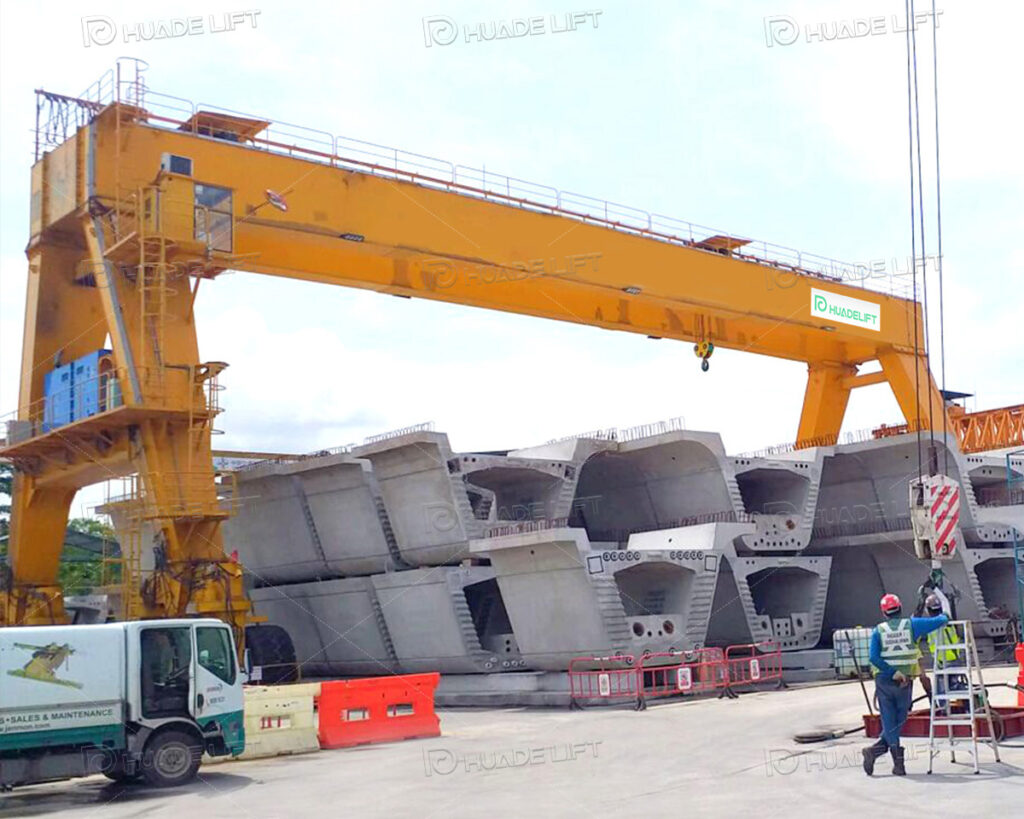
Working Principle of Rubber-Tired Gantry Cranes
The working principle of rubber-tired gantry cranes primarily relies on the synergistic interaction of mechanical, hydraulic, and electrical control systems. Its main components include the gantry frame, crossbeam, hoisting mechanism, traveling mechanism, and control system. During operation, the travel mechanism is driven by the hydraulic system, enabling the crane to move flexibly on the ground and position itself at the location of the cargo to be loaded or unloaded. The hoisting mechanism drives the drum via an electric motor, causing the steel wire rope or chain to wind up or down, thereby lifting or lowering the cargo. Meanwhile, the electrical control system precisely controls the entire process, ensuring the crane operates according to pre-set programs and parameters.
Structural Design
Rubber-tired gantry cranes typically consist of a steel structure mounted on wheels or rubber tires. This structure is supported by a frame or gantry that provides stability and strength. The frame houses the mechanical components, including the power system, hoisting mechanism, and control system. A well-designed structure ensures the crane’s stability and reliability when handling heavy loads and performing various operations.
Rubber Tires and Drive System
The primary distinction between an RTG and other gantry cranes lies in its rubber tires. Rubber tires enable the crane to move across various surfaces without requiring fixed tracks. The drive system includes an electric motor and transmission, which provide power to the tires to propel the crane. The drive system allows the RTG to move forward, backward, left, and right, enabling precise positioning of containers and significantly enhancing operational flexibility and efficiency.
Lifting Mechanism
The hoisting mechanism of an RTG is similar to that of other gantry cranes, comprising a winch, steel ropes, and lifting attachments. The winch is responsible for lifting and lowering containers, while the steel ropes provide the necessary lifting force. The lifting attachments are accessories connected to the containers, facilitating safe lifting and positioning. The performance of the hoisting mechanism directly impacts the crane’s operational efficiency and safety, so its design and manufacturing undergo rigorous testing and validation.
Control System
RTGs are controlled via an advanced control system that enables precise and efficient operation. The control system includes a radio remote control or an operator console installed in the cab. The operator can control the crane’s movements, including lifting, lowering, and lateral movement, through the control system. The control system also integrates safety features, such as limit switches and emergency stop buttons, to ensure operational safety.
Power Supply
RTGs are typically powered by electricity to reduce emissions and noise levels. They are equipped with electrical systems, including transformers, switchgear, and power cables. Depending on the specific crane design and requirements, power can be supplied via a cable reel system or a conductor rod system. A stable power supply is essential for the crane’s normal operation, and different power supply methods are suitable for different operational environments.
Stacking and Container Handling
The primary purpose of an RTG is to handle containers at container terminals or intermodal yards. The crane can stack containers with precision and efficiency. It can reach multiple rows of containers and stack them vertically, thereby effectively utilizing available space. The lifting device connected to the hoisting mechanism securely grips and positions containers during lifting and stacking operations, enhancing the efficiency and accuracy of container handling.
Safety Features
Operational safety is a top priority for RTGs. The crane is equipped with various safety features to prevent accidents and protect personnel and cargo. These features include collision avoidance systems, overload protection, stability control systems, and emergency stop buttons. Additionally, sensors and cameras may be installed to provide operators with better visibility and assistance, further enhancing operational safety.
Maintenance and Inspection
Regular maintenance and inspections are critical to ensuring the safe and reliable operation of RTGs. Daily maintenance tasks include lubrication, component inspections, and monitoring the condition of tires and drive systems. Inspections should be conducted by qualified personnel to identify any wear, damage, or potential issues that may affect crane performance or safety, enabling timely repairs and replacements to extend the crane’s service life.
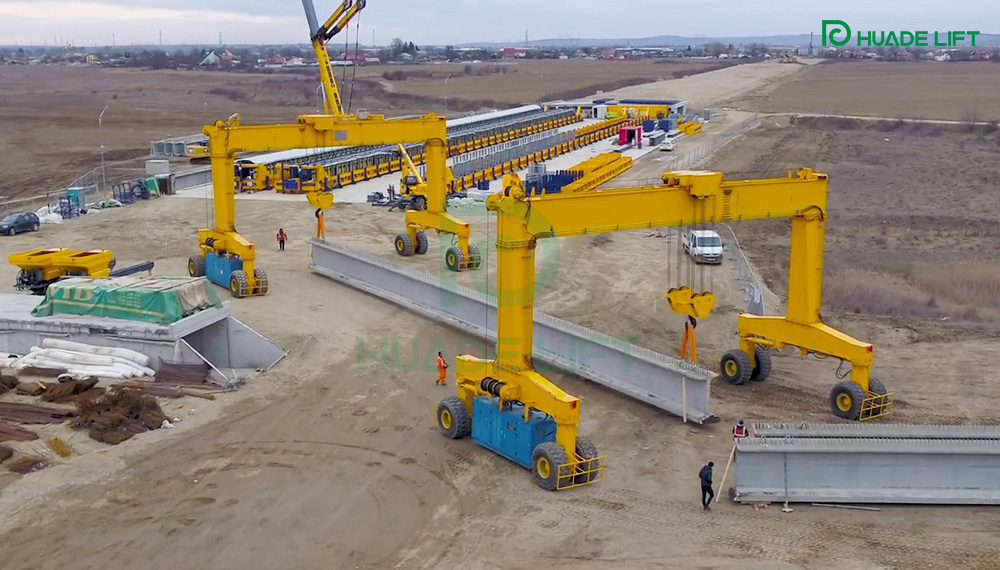
Advantages of Rubber Tyre Gantry Crane
Increased Mobility for Faster Operations
The ability to move freely without being constrained by a fixed track system gives RTGs a significant advantage in terms of speed and efficiency. Traditional gantry cranes are typically limited to tracks, restricting their mobility range and potentially slowing down overall operational speed. In contrast, RTG mobile gantry cranes can navigate through yards, quickly adjust positions, and perform lifting and stacking operations without wasting time on repositioning. This enhanced mobility accelerates container handling speed and increases throughput, which is critical in environments such as container ports where rapid turnaround times are essential.
Adaptability to Changing Layouts
Many ports and industrial facilities face layout changes due to expansions, shifting demand, or changes in cargo types. RTGs are well-suited for such environments as they can easily adapt to these changes without requiring major structural adjustments. Whether the yard is being expanded to accommodate more containers or reconfigured to optimize traffic flow, RTGs can be moved to new areas and redeployed without the need for costly upgrades or new infrastructure.
Efficient Use of Space
In busy container yards, space is often at a premium. RTGs enhance space utilization efficiency by enabling operators to access containers from multiple angles and stack them higher, thereby maximizing storage capacity. RTGs can stack containers in a compact manner and easily adjust their positions to clear pathways, achieving optimal yard utilization. This is particularly advantageous in crowded areas where traditional fixed-track cranes struggle to provide comparable efficiency.
Operational Flexibility in Diverse Environments
RTGs are not limited to container yards but can also be used in other environments such as shipyards, railway yards, construction sites, and warehouses. Their versatility enables them to handle a wide variety of loads, including bulk materials, machinery, and construction equipment, making them indispensable in multi-purpose facilities. The ability to switch between different types of work environments without requiring specialized equipment makes RTGs an attractive choice for businesses with diverse operational needs.
Reduced Need for Additional Equipment
A single machine combines lifting, moving, and stacking capabilities, reducing the need for additional equipment such as forklifts or trailers. This integration of functions lowers operational costs, streamlines workflows, and enhances overall efficiency. Businesses can reduce the number of machines required to perform the same tasks, thereby lowering maintenance costs and minimizing downtime for repairs or maintenance.
Improved Safety and Operational Control
Modern RTGs are equipped with advanced safety features that further enhance their operational flexibility. Features such as collision avoidance systems, load sway control systems, and automatic monitoring systems help ensure smooth and safe operations. Operators can better control the crane’s movement and lifting operations, minimizing the risk of accidents and improving overall productivity. The enhanced safety also allows businesses to operate RTGs in more challenging environments or adverse weather conditions, increasing their operational flexibility.
Application Scenarios Of Rubber Tired Gantry Crane
Container Terminals
One of the most common application scenarios for RTG cranes is container terminals. These cranes can easily lift and move containers, making the process of loading and unloading cargo from ships faster and more efficient. Modern container terminals have a large number of RTG cranes, which work in coordination with other types of cranes and lifting equipment to ensure the rapid turnaround of ships.
Construction Sites
RTG cranes are also used in construction sites. In construction projects, they are ideal for moving materials and equipment from one location to another. Due to their rubber tires, they are particularly useful in narrow spaces or areas with limited access. Additionally, they can lift heavy loads, making them an ideal choice for construction projects requiring the movement of large quantities of materials.
Warehouses
RTG cranes are also frequently used in warehouses. They are used to move cargo pallets from one location to another, helping to speed up the loading and unloading process. Many warehouses now use automated RTG cranes, which use sensors and other technologies to move pallets without the need for human operators. This makes the process more efficient and helps reduce the risk of accidents.
Intermodal Yards
Finally, RTG cranes are also used in multimodal terminals. These terminals are where containers are transferred from one mode of transportation to another, such as from trucks to trains and vice versa. RTG cranes are used to lift and move containers from one mode of transportation to another, enabling efficient cargo transfer.
