
Introduction
With the rapid development of the global steel industry, steel mills face increasing production and logistics pressures. Steel production involves not only complex smelting and rolling processes but also requires efficient storage and transportation systems to ensure the swift movement of raw materials and finished products. Particularly during the handling of steel coils, sections, and heavy structural components, traditional forklifts and manual handling methods struggle to meet the demands for high efficiency and safety.
Against this backdrop, rubber tyred gantry cranes have emerged as critical equipment for steel mill warehousing and logistics. Rubber tire gantry cranes enable high-density stacking, rapid handling, and precise positioning within confined spaces, significantly boosting storage efficiency while reducing labor costs and safety risks. This article systematically analyzes the application value of rubber tire gantry cranes in steel mill warehousing, explores their key functions for enhancing storage efficiency, and provides selection and application recommendations based on practical case studies.
What is a Rubber Tyred Gantry Crane?
A rubber-tyred gantry crane is a specialized bridge crane designed for stacking, handling, and loading/unloading heavy materials. Unlike traditional rail-mounted gantry cranes, it features rubber tires on its base, enabling free movement on hardened surfaces with superior flexibility and mobility.
A rubber-tyred gantry crane typically comprises the following components:
Main beam and lifting system: Used to carry and hoist materials such as steel plates and coils;
Travel wheels and drive system: The tire-based design eliminates the need for tracks, adapting to complex warehouse environments;
Control and safety system: Includes automatic collision avoidance, load monitoring, limit controls, and remote operation capabilities;
Power system: Currently predominantly electric or hybrid-powered, balancing energy efficiency with high-performance operation.
Advantages of Rubber Tyred Gantry Cranes
Compared to traditional forklifts and rail-mounted gantry cranes, rubber tyred gantry cranes offer significant advantages:
Maneuverability: Rubber tires enable free movement within warehouses and yards without complex track layouts;
High Load Capacity: Capable of handling steel coils or materials weighing tens to hundreds of tons, meeting heavy-duty handling demands in steel mills;
High Stacking Efficiency: Enables high-density stacking, maximizing warehouse space utilization;
Enhanced Safety: Intelligent controls and collision-avoidance design reduce operational risks.
These characteristics make rubber-tyred gantry cranes a vital choice for steel mill warehouse automation.

Key Challenges in Steel Mill Warehousing
Heavy Steel Material Handling Demands
Steel mill warehouses typically store steel coils, profiles, hot-rolled coils, and large prefabricated steel components. These materials are heavy and bulky, making traditional forklifts inefficient for handling. The process often leads to tipping, collisions, and material damage.
Limited Storage Space
Steel mill warehouses and yards often have constrained areas, particularly in large facilities where storage space utilization directly impacts production line feed rates. High-density stacking demands render traditional manual stacking inefficient and potentially hazardous.
Limitations of Manual Forklifts
While forklifts remain widely used in steel mills, they present significant constraints:
– Limited handling capacity prevents single-lift transport of oversized steel coils;
Limited stacking height prevents full utilization of vertical space;
Manual operation poses safety risks and accident hazards;
Reliance on operator experience complicates management.
Dual Pressure of Safety and Efficiency
Steel mills operate at a fast pace, making warehousing a critical factor in overall efficiency. Safely and efficiently handling heavy steel within confined spaces is a challenge every mill must address. The introduction of rubber tyred gantry cranes provides a reliable solution to this problem.
Advantages of RTG Application in Steel Mill Warehousing
Enhanced Handling Efficiency
RTGs can lift large-tonnage steel coils or long sections in a single operation, significantly boosting handling efficiency. For instance, a single lift can move over 30 tons of steel coils, whereas traditional forklifts can handle only 5–10 tons at most. Shortened handling cycles improve internal warehouse logistics flow, reducing waiting and transfer times.
Optimized Storage Space
With precise stacking capabilities, rubber-tyred gantry cranes enable higher and more compact stacking of steel coils and profiles, maximizing warehouse space utilization. Their multi-station operation allows simultaneous work across multiple yards, further optimizing spatial layout.
Reduced Labor Dependency
The automated control system of rubber-tyred gantry cranes minimizes reliance on forklifts and manual handling. During steel handling and stacking, operators only need to perform remote control or semi-automatic operations, significantly lowering labor costs and operational complexity.
Enhanced Safety
Rubber-tyred gantry cranes are equipped with anti-collision, limit switch, and load monitoring systems to prevent material collisions, tipping, and overloading. In heavy-duty steel mill environments, safety is a critical prerequisite for improving storage efficiency.
Strong Environmental Adaptability
Rubber-tyred gantry cranes operate flexibly in both outdoor yards and indoor warehouses, adapting to steel mills’ variable ground conditions and round-the-clock operational demands. Their electric or hybrid power systems reduce energy consumption while meeting environmental requirements.
Key Features of RTG for Enhanced Storage Efficiency
In steel mill storage scenarios, steel materials (such as coils, long sections, and prefabricated steel components) are characterized by heavy weight, diverse specifications, and high turnover rates. Traditional lifting equipment often faces challenges like low operational efficiency, poor space utilization, and high energy consumption with significant pollution. Rubber-tyred gantry cranes, with their purpose-built functional design, emerge as the core equipment to resolve these pain points and enhance storage efficiency. Their key capabilities unfold across four dimensions:
Multi-Bay Collaborative Operation
Steel mill storage areas are typically divided into multiple independent yards storing different steel types (e.g., hot-rolled coil yards, section yards, finished component yards), requiring frequent material transfers between yards. Equipped with high-precision positioning systems (e.g., laser navigation, RFID tracking) and multi-device coordination modules, rubber tire gantry cranes autonomously plan travel routes based on Warehouse Management System (WMS) instructions, seamlessly navigating between yards without manual intervention.
For instance, upon completing unloading at one coil yard, the RTGC can immediately switch to adjacent section yards for loading operations without waiting for other equipment handover. This significantly reduces idle travel time and standby downtime between yards. Data indicates that compared to traditional fixed-track cranes operating in a “single-yard dedicated mode,” the multi-station collaborative operation of rubber tire gantry cranes significantly enhances overall logistics efficiency in steel mill warehousing. This is particularly evident during peak periods of concentrated steel inbound and outbound operations, substantially alleviating storage turnover pressure.
High-Load Adaptive Design
Common steel mill materials—coils, long sections (e.g., H-beams, seamless pipes), and prefabricated steel components (e.g., structural frames)—typically feature substantial weight, demanding exceptional load-bearing capacity and stability from lifting equipment. The rubber-tyred gantry crane (RTGC) addresses these challenges through: – Reinforced main beam structure (welded with high-strength steel for superior bending and torsional resistance) – Multi-wheel load distribution design (equipped with multiple rubber tires to disperse ground pressure) – High-precision hydraulic lifting system This configuration enables stable handling of diverse heavy steel materials, fully meeting the weight requirements of mainstream steel mill materials.
This high load capacity enables “single-lift placement”: for instance, large-sized, heavy precast steel components require multiple lifts with repeated angle adjustments using traditional forklifts—a time-consuming process that risks structural deformation. whereas the rubber-tyred gantry crane can complete the lift in a single operation using customized lifting attachments (such as specialized clamps or counterweights), significantly reducing per-operation time. This approach also avoids equipment wear and material loss caused by repetitive handling, indirectly lowering warehouse operating costs.
Intelligent Precision Stacking
Land resources in steel mill storage areas are limited. Maximizing steel stacking capacity within confined spaces is key to reducing storage costs. Rubber-tyred gantry cranes feature visual recognition systems (high-definition cameras + AI algorithms) and closed-loop controlled hoisting mechanisms, achieving millimeter-level stacking precision: When stacking steel coils, the system automatically identifies coil dimensions and existing stack heights to calculate optimal spacing, preventing space wastage from misalignment. For long profiles, the RTGC utilizes laser ranging for positioning, ensuring end-to-end alignment and minimizing space occupied by misalignment.
Consider a medium-sized steel mill’s coil yard: traditional cranes require wide safety gaps between rows due to precision limitations, and stacking height is constrained by manual judgment. Rubber-tyred gantry cranes, however, enable precise control to significantly reduce safety gaps and increase stacking height, markedly improving yard space utilization. This effectively adds substantial storage capacity without expanding the original yard area. Precise stacking also prevents surface scratches caused by steel-to-steel collisions, enhancing the quality of finished steel products. Furthermore, orderly stacking facilitates rapid steel location through automated systems, reducing “search time” and further boosting outbound efficiency.
Energy Efficiency and Sustainability Features
Under the dual carbon goals, steel mills increasingly demand energy-efficient and eco-friendly storage equipment. Modern rubber-tyred gantry cranes abandon traditional diesel-powered models with high energy consumption and pollution. They primarily adopt pure electric or diesel-electric hybrid systems:
– Pure electric rubber tire gantry cranes powered by lithium-ion battery packs operate with significantly lower noise than diesel models and achieve zero carbon emissions. Hybrid rubber-tyred gantry cranes activate diesel engines during heavy-load lifting while switching to electric drive for light-load travel, significantly reducing energy consumption and carbon emissions compared to conventional diesel models.
Additionally, these cranes incorporate energy recovery systems: during load descent or braking deceleration, the system converts gravitational potential energy and kinetic energy into electricity, recharging the battery pack to further reduce energy consumption. Some high-end models also feature high-efficiency air filtration systems, minimizing dust pollution generated during operation. These configurations not only help steel mills reduce energy costs in warehousing operations but also support their “green warehousing” objectives. This aligns with national environmental policies for heavy industry and enhances corporate sustainability competitiveness.
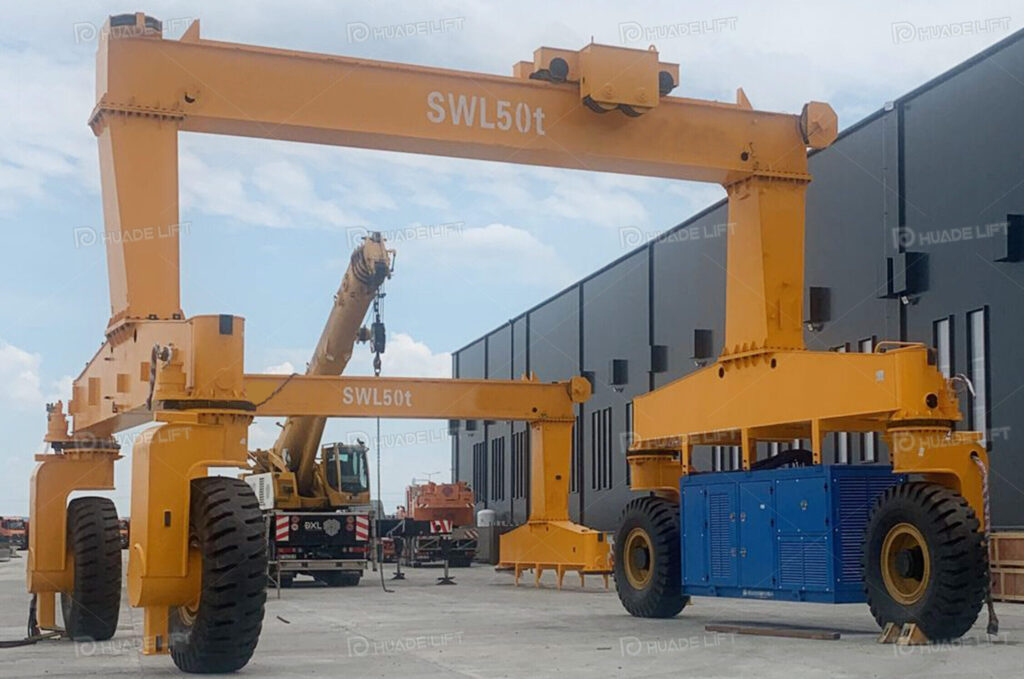
Rubber Tyred Gantry Crane Application Examples in Steel Mills
Rubber Tyred Gantry Cranes have demonstrated significant efficiency improvements in warehousing applications across multiple large steel mills. At one major steel mill, the storage area previously relied on forklifts to move steel coils, with operational efficiency constrained by yard space and staffing levels. After introducing rubber tire gantry cranes, coil handling efficiency increased by approximately 40%, stacking heights rose by two or more layers, and warehouse utilization improved significantly. Concurrently, manual operation time decreased by 50%, and safety incident rates dropped markedly.
Another steel mill deployed a rubber-tyred gantry crane operating in Tandem Mode for handling heavy precast steel components, enabling single-lift transport of steel beams exceeding 60 tons. Through precise stacking via intelligent control systems, this significantly accelerated warehouse turnover and optimized production line material supply rhythms. These cases demonstrate that rubber-tyred gantry cranes not only enhance storage efficiency but also play a pivotal role in optimizing steel mills’ overall production processes.
Recommendations for Selecting Suitable Rubber-Tyred Gantry Cranes for Steel Mills
Selecting Models Based on Warehouse Conditions
When choosing rubber-tyred gantry cranes, steel mills should select appropriate crane models based on warehouse area, stacking height, and material specifications. For indoor warehouses with limited space, models with smaller spans and high maneuverability are recommended. For large outdoor yards, models with high load-bearing capacity and multi-station operation capability are preferable.
Functional Customization
Modern rubber tire gantry cranes support diverse custom features, such as:
Tandem Mode (dual-hoist operation): Ideal for handling oversized or extra-long steel sections;
Remote Monitoring Systems: Facilitates management and scheduling to enhance operational efficiency;
Automated Stacking and Route Planning: Reduces manual intervention while improving safety and precision.
After-Sales Service and Maintenance
As heavy machinery, rubber-tyred gantry cranes require rigorous daily maintenance and after-sales support. Steel mills should select suppliers with proven technical expertise and comprehensive service systems to ensure long-term, stable equipment operation.
Conclusion
As steel mills expand production scale and storage logistics demands increase, traditional manual handling and forklift operations can no longer meet requirements for high efficiency and safety. Rubber-tyred gantry cranes, with their high load capacity, precise stacking, multi-station operation, and intelligent control systems, emerge as the ideal solution for enhancing steel mill storage efficiency.
Rubber tire gantry cranes not only optimize warehouse operations and maximize space utilization but also reduce reliance on manual labor and mitigate safety risks. Within the trend toward digital and automated logistics, steel mills adopting rubber tire gantry cranes can achieve significant benefits across their entire production operations.
Through scientific selection, customized functionality, and strategic layout, steel mills can fully leverage the advantages of rubber tire gantry cranes in warehousing and logistics, achieving comprehensive improvements in efficiency, cost, and safety.
