
Understanding Rubber Tyre Gantry Cranes
Definition
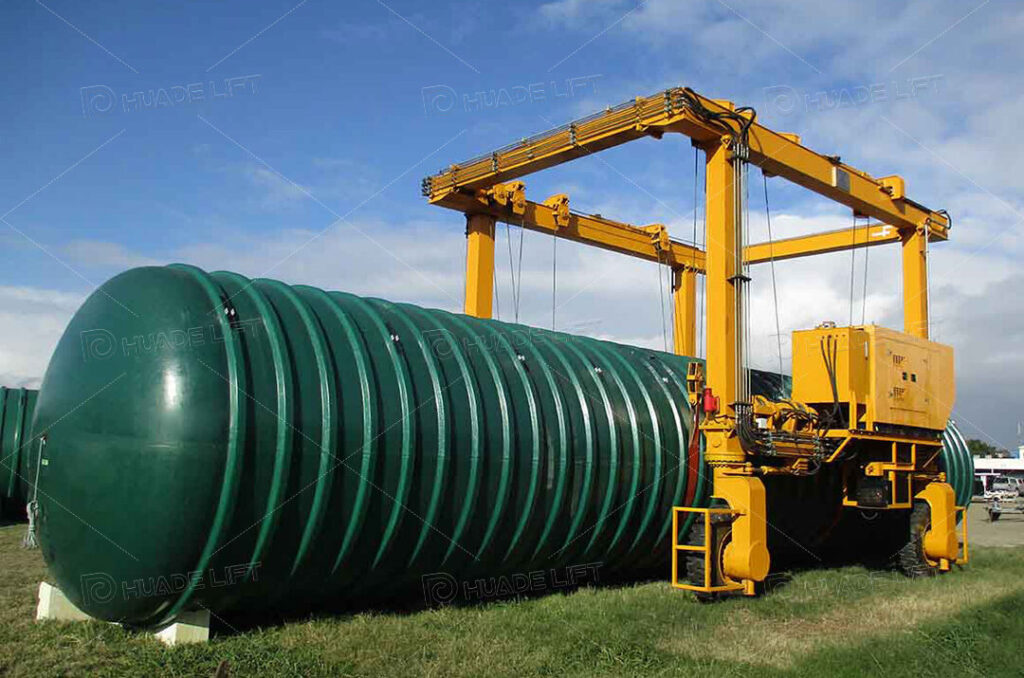
Rubber tyre gantry cranes, or rubber-tired gantry cranes, are gantry cranes equipped with rubber tires as their traveling mechanism. With their unique design and performance, they hold a significant position in the material handling field. Moving on tires across the ground, it can flexibly adjust its working position without rail restrictions, freely traveling over large areas. It operates stably whether on flat factory grounds or outdoor areas with some undulations.
Advantages for Off-Site Modular Manufacturing Plants
For off-site modular manufacturing plants, the advantages of rubber tyre gantry cranes are indispensable. During factory production, handling large prefabricated modules is a critical process. These modules are bulky, heavy, and structurally complex, demanding high safety and efficiency from handling equipment. rubber tyre gantry cranes leverage their powerful lifting capacity and stable performance to safely and efficiently transport these large prefabricated modules, preventing damage during handling and ensuring module quality.
The Role of Rubber Tyre Gantry Cranes in Off-Site Modular Construction
Full-Process Module Handling: Seamless Integration from Production to Loading
Within the closed-loop production system of off-site modular construction, the end-to-end transfer of modules from the production line to loading and transportation is the core link determining production rhythm and product quality. rubber tyre gantry cranes, with their customized adaptability, serve as the “central hub” of this chain. At the production line’s end, their laser ranging and visual recognition systems automatically locate module lifting points. Combined with continuously variable hoisting mechanisms, they achieve seamless transitions from ground-level molds to aerial transport. This eliminates collision risks from manual alignment in traditional lifting, particularly benefiting modules with fragile decorative surfaces like stone cladding or glass curtain walls.
During storage operations, the rubber tyre gantry crane interfaces with the factory’s warehouse management system via a programmable logic controller (PLC). It automatically plans storage locations based on module specifications and project timelines, precisely placing modules at predefined support points with optimized stacking heights to maximize space utilization. During loading, its dynamic weighing and posture adjustment functions monitor module center-of-gravity shifts in real time. By fine-tuning the lifting device angle, it ensures perfect alignment between the module and the transport vehicle’s mounting brackets. Combined with hydraulic clamping devices, this achieves “one-time positioning and secure locking,” significantly reducing the risk of module shifting during long-distance transport.
Empowering On-Site Installation: Streamlined Processes and Efficiency Enhancements
Traditional modular construction sites often grapple with challenges like “difficult multi-device coordination and low positioning accuracy.” The rubber tyre gantry crane addresses these pain points through multifunctional integration, achieving “subtractive optimization” of construction workflows in bridge construction. Adapting to diverse scenarios through rapid attachment changes (e.g., vacuum suction cups, counterweight beams), it handles modules of varying sizes and weights—from lightweight bathroom units to heavy structural steel components—independently completing unloading, on-site transport, and precise positioning without requiring auxiliary support from truck cranes or tower cranes, thereby minimizing equipment coordination time.
For positioning accuracy, the Hyundai rubber tyre gantry crane integrates GPS differential positioning with laser guidance technology to achieve high-precision placement in complex construction environments. For instance, during high-rise modular building installations, it automatically calibrates connection points between modules and foundation structures by preloading BIM model data, eliminating manual calibration and significantly reducing single-module installation time. Simultaneously, their flexible steering systems adapt to confined construction spaces, enabling direct operation alongside building structures. This eliminates secondary material handling, further boosting construction efficiency.
Multi-dimensional Safety Protection
Safety is the fundamental requirement for off-site modular construction. rubber tyre gantry cranes establish comprehensive safety barriers through a triple-tiered system: “Proactive Alerts + Passive Protection + Intelligent Monitoring.” At the equipment level, its standard multiple safety protection devices form a three-dimensional safety net: the overload protection system monitors load changes in real time, automatically cutting off lifting operations and triggering alarms when exceeding safe limits; limit switches strictly control lifting height and operating radius to prevent out-of-range operations; the collision avoidance system uses millimeter-wave radar to detect surrounding equipment and personnel, enabling automatic deceleration and shutdown at close range.
For transporting specialized modules, Rubber tyre gantry cranes offer customizable upgrades: vibration-damping slings with elastic buffering structures minimize lifting/lowering vibrations for modules containing precision water/electrical pipelines; vacuum-suction slings paired with pressure-sensing systems monitor real-time suction force variations to prevent glass breakage in fragile curtain wall assemblies. Regarding personnel safety, operators remotely control the crane from an enclosed, air-conditioned cab with vibration damping. High-definition cameras and infrared night vision systems provide clear visibility of the work area, eliminating the need to enter hazardous zones and fundamentally reducing the risk of personnel injury.

Reusability and Multi-Project Applications
Cross-Scenario Deployment
The Rubber tyre gantry crane’s rubber-tired mobility breaks free from the site constraints of traditional rail-mounted cranes, serving as a core tool for construction enterprises to achieve “equipment asset lightweighting.” In multi-factory collaborative production models, once a factory completes module production for a current project, Rubber tyre gantry cranes can be rapidly transferred to other factories via flatbed trailers. With only minor adjustments to tire pressure and braking systems, they can immediately commence module handling for new projects. This eliminates the need for separate equipment purchases at new sites, significantly reducing initial capital expenditures.
In managing project cycle fluctuations, the reusability of rubber tyre gantry cranes effectively resolves equipment idling issues. For instance, during peak project seasons, multiple rubber tyre gantry cranes can be centrally deployed to meet simultaneous construction demands across multiple sites. Conversely, during off-peak periods, equipment can be transferred to other factory areas to handle storage yard organization tasks, substantially increasing annual equipment utilization rates. Furthermore, certain rubber tyre gantry crane models support rapid counterweight and lifting attachment changes. By adjusting lifting capacity, they adapt to diverse modular projects—residential, commercial, industrial—further expanding the equipment’s application scope.
Multi-Project Collaborative Management
The high mobility of rubber tyre gantry cranes enables flexible deployment across multiple concurrent projects, making them a vital tool for enterprise resource management. Through a unified equipment scheduling system, real-time monitoring of crane usage across project sites allows dynamic adjustments to equipment positioning based on construction progress. This prevents situations where equipment remains idle on some projects while others face shortages.
This cross-project coordination capability not only increases equipment utilization but also reduces the need for duplicate equipment purchases, lowering overall operational costs for enterprises. Simultaneously, standardized operating procedures and equipment maintenance systems facilitate smoother transitions between projects for rubber tyre gantry cranes, shortening the time required for equipment adaptation to new environments.
Green Production
The reusability and energy-saving characteristics of rubber tyre gantry cranes align deeply with the green development demands under the construction industry’s “dual carbon” goals. In terms of resource conservation, the reuse of a single rubber tyre gantry crane reduces the steel and electricity consumption required for new equipment production, correspondingly lowering carbon dioxide emissions. Furthermore, the energy recovery systems installed on modern RTGs achieve significant energy savings during operation—recovering potential energy during descent to generate and store electricity, which is then released to assist lifting operations. This technology is equally applicable in off-site modular factory settings.
In environmental protection, emissions reduction, and waste control, rubber tyre gantry cranes’ precision operations play a pivotal role: their stable performance significantly lowers module damage rates during handling, reducing construction waste from damaged components. Efficient workflows shorten production cycles, indirectly decreasing water and electricity consumption throughout manufacturing. Certain new-energy rubber tyre gantry cranes adopt pure electric power systems paired with off-grid energy storage modules. This eliminates the need to start diesel engines during relocation, completely removing exhaust emissions and noise pollution. This meets environmental requirements for factories near urban areas and provides equipment assurance for achieving “low-carbon throughout the entire lifecycle” in modular construction.
Technological Advancements and Future Adaptability
As modular construction technology evolves, rubber tyre gantry cranes undergo continuous technical upgrades to meet future demands. New intelligent control systems enable coordinated operations among multiple cranes, enhancing efficiency in complex construction scenarios. Simultaneously, automated technologies lay the groundwork for unmanned operation, further reducing labor costs and improving workplace safety.
In materials and structure, lightweight designs and high-strength materials reduce the equipment’s energy consumption while maintaining lifting performance. These upgrades not only enhance rubber tyre gantry cranes’ value in current modular construction projects but also prepare them for future demands of higher standards and more complex construction requirements.
Would you like me to integrate this content with Part Two to form a complete SEO-optimized article? This approach ensures greater coherence and more strategic keyword placement throughout the piece.
Best Practices for Rubber Tyre Gantry Crane Deployment
Planning and Site Assessment
Thorough planning and site assessment prior to deploying rubber tyre gantry cranes are fundamental to ensuring efficient and safe crane operations. First, analyze the overall layout of the off-site modular factory to define the locations and boundaries of functional zones such as production lines, storage areas, and loading zones. Plan the rubber tyre gantry crane’s operational paths and working areas to ensure its coverage meets material handling demands throughout the production process while avoiding conflicts with other equipment, structures, and personnel access routes.
Maintenance and Safety Protocols
Regular maintenance and strict safety protocols are crucial measures for ensuring the long-term stable operation and safe working conditions of rubber tyre gantry cranes. Regarding maintenance, a comprehensive maintenance plan must be established to conduct periodic inspections and upkeep of all rubber tyre gantry crane components. Tires are critical travel components of rubber tyre gantry cranes. Regular inspections of tire wear levels and air pressure are required, with severely worn or damaged tires replaced promptly to ensure the crane’s travel performance and stability. Lifting components such as wire ropes, hooks, and pulleys are critical to the crane’s lifting function. Regular inspections for wear, corrosion, deformation, and other issues are essential. Any problems must be promptly repaired or replaced to prevent safety incidents caused by component failure.
Challenges and Solutions
Site and Transportation Constraints
In off-site modular construction projects, the deployment and operation of rubber tyre gantry cranes often face site and transportation limitations. Site constraints arise when off-site factories are located in suburban areas or industrial parks with narrow surrounding roads and heavy traffic. Internal crane maneuvering space may also be limited, particularly for large RTGs whose turning radius and operational span demand substantial clearance. Confined areas can hinder normal crane operations, reducing module handling efficiency.
Regarding transportation, relocating rubber tyre gantry cranes between facilities or project sites may encounter road access constraints such as insufficient load-bearing capacity on certain sections, bridge height restrictions, or tunnel width limitations. These factors can impair transportation efficiency and potentially cause schedule delays. Additionally, cross-regional transportation of rubber tyre gantry cranes requires obtaining a series of transport permits. Delays in processing these permits can also impact the crane’s relocation and deployment.
Handling Sensitive Modules
Traditional handling methods often fail to meet the special requirements of sensitive modules, increasing the risk of damage. Addressing this issue requires a dual approach: equipment modification and operational standardization. For equipment modification, rubber tyre gantry cranes should be equipped with specialized flexible lifting devices. These devices, made from elastic materials, absorb vibrations during lifting, minimizing module sway. Additionally, vibration monitoring sensors and stabilization control systems should be installed on the lifting devices to continuously monitor module vibrations. Should vibrations exceed safety thresholds, the system automatically adjusts the crane’s operating speed and lifting rhythm to ensure module stability.
Regarding operational protocols, specialized handling procedures for sensitive modules were established, with operators receiving dedicated training to familiarize them with module characteristics and handling requirements. Pre-lifting inspections verify packaging integrity and securing methods to ensure modules remain stable during hoisting.
Conclusion
In the era of rapid development in off-site modular construction, rubber tyre gantry cranes have become core equipment supporting its efficient operation, playing an irreplaceable role in module handling and transportation, simplified on-site installation, and operational safety assurance. Their outstanding maneuverability and flexibility not only meet the diverse module handling demands across multiple zones and types within off-site factories but also enable cross-project redeployment for equipment reuse. This significantly reduces corporate capital expenditures and enhances return on investment. From a sustainability perspective, the reusability and energy-efficient characteristics of rubber tyre gantry cranes align closely with the construction industry’s green development trends, providing robust support for achieving low-carbon production in off-site modular construction.
