
Modern bridge construction faces challenges such as complex site conditions and stringent material handling demands. Site mobility and efficient material processing capabilities directly impact construction progress and overall efficiency. Rubber tyre gantry cranes, with their unique structural design and functional advantages, have become key equipment for improving bridge construction processes and enhancing site utilization efficiency. Their role in optimizing operational modes and shortening construction cycles provides a crucial direction for addressing bridge construction pain points.
Understanding Rubber Tyre Gantry Cranes
Basic Definition and Core Characteristics of Rubber Tyre Gantry Crane
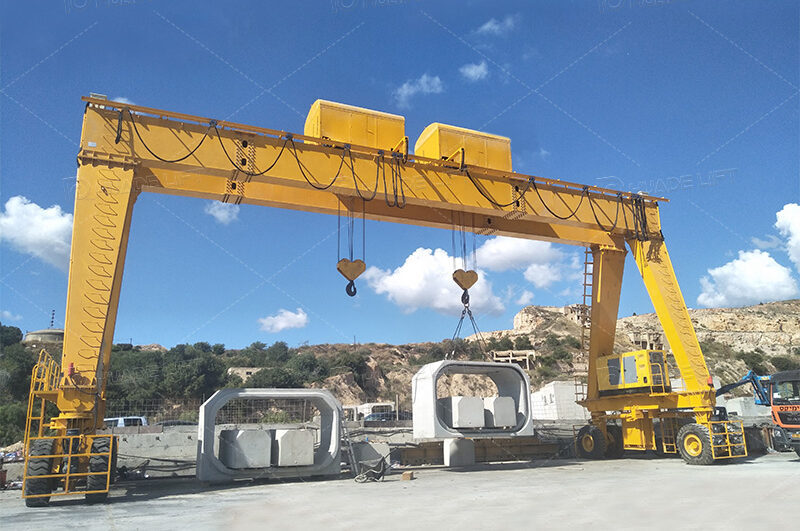
The full name of the rubber tyre gantry crane is the rubber tyre gantry crane, a heavy-duty lifting device that combines tire-based travel mechanisms with a gantry frame structure. Its core characteristics center on flexibility and precision: it can move multidirectionally without fixed tracks and, paired with a specialized control system, enables precise control over material lifting and positioning, meeting the demands for component handling accuracy in bridge construction.
Expanding Application Domains of Rubber Tyre Gantry Crane
Initially prevalent in container handling for logistics warehousing, rubber tyre gantry cranes have expanded into construction applications as bridge projects adopt prefabrication and modularization. They excel in transporting, storing, and installing bridge prefabricated components, as well as transferring large steel structures on-site, adapting to diverse construction requirements.
Comparative Advantages Over Traditional Lifting Equipment
Compared to conventional equipment, rubber tyre gantry cranes offer significant advantages: Unlike tower cranes, they require no fixed foundations and operate without restrictions from tower structures or booms, allowing flexible adjustment of working areas. Unlike rail-mounted gantry cranes, they are free from track constraints, eliminating the need for pre-laid tracks and enabling free movement across various sites to adapt to different bridge construction terrains.
Key Performance Parameters for Bridge Construction Adaptation
For bridge construction, rubber tyre gantry cranes must prioritize four parameters: lifting capacity matching precast component weights, operational span covering typical work ranges, mobility meeting multi-area transition demands, and specialized lifting gear or auxiliary devices compatible with component shapes to ensure stable and safe handling.
Core Role of Rubber Tyre Gantry Cranes in Bridge Construction
Optimizing Precast Component Receiving and Storage
Rubber Tyre Gantry Cranes can directly interface with component transport vehicles, enabling efficient unloading and eliminating cumbersome intermediate transfer operations. Leveraging gantry frame structures and precise lifting control, they can stack components systematically according to plans. This maximizes vertical and horizontal space utilization, minimizes storage footprint on construction sites, optimizes overall site layout, and prevents storage area disorganization from hindering construction progress.
Simplifying Component Transfer and Positioning
During component transfer, the rubber tyre gantry crane enables direct transport from storage to installation zones without relying on auxiliary transport equipment, significantly streamlining the process. Its high-precision positioning control system ensures components are placed smoothly at designated installation points, reducing subsequent manual adjustments, minimizing installation errors, and directly enhancing installation efficiency while shortening project timelines.
Integration of Multiple Operational Functions
The rubber tyre gantry crane integrates functions including unloading, storage, transportation, and positioning, reducing reliance on multiple equipment types at the construction site. Traditional bridge construction requires different equipment for various stages, often leading to process interruptions due to poor coordination. The rubber tyre gantry crane independently handles multiple operational phases, shortening the workflow chain, lowering coordination difficulties between equipment, and minimizing process breakpoints.
Establishing a Closed-Loop Operation
The rubber tyre gantry crane creates a complete closed-loop operation in bridge construction: from receiving transported precast components at the site, to storing them according to plan, transferring them to installation areas based on construction progress, and finally assisting with component positioning—all without requiring additional equipment intervention. This integrated operation ensures a seamless component handling process, avoids time losses from equipment switching, and enhances overall construction efficiency.
How to Enhance Bridge Construction Efficiency and Site Mobility
Flexible Site Mobility
Multi-Directional Travel Design
Pneumatic-rubber tyre gantry cranes employ multi-wheel drive and independent steering systems, supporting straight travel, diagonal travel, 360° rotation, and other movement modes. They can adjust direction without fixed tracks. In urban bridge construction, when encountering irregular sites formed by surrounding buildings and roads, the diagonal travel mode allows the crane to bypass obstacles and reach the work area directly. On narrow sites along water-crossing bridges, the rotating travel function reduces the space required for turning, avoiding frequent route adjustments and improving mobility efficiency.
Compact Structure and Space Optimization
The crane body and outriggers feature an adjustable design. During operation, outriggers extend for stability; when idle, they retract, significantly reducing the body width for passage through narrow passages. Compared to traditional tower cranes requiring extensive foundation and operational radius space, rubber tyre gantry cranes offer superior site adaptability. They enable efficient operation within confined areas without major site modifications, making them particularly suitable for urban bridge projects with limited space resources.
Rapid Cross-Area Transfer
Bridge construction typically involves multiple independent pier locations or work sections. Traditional lifting equipment requires disassembly, transportation, and reassembly when moving between different work surfaces, creating cumbersome processes. In contrast, rubber tyre gantry cranes can move directly within the construction site without complex disassembly. They can switch work surfaces in a short time, ensuring synchronized progress across all work sections. This rapid relocation capability prevents construction interruptions caused by equipment handover delays, enhancing overall construction coordination efficiency.
Accelerating Construction Workflows
Integrated Operations
Rubber Tyre Gantry Cranes consolidate multiple functions—including component unloading, storage, transfer, and positioning—enabling end-to-end operations without relying on auxiliary equipment. Traditional methods require multiple transitions (“unloading equipment → transport equipment → lifting equipment”) from transport vehicles to installation points, creating potential workflow bottlenecks. In contrast, rubber tyre gantry cranes directly interface with transport vehicles for unloading and proceed directly to the installation area for positioning, eliminating intermediate steps and shortening the material handling cycle per operation.
Core Equipment Coordination
During bridge precast component installation, the girder car requires a continuous supply of components. In traditional methods, component feeding relies on multiple equipment coordination, often leading to girder car downtime due to delayed supply. The rubber tyre gantry crane can anticipate the girder car’s operational rhythm, pre-positioning components at feeding points to achieve seamless “girder car installation – rubber tyre gantry crane feeding” coordination. By dynamically matching operational rhythms, idle time for the girder-laying crane is eliminated, enhancing core equipment utilization and boosting installation efficiency.
Automated Control
Equipped with high-precision automated control systems, rubber tyre gantry cranes utilize sensors and positioning technology to achieve accurate lifting, transfer, and placement of components, minimizing human operational errors. During component positioning, installation accuracy requirements are met without subsequent manual adjustments, preventing rework caused by positioning deviations. Additionally, automated operations maintain a consistent work rhythm, eliminating efficiency fluctuations inherent in manual operations and ensuring continuous, high-efficiency material handling.
Safety and Operational Reliability
Structural Stability Design
The rubber tyre gantry crane utilizes a high-strength steel structural frame and reinforced outriggers. Anti-slip pads and locking devices at the outrigger bases maintain machine stability during heavy lifting, preventing tilting or swaying. On slightly uneven terrain, the outriggers hydraulically adjust for leveling to ensure machine balance. Even under sudden external forces, the locking system secures outrigger positions, preventing component falls and providing fundamental operational safety.
Intelligent Safety Protection
The rubber tyre gantry crane integrates multiple safety control systems, including load limiting, collision warning, and emergency braking. The load limit system continuously monitors lifted weight, automatically halting hoisting operations when exceeding rated capacity to prevent overload damage. The collision warning system detects surrounding equipment and personnel via radar or cameras, issuing alerts and decelerating when approaching safety distances to reduce collision risks. The emergency braking function enables rapid shutdown during sudden malfunctions, minimizing risk propagation.
Modular Maintenance and Environmental Adaptability
Core components of the rubber tyre gantry crane (such as travel motors and hydraulic pumps) feature modular design for rapid replacement during failures without requiring full equipment disassembly, thereby shortening repair time. Additionally, a condition monitoring system continuously collects component operational data, providing early warnings of potential faults to facilitate planned maintenance. Furthermore, the equipment demonstrates strong environmental adaptability, operating stably under diverse climatic conditions including high temperatures, low temperatures, and humidity. This minimizes downtime caused by environmental factors, ensuring construction continuity.

Practical Application Scenarios
During precast component receiving operations, the rubber tyre gantry crane interfaces directly with flatbed transport vehicles. Using specialized lifting attachments, it smoothly hoists components, eliminating damage caused by ground contact in traditional unloading methods. Simultaneously, components are stacked systematically by type and installation sequence according to site storage planning. Leveraging the vertical space advantage of gantry frame structures enables multi-level component stacking, minimizing storage area footprint on the construction site and optimizing site layout.
During the component storage management phase, the rubber tyre gantry crane can adjust storage locations based on construction progress. Components scheduled for imminent installation are transferred to storage points near the installation area, shortening subsequent transport distances. Precise lifting control also enables secondary organization or inspection of stored components, ensuring they remain intact during storage and preventing improper storage from affecting future installation.
During component transfer to installation zones, rubber tyre gantry cranes can dynamically adjust travel routes based on site conditions, avoiding personnel and equipment in operation to minimize disruption to other work processes. Upon reaching installation points, automated positioning systems smoothly place components onto girder erectors’ feeding platforms or designated installation locations. This eliminates manual adjustment, enabling direct transition to installation procedures and boosting efficiency.
During installation support, the rubber tyre gantry crane collaborates with the girder erector for component fine-tuning. By controlling lifting height and horizontal positioning, it ensures precise alignment at installation nodes, reducing adjustment demands on the girder erector. For heavy or irregularly shaped components, the crane’s stable lifting capability maintains equilibrium during installation, preventing misalignment and enhancing project quality.
From an overall construction perspective, the application of rubber tyre gantry cranes has restructured the material handling model in bridge construction. It integrates previously dispersed operations—unloading, storage, transfer, and positioning—into a unified workflow. This reduces coordination bottlenecks between equipment while lowering labor and equipment investment costs, driving bridge construction toward greater efficiency, intensification, and safety.
Future Trends and Technological Advancements
Functional Upgrades in Infrastructure Construction
As infrastructure projects grow larger and more complex, rubber tyre gantry cranes will evolve toward greater span, higher load capacity, and enhanced precision. Structural and drive systems will be optimized to meet demands for river-crossing bridges and urban elevated structures, while environmental adaptability for high-altitude and extreme cold scenarios will be strengthened, positioning them as core equipment for all-scenario applications.
Deep Integration of Intelligent Systems
Automation, remote monitoring, and IoT will reshape operational models: automated technology enables unmanned component handling and transportation; remote monitoring eliminates spatial and temporal constraints; IoT establishes a closed-loop “equipment-cloud-management” data system for real-time parameter monitoring, predictive fault detection, and reduced downtime.
Green Development Direction
Under the dual carbon goals, hybrid-powered and electric rubber tyre gantry cranes will become mainstream. Pure electric models achieve zero emissions and low noise, while hybrid models balance power and energy efficiency. Supporting systems like mobile charging stations and photovoltaic power supply will also be refined, driving low-carbon construction.
Emerging Technologies Empower Efficiency Gains
5G enables low-latency multi-machine coordination, AI optimizes work paths to minimize unnecessary movement, and lightweight materials reduce equipment weight, enhancing mobility and energy efficiency. These advancements further strengthen their operational advantages in complex sites, driving construction efficiency upgrades.
Conclusion
Rubber tyre gantry cranes, with their flexible on-site mobility, efficient process integration, and reliable safety features, have become core equipment for addressing challenges in bridge construction—such as limited workspace, low efficiency, and complex coordination. Their role in optimizing site utilization, shortening construction cycles, and mitigating safety risks aligns with modern bridge construction’s shift toward prefabrication and modularization. For construction enterprises, adopting rubber tyre gantry cranes not only enhances project profitability but also drives technological advancement, providing robust support for high-quality bridge engineering progress.
