
Introduction
Modern industrial sites commonly face challenges such as dense spatial layouts, narrow passageways, and compact operational areas, severely limiting material handling efficiency. Against this backdrop, tire-type gantry cranes (RTGs) have emerged as the ideal solution for material handling in confined spaces, leveraging their trackless mobility to revolutionize heavy-duty material processing in tight environments.
Overview of Rubber Tyred Gantry Cranes
Rubber-tired gantry cranes are mobile lifting equipment utilizing rubber tires for movement. Unlike rail-mounted gantry cranes with fixed travel paths, they operate without permanent track infrastructure, enabling unrestricted movement within designated work zones and offering exceptional site adaptability. Originally prevalent in multimodal transport yards, these cranes have expanded into industrial workshops, construction sites, and other space-constrained scenarios, becoming the preferred choice for balancing lifting capacity and maneuverability.
The Design of Rubber Tyred Gantry Cranes

HUADE LIFT Rubber Tyred Gantry Crane | Mobile Adaptability Design Industrial Equipment in Operation
The key to rubber-tired gantry cranes’ efficient operation in confined spaces lies in their “mobile adaptability” design philosophy. From the travel system to structural layout, every detail precisely addresses operational challenges in narrow environments, ensuring both flexibility and stability.
Rubber Tire Travel System
The rubber tire travel system is central to the crane’s confined-space adaptability. Large-diameter tires reduce ground pressure, accommodating diverse surfaces, while the trackless design eliminates path restrictions. Operators can flexibly navigate around obstacles and plan routes without requiring reserved track space, enhancing site utilization. This allows free movement between work zones, minimizing infrastructure modification costs.
Multi-Mode Steering System
Modern tire-mounted gantry cranes employ a full-wheel steering system for flexible multi-mode switching, efficiently handling diverse spatial operations. Straight steering ensures stable long-distance movement in open areas; crab steering enables diagonal traversal for narrow aisle adjustments; center-pivot rotation minimizes turning space by rotating around the center of gravity; lateral steering assists precise positioning in densely packed cargo areas. This multi-mode coordination enables rapid maneuvering in confined spaces, significantly reducing operational space requirements.
Compact and Customizable Design
To meet confined-space requirements, tire-mounted gantry cranes offer customizable designs. In height-restricted environments, manufacturers optimize main beam and outrigger structures to lower overall height for operational safety. For width-constrained scenarios, compact chassis layouts and structural refinements reduce lateral dimensions, ensuring flexible passage. This adaptable design accommodates diverse spatial limitations without requiring site modifications.
Smooth Control System
Confined spaces demand stringent precision in equipment operation. The tire-mounted gantry crane achieves accurate performance through three key technological enhancements:
Variable-speed drive enables stepless speed adjustment, allowing low-speed precision maneuvers in narrow areas and rapid operation in open spaces.
Precision braking system ensures smooth starts and stops, minimizing impact effects.
Remote control overcomes visibility limitations, enabling operators to precisely control the equipment from safe zones, significantly enhancing operational safety and efficiency.
Key Mobility Features of Rubber Tyred Gantry Cranes
The maneuverability advantages of tire-mounted gantry cranes stem not from a single design element, but from the synergistic interaction of multiple core characteristics. These features collectively ensure efficient operation within confined spaces, forming the key distinguishing advantage over other lifting equipment.
Rail-Free Mobility
The rail-free design represents the most fundamental mobility feature of tire-mounted gantry cranes. By eliminating track constraints on travel paths, the equipment achieves unrestricted movement within its operational range. This not only reduces track installation costs but also enables flexible positioning adjustments. In confined spaces, this mobility facilitates rapid switching between multiple loading points and workstations, enhancing efficiency while conserving floor space.
Multi-Terrain Adaptability
Rubber tires grant tire-mounted gantry cranes exceptional ground adaptability, enabling stable operation on concrete, asphalt, and temporary construction surfaces without requiring dedicated tracks. This modification-free feature proves particularly advantageous in confined spaces with complex ground conditions. It eliminates ground preparation costs while flexibly navigating obstacles, effectively reducing upfront site preparation investments.
Precise Load Positioning Capability
Operations in confined spaces demand exceptional equipment maneuverability and load positioning accuracy. The tire-mounted gantry crane achieves high-precision load placement through its lateral carriage movement, precise lifting control, and intelligent operating system. Even in densely packed storage areas with tight spaces, operators can execute fine-tuned maneuvers to accurately position loads, effectively reducing error risks while enhancing operational efficiency and safety.
Independent Operation Capability
Tire-mounted gantry cranes achieve high autonomy through diverse power supply options. Diesel drive suits power-free outdoor settings, electric drive adapts to indoor environments with stable power supply, while hybrid power enables flexible switching. These three modes cover varying scenario demands. The equipment independently completes the entire process—from lifting to transfer—within confined spaces without complex external support, significantly enhancing operational autonomy and adaptability.
Rubber Tyred Gantry Mobility in Various Industrial Applications
Leveraging their maneuverability and flexibility, rubber-tired gantry cranes excel in space-constrained industrial settings. They efficiently handle dense cargo handling and large component installation, making them ideal equipment for confined space operations.
Construction Sites and Prefabricated Component Facilities
Construction sites and precast component factories feature dense storage bays and complex production lines, requiring the transfer and installation of numerous precast components within confined areas. Equipped with multi-mode steering systems, tire-mounted gantry cranes operate flexibly in densely stacked zones, precisely aligning with storage bays for material handling without requiring clearance. Their trackless design saves space and adapts to uneven terrain, enabling efficient large-component transfer and installation without expanding operational footprints.
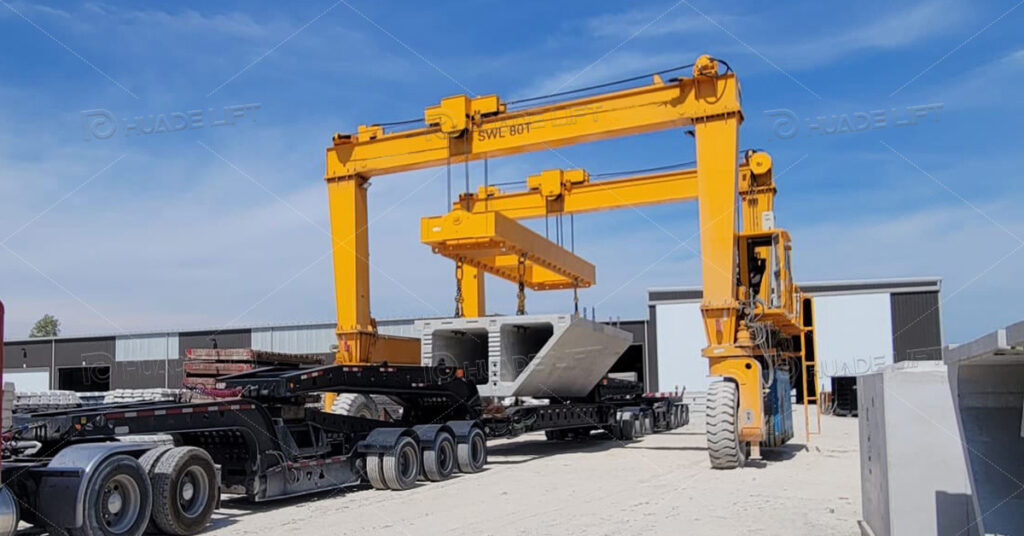
HUADE LIFT 80T Rubber Tyred Gantry Crane Lifting Concrete Precast Components | Heavy Cargo Logistics in Industrial Yard
Steel and Metal Processing Industry
Steel mills and metal fabrication plants feature compact layouts with densely stacked materials and narrow, obstacle-laden aisles. Rubber-tired gantry cranes navigate these confined passages freely through their compact chassis and agile steering, precisely handling metal materials of varying specifications. Their rapid positioning reduces process waiting times, while accurate load placement ensures operational safety, enabling efficient material circulation within tight spaces.
Logistics Consolidation and Cross-Docking Yards
Logistics consolidation centers and cross-docking yards experience high cargo turnover within limited space, demanding efficiency in loading, unloading, shifting, and stacking. Rubber-tired gantry cranes, with their trackless design, offer flexible deployment across work areas, free from the constraints of fixed rail systems. Their cost-saving infrastructure and compact operation maximize space utilization, significantly boosting cargo turnover efficiency, reducing backlogs, and enabling seamless logistics transfers in confined spaces.
Renewable Energy Component Handling
At construction sites for renewable energy projects like wind and solar power, handling large, irregular components poses challenges due to confined spaces and the need for multiple equipment coordination. Rubber-tired gantry cranes leverage their agility, precise control, and trackless design to efficiently complete component loading/unloading and installation, ensuring construction safety and efficiency.
Advantages of Rubber Tyred Gantrys in Confined Spaces
Compared to other lifting equipment, mobile gantry cranes offer significant advantages in confined space operations. With high space utilization, low operating costs, flexible operation, and excellent safety performance, they are the ideal equipment for confined space tasks.
Maximized Space Utilization
Free from track constraints, tire-mounted gantry cranes eliminate track footprints, allowing full utilization of ground space. Their compact design and agile maneuverability enable efficient operation in confined areas without requiring extensive clearance zones, significantly boosting site utilization. In space-constrained industrial settings, this advantage effectively enhances operational efficiency, achieving increased production capacity without expanding the facility footprint.
Reduced Infrastructure Costs
Compared to rail-mounted gantry cranes, tire-mounted models require no permanent track installation or infrastructure. They can be deployed directly in confined areas, drastically shortening commissioning cycles. Their mobility enables cross-regional equipment sharing, eliminating redundant configurations and significantly lowering site modification and operational costs. This makes them an ideal choice for budget-constrained enterprises or those with limited renovation space.
Exceptional Operational Flexibility and Adaptability
Tire-mounted gantry cranes excel in confined spaces like narrow aisles and dense storage areas due to their outstanding maneuverability. By flexibly adjusting steering and speed, they deliver efficient operations while accommodating diverse loads—from containers to metal components—without requiring equipment changes or complex adjustments. This makes them particularly suited for industrial settings with fluctuating operational demands.
Enhanced Safety Performance
Collision risks are common in confined spaces. The tire-mounted gantry crane mitigates these hazards through multi-dimensional safety design. Its precision control system enables accurate load positioning, while the multi-mode steering system improves maneuverability in tight areas. Enhanced visibility equipment provides real-time environmental monitoring, complemented by smooth start/stop braking functionality. This comprehensive approach ensures operational safety, delivering efficient and reliable lifting in restricted environments.
Scalability and Future-Proofing
Production layouts often require adjustments due to expansion or changing demands. The tire-mounted gantry crane’s trackless design enables rapid redeployment without extensive equipment or infrastructure modifications. Furthermore, it supports automation upgrades and flexible integration of smart modules, aligning with industrial digitalization trends. This effectively reduces equipment obsolescence risks, providing enterprises with a long-term material handling solution.
Rubber Tyred Gantey vs Other Equipment in Confined Areas
Performance Comparison with Straddle Carriers
While straddle carriers handle short-distance material transport, their overall performance in confined spaces falls short of tyre-mounted gantry cranes. Key differences include:
Maneuverability: Straddle carriers feature limited steering modes with large turning radii, making adjustments difficult in narrow aisles. Rubber-tired gantry cranes utilize multi-mode steering systems that significantly reduce turning space requirements, making them more suitable for confined areas.
Site Adaptability: Straddle carriers demand high ground flatness and may become unstable in complex, restricted environments. Rubber-tired gantry cranes adapt to diverse terrains with superior stability.
Load Positioning Accuracy: Straddle carriers exhibit lower load positioning precision, increasing collision risks in densely packed cargo areas. Rubber-tired gantry cranes achieve high-precision load positioning through advanced control systems, making them superior for operations demanding exact positioning.
Performance Comparison with Reach Stacks
Reach stacks are common mobile lifting equipment suited for material handling and short-distance transfers, but face significant limitations in confined spaces:
Operating Range: Reach stackers are constrained by boom length and angle, making comprehensive operations in narrow spaces difficult. Rubber-tired gantry cranes, with their lateral carriage movement and multi-mode steering, can cover multiple storage locations within confined spaces.
Space Occupancy: Reach stackers have long bodies, requiring substantial space for turning and maneuvering in narrow aisles. Rubber-tired gantry cranes feature compact body layouts, saving space and offering greater flexibility.
Load Capacity: Within equivalent space, rubber-tired gantry cranes offer superior load capacity, handling heavy materials and better meeting confined-space requirements.
Optimal Scenarios for Rubber Tyred Gantry Cranes
Space Constraints: Narrow, irregular work areas requiring frequent equipment repositioning;
Complex Ground Conditions: Inability to install rails or uneven ground surfaces;
Diverse Loads: Handling multiple cargo types and weights with high flexibility requirements;
Space Constraints: Efficient space utilization to minimize infrastructure footprint;
Frequent Process Changes: Rapid equipment adaptation to evolving operational demands.
In these scenarios, their mobility, spatial adaptability, and operational flexibility significantly enhance work efficiency and safety.
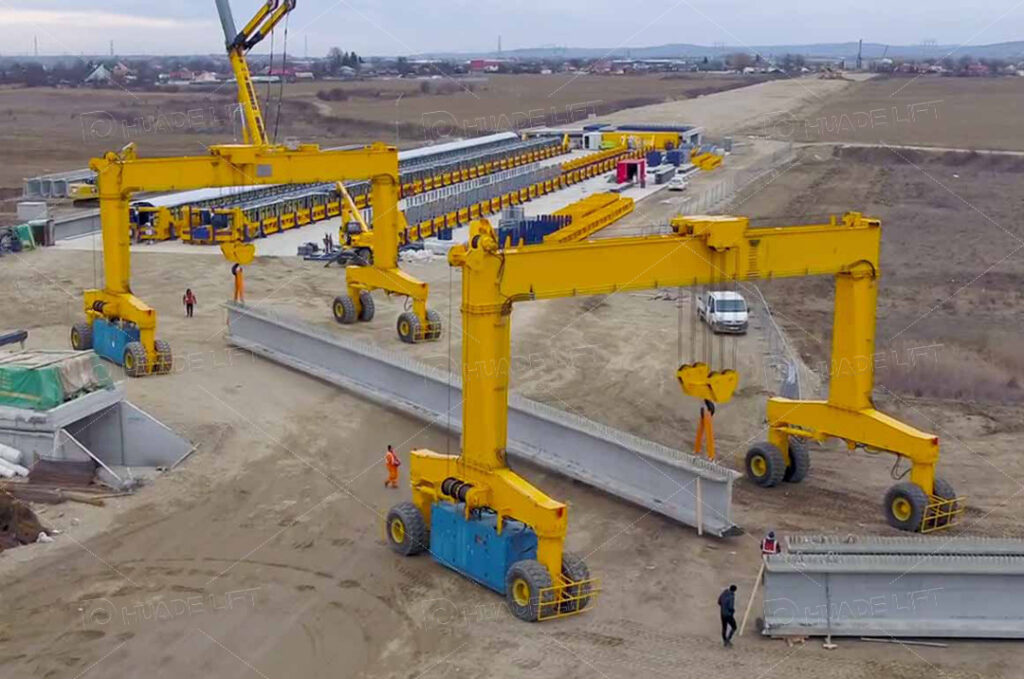
HUADE LIFT Rubber Tyred Gantry Crane Cluster | Bridge Girder Prefabricated Component Hoisting in Infrastructure Construction
Considerations for Using Rubber Tyred Gantrys in Confined Spaces
Enhanced Visibility and Environmental Monitoring
Obstacles and densely packed cargo in confined spaces can create operational blind spots, increasing collision risks. To address this, install high-definition cameras around the crane body to transmit real-time environmental footage to the control panel or remote controller. Additionally, operators must conduct comprehensive pre-operation inspections of the work area, familiarize themselves with the layout and obstacle locations, and maintain high concentration during operations. This prevents accidents caused by blind spots and ensures precise equipment operation in complex visual environments.
Speed Restrictions and Operating Standards
Clear speed restrictions must be established for confined space operations: Maintain low speeds in narrow aisles and dense storage areas. Use slow, precise adjustments when positioning loads to avoid swaying and collisions caused by rapid movements. Operators must undergo specialized training to master multi-mode steering transitions and precision control techniques, strictly adhering to operational procedures. Regular skill assessments enhance their adaptability and emergency response capabilities in confined spaces.
Emergency Braking and Collision Prevention Systems
High-risk confined space operations demand reinforced safety measures. Pre-operation checks must verify emergency brake button responsiveness to ensure effective emergency stopping. Collision prevention systems require regular maintenance, including sensor calibration and alarm testing. Develop contingency plans covering collision and malfunction scenarios, conduct emergency drills to enhance response capabilities, and equip rescue gear to enable rapid intervention and minimize accident damage.
Site Preparation and Environmental Adaptation
Before operating tire-mounted gantry cranes in confined spaces, prepare through five key areas: site clearance, ground treatment, route planning, spatial adaptation, and environmental optimization. Clear non-essential obstacles to expand operational space and level/reinforce substandard surfaces. Reasonably plan operational routes and cargo positioning layouts. Measure indoor working area dimensions to ensure equipment compatibility. Simultaneously, ensure adequate ventilation and lighting in the working environment to reduce operational error risks.
How to Choose Rubber Tyred Gantry Crane for Limited Workspaces
Span, Height, and Wheel Set Configuration
Span selection should match the width of the working space. Prioritize equipment with a moderate span to cover the target area while preventing excessive span from compromising maneuverability in narrow passages. Equipment height must match the site while balancing height and load capacity.
Wheel configuration impacts ground compatibility and load-bearing. Multi-wheel configurations are preferable in confined spaces to distribute weight and reduce ground pressure. Wheel material depends on surface type: choose wear-resistant tires for rough surfaces and anti-slip tires for smooth surfaces to ensure driving stability.
Steering Configuration Selection
Steering configurations should be selected based on operational needs:
In extremely narrow spaces with frequent turns, prioritize equipment with all-wheel steering or multi-mode steering capabilities. Crab steering and rotary steering enable tight-radius turns.
In open areas, choose basic steering modes to balance functionality and cost.
Additionally, for operations in confined spaces, always select equipment with responsive steering systems and precise execution to avoid collision risks caused by steering delays.
Power Source Selection
Power source selection must align with operational environment energy and environmental requirements. In outdoor settings without stable power supply—such as construction sites or open-air yards—diesel-powered systems offer independent power advantages, ensuring prolonged continuous operation. For indoor environments or facilities with stringent noise/environmental standards—like workshops or urban logistics centers—electric-powered systems provide superior advantages through low noise, zero emissions, and cost-effectiveness.
Hybrid power is ideal for complex environments with unstable energy supply, offering flexible mode switching that balances mobility and environmental performance. It is the preferred choice for high-continuity operations in confined spaces.
Automation Level and Future Expandability
Automation level and future expandability are critical considerations when selecting a tire-mounted gantry crane. Automation should be tailored to operational needs: For fixed workflows in constrained environments, automated or semi-automated equipment with auto-positioning and travel functions reduces errors, boosts efficiency, and minimizes risks. For flexible operations with diverse loads, manual or remote-controlled models facilitate precise handling. Simultaneously, equipment should support functional upgrades and parameter adjustments—such as expandable hoisting mechanisms and controllable systems—to accommodate future load increases and operational expansions. This avoids secondary purchases and reduces long-term costs.
Conclusion
Amid intensifying spatial constraints in industrial settings, tire-mounted gantry cranes emerge as the preferred solution for heavy material handling in confined spaces. Their trackless mobility, agile steering, and compact design deliver significant advantages. Designed around “space adaptation” and “efficient operation,” they leverage rubber tires to overcome track limitations, enhance spatial flexibility through multi-mode steering, and ensure operational precision through precise control. Widely adopted in construction, steel, and logistics industries, these cranes offer a solution for space-constrained environments. If spatial limitations hinder your operations, consider adopting a tire-mounted gantry crane. Harness its mobility advantages to boost material handling efficiency and site utilization, empowering your business growth.
