
In settings such as marinas, ship repair yards, and yacht clubs, the marine travel lift (also known as a mobile ship crane) serves as an indispensable core piece of equipment. With precise operation, it lifts, moves, and transfers vessels like yachts and fishing boats between workstations. Serving as the vital link between waterborne operations and land-based services, its applications span the entire lifecycle of vessel operation, maintenance, and storage.
Basic Understanding
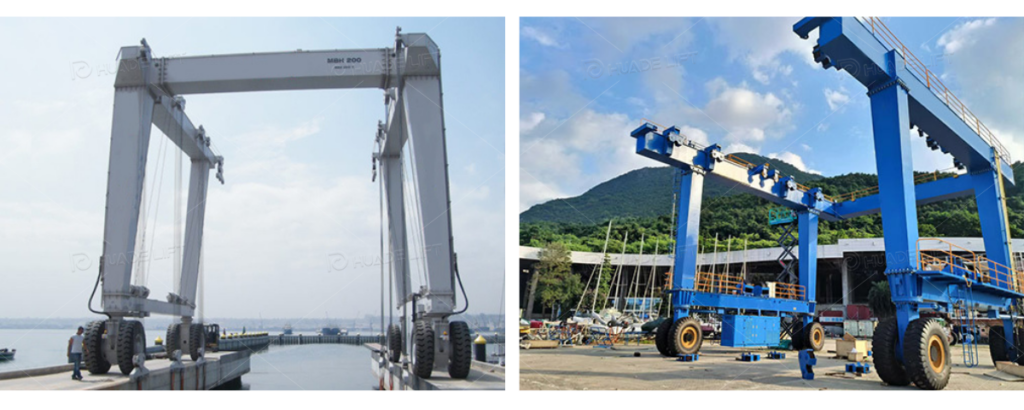
To accurately understand the purpose of a marine travel lift, one must first clarify its core positioning and structural characteristics. Unlike traditional equipment such as fixed cranes or slipways, the marine travel lift is an integrated “mobile lifting and transport” device specifically designed for vessels. Its core principle involves reinforcing slings to support the vessel’s underside, combined with a wheeled gantry structure, enabling vertical lifting, flexible land movement, and precise placement of ships.
Structurally, a complete marine travel lift comprises seven core components that collectively enable its multifunctional capabilities: The gantry frame provides overall support and operational reach, serving as the equipment’s “skeleton.” The lifting system employs nylon slings, pulley blocks, and hoisting mechanisms to raise and lower the hull, ensuring even force distribution. The travel mechanism, composed of multiple wheel sets and steering devices, enables flexible mobility; the hydraulic system delivers stable power for lifting, steering, and driving; the control system ensures precise operation via the operator cabin or remote control, guaranteeing task accuracy; the power system supplies energy for the entire equipment’s operation; safety devices, including limit switches, overload protection, and emergency stop modules, reinforce operational safety.
Compared to fixed cranes constrained by tracks and limited adaptability to slipways, marine travel lifts leverage “mobility + versatility” as core advantages. They accommodate diverse vessels—from leisure craft to large yachts and commercial ships—navigating narrow marina spaces with agility while achieving precise positioning in shipyard complexities. This foundation enables their extensive application across diverse scenarios.
Water-land Transfer
The most fundamental and core function of a marine travel lift is to enable the safe transfer of vessels between water and land, serving as a “bridge” connecting these two operational environments. Whether for routine vessel maintenance, seasonal lay-ups, new ship launches, or emergency rescue operations, this capability is indispensable.
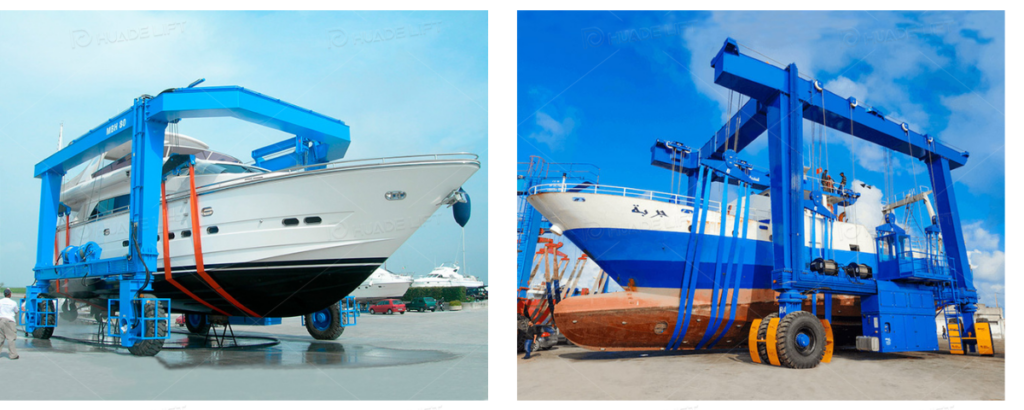
In routine operations, “vessel haul-out” represents the most common application scenario. For vessels operating continuously in water, hulls are prone to marine fouling and corrosion, necessitating periodic haul-out for cleaning and maintenance. During this process, the marine travel lift precisely positions reinforced slings beneath the hull at predetermined lifting points. Utilizing its hydraulic system, it slowly lifts the vessel vertically out of the water. Once airborne, the travel mechanism transports the ship to designated hard-surface areas or repair stations. This operation requires no fixed tracks, allowing flexible route adjustments based on site layout and significantly boosting transfer efficiency.
Marine travel lifts also play an irreplaceable role in launching vessels. Whether for a new ship’s maiden launch or a vessel returning to water after maintenance, the equipment ensures safe transfer to the water’s edge through smooth lifting and precise movement. It then gently lowers the vessel into the water, preventing hull damage from shore collisions. Particularly for categories demanding extreme precision during launching—such as yachts and high-end commercial vessels—the marine travel lift achieves millimeter-level positioning through its precise control system, ensuring a safe and stable launching process.
Additionally, within marinas or shipyards, the marine travel lift handles cross-area transportation tasks. For instance, they move vessels awaiting repair from berthing docks to repair workshops, transport completed repairs to storage areas, or flexibly reposition vessels based on workstation scheduling needs. This adaptable transfer capability overcomes the spatial constraints of fixed equipment, streamlines site operations, and significantly enhances space utilization in maritime facilities.
Storage Scheduling
In scenarios such as marinas, yacht clubs, and vessel storage facilities, the conflict between limited space resources and growing vessel storage demands is becoming increasingly prominent. Marine travel lifts, with their flexible transfer capabilities and stable load-bearing performance, have emerged as an “efficient tool” for optimizing vessel storage scheduling and enhancing site utilization.
In seasonal storage scenarios, marine travel lifts play a critical role. For instance, during winter’s colder temperatures, some vessels must be taken out of service and stored ashore to prevent ice formation from damaging hulls. In summer’s peak sailing season, idle vessels also require temporary storage to free up dock space for active craft. Marine travel lifts swiftly lift vessels out of the water and transport them to land-based storage areas, enabling compact vessel arrangement. Compared to traditional waterborne storage, land-based storage not only reduces marine fouling and corrosion but also significantly conserves water space, allowing limited dock resources to serve more operational vessels.
The flexibility advantages of marine travel lifts become even more evident in temporary storage and workstation scheduling scenarios. Vessels awaiting repairs, new ships ready for launch, and yachts awaiting customer pickup all require temporary parking areas. Marine travel lifts can dynamically adjust vessel positions based on available space, preventing congestion and ensuring smooth workflow. For instance, when workshop bays become vacant, vessels awaiting repair can be swiftly transferred to those bays. When berths open up at the dock, stored vessels can be moved to the dock for launching, enabling seamless coordination across all stages.
Furthermore, for high-end yachts, private vessels, and other categories with specialized storage requirements, marine travel lifts can integrate with dedicated storage facilities to ensure secure vessel preservation. Through precise maneuvering, vessels are gently positioned on specialized storage racks or within indoor warehouses, preventing hull collisions with other objects while minimizing damage from direct sunlight, wind, and weather exposure. This safeguards the quality of vessel storage.
Customized Solutions for Specific Scenarios
Beyond these core applications, marine travel lifts can also adapt to various specialized maritime scenarios, providing tailored solutions for vessel operations across different sectors. Their applications now span commercial, military, and emergency rescue domains.
Commercial Vessel Sector
Marine travel lifts meet the operational needs of fishing vessels and small cargo ships. Fishing vessels operate continuously at sea, requiring regular replacement of nets and fishing gear, while their hulls undergo frequent maintenance due to seawater corrosion. Marine travel lifts swiftly lift fishing vessels out of the water, facilitating equipment replacement and repairs. Small cargo vessels may require transshipment between different docks or regions due to cargo handling needs. Marine travel lifts enable cross-regional transshipment through their flexible mobility, facilitating efficient loading and unloading operations.
Military Domain
Marine travel lifts serve as critical equipment for maintaining naval vessels. Military craft like patrol boats require regular maintenance to ensure mission reliability. Marine travel lifts meet the stringent demands of military vessels for precision, safety, and confidentiality, enabling secure vessel transfer, inspection, and storage within military bases to support maritime operations.
Emergency Rescue Scenarios
Marine travel lifts serve as vital rescue tools. During crises like vessel grounding, pre-sinking malfunctions, or hull damage, these lifts rapidly deploy to the scene. They smoothly hoist vessels and transport them to safe zones, preventing further damage while minimizing casualties and property loss. For instance, when a fishing vessel runs aground near the coast, the marine travel lift can lift it off the shoal and transport it to a repair area for restoration, minimizing losses caused by the incident.
Core Competencies of Marine Travel Lift
The marine travel lift‘s versatility in handling water-to-land transfers, maintenance support, storage scheduling, and specialized scenarios stems from its inherent performance advantages. These strengths enable it to maintain efficient and safe operations across diverse environments.
Robust Load-Bearing Capacity
The equipment covers a full range of load specifications, from small recreational boats to large commercial vessels and luxury yachts. Load capacity can be customized according to operational requirements, ensuring safe lifting and transfer for vessels of varying tonnage and dimensions. Whether handling a few-ton private dinghy or a hundred-ton commercial fishing vessel or yacht, a suitable marine travel lift model is available.
Exceptional Maneuverability and Precise Control
Equipped with accurate steering and control systems, the equipment navigates complex terrains like marinas and shipyards with agility, enabling precise vessel positioning and placement even in confined spaces. Meanwhile, an intuitive control system and ergonomically designed operator cab reduce operator fatigue, further enhancing operational precision and efficiency.
Customizable Adaptability
Adjustable beams and lifting points, combined with slings of varying materials and designs, accommodate vessels of different hull shapes and structures. This ensures even force distribution during lifting, preventing damage. For specialized vessel requirements, beams, slings, and control systems can be customized, further expanding application scope.
Robust Construction and Comprehensive Safety Features
Marine environments feature high corrosion and humidity. Constructed from high-strength steel with advanced anti-corrosion coatings, the marine travel lift effectively resists seawater corrosion, UV exposure, and long-term operational wear, extending equipment lifespan. Simultaneously, safety devices like overload protection, emergency stop, and limit switches provide comprehensive safeguards for operators and vessels, ensuring worry-free operations.
Low Maintenance Costs and Eco-friendly Design
Utilizing premium core components with minimal wear rates and simplified maintenance procedures, the equipment effectively reduces downtime and lowers operational expenses. Furthermore, select models support electric or hybrid power systems for lower energy consumption. Combined with environmentally friendly materials and manufacturing processes, they meet the green development demands of the modern maritime industry, enabling widespread application in scenarios with stringent environmental requirements.
Maintenance Support
As equipment operating long-term in complex marine environments, regular maintenance is crucial for ensuring navigation safety and extending the service life of vessels. The marine travel lift serves as the “core support” for ship repair operations, providing a stable, stress-free working environment for all types of maintenance tasks. It accommodates the full spectrum of requirements, from routine upkeep to major overhauls.
For fundamental hull maintenance, marine travel lifts can completely lift vessels out of the water, fully exposing underwater components like the hull bottom, propellers, and rudders. This creates optimal conditions for tasks such as rust removal, painting, and anti-corrosion treatment. Traditional equipment struggles to achieve full hull exposure, forcing maintenance crews to work underwater or partially submerged—a process that is inefficient and fraught with safety hazards. In contrast, marine travel lifts securely position vessels on solid ground or specialized supports, allowing technicians to work from multiple angles without blind spots. This not only enhances maintenance quality but also significantly reduces operational risks.
For critical mechanical components like engines, propellers, and drive shafts—often located below the waterline—the marine travel lift becomes indispensable. These parts require complete removal from water for disassembly, inspection, or replacement. By precisely adjusting the position of lifting beams and slings, the lift maintains the hull’s equilibrium, preventing deformation or component damage from uneven stress distribution. Simultaneously, the equipment’s stability ensures the vessel remains stationary during repairs, providing maintenance personnel with a secure and stable working environment.
In major ship refit scenarios, the marine travel lift is an indispensable core piece of equipment. Whether undertaking hull structural modifications, deck equipment upgrades, or internal system overhauls, the vessel must remain in a stable, land-based state for extended periods. With its formidable load-bearing capacity, the marine travel lift can hoist large commercial vessels or luxury yachts, transferring them to dedicated refit areas while ensuring continuous stability throughout the process. This guarantees the smooth execution of complex refit projects. Furthermore, the equipment’s adaptability to various hull shapes and sizes accommodates the refit and transfer needs of non-standard and custom vessels, significantly expanding its application scope within the maintenance sector.
Typical Application Scenarios
Given its versatile applications and distinct advantages, the marine travel lift has become essential equipment across multiple maritime scenarios. Its usage spans the entire spectrum from civilian to commercial operations, covering routine tasks to specialized requirements. Key application areas include:
Marinas
As one of the core applications, travel lifts facilitate daily lifting, maintenance transfers, and temporary storage for yachts and leisure craft. They support regular marina operations and enhance operational efficiency.
Ship Repairyards/Dry Docks
They handle core transfer tasks for ship repairs, refurbishments, and component replacements, providing a stable operational foundation for various maintenance works. They accommodate repair needs ranging from small vessels to large commercial ships.
Fishing Port
Serves the daily maintenance, equipment replacement (fishing nets, gear), and repair of fishing vessels, enabling rapid restoration of operational capability and safeguarding fishing productivity.
Military Bases
Provide maintenance, repair, and storage services for military craft including small boats and patrol vessels, meeting stringent military requirements for precision, safety, and confidentiality.
Yacht Clubs
Offer dedicated launching, maintenance, and storage services for high-end yachts, ensuring vessel safety and quality while elevating club service standards.
Vessel Storage Base: Facilitates seasonal and long-term vessel storage through high-density berthing, optimizing space utilization and reducing storage costs.
Emergency Rescue Site: Delivers rapid lifting and transfer services during emergencies like vessel groundings or malfunctions, minimizing incident damage while safeguarding personnel and vessels.
Conclusion
From water-land transfer and maintenance support to storage scheduling and emergency rescue, marine travel lifts have become indispensable “all-purpose equipment” in the maritime industry thanks to their versatile applications and core advantages. They break down operational space barriers and optimize site efficiency while reducing operational costs and enhancing operational stability through precise and safe performance. As the maritime industry evolves, the vessel fleet and operational demands continue to grow. As a core support equipment, marine travel lifts will expand their applications into more customized and high-end scenarios, continuously empowering the industry’s high-quality development.
For operators, selecting equipment that matches their needs and delivers reliable performance is key to enhancing efficiency, controlling costs, and ensuring safety. Future technological advancements will drive breakthroughs in load capacity, maneuverability, environmental sustainability, and intelligence, providing more innovative solutions for maritime operations.
