
Why Understanding Rubber Tyred Gantry Crane Price Matters
Rubber Tyred Gantry, as a key equipment in logistics and port operations, is a major investment project, and its price fluctuations directly affect the overall capital planning and project profitability. Mastering the logic of rubber tyred gantry prices and RTG crane cost not only helps purchasers accurately plan capital expenditures and reasonably screen suitable models and suppliers, but also effectively identifies the core cost-driving points, explores potential cost-saving space, and provides reliable support for the development of long-term operation and maintenance budgets.
How Lifting Capacity Affects Rubber Tyred Gantry Crane Price
Core Correlation Between Lifting Capacity and Price
Lifting capacity is the core key factor affecting the rubber tyred gantry crane price and RTG crane cost, and the two are not simply linear correlation, but with the gradual increase in the lifting capacity, the price shows an obvious accelerated upward trend.
Key Factors Increasing Costs
In order to stably carry a larger load, the main body of the equipment needs to adopt a heavier, higher strength grade steel structure, which not only increases the amount of high-quality steel, but also improves the difficulty of welding, machining and other processes, which directly pushes up the cost of materials and manufacturing; and at the same time, it needs to be equipped with a higher-power electric motor and hydraulic system, with a more sophisticated safety protection and control system to protect the safety of heavy-duty operations, and the process of load testing, stability testing, etc., after manufacturing.
Selection Principles
When selecting a model, it is necessary to focus on the actual operational needs, comprehensively sort out the core load scenarios of daily operations, and clearly define the upper limit of the required lifting capacity, as well as combining with the future expansion of production capacity and expansion of operational scenarios of the enterprise’s planning to make a comprehensive judgment. Not only to avoid excessive specification leads to waste of investment in the early stage, but also to prevent the lifting capacity is not enough to limit the flexibility of the subsequent operation, to achieve the precise matching of demand and cost.
How Working Environment Impacts Rubber Tyred Gantry Crane Price and Cost
Equipment in Different Operating Environments
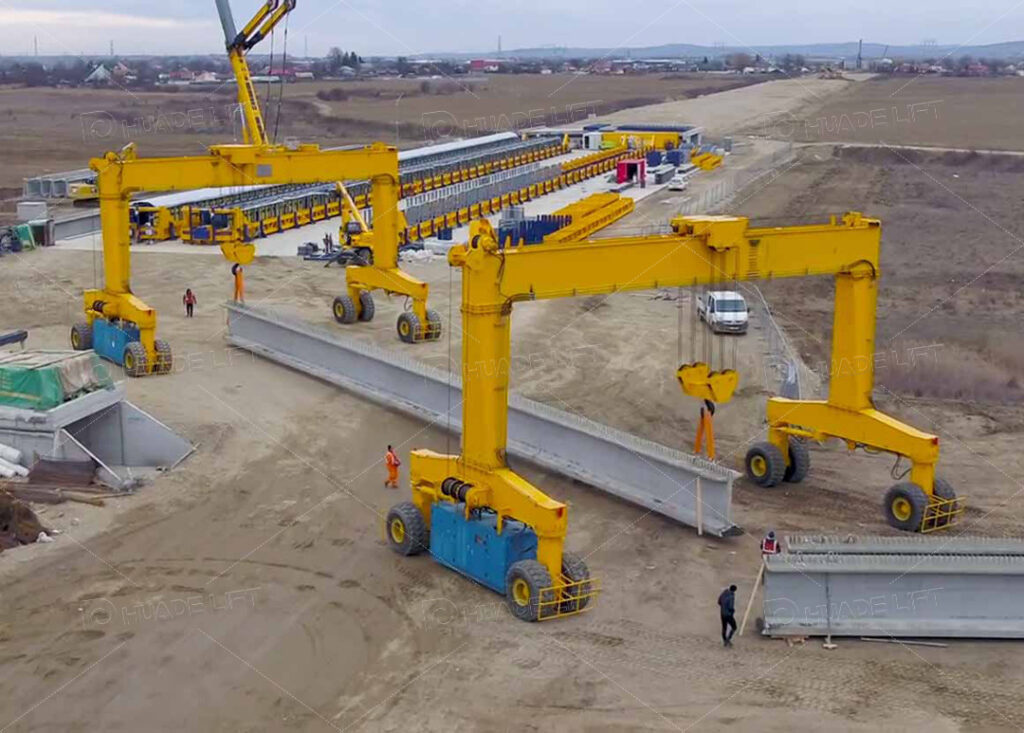
Rubber tyred gantrys operate in a variety of scenarios, ranging from open container yards, coastal intermodal terminals to indoor industrial logistics facilities, and so on, with significant differences in working conditions, and consequently, different requirements for the performance and protection capabilities of the equipment, which will ultimately affect the cost of manufacturing.
Environmental Factors Affecting Costs
Wind load, climate conditions, ground flatness, frequency of operation and continuous working period are the core factors affecting costs at the environmental level. Rubber tyred gantrys operating in harsh environments, such as high temperature and humidity, salt spray erosion, or rugged ground, need to be equipped with enhanced structural protection devices and highly durable components to effectively resist environmental erosion and wear and tear, and to extend the service life of the equipment.
Cost-Balancing Logic Behind Special Designs for Harsh Environments
The cost-balancing logic of environment-adapted design environments may increase the initial procurement cost due to material upgrading and structural reinforcement, but it can significantly reduce the failure rate and maintenance and replacement expenses in long-term operation and maintenance, and achieve overall cost optimization from the perspective of the whole life cycle of the equipment, balancing short-term investment and long-term benefits.
How Power Supply Options Influence Rubber Tyred Gantry Crane Pricing
Core Differences Between Three Power Modes
Rubber tyred gantrys are mainly available in three power modes: electric, diesel, and hybrid. Due to different core technologies, component configurations, and ancillary needs, there are obvious differences in the upfront purchasing price and long-term O&M cost.
Cost Comparison (Electric RTG Crane vs Diesel RTG Crane Cost)
From the perspective of upfront investment, electric rubber tyred gantry requires supporting power supply facilities, high-precision electronic control systems and special motors, so the cost of core components and supporting engineering is higher, and the initial investment is relatively high; diesel rubber tyred gantry relies on mature engine technology, and does not require complex supporting power supply equipment, so the upfront investment has an obvious advantage.
Selection Principles
When purchasing rubber tyred gantrys, it is necessary to combine the environmental policy requirements of the operation scenario, the stability of on-site energy supply and the long-term budget planning of the enterprise to make a comprehensive decision, taking into account the suitability of the equipment and the cost-effectiveness, and finding a balance between the short-term investment and the long-term operation and maintenance of a controllable economy.
How Steering Modes Affect Rubber Tyred Gantry Crane Price
Core Reason for the Impact on Prices
The core impact stems from the differences in mechanical complexity, component configuration and subsequent supporting costs corresponding to different steering modes. There is an obvious difference between basic and advanced steering modes in terms of core components, and advanced modes need to be equipped with independent wheel actuators, precision steering systems, and reinforced steering racks, among other components.
Additional Costs of Complex Steering Mode
Complex steering mode not only increases the cost of mechanical components, but also requires upgrading of the power system to adapt to higher drive power requirements, as well as reinforcing the structure of the equipment, and strengthening the main beams, outriggers and beams to ensure the safety of operation under sidewalk and full-swing conditions. In addition, the advanced steering mode requires multiple rounds of precise calibration and testing under multiple working conditions, which prolongs the production cycle and incurs additional testing and debugging costs.
Suggestions for Selection
Basic steering modes such as fixed-point steering and unidirectional steering are taken as the benchmark price, while the price of advanced modes such as full-wheel steering and crab steering will increase by 15%-30% in turn. Selection needs to be combined with the needs of the operating scenario: the basic mode can be used for straight-line operation in open areas, and the advanced mode can be upgraded when frequent repositioning and lateral docking are required in narrow areas, so as to avoid wasting costs by blindly increasing the allocation.
How Customization Increases Rubber Tyred Gantry Crane Cost
Reasons for Customization Demand
The standard configuration of rubber tyred gantry can only meet the generalized basic operation demand and adapt to the regular operation scenarios and processes.
Customization needs will directly push up the overall RTG crane customization cost , the cost of the amplitude of the code with the technical complexity of the custom content, the scope of the transformation is closely related to the transformation of the more in-depth, the higher the technical difficulty, the more significant increase in cost.
Customization Direction and Cost Impact
The common customization direction covers a number of core dimensions, each adjustment needs to be targeted to optimize the equipment configuration. Lifting capacity adjustment is not a simple replacement of components, the main structure of the equipment, the core load-bearing components to carry out a comprehensive transformation and reinforcement; operating speed optimization needs to be upgraded drive system and transmission components, these transformations will produce a corresponding premium cost.
In addition, control system upgrades and safety function enhancement are also mainstream customization needs, intelligent control system and customized safety technology commissioning, need to match the original system of the equipment, which further pushes up the overall cost.
Cost Control Principles
The core of customization cost control is “accurate adaptation, according to the needs of the trade-offs”, which can be implemented in three aspects:
Pre-sort out the core requirements: the joint operations department to clarify the necessary selection of customized items and operational pain points, and resolutely eliminate non-core redundant functions, to avoid ineffective allocation.
Setting the upper limit of customization cost: Combined with the project budget, agree with the manufacturer on the customization premium range and the overspending adjustment mechanism, so as to strictly control the cost from the source.
Prioritize modular customization: Reduce design and modification costs with the help of modular components, taking into account future expandability and avoiding the waste of one-time full-volume customization.
What Installation Costs Should Be Considered in the Project
Installation and Site Preparation
Installation and site preparation cost is an important part of the overall investment of rubber tyred gantry installation cost, which is easy to be neglected but directly affects the project schedule, installation quality and budget control.
Core Cost Composition
The cost of foundation works should be combined with the self-weight and load of the equipment to reinforce the foundation and build a support structure to avoid ground settlement and equipment deflection in the later stage; meanwhile, it also includes the cost of ancillary system installation (cable laying, system debugging) and professional training of the operators to ensure that the equipment is operated in a standardized manner.
Cost Control Suggestions
Docking equipment manufacturers and installation teams in advance, scientific planning of installation and site preparation time nodes and implementation of the program, accurate accounting of the work of manpower, materials and technical services costs, set aside a reasonable budget flexibility space, can effectively avoid budget overruns caused by unforeseen circumstances, and at the same time to protect the installation process in an orderly manner, to ensure that the project landed in a timely manner, the smooth commissioning of the equipment.
How Brand and After-Sales Support Influence Total Ownership Cost
Brand influence and after-sales service quality directly determine the investment benefit of the whole life cycle of the equipment.
Hidden Value of After-sales Service
High-quality after-sales service usually covers regular door-to-door maintenance, adequate supply of original spare parts and continuous professional technical training. These services can detect potential equipment failures in advance, effectively reduce downtime, reduce maintenance costs and spare parts replacement expenditures, while extending the service life of the equipment and operational stability. On the contrary, imperfect after-sales service is prone to shortage of spare parts, lagging maintenance response and other problems, leading to the later operation and maintenance into passive, significantly pushing up the total cost of ownership.
Suggestions for Selection
When selecting a model, it is necessary to establish a comprehensive cost concept, taking into account the initial purchase price and long-term service guarantee, and not to ignore the quality of service for the sake of low price. Priority should be given to suppliers with good brand reputation and perfect after-sales service system, and service terms should be included in the procurement considerations, so as to optimize the whole life-cycle cost and enhance the return on investment of the equipment through high-quality services.
What Hidden Costs Exit Beyond the Purchase Price
Rubber tyred gantry’s overall investment cost far exceeds the initial purchase price, forming a major part of the RTG total cost of ownership, and hidden costs account for a significant and easily overlooked portion of the total cost of ownership.
Potential Impact of Hidden Costs
The downtime caused by equipment failure not only directly delays the progress of cargo loading and unloading, stockpiling and other operations, but also may trigger a chain reaction of stagnation in upstream and downstream segments, resulting in additional economic losses and credibility impact. At the same time, the energy consumption and expenditures on lubricants, coolants and other consumables in the operation of the equipment will gradually accumulate in the long-term operation, and become a component of the total cost of ownership that cannot be underestimated.
Suggestions for Avoidance
Low-priced equipment mostly has short boards in quality and core components, and it is easy to push up the hidden cost due to faults, high energy consumption, and fast loss of spare parts, so to avoid the “low-priced trap”, we can refer to the following suggestions:
Verification of the core configuration and quality: Compare the steel structure materials of different brands of equipment of the same type, the brands of core components, and the standards of quality control, and reject the low-priced products with no quality assurance. Reject low-priced products without quality assurance.
Calculate the full-cycle cost: Combine the estimated energy consumption, maintenance frequency, downtime loss, etc., to establish the obvious and hidden cost measurement model, instead of simply using the initial purchase price to make decisions.
Binding operation and maintenance guarantee terms: Define suppliers’ maintenance cycle, spare parts timeliness and charging standards, and prioritize brands with perfect after-sales service to reduce the cost of uncertainty in operation and maintenance.
Reference to industry reputation cases: Research the use of similar enterprises feedback, check the hidden cost of hidden dangers, to avoid stepping on the pit.
How Buying Directly from Manufacturers Can Reduce Project Costs
Directly docking with rubber tyred gantry manufacturers for procurement can eliminate the layers of price premiums in the intermediate links from the source, and realize the accurate control and transparency of procurement costs.
Cost Savings of the Direct Supply Model
Manufacturer direct supply adopts the factory direct shipment model, the offer directly reflects the actual cost of equipment production and reasonable profits, profit margins are transparent and controllable, no duplication of administrative fees, channel commissions and other additional expenditures, which significantly reduces the core procurement costs. At the same time, the manufacturer is equipped with a professional engineering design and technical team, can be in-depth docking purchaser’s actual operating scenarios and needs, to provide targeted scenarios of customized design, accurate optimization of the equipment structure, the core parameters and configuration of the program, from the root cause to avoid the ineffective cost of over-specification waste.
Advantages of Scale Purchasing
For scale projects of multiple equipment purchasing, direct connection to the manufacturer can also gain additional bargaining space and preferential policies by virtue of the advantage of bulk orders, further expanding the cost savings. This direct supply model not only reduces procurement expenditure, but also synchronizes the quality of equipment and delivery efficiency, and improves the return on investment of the project in all aspects.
Common Mistakes That Increase Overall Purchase Costs
Common Procurement Misconceptions
Procurement of cognitive misconceptions easy to push up the total cost of ownership, the root cause is the rubber tyred gantry price logic, their own needs and adaptability of cognitive bias, the specific performance of the three categories, will increase the cost of procurement and long-term operation and maintenance:
Do not understand the price differences in the core reasons: purchasers are more concerned about the surface of the price quotes, ignoring the back of the configuration, process, brand and service differences. Blindly choose the low-priced models easy to buy reduced products, and later due to rapid wear and tear of components, more failures, resulting in high maintenance and downtime costs.
Blindly linked to the price and performance: there is a “high price is excellent” or “low price is enough” two extremes. The former pays a premium for useless functions and wastes investment, while the latter neglects adaptability, leading to inefficient and high consumption of equipment and pushing up total life cycle costs.
Insufficient or excessive configuration: insufficient configuration requires later transformation, which increases costs and reduces stability; excessive configuration is blindly upgraded for potential demand, which not only raises initial costs, but also increases energy consumption and maintenance difficulties.
Selection Methods to Avoid Misconceptions
To avoid procurement misconceptions, we need to follow scientific selection methods, focusing on the balance between demand and cost, specifically from four aspects:
Anchor the core operational requirements: joint operations to sort out the key parameters such as load, frequency, site, etc., to clarify the necessary indicators, to eliminate blind upgrades for the potential demand, to avoid the waste of over-specification.
Dynamic selection in combination with long-term planning: taking into account 1-3 years of production capacity and scene expansion needs, give priority to modular upgradeable equipment rather than one-time overmatching, balancing the current cost and future adaptability.
Establish a multi-dimensional evaluation system: Abandon the “price-only theory”, consider configuration, quality, energy consumption, and after-sales service, and establish a full-cycle cost model to compare short-term purchase price with long-term operation and maintenance expenses.
Pre-verification of adaptability: Through simulation tests or reference to similar cases, the adaptability of the equipment is verified to avoid the hidden costs caused by later transformation and poor adaptability.
Conclusion
Rubber tyred gantry crane cost control is a systematic work, need to cover procurement, customization, installation and full life cycle operation and maintenance costs, to establish a comprehensive cost concept; the core of the selection is to accurately match the operational needs, under the premise of ensuring efficiency and safety, balancing the short-term budget and long-term benefits, cost optimization needs to grasp the price drivers, preferred direct supply channels and cost-effective brands, through scientific selection and channel control. Through scientific selection and channel control, we can achieve reasonable control of overall costs and maximize investment benefits.
