
In industrial and construction site yards, fixed cranes are bound by the rail, easy to be idle and poorly adapted to changes in operational requirements and layout adjustments, which increases enterprise costs. As a front-line engineer, I found that the mobility of the rubber tyred gantry crane can solve these pain points, and its flexible mobility characteristics, is the core support for flexible yard operations.
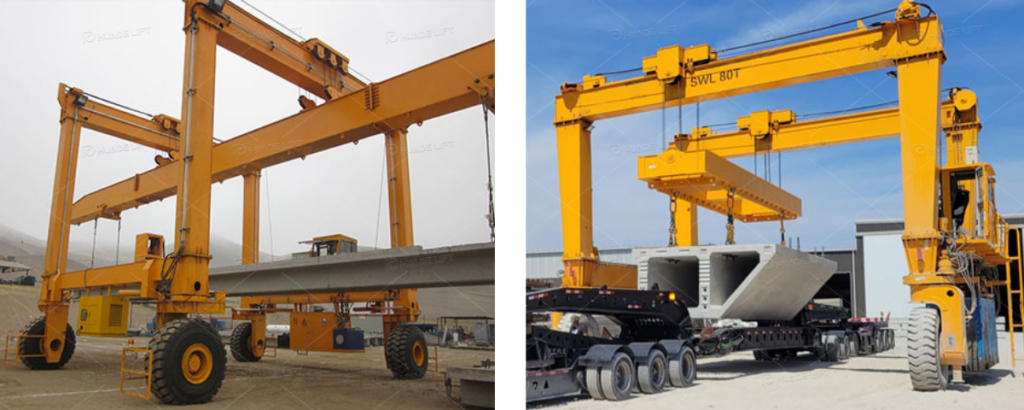
Why Flexible Yard Operations Are Becoming More Common
The Rising of Project-based Operations
Current manufacturing, construction field operation mode has shifted from scale, fixed to project-based, customized, each project’s material type, handling needs are different, the need to flexibly adjust the handling path, stacking area and operational tempo, fixed cranes, “a region of a device” mode of input, easy to idle, can not match the dynamic demand.
In the manufacturing field, the project-oriented characteristics of heavy equipment production is particularly obvious, the difference in orders leads to different types, sizes and weights of parts, yard partition and operation process needs to be adjusted in real time; in the construction field, the same project, the material demand for different construction phases varies greatly, from sand and gravel, reinforcing bars to prefabricated components, the handling demand is always changing dynamically, and it is difficult to adapt to the fixed yard model.
Frequent Adjustment of Yard Layout
Market demand iteration accelerates, enterprises need to frequently adjust the yard layout: on the one hand, after upgrading the product line, the demand for material stacking changes, the need to re-planning partition; on the other hand, the site resources are tense, the need to optimize the layout to improve the space utilization rate. Fixed cranes are restricted by the rail, can not move with the layout adjustment, and may even become an obstacle to the operation.
Expansion of Temporary Yard Operations
Construction, large-scale engineering field, temporary, semi-permanent yards are becoming more and more common, the use of such yards cycle is short, flexible operational needs, designed for specific projects phase demand services, the project is required to dismantle or integration. Fixed cranes need to lay tracks and build foundations, with high investment and long cycle time, and the infrastructure can not be relocated after the end of the project, which is a serious waste.
Rubber tyred gantry does not require complex infrastructure, only need to level the hardened ground can be quickly deployed, after the end of the project can be relocated to other sites through the trailer reuse, perfectly suited to the temporary yard scenarios, significantly reducing equipment investment and waste of resources.
Limitations of Fixed Cranes
Fixed cranes in the traditional fixed yard, although stable, but in the flexible scene shortcomings are obvious:
Limited Adaptability
The machine is restricted by the tracks and cannot cross obstacles,making it unusable during operating area adjustments,layout changes,or temporary blockages;
High Infrastructure Cost
The construction of tracks requires substantial time and effort,and ongoing maintenance adds to the overall cost;
Low Equipment Utilization
Equipment can only serve a specific area and is prone to idling due to limited resources and fluctuating workloads, increasing pressure on corporate funds.
Flexible yard cranes with rubber tires can make up for these shortcomings, becoming the ideal choice for flexible yard.
Why Mobility Matters in Industrial Operations
Dynamic Operational Scenarios
With the advancement of Industry 4.0, manufacturing, construction, shared yards and other scenarios are all transformed to dynamic and flexible, the operational program needs to be adjusted in real time according to the orders, materials, site conditions, mobility has become the core design elements of the gantry crane.
In manufacturing, production schedules are adjusted based on orders. Sometimes heavy components may need to be handled, other times multi-regional material transfer is required. And on construction sites, weather conditions and material availability can dictate dynamic changes, which require cranes to be able to react quickly to maintain the normal flow of construction.
Core Practical Value of Mobility
Rrubber tyred gantry crane mobility is not simply “can move”, but can enhance the value of yard operations in all aspects, to solve the core pain points of the enterprise, these values are from my actual project experience.
A Single Device Covers Multiple Areas
A single mobile material handling crane can switch between multiple areas, eliminating the need for multiple stationary cranes. This maximizes equipment utilization.
Reduced Equipment and Manpower Investment
A mobile yard crane replaces several stationary units, which not only reduces the need for operators, but also simplifies the management process.
Breaking Through Track Limitations
Rubber tire cranes can travel freely on hardened surfaces, thus maximizing space utilization in shared yards.
Reduced Infrastructure and Maintenance Costs
No tracks need to be laid, and maintenance involves only the tires and chassis, not the tracks themselves.
Rapid Deployment and Relocation
Deployment takes around 2 days, compared to weeks/months for fixed cranes, making it suitable for emergency or temporary operations.What Makes Rubber Tired Gantry Mobility Unique
What Makes Rubber Tyred Gantry Mobility Unique
Core Design: Rubber Tires vs. Rail Steel Wheels
Rrubber tyred gantry crane mobility unique core of the walking parts design and traditional rail cranes are fundamentally different, which is also the most common customer inquiries.
Limitations of traditional rail cranes
Traditional gantry cranes are designed with steel wheel tracks, which are stable and highly accurate, but highly inflexible, and cannot operate when the tracks are damaged or blocked, and cannot adapt to the layout adjustment of the yard, and are prone to idling.
Rubber Tire Bogie Design for Rubber Tyred Gantrys
Rrubber tyred gantry crane adopts rubber tire bogie design, instead of steel wheels and rails, it can drive on various hardened surfaces such as concrete, asphalt, reinforced gravel, etc., and can operate normally as long as the load capacity meets the standard, completely getting rid of the rail constraints.
Additional Advantages of Rubber Tires
Rubber tires can reduce the wear and tear on the ground and lower the cost of ground maintenance, especially suitable for temporary stockyards with low hardening standards; at the same time, the shock absorption effect is good, and the equipment travels more smoothly, avoiding the shaking and falling when handling materials, and protecting the safety of materials and equipment.
All-Round Job Adaptability Through Mobility
Rubber tyred gantry’s mobility is an all-around job adaptation capability, which is far more than the simple movement of “from point A to point B”, and covers multiple dimensions such as directional adjustment, spatial adaptation, and load movement.
Flexible Adaptation in Complex Environments
Rubber tire crane can flexibly adjust its direction and working position in narrow aisles and irregular areas, avoiding collision with materials and equipments, and adapting to complex yard environments.
Stable Movement Under Load
Unlike ordinary cranes that are flexible with no load and bulky with load,rubber tyred gantry crane is specially designed and debugged to drive smoothly and steer flexibly even when carrying heavy loads, which is especially suitable for precise handling of materials such as heavy prefabricated components and reduces the risk of material damage.
Fast Start and Stop to Match the Rhythm of Operation
Rubber tyred gantry crane start and stop response is fast, can frequently adjust the operating position, to match the fast-paced operation of busy yards, to avoid slow start and stop to affect the efficiency.
Accurate Adaptation to the Needs of Flexible Yards
Rubber tyred gantry crane mobility can be perfectly adapted to the core needs of flexible yards “flexible adjustment, high efficiency and low cost”, to solve the pain points that fixed cranes can not be solved, which is the key to its irreplaceable.
Flexible yards need to be flexible and optimized according to operational needs, material changes, site adjustment, it can quickly deploy the operating area, adjust the mode of operation, without the need for equipment relocation or infrastructure modification; in the construction of temporary yards, the construction progress can be switched to the operating area to adapt to the handling of sand, gravel, prefabricated components, heavy equipment and other materials, to adapt to the future development of the enterprise changes.
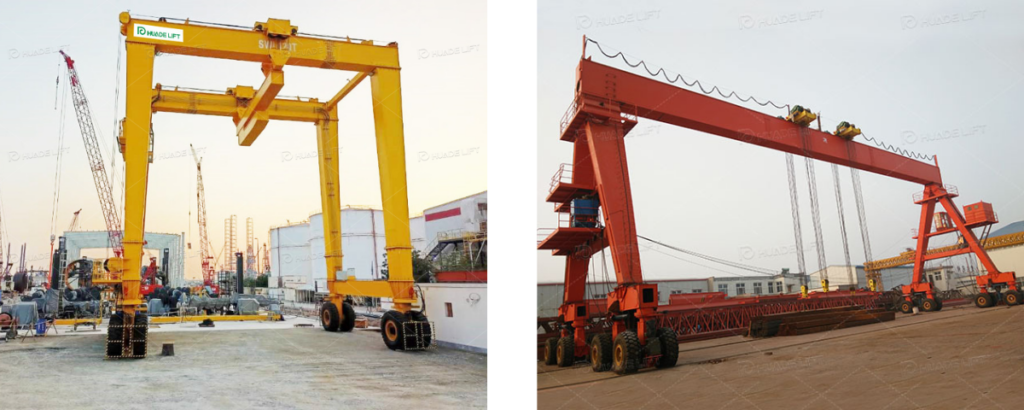
Mobility Advantage: Rubber Tyred Gantry Cranes
Unrestricted Movement
The most prominent advantage of rubber tyred gantry crane is that it is not constrained by the track, and can move freely in the entire hardened yard without presetting the operation path, and it can easily drive in a straight line, make turns, and cross the small obstacles to adapt to all kinds of dynamic yard scenarios.
As the operational requirements of multi-functional areas in industrial factories are changing, it can quickly switch between the areas of raw material warehousing, parts turnover, and finished product warehousing to match the whole production process; as the operational requirements of construction sites are changing rapidly, also can quickly respond to changes in the weather, construction adjustments, etc., and choose the shortest path to transfer materials to save operational time.
Multi-Directional Steering Flexibility
Modern rubber tyred gantry crane is equipped with a multi-mode steering system, which can solve the problems of traditional cranes’ inconvenient turning and occupying a large space, and is suitable for narrow and irregular yard scenes.
Its steering modes include straight-line steering, 90-degree lateral movement, diagonal steering, turntable rotation, etc., which can be flexibly switched according to the site conditions: straight-line steering is suitable for long-distance transfer, 90-degree lateral movement is suitable for narrow passages, and diagonal steering and turntable rotation are suitable for irregular yards to ensure that the narrow space can be smoothly operated and accurately docked.
No Need for Tracks to Save Costs
This is the core difference between rubber tyred gantry crane and traditional rail cranes, and is also the key to its cost reduction. Fixed crane track construction is time-consuming and labor-intensive, the investment can not be recovered, while rubber tyred gantry crane does not need a track, only need to meet the standards of ground bearing capacity can be deployed to significantly reduce the initial investment; no need to maintain the track at a later stage, only need to maintain the tires, the chassis and other components, the long-term operating costs are lower.
Key Mobility Features Buyers Should Pay Attention To
Tire Type and Ground Adaptation
Rubber tyred gantry crane tires are divided into two types: solid tires are wear-resistant, puncture-resistant, and suitable for temporary construction yards with debris on the ground; pneumatic tires have good shock absorption and smooth running, and are suitable for industrial yards with flat ground and handling of precision parts. At the same time, we need to pay attention to the ground bearing capacity and flatness, and reinforce the ground in advance for temporary yards, and regularly maintain long-term yards to avoid affecting the maneuverability and safety of rubber tyred gantry cranes.
Steering System and Turning Radius
The steering system is the core component that affects the maneuverability of cranes, especially for narrow scenarios, so you need to pay attention to the stability and turning radius when purchasing. High-quality steering system can still switch modes flexibly and smoothly under load, avoiding potential safety hazards. The smaller the turning radius is, the more flexible the crane is in narrow spaces, which needs to be selected in combination with the width of the yard and the size of the aisle, avoiding collision with materials and equipment when turning.
Stability Under Load
The mobility of rubber tyred gantry depends on its ability to move smoothly under load, so you need to pay attention to the smoothness and flexibility when purchasing. High-quality crane chassis is reasonably designed, stable center of gravity, large tire contact area, no obvious shaking when carrying heavy loads; at the same time, it can still steer and move flexibly under load to ensure operational efficiency and material safety, and it is recommended to test the mobility under load on site.
Match the Actual Working Conditions with the Parameters
Avoid the misunderstanding of “the higher the parameters, the better” when choosing and purchasing, and select the parameters in combination with the size of the yard, type of materials, handling distance, and operating rhythm. Temporary storage yards do not need too high driving speed, focus on steering and load stability; large industrial storage yards can pay attention to driving speed; at the same time, reserve 10%-20% parameter redundancy to adapt to future changes in operational requirements, to avoid parameter wastage or insufficiency.
Applications Of Mobile Rubber Tyred Gantry Cranes
Industrial Manufacturing Yard
Heavy equipment manufacturing, large parts processing and other industries, the weight of materials, many types of complex and dynamic operational needs, rubber tyred gantry can be flexibly adapted to different material handling needs, rapid switching between multiple areas, with the production process; at the same time to adapt to the customized orders brought about by the adjustment of the layout of the yard, to avoid idling equipment, improve operational efficiency.
Construction Site Yard
Construction temporary and semi-permanent yards have short duration, flexible demand and complex site, the machine can be quickly deployed without tracks, switching operation areas to transfer materials such as gravel, steel, prefabricated components and so on in line with the construction progress; in emergency repair and temporary expansion projects, it can be responded quickly to avoid delaying the construction period, and it can be relocated and reused after the project is over to reduce the investment.
Shared Yard in Industrial Park
Shared yard serves many enterprises with different material types and operation rhythms, rubber-tired gantry can flexibly adapt to the handling needs of different enterprises, and a single device serves many enterprises, reducing equipment investment; at the same time, it can adjust the operation area and layout with the changes of the settled enterprises, improve the utilization rate of the yard, and adapt to the flexible needs of the shared yard.
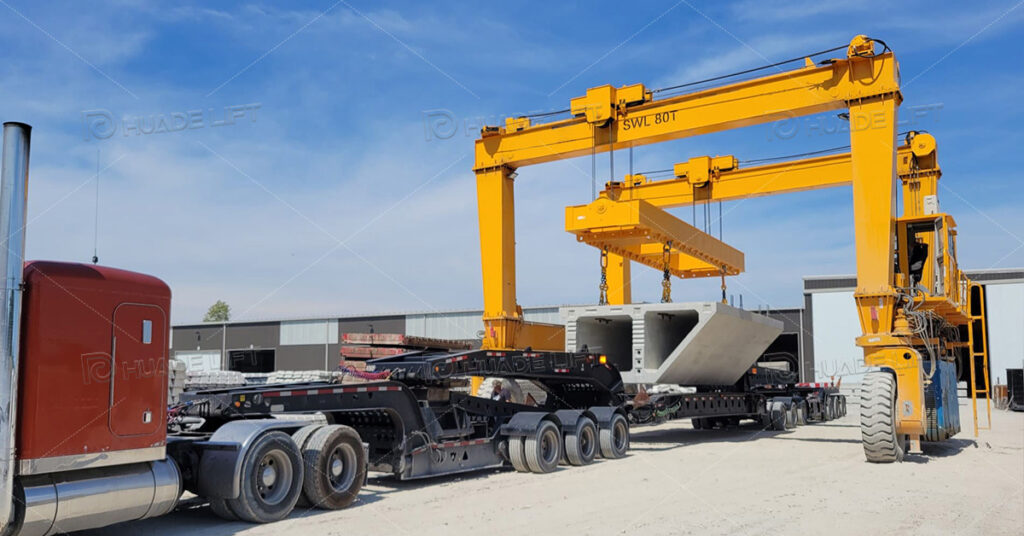
Common Mistakes Buyers Make When Evaluating Gantry Crane Mobility
Blindly Pursuing Lifting Capacity
lifting capacity needs to be matched with the actual weight of the material, blind pursuit of high lifting capacity will increase the procurement cost, reduce equipment mobility, such as small businesses handling 5-10 tons of material, without the need to purchase 20 tons of rubber tyred gantry crane. It is recommended that, according to the weight of the commonly used materials, set aside 10%-20% redundancy can be.
Ignoring future layout changes
When choosing and purchasing, you need to combine with the future development plan of the enterprise, consider the possibility of yard layout adjustment and changes in operational requirements, choose equipment with strong mobility and wide adaptability to avoid idle equipment due to the layout adjustment, which will increase the extra cost.
Thinking All Rubber Tyred Gantry Maneuvers Are the Same
Rubber tyred gantrys from different manufacturers differ in design, components, and processes, and the maneuverability gap is large. High-quality crane chassis, steering system is well-designed, good quality tires, mobility is stronger; small manufacturers equipment is prone to poor movement, steering jams and other problems. When choosing, you need to test the maneuverability on the ground and choose manufacturers with mature technology and perfect after-sales service.
Underestimating Maintenance and Ground Conditions
Neglecting maintenance costs and ground conditions will increase the burden of later operations. You need to choose the equipment with long maintenance cycle, easy procurement of parts and low maintenance cost; at the same time, check the ground conditions in advance to ensure the bearing capacity and flatness, and reinforce it if necessary to avoid affecting the operation of the equipment.
How to Decide if a Mobile Rubber Tyred Gantry Crane is Right for You
Clarifying Operational Requirements
To determine whether rubber tyred crane is suitable, first need to sort out the core needs, including material weight, size, yard size, layout, number of operating areas, rhythm and future planning; at the same time, pay attention to their own pain points, such as idle equipment, low efficiency, high investment in infrastructure, layout adjustment difficulties, etc., its core advantage is to solve these pain points.
Key Evaluation Questions
Can be quickly judged by three key issues: first, whether the layout of the yard changes frequently, frequent adjustment is more suitable for rubber tyred gantry, fixed layout can be considered fixed crane; second, whether space utilization is a key demand, space is tight rubber tyred gantry is more suitable, space is sufficient for flexible options; third, whether the material handling is varied, the complexity of the demand is more suitable for crane, a single material can be considered fixed Crane.
Clarify the Priority of Mobility
If mobility is the core demand, such as temporary yard, shared yard, rubber tyred gantry is the first choice to ensure the smooth progress of the operation; if it is more important to the stability of the operation, accuracy and low procurement costs, and the operation process is fixed, single material, fixed cranes can be considered.
Comprehensive Cost–Benefit Evaluation
Comprehensive assessment of upfront investment, later operating costs and equipment utilization rate: upfront rubber tyred gantry procurement costs are slightly higher, but no rail inputs are required, and the advantages of temporary yards are obvious; later crane maintenance costs are low, utilization rate is high, and the comprehensive benefits of long-term use are better. It is recommended to calculate the return on investment cycle, and choose flexibly according to the use cycle of the yard and operational needs.
Conclusion
Flexible yards have become mainstream, mobility is the core demand, the shortcomings of fixed cranes highlighted. Rubber tyred gantry with rubber tires designed to get rid of the rail bondage, adapted to multiple scenarios, reduce costs and increase efficiency, and its core value is to be transformed into operational benefits. Selection needs to be combined with the working conditions, the future of its technology will continue to upgrade, help enterprises to enhance competitiveness.
