
Understanding Industrial and Project-Based Straddle Carrier Applications
What Industrial and Project-based Handling Means in Material Handling Systems
There is no uniform standard for industrial and project-type handling, the core is to cooperate with the whole process of industrial production or specific projects, to complete the loading and unloading of materials, equipment, transportation and stacking, mostly temporary operations and loads without fixed specifications, and ports only deal with standardized containers of different modes.
The industrial application of straddle carrier is extended from ports to industrial workshops and project sites, its lifting and handling function can replace traditional equipment, and efficiently complete all kinds of difficult material handling with flexibility.
How Straddle Carrier Applications Differ from Port-based Operations
Unlike standardized terminal workflows, straddle carrier non-port applications focus on adaptability to changing sites, irregular loads, and temporary operating conditions.
The application of trans-loader in industrial and project scenarios is significantly different from that of ports, and it is not simply a replacement of the site.
In terms of operating environment, ports have hardened and leveled sites with uniform load-bearing capacity, while industrial and project sites are mostly unhardened temporary sites or complex terrains, which require higher adaptability of straddle carriers to the environment.
In terms of task requirements, ports focus on batch and standardized container handling and pursue speed, while industrial and project sites have diverse loads and irregular distances and pay more attention to operational safety and flexibility.
Typical Characteristics of Non-port and Off-Port Handling Environments
The characteristics of non-port and out-of-port handling environments directly define the core challenges of industrial straddle carrier handling, where ground adaptability, stability, and maneuverability are essential.
There are no standardized hardened yards, uneven ground bearing capacity, obstacles or slopes, which require the straddle carrier to have strong ground adaptability.
The loads are mostly non-standardized materials, with large differences in parameters and unstable center of gravity, which test the lifting and load adjustment ability of straddle carriers.
The straddle carriers are flexible and durable, as the work has no fixed rhythm, and most of the tasks are temporary outdoor tasks and need to cope with bad weather.
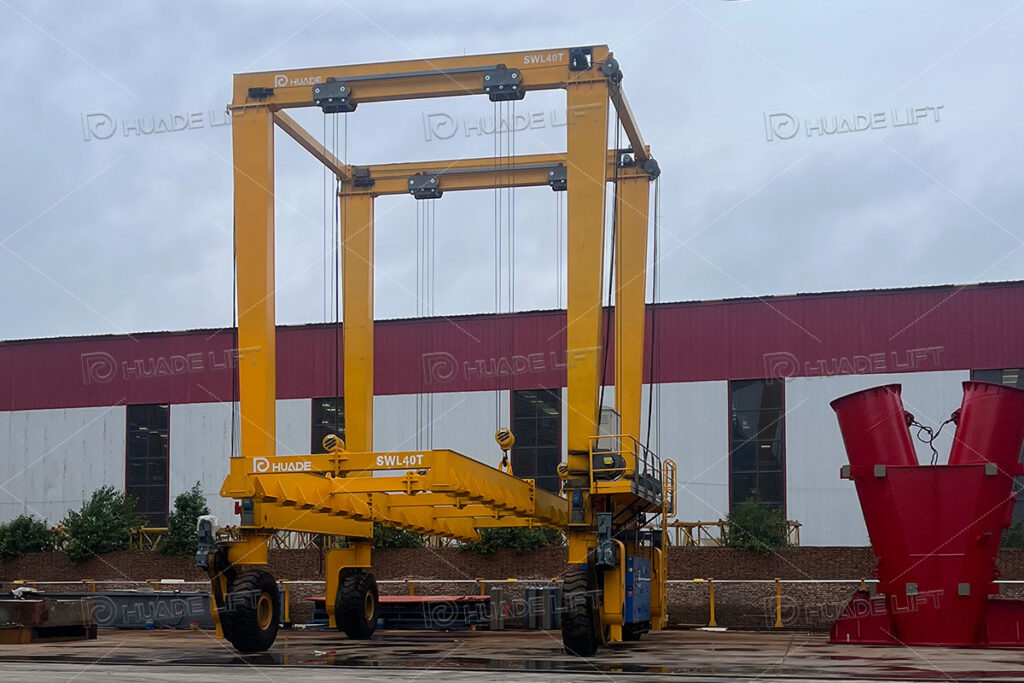
Common Industrial Use Cases for Straddle Carrier Handling
These scenarios represent typical straddle carrier industrial applications, where flexibility and integrated lifting and transport are critical to operational efficiency.
Container Handling Outside Ports and Terminals
The basic application of straddle carrier in the industrial field is the short-distance transfer of containers outside the port, which is concentrated in industrial yards, logistics hubs and project sites, and the core demand is to flexibly connect the production and logistics links.
Container Transport in Industrial Yards and Logistics Hubs
Industrial yards and logistics hubs are mainly short-distance flow of containers, cross-traffic trucks are moderate in size, can pass in the narrow factory roads, and has the integration of lifting and handling functions, without additional equipment, can independently complete the whole process of operation, reduce costs and improve efficiency.
Short-Distance Container Movement within Project Sites
Containers at the project site are mostly used as temporary office and material warehouses, and need to be transferred over short distances with the construction progress, with narrow operation sites, dense personnel and equipment, and prone to collision. With flexible steering and small turning radius, the transporter can precisely adjust the position of containers and slow down the speed in crowded areas to ensure safety and adapt to the construction progress.
Wind Power and Renewable Energy Projects
In renewable energy projects, straddle carrier wind power applications are increasingly used for handling towers, blades, and large prefabricated components in complex terrain.
Handling Wind Turbine Components and Wind Towers
Wind turbine tower is a cylindrical structure, the center of gravity is difficult to fix, cross-transportation vehicle equipped with a special spreader to disperse the force, the operator real-time adjustment of the body posture, to ensure the stability of the transfer.
Wind turbine blades are more than 60 meters long, light in weight and easily damaged by the wind, so the cross-transportation vehicle is equipped with special frames to fix the blades and slowly control the obstacle avoidance to ensure that the blades are in good condition.
Wind Energy Logistics and Large Component Transportation
The transporter runs through the whole link of wind power energy logistics, transferring components at prefabrication and assembly sites to ensure assembly advancement, and accurately transferring components to the installation location after entering the wind farm, adapting to the complex terrain and reducing secondary transportation.
Infrastructure and Bridge Construction Projects
Straddle carriers play a key role in infrastructure projects, and are widely used for their lifting and transferring capacity, which is suitable for heavy-duty component handling to ensure construction progress and quality.
Bridge Segments and Precast Concrete Handling
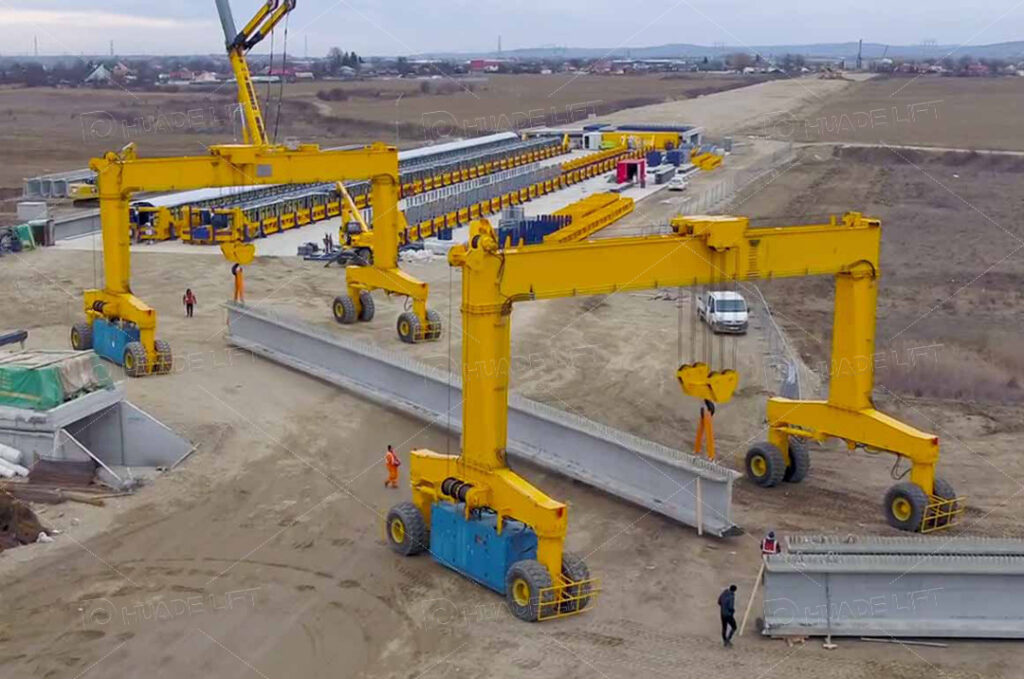
Prefabricated bridge segments are heavy and irregular in shape, making traditional handling inefficient. Straddle carriers can be lifted directly into the prefabrication plant and transported to transportation vehicles or construction sites, ensuring stability and no damage.
Precast concrete components are fragile and prone to breakage. The smooth movement of the straddle carrier reduces bumps and cracking risks to ensure construction quality.
Construction Site Handling for Large Infrastructure Projects
Large infrastructure construction sites are complex, with many obstacles and dynamic adjustments to the work area. The straddle carrier does not need a fixed site, and can travel flexibly to avoid obstacles, quickly complete the movement of components, and follow the rhythm of the construction to adjust the work position, saving preparation time.
Energy Storage and Power Module Handling
In recent years, the rapid development of the energy storage industry, battery containers, energy storage modules and other equipment handling needs to expand, cross-transportation trucks compact size, flexible steering, can be accurately adapted to industrial facilities within the compact site, the application is increasingly common.
Energy Storage Systems and Battery Container Handling
Battery containers weigh dozens of tons and need to be transferred and stacked in short distances inside energy storage power stations. The narrow space makes it difficult for traditional handling methods to operate, but the straddle carrier can complete the whole process independently, which is simple and does not take up much space.
BESS Transportation within Industrial Facilities
The installation of energy storage systems requires high positional accuracy, and the straddle carrier can accurately control the position and angle of battery containers (BESS); during post-maintenance, it can quickly transfer containers that need to be overhauled or replaced, thus shortening the downtime of the power station.
Steel Structures and Large Industrial Modules
Steel Structure Handling and Oversized Industrial Module Handling are important application scenarios of transporter, which can effectively solve the problem of handling oversized and heavy components in steel structure processing, petrochemical, shipbuilding and other industries, and gradually replace the traditional handling methods by virtue of lifting capacity and flexibility.
Steel Structure Handling and Oversized Load Transportation
The weight and shape of steel components vary greatly, the material is special and easy to be deformed by the force, so it is necessary to avoid collision and shaking during the handling. The transporter is equipped with special spreader to disperse the force, and the oversized and heavy components can be operated by multiple trucks to ensure the safety and stability.
Large Module Handling in Fabrication and Assembly Yards
In petrochemical equipment prefabrication module, shipbuilding hull module and other sites, straddle carriers are responsible for transferring modules from the processing area to the assembly area, connecting the production link and guaranteeing the progress, and their compact and flexible features can be accurately transferred in narrow sites without affecting the assembly work.

How Straddle Carriers are Used in Project-Based Handling Operations
In practical terms, straddle carrier project handling refers to the use of straddle carriers for temporary, non-standardized lifting, transportation, and on-site logistics tasks throughout different project stages.
Lifting and Transport Process in Industrial Environments
In the industrial environment, the lifting and transferring process of transporter has no fixed pattern, the operator needs to combine the actual site, clarify the load parameters and transfer distance, adjust the lifting and driving parameters, accurately select the lifting point, avoid shaking and tipping, and ensure stable transferring. In the wind power project, the transporter adjusts the body to align with the lifting point, slowly lifts to monitor the status, and then drives to the designated position after stabilizing to put it down smoothly, the whole process of rigorous operation to ensure safety.
On-Site Transportation and Internal Logistics Workflows
Straddle carrier on-site transportation enables heavy components to be moved directly within the restricted project area without relying on additional lifting equipment, and it can shuttle flexibly in the narrow site without fixed rails and switch the operation area quickly. In large-scale projects, straddle carriers can be used with other logistics equipment to build an on-site internal logistics system, realizing the smooth connection of material transfer and waste removal, and avoiding the accumulation of materials and secondary handling.
Handling Oversized and Heavy Components Safely and Efficiently
Oversized and super-heavy components are of high value and not easy to repair.Straddle carrier heavy load handling offers clear advantages in stability, safety control, and short-distance maneuverability. With strong lifting capacity, it can stably lift dozens to hundreds of tons of components, and is equipped with load limit and other perfect safety protection devices, which can automatically alarm to avoid the risk of overweight; the driving speed can be flexibly adjusted, with special spreaders and support devices to enhance the stability of the handling to avoid shaking and tilting.
Why Straddle Carriers are Selected for Industrial and Project Logistics
Flexibility in Temporary and Changing Job Sites
Industrial and project sites are mostly temporary sites, the operation area is constantly adjusted with the advancement of the project, it is difficult to move the fixed lifting equipment, and the large trailer has high requirements on the site, and the narrow and complex site is impassable. The straddle carrier does not require fixed tracks and hardened areas, and can move flexibly in all types of terrain, with flexible steering to quickly adapt to changes in the work area and keep up with project progress.
Handling Efficiency Compared to Fixed Lifting Systems
Compared with fixed lifting systems such as gantry cranes and tower cranes, transporters are more efficient. Fixed Lifting Systems have a fixed working area, can’t be transferred over long distances, and need to be equipped with trailers, which are cumbersome to install and debug, and prone to delaying the progress; Transporters have the integrated function of lifting and transferring, and can independently complete the whole process of operation, with easy installation and quick commissioning.
Reduced Reliance on Cranes and Trailers in Projects
The traditional project handling needs crane and trailer to work together, increasing the cost of equipment investment, and the need to coordinate the operating rhythm, equipped with more operators, to enhance the cost and complexity of the operation. A straddle carrier can take on lifting and transferring tasks at the same time, replacing some of the functions of traditional equipment, and can be operated by a single operator, especially in temporary and phased projects. This advantage is even more prominent, and can effectively control the cost and avoid delays in the progress of the equipment coordination problems.
Load Characteristics and Handling Capabilities in Industrial Applications
In industrial applications, the effectiveness of straddle carriers depends on whether their handling capacity can be adapted to the load characteristics of the site.
Typical Load Types in Industrial and Project-Based Handling
The handling of industrial and project scenes is dominated by non-standardized loads, such as containers, wind power components, bridge segments, prefabricated concrete components, energy storage modules, steel components, etc. The difficulty of handling containers is lower, while wind power components are more difficult to handle. Among them, containers are less difficult to handle, wind power components, steel components and other irregular shapes, center of gravity is not fixed, the handling difficulty is higher; prefabricated concrete components are easy to break, the energy storage module contains precision parts, the handling needs to avoid bumps, collisions and tilting.
Load Capacity Considerations for Heavy and Oversized Components
When selecting the model, lifting capacity is the core indicator, but also need to consider other factors. The lifting capacity of the transporter needs to be adapted to the heaviest loads on the site, pay attention to the location of the center of gravity of the load and the distribution of the force, to avoid unreasonable center of gravity leading to the potential danger of tipping over; for the extra-long, extra-wide loads, it is also necessary to take into account the operating space of the transporter and the adaptability of the spreader, to ensure that the smooth completion of the lifting and transfer.
Stability and Maneuverability in Confined Job Sites
Industrial and project sites are narrow and have many obstacles, requiring the straddle carrier to be both flexible and stable. With compact size, flexible steering and small turning radius, straddle carriers can weave in and out of narrow sites to avoid obstacles and adjust speed to ensure safety. Equipped with perfect stabilization system and special suspension, they can monitor the body attitude to prevent tipping, adapt to different floors, and minimize the impact of bumps on loads.
Comparison with Other Industrial Handling Solutions
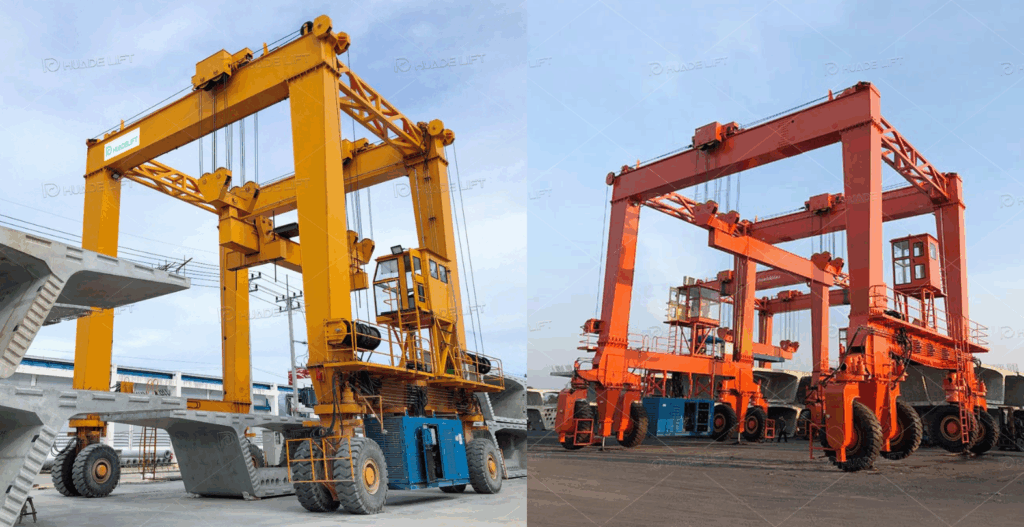
Industrial and project handling, in addition to straddle carriers, there are cranes, trailers, SPMT and other equipment, there is no absolute optimal equipment, there is only equipment that meets the needs of the project, compare the advantages and disadvantages of various types of equipment can be clear direction of selection.
Straddle Carrier Vs Crane in Project-Based Handling
Cranes have strong lifting capacity and high lifting precision, which is the necessary equipment for the lifting of oversized parts, but they can only lift and can not be transported over long distances, and need to be coordinated with trailers, and the installation is complicated, with high requirements for the site, and cannot operate in narrow sites. Straddle carrier has the advantages of integrated lifting and transferring, high efficiency, strong mobility, suitable for narrow and temporary sites, the two are not substitutes, need to work together.
Straddle Carrier Vs Trailer and SPMT for Industrial Transport
Trailers and SPMT are good at long-distance trans-regional transportation, SPMT is strong in carrying, stable in driving, suitable for long-distance transportation of oversized, super-heavy and precision equipment, which is not as good as trans-shipment trucks. However, both of them are only capable of transshipment, but not lifting, and need to cooperate with cranes, and they have high requirements for the site, and cannot pass through the narrow project site. Straddle carriers are more suitable for short-distance transportation at the project site, can independently complete the loading and unloading of transshipment, strong mobility, and can travel through the narrow site to make up for the limitations of the two on-site operations.
When Straddle Carriers Offer Better Project Efficiency
Although there are shortcomings in lifting and long-distance transfer, the efficiency of straddle car is outstanding in specific scenarios: mountain wind power, construction sites and other narrow sites, it can be quickly put into operation; short-distance, high-frequency and temporary operations, it can be independently operated, quickly transferred, and its efficiency is better than the traditional way.
Key Factors When Applying Straddle Carriers in Industrial Projects
Site Layout and Working Range Considerations
In the project planning stage, it is necessary to combine the turning radius and body width of the transporter with other parameters to reasonably plan the site layout, reserve operating space and driving roads, clear obstacles, divide the operating area, and clearly define the scope of work to avoid conflicts, such as construction sites need to be divided into transporter operating areas and set up warning signs.
Load Dimensions and Project Handling Requirements
Selection should not blindly pursue the lifting capacity, need to be combined with the actual needs of the project, clear handling of material weight, size, center of gravity, material and other parameters, choose the lifting capacity, spreader suitability of the appropriate cross-truck, while taking into account the handling distance, frequency of operation, the operating environment and other factors, to avoid the cost of waste and inconvenience of the operation.
Integration into Existing Project Logistics Systems
The transporter needs to be smoothly connected with the existing logistics system of the project in order to maximize its value. In large-scale industrial projects, it is necessary to plan the operation rhythm and flow with trailers and cranes, connect operation data, monitor the status, and train operators to ensure synergy.
Future Trends in Industrial and Project-Based Straddle Carrier Applications
With the development of industry and the expansion of renewable energy and infrastructure sectors, the application of straddle carriers in industrial and project scenarios will be more extensive and upgraded to meet the needs of the industry.
Growing Demand from Renewable Energy and Infrastructure Sectors
Global emphasis on renewable energy, wind power, photovoltaic, energy storage and other projects to expand the scale of the demand for straddle car; wind power projects to the extension of complex terrain, the demand for special straddle car increased, infrastructure projects also further expand the application of its scenarios.
Increasing Use in Modular Construction and Energy Projects
Modular construction is highly efficient, environmentally friendly and widely used, and its prefabricated modules are suitable for straddle carriers to handle, so the application of straddle carriers in this scenario will increase; in addition, the promotion of hydrogen energy, nuclear energy and other emerging energy projects will bring new application scenarios for straddle carriers to expand the scope of their application.
Role of Straddle Carriers in Flexible Industrial Handling Systems
In the future, industrial and project logistics will pay more attention to flexibility and convenience, and the role of straddle carriers as the core flexible handling equipment will be more important, and at the same time, they will develop towards intelligence, customization, environmental protection, lightweight development, and further enhance the adaptability.
Conclusion
The application of transporter has broken through the limitations of the port, widely covering wind power, infrastructure and other fields. Its flexibility and lifting and transferring integration advantages, effectively solve the traditional equipment in complex sites, non-standardized load handling problems; reasonable use can simplify the process, control costs, the future will be intelligent, environmental protection development, to provide more efficient logistics solutions.
