
In precast yards and other industries, rubber tyred gantry crane as the core material handling equipment, due to long-term high load operation and complex working conditions are prone to various types of failure, affecting the efficiency, increase costs and even lead to safety hazards. For operation and maintenance personnel, it is crucial to master its high-frequency fault diagnosis and solution skills.
Electrical System Common Faults and Solutions
The electrical system is the “brain” of rubber tyred gantry crane, control all the actions of the equipment and power distribution, faults can easily lead to machine shutdown or functional failure, troubleshooting difficulty is high. The following dismantling of the two major high-frequency faults and solution ideas to facilitate the operation and maintenance personnel reference.
Power Supply Problems and Troubleshooting
Power supply system is the “source” of the electrical system, utility or diesel generator power supply may be faulty, the core performance of the machine power outage, voltage instability, local circuit response, need to be targeted investigation and processing.
Investigation follow the “from the whole to local, from simple to complex” principle:
- Check whether the external power supply is normal, and then verify whether the internal electrical connections are loose, oxidation;
- Inspect the fuse, circuit breaker and other protection parts, to avoid blind replacement or closing the gate;
- Use a multimeter and other tools to pinpoint the fault.
Solution: Grind and tighten the loose and oxidized parts and insulate them well; replace the matching fuse or close the circuit breaker after checking the potential danger of short circuit and overload; and replace the broken cables and aging components in time.
Daily maintenance: Monthly tightening and cleaning of electrical connections, quarterly checking of protection components, outdoor equipment to do a good job of waterproof, dustproof and anti-corrosion protection to reduce the recurrence rate of failure.
Control System Troubleshooting and Solutions
The control system consists of controllers, sensors and other components, the fault manifests itself in the operation of unresponsive, reporting errors, operational disorders, the reasons are divided into software and hardware level, need to be accurately differentiated.
Troubleshooting first check the operating panel error code or access to diagnostic logs, quickly locate the scope of the problem; software failure is mostly a sudden disorder and no traces of hardware damage, hardware failure is mostly a specific action failure, reporting errors repeatedly.
Software failure solutions: restart the control system, invalid update or reinstallation of the system, backup parameters and clean up the cache, check the communication module to ensure that the signal is smooth.
Hardware failure solutions: regularly check the sensor, controller, operating panel, timely repair or replacement of faulty parts, calibrate parameters after replacement to ensure compliance with equipment requirements.
Daily maintenance: clean and fasten the control parts regularly, do a good job of waterproof and dustproof, every six months a comprehensive inspection of the system, back up the parameters, update the software, to avoid blind operation.
Mechanical System Common Faults and Solutions
Mechanical system is rubber tyred gantry crane “skeleton”, covering tires, gearboxes, axles and other core components, directly bear the weight of the container. Long-term high-load operation is easy to lead to parts wear and aging, the following dismantling of the three major high-frequency failure and low-cost solutions.

Tire Slippage
Tire skidding mostly occurs in heavy load, slippery ground scenarios, manifested as tire idling, speed drop, equipment run-off, the core cause is uneven torque distribution and ground, tire state abnormalities.
Solution: Adjust the differential settings and control parameters to ensure that the driving force of each tire is uniform; clean up the ground debris, level the ground, improve friction; regular inspection of tires, timely replacement of worn and damaged tires, and adjust the air pressure according to the requirements.
Daily maintenance: check the tire status and air pressure every week, calibrate the differential and control system every month, regulate the operation, avoid rapid acceleration and braking under heavy load.
Gearbox Overheating
Gearbox is the core transmission components, overheating failure manifested in the shell of high temperature, noise, lubricant deterioration, caused by insufficient lubrication, excessive load, cooling system failure.
Solution: regularly replenish and replace the matching lubricant, clean up the internal impurities; strictly prohibit overloading operations, rationalize the operating rhythm; clean up the heat sink debris, repair and replace the faulty cooling fan.
Daily maintenance: check the lubricant level and oil quality every week, test the cooling system and internal parts every month, and establish a maintenance account to prolong the service life of the gearbox.
Wear and Tear on Axles
Axle is the core load-bearing parts, long-term high-load operation will appear normal wear, improper maintenance will lead to increased wear, or even fracture caused by safety accidents.
Solution: Replace the seals every 6 months, check and replace the faulty bearings every year; grind and repair the axle for mild wear, replace the matching axle and calibrate it for serious wear; standardize the operation, and do a good job in lubrication and anticorrosion protection.
Daily maintenance: establish axle maintenance account, regularly check the wear state, avoid frequent rapid acceleration and braking, and do a good job of dustproof, waterproof and anticorrosion protection.
Power System Common Faults and Solutions
The power system is the “heart” of the rubber tyred gantry crane, covering the main contactor, slide iron, guide rail and other components, vibration and harsh environments are prone to lead to poor contact, power failure and other faults, which need to be dealt with immediately to avoid expansion.
Vibration-induced Self-locking Failure of the Main Contactor
The main contactor control power circuit on and off, self-locking failure will lead to sudden equipment shutdown, mostly occurring in the lifting, walking and other vibration scenes, the core cause is the vibration caused by the slide rail loosening, power supply instability.
Solution: reinforce the slide rail connection, repair or replace the deformed rail; fasten the main contactor and repair and replace the faulty contacts; add buffer pads to reduce the vibration impact.
Routine maintenance: fasten and clean the relevant parts every week, check the main contactor contacts and self-locking function every month, and investigate the potential faults in time.
Transient Phase Loss due to Poor Rail Contact
The guide rail is exposed for a long time, which is easy to cause poor contact due to corrosion, dust and deformation, leading to instantaneous phase loss, which is manifested in frequent equipment shutdowns and restarts, affecting operational efficiency.
Solution: Comprehensively inspect the guide rail, polish and remove rust, clean up debris and repair deformed parts; regularly clean and maintain the guide rail and slide iron, and replace worn parts in time; install a phase loss protection device to monitor the power supply status in real time.
In daily operation, the operator should pay attention to the status of the equipment, and check the contact condition of the guide rail in time when there are frequent stoppages.
Power Failure due to Vibration from Heavy Lifting
Transient vibration when lifting heavy objects, easy to lead to the main contactor loose, poor contact points, triggering equipment power failure, heavy hanging safety risks.
Solution: standardize the lifting operation, start slowly, adjust the center of gravity of the heavy load to reduce vibration; reinforce the main contactor and add buffer pads, repair or replace the faulty contacts; test the performance of the main contactor every month, and clean and maintain it on a regular basis.
Daily operation and maintenance should pay attention to the state of the equipment when lifting, and stop the machine in time to investigate any abnormality.
Operational and Human Factors Failures and Responses
Failure caused by human factors accounted for more than 30%, mainly concentrated in the reducer gears, wheels and track parts, the following dismantling of the causes of failure and countermeasures to avoid failure from the source.
Reducer Gear Failure
Reducer gear failure manifested as deformation, fracture, tooth pitting, the core cause is overloading, improper operation, cleaning is not in place, improper use of lubricants and other human factors.
Countermeasures: Repair or replace the faulty gears in time, calibrate the reducer parameters; standardize the operation, strictly prohibit overloading, avoid rapid acceleration and braking, and strengthen the training of operators; clean the reducer on a regular basis, choose the matching lubricant and replace it on time, and establish a maintenance ledger.
Maintenance-related Issues and Optimization Recommendations
Scientific maintenance can reduce failures, extend equipment life and reduce costs. The following disassembles the key points of replacement of wearable parts and cost control techniques to help optimize the maintenance program.
Common Wear Parts and Replacement Points
Rubber tyred gantry crane common wear parts include tires, brake pads and braking system, batteries (electric special), electrical components, the replacement of key points are as follows:
Tires: tread wear to 1.6mm or broken replacement, normal operation 1-2 years replacement, poor working conditions can be shortened to 6-12 months, replacement of matching models and replacement in pairs.
Brake pads and braking system: replace the brake pads when the thickness is less than 3mm, replace the brake pads in 6-12 months for normal operation, overhaul the braking system every year, and carry out braking test after replacement.
Batteries: replace when capacity drops below 80% of rated capacity, replace in 3-5 years normally, standardize charging process, do daily maintenance, calibration test after replacement.
Electrical components: regular inspection of aging and damaged parts, wiring replaced in 3-5 years, sensors and controllers replaced in 2-3 years, system test after replacement.
Maintenance Cost Control Tips
First, planning in advance for the replacement of wearable parts, batch purchasing and reserving core parts to reduce emergency procurement costs and downtime losses; second, distinguishing the importance of parts and replacement frequency, and reasonably allocating the maintenance budget to avoid over-maintenance; third, establishing a hierarchical maintenance plan, defining the maintenance priorities of each cycle, solving potential failures in advance, and reducing the cost of secondary maintenance.
Problems Caused by the Environment and Working Conditions and How to Deal with Them
Rubber tyred gantry crane operating scenes are often faced with high humidity, high salt and other complex environments, humid environments are prone to cause hidden failures, aggravate the wear and tear of components aging, the following focus on dismantling its impact and countermeasures.
Impacts of Humid Environments
The core hazard of humid environment is corrosion of electrical contacts and connectors, resulting in failures such as increased electrical resistance, control system signal disturbance, and premature failure of components, as well as aggravated corrosion of mechanical parts, deterioration of oil, and triggering various types of malfunctions.
Typical Failure Cases and Solutions
Case 1: Intermittent failure due to corrosion of the lifting circuit relay. Solution: Replace the corrosion-resistant relay and add a protective housing, and regularly clean and test the relay status.
Case 2: VFD components are damp, resulting in short-circuit and insulation degradation. Solution: shut down and dry, repair and replace faulty parts, optimize the storage environment, make good sealing protection, and test the insulation resistance regularly.
General protection: use IP65 and above protection level components, regular cleaning and anticorrosion, good equipment sealing, optimize the working storage environment, add dehumidification facilities.
How to Reduce Rubber Tired Gantry Crane Problems
To reduce rubber tyred gantry crane failures, we need to start from the three dimensions of fault detection, preventive maintenance, personnel training, and build a systematic prevention and control system to achieve efficient and low-cost operation of the equipment.
Advanced Troubleshooting Techniques
The equipment comes with a diagnostic system to retrieve error codes and operation logs to quickly locate faults; with multimeters, oscilloscopes, infrared thermometers and other tools to form a “system diagnostic + tool testing” mode to improve troubleshooting efficiency and accuracy and reduce downtime.
Preventive Maintenance
Establishment of hierarchical maintenance plan: clear daily, weekly, monthly and yearly maintenance focus, by the corresponding personnel, to ensure that the maintenance is carried out in an orderly manner; do a good job of lubrication, choose the appropriate lubricant, replenish and replace it on time; formulate in advance a replacement plan for wearing parts, replace and calibrate them in a timely manner, so as to avoid expansion of the failure.
Operator and Maintenance Training
Targeted training: enhance the operator’s ability to standardize the operation and fault identification awareness, to avoid the hidden dangers of man-made operations; enhance the maintenance staff to troubleshoot and repair skills, to ensure that the maintenance work is professional and efficient, and to reduce the occurrence of failures from the source.
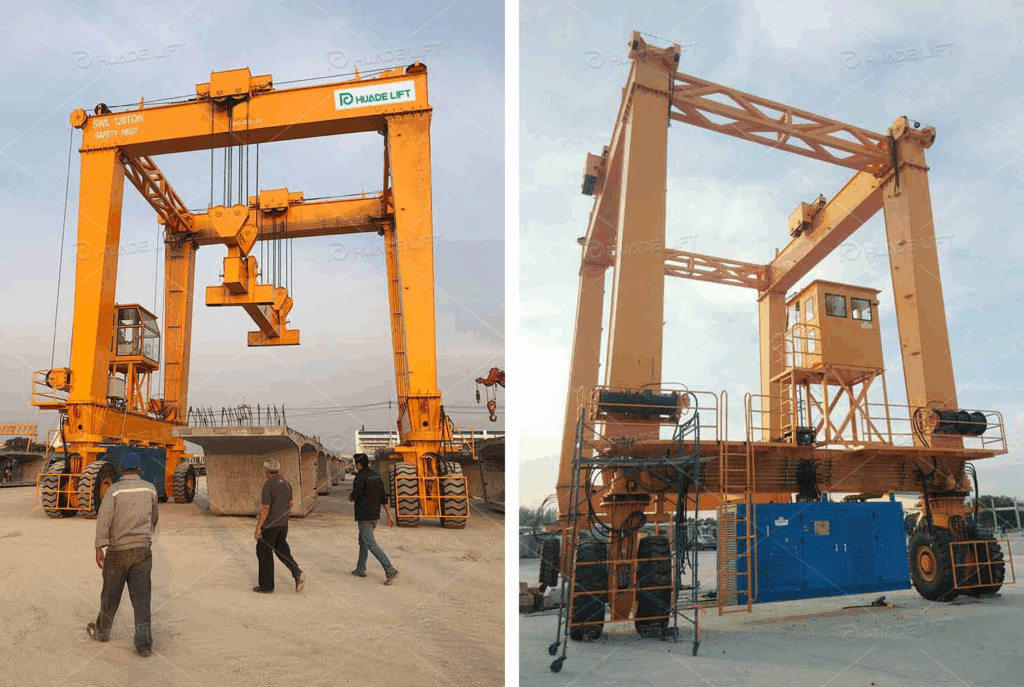
Why Choosing the Right Rubber tyred Crane Supplier Matters
For container terminals and yards, selecting the right rubber tired gantry crane supplier is an important prerequisite for reducing equipment failures, controlling operating costs, and guaranteeing high operational efficiency. The level of engineers, customized services and after-sales technical support provided by different suppliers varies significantly, which directly affects the suitability, stability and long-term operation and maintenance experience of the equipment.
High-quality suppliers will combine the customer’s yard container throughput, stacking program and future development plans, accurately recommend the appropriate rubber tyred gantry crane models, from the source to avoid “equipment and working conditions do not match” caused by various types of failure. At the same time, the rubber tyred gantry crane produced by professional suppliers can be adapted to the high throughput, high load operation, fast cycle operation and strict schedule requirements of the terminal, which greatly reduces the failure rate of the equipment.
In addition, reliable suppliers can provide a full range of after-sales technical support, timely solution to all kinds of problems in the operation of the equipment, reduce downtime, and help customers maximize the return on investment in fixed costs. HuadeLift, as a professional supplier of rubber tyred gantry crane, has been deeply cultivated in the industry for many years, and can provide customized equipment solutions and perfect after-sales service to help customers avoid operational hazards and achieve the best results. As a professional supplier of rubber tyred gantry crane, HuadeLift has been working in the industry for many years and can provide customized equipment solutions and perfect after-sales service to help our customers to avoid operation hazards and realize efficient and low-cost operation.
Summary
Rubber tyred gantry crane faults are mainly concentrated in the electrical, mechanical, power system, and most of them are related to operation, maintenance and environment. Mastering the troubleshooting and solution techniques in this article, doing preventive maintenance, standardizing operation and strengthening personnel training can effectively reduce failures, prolong equipment life, reduce operating costs, and ensure the efficient and safe operation of terminals and yards.
